DEFENCE OF JELLALABAD. 12th. November, 1841, to 7th. April, 1842.
Reading edition
The fortress of Jellalabad was found to be in a very dilapidated state, and the inhabitants disaffected to the government of the Shah. The Afghans collected to about ten thousand, and the walls of the fort being without parapets, and the 243garrison having only one day and a half supplies, on half rations, a sally was made on the 14th. of November, which routed the enemy, and enabled the troops to collect provisions, and erect works for the defence of the fortress, which called forth the efforts of all. While thus employed, the Afghans in great force again invested the place on the 27th. of November, but they were completely routed and dispersed by a sally of the garrison on the 1st. of December.
On the 9th. of January, 1842, the garrison was summoned to give up the fortress by the leader of the Afghan rebellion, in fulfilment of a convention entered into at Cabool with Major-General Elphinstone, who was taken prisoner at a conference, and died shortly afterwards; but Sir Robert Sale being fully assured of the bad faith of the insurgents, refused.
Captain Broadfoot, garrison engineer, and Captain Abbott, commissary of ordnance, aided by the indefatigable exertions of the troops, put the works into a state of defence to resist any Asiatic enemy not provided with siege-artillery; but the place was kept in a continual state of alarm by the occurrence of one hundred shocks of an earthquake in the course of a month, one of which, on the 19th. of February, occasioned the parapets to fall, injured the bastions, made a breach in the rampart, destroyed the guard-houses, reduced other portions of the works to ruins, and demolished one third of the town. With that unconquerable spirit of perseverance for which the troops had already been distinguished, they instantly turned to the repair of the works. Sirdar Mahomed Akbar Khan, Barukzye, the assassin of the late Envoy, and the treacherous destroyer of the Cabool force, flushed with success, approached with a numerous army to overwhelm the little garrison; he attacked the foraging parties on the 21st. and 22nd. of February; but was astonished at finding the works in a state of defence, whereupon he established a rigorous blockade. From that time to the 7th. of April, the reduced garrison was engaged in a succession of skirmishes, in which the 13th. had opportunities of distinguishing themselves; particularly detachments under Captains Pattisson and Fenwick, Lieutenants George Wade and W. Cox.
Information was received on the 5th. of April, that the force 244under Major-General, now General Sir George Pollock, G.C.B., had experienced reverses in the Khyber, and had retraced its steps towards Peshawur; and on the 6th. a feu-de-joie and salute of artillery were fired by Mahomed Akbar, in honour of the event. It was also reported that the Ghazees had been defeated, and that the Sirdar had retreated into Lughman. Sir Robert Sale resolved to anticipate the last-mentioned event, by a general attack on the Afghan camp, with the hope of relieving Jellalabad from blockade, and facilitating Major-General Pollock’s advance. Directions were accordingly given to form three columns of infantry, the central one consisting of the 13th., (mustering five hundred bayonets,) under Colonel Dennie, C.B.; the left comprising a similar number of the 35th. Native Infantry, under Lieutenant-Colonel Monteath, C.B.; and the right composed of one company of the 13th., one of the 35th. Native Infantry, and the detachment of Sappers, under the command of Lieutenant Orr, amounting to three hundred and sixty men, was commanded by Captain (afterwards the celebrated Sir Henry) Havelock, of the 13th.: these were supported by the fire of the guns of No. 6 field battery under Captain Abbott, the whole of the small cavalry force being under Captain Oldfield and Lieutenant Mayne.
At daylight on the morning of the 7th. of April, the troops issued from the Cabool and Peshawur gates. Mahomed Akbar Khan, had formed his force of about six thousand men in order of battle for the defence of his camp; its right resting on a fort, and its left on the Cabool river. The attack was led by the skirmishers and column under Captain Havelock; this drove the enemy from the extreme left of his advanced line of works, which it pierced at once, and proceeded to advance into the plain; the central column at the same time directed its efforts against a square fort, upon the same base, the defence of which was obstinately maintained. Colonel Dennie, while nobly leading his regiment to the assault, received a shot through his body, which, to the deep regret of officers and men, shortly after proved fatal.
The rear of the work having been finally gained by passing to its left, orders were given for a combined attack upon the 245enemy’s camp; this was brilliant and successful. The artillery, advanced at the gallop, and directed a heavy fire upon the Afghan centre, while two columns of infantry penetrated his line near the same point, and the third forced back his left from its support on the river, into which some of his horse and foot were driven. The Afghans repeatedly attempted to check the advance by a smart fire of musketry—by throwing forward heavy bodies of horse, which twice threatened in force the detachments of infantry under Captain Havelock, and by opening three guns, screened by a garden wall; but in a short time they were dislodged from every point of their positions, their cannon taken, and their camp involved in a general conflagration.
By about seven o’clock in the morning the battle was over and the enemy in full retreat in the direction of Lughman. Two Afghan cavalry standards were taken, besides four guns which had been lost by the Cabool army and Gundamuck forces. Great quantities of matériel and stores were, together with the enemy’s tents, destroyed, and the defeat of Mahomed Akbar, in open field, by the troops he had boasted of blockading, was complete.
Armourer Sergeant Henry Uylett, of the 13th., captured Mahomed Akbar’s standard, which he took from a cavalry soldier, whom he killed. The standard is of scarlet cloth, with a green border, and crimson and yellow fringe. It is triangular in shape and swallow-tailed. About the centre a patch of light blue cloth is introduced, on which are neatly sewn some characters in yellow cloth, being an extract from the Koran, signifying “The Omnipotent God! In the name of God, the clement and the merciful! With God as a helper, victory is nigh.” This and two other flags, captured by the 13th. on the same day, were deposited in Chelsea Hospital.
The enemy’s loss was very severe; the field of battle was strewed with the bodies of men and horses, and the richness of the trappings of some of the latter denoted that chiefs of rank (several being present and taking part in the action) had fallen.
In February following, the thanks of Parliament were accorded to the Governor-General of India, and to the officers 246and troops employed in Afghanistan, the resolutions being moved in the House of Lords by the Duke of Wellington, and in the House of Commons by Sir Robert Peel, who, after eulogizing the gallant conduct of Sir Robert Sale and the garrison of Jellalabad, (appropriately designated “Illustrious,”) specially deplored the death of Colonel Dennie, justly described as “one of the most noble and gallant spirits, whose actions have ever added brilliance to their country’s military renown.”
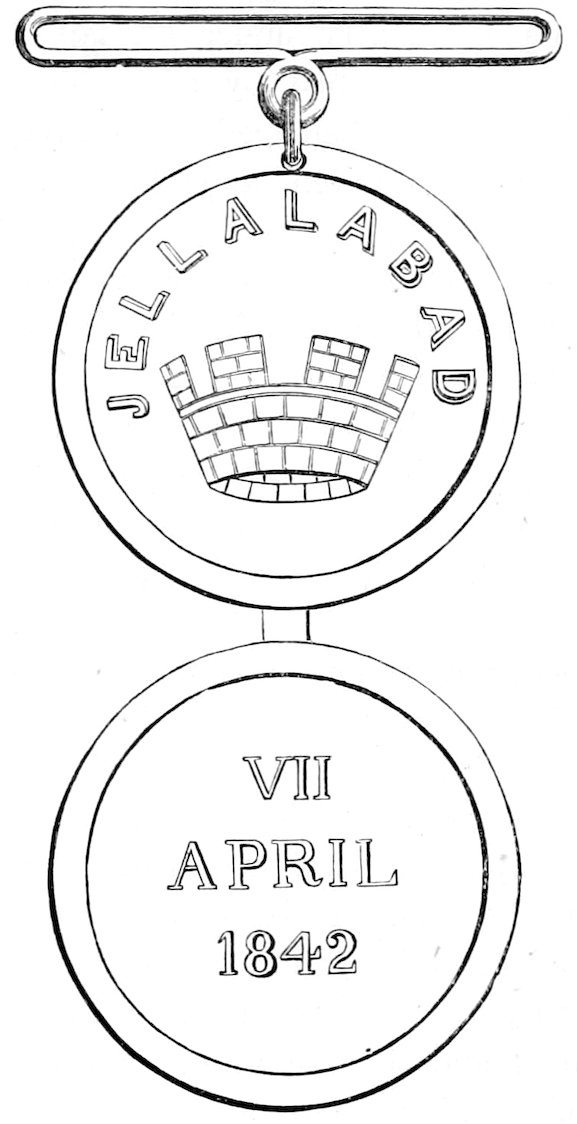
FIRST JELLALABAD MEDAL.
On the 26th. of August, 1842, it was officially announced in the “London Gazette,” that “In consideration of the distinguished gallantry displayed by the 13th. Light Infantry, during the campaigns in the Burmese empire and in Afghanistan, Her Majesty has been graciously pleased to approve of that regiment assuming the title of the ‘13th., or Prince Albert’s Light Infantry;’ and of its facings being changed from yellow to blue.
“Her Majesty has also been pleased to authorize the 13th. Regiment of Light Infantry to bear on its colours and appointments a ‘Mural Crown,’ superscribed ‘Jellalabad,’ as a memorial of the fortitude, perseverance, and enterprise, evinced by that regiment, and the several corps which served during the blockade of Jellalabad.”
247