BATTLE OF TALAVERA DE LA REYNA. 27th. and 28th. July, 1809.
Reading edition
When the British Forces had returned to England, Corunna, Bilboa, and all the most important places on the northern coast of Spain, fell under the French sway. Saragossa was besieged a second time, and after a defence unequalled perhaps in modern military history, was compelled to capitulate. Marshal Soult quitted Gallicia, entered Portugal, and obtained an entrance into Oporto. In April, Lieutentant-General Sir Arthur Wellesley, with another British army, disembarked at Lisbon, and advanced on Oporto.
Although no medal was granted for the passage of the Douro, on the 12th. of May, 1809, the exploit was a highly brilliant one. The British commander was desirous of passing the river to drive the French from Oporto; but the stream was deep, rapid, and more than three hundred yards in width, and ten thousand French veterans guarded the opposite shore. 96The passage was however effected in the following manner. A Portuguese barber had crossed the river in a skiff, and a British staff officer (Colonel Waters) aided by the barber and the prior of Amarante, traversed the stream and returned in half an hour with three large barges. Between ten and eleven o’clock an officer and twenty-five soldiers of the 3rd. Foot entered the first boat, crossed the stream unobserved, and took post in a large unfinished building on the banks of the river, designated the seminary, which was surrounded by a wall extending to the water on each side of it. In this manner a lodgment was made in the midst of the enemy’s army without being noticed. A second and a third boat followed, but scarcely had the men from the latter reached the shore, when a sudden burst of alarm was heard amidst the French troops, and a furious attack was made by their cavalry, infantry, and artillery, upon the seminary. The 3rd. Foot stood their ground bravely, and singly resisted the French legions until supported by the 48th. and 66th. British and 16th. Portuguese regiments. Meanwhile Lieutenant-General the Honourable Edward Paget had fallen dangerously wounded, and Major-General Hill commanded in the seminary. A fierce conflict of musketry was maintained, the French artillery played on the building, the British guns on the other side of the river opened their fire, and the struggle soon became violent. Meanwhile some citizens crossed the river with several large boats, additional forces were enabled to pass over, and ultimately the French were driven from Oporto with the loss of five hundred men killed and wounded, in addition to about seven hundred left in the hospitals.
The British commander subsequently pursued Marshal Soult’s army through the wild and mountainous districts of Portugal, but, in consequence of Marshal Victor having defeated General Cuesta, was compelled to resist from following Marshal Soult; and having formed a junction with the Spanish general, the combined forces proceeded along the valley of the Tagus, and took up a strong position at Talavera. The enemy, in the course of the 24th., 25th., and 26th., collected all his forces between Torrijos and Toledo, leaving but a small corps of two thousand men in that place. The united army consisted 97of the corps of Marshal Victor, of that of General Sebastiani, and of seven or eight thousand men, the guards of Joseph Bonaparte, and the garrison of Madrid; and it was commanded by him, aided by Marshals Jourdan and Victor, and General Sebastiani.
It became obvious that the enemy intended to try the result of a general action, for which the best position appeared to be in the neighbourhood of Talavera; and General Cuesta having taken up this position on the morning of the 27th., Lieutenant-General Sherbrooke was directed to retire with his corps to its station in the line, leaving Major-General M‘Kenzie with a division of infantry and a brigade of cavalry, as an advanced post in a wood on the right of the Alberche, which covered the left flank of the British.
The position taken up by the troops at Talavera extended rather more than two miles; the ground was open upon the left where the British army was stationed, and it was commanded by a height, on which was, in echellon and in second line, a division of infantry, under the orders of Major-General Hill. Between this height and a range of mountains still further upon the left, there was a valley, which was not at first occupied, and it was commanded by the height before mentioned, whilst the mountain range appeared too distant to have any influence upon the expected action.
Spanish troops composed the right, which extended immediately in front of the town of Talavera down to the Tagus. This part of the ground was covered by olive trees, and was much intersected by banks and ditches. The high road leading from the bridge over the Alberche, was defended by a heavy battery in front of a church, which was occupied by Spanish infantry. All the avenues to the town were defended in a similar manner; the town was occupied, and the remainder of the Spanish infantry were formed in two lines behind the banks on the roads which led from the town and the right, to the left of the British position. In the centre, between the two armies, there was a commanding spot, on which a redoubt had been commenced, with some open ground in the rear. Here Brigadier-General Campbell was posted with a 98division of infantry, supported in his rear by Major-General Cotton’s brigade of dragoons, and some Spanish cavalry.
At about two o’clock on the 27th. of July the enemy appeared in strength on the left bank of the Alberche, and manifested an intention to attack Major-General M‘Kenzie’s division. The attack was made before they could be withdrawn, but the troops, consisting of Major-General M‘Kenzie’s and Colonel Donkin’s brigades, with Major-General Anson’s brigade of cavalry, and supported by Lieutenant-General Payne with the other four regiments of cavalry, in the plain between Talavera and the wood, withdrew in good order, but with some loss, particularly by the second battalion of the 87th., and the second battalion of the 31st. regiment in the wood.
In his despatch, Lieutenant-General the Right Honourable Sir Arthur Wellesley, K.B., stated, “Upon this occasion the steadiness and discipline of the 45th. regiment, and of the fifth battalion of the 60th., were conspicuous; and I had particular reason for being satisfied with the manner in which Major-General M‘Kenzie withdrew his advanced guard.”
As the day advanced, the French appeared in larger numbers on the right of the Alberche, and it was apparent that they were advancing to a general attack upon the combined army. Major-General M‘Kenzie continued to fall back gradually upon the left, where he was placed in the second line, in the rear of the guards, Colonel Donkin being posted in the same situation further upon the left, in the rear of the King’s German Legion.
The enemy immediately commenced his attack in the dusk of the evening, by a cannonade upon the left of the allied position, and by an attempt with his cavalry to overthrow the Spanish infantry, posted, as before stated, on the right. This attempt entirely failed. Early in the night he pushed a division along the valley on the left of the height occupied by Major-General Hill, of which a momentary possession was obtained, but it was instantly regained by an attack with the bayonet. Another attempt was repeated during the night, but failed, and again at daylight in the morning of the 28th. of July, by two divisions of infantry, which was repulsed by Major-General Hill. In these different affairs the 29th., and 99the first battalion of the 48th. regiment, gained especial notice. Many brave officers and soldiers were lost in the defence of this important point, and Major-General Hill was slightly wounded.
A general attack by the enemy’s whole force was made about noon, upon the whole of that part of the position occupied by the British army. Sir Arthur, in consequence of the repeated attempts upon the height on his left by the valley, had placed there two brigades of British cavalry, supported in the rear by the Duc d’Albuquerque’s division of Spanish cavalry. The enemy then placed light infantry in the range of mountains on the left of the valley, which were opposed by a division of Spanish infantry, under Lieutenant-General De Bassecourt. The general attack began by the march of several columns of infantry into the valley, with a view to attack the height occupied by Major-General Hill. These columns were immediately charged by the 1st. German Light Dragoons and 23rd. Dragoons, under the command of Major-General Anson, directed by Lieutenant-General Payne, and supported by Brigadier-General Fane’s brigade of heavy cavalry; and although the 23rd. Dragoons suffered considerable loss, the charge had the effect of preventing the execution of that part of the enemy’s plan. At the same time he directed an attack upon Brigadier-General Alexander Campbell’s position in the centre of the combined armies, and on the right of the British. This attack was most successfully repulsed by Brigadier-General Campbell, supported by the king’s regiment of Spanish cavalry and two battalions Spanish infantry: the enemy’s cannon being taken by the Brigadier-General, who mentioned particularly the conduct of the 97th., the second battalion of the 7th., and the second battalion of the 53rd. regiment.
An attack was also made at the same time upon Lieutenant-General Sherbrooke’s division, which was on the left and centre of the first line of the British army. This attack was most gallantly repulsed by a charge with bayonets by the whole division; but the brigade of guards, on the right, having advanced too far, they were exposed on their left flank to the fire of the enemy’s battery, and of their retiring 100columns. The division was obliged to retire towards the original position, under cover of the second line of Major-General Cotton’s brigade of cavalry, which had been moved from the centre, and of the first battalion of the 48th. regiment. This regiment had also been moved from its original position on the heights, as soon as the advance of the guards was observed, and it was formed on the plain and advanced upon the enemy, covering the formation of Lieutenant-General Sherbrooke’s division.
Shortly after the repulse of this general attack, in which apparently all the enemy’s troops were employed, he commenced his retreat across the Alberche, which was conducted in the most regular order, and was effected during the night, leaving in the hands of the British twenty pieces of cannon, ammunition, tumbrils, and some prisoners.
The attacks were principally if not entirely directed against the British troops. The Spanish commander-in-chief, his officers, and troops, manifested every disposition to render assistance to their allies, and those of them who were engaged did their duty; but the ground which they occupied was so important, and its front at the same time so difficult, that Sir Arthur Wellesley did not think it proper to urge them to make any movement on the left of the enemy, while he was engaged with the troops more immediately under his command.
Such a prolonged action against more than double the number of the British could not be sustained without great loss of valuable officers and soldiers, but the casualties of the enemy were much larger. Entire brigades of French infantry were destroyed, and the battalions that retreated were much reduced in number. The French loss was estimated at ten thousand men. Generals Lapisse and Morlot were killed; Generals Sebastiani and Boulet were wounded.
Major-General M‘Kenzie, who had distinguished himself on the 27th., Brigadier-General Langwerth, of the King’s German Legion, and Brigade-Major Beckett, of the Coldstream Guards, were killed.
During a pause in the second day’s fight both armies went to the banks of the small stream, a tributary of the Tagus, for water, which flowed through a part of the battle-ground. 101The men approached each other and conversed like old acquaintances, even exchanging their canteens and wine-flasks. In the words of the author of “The Bivouac” (the Rev. W. H. Maxwell, Prebendary of Balla):—“All asperity of feeling seemed forgotten. To a stranger they would have appeared more like an allied force than men hot from a ferocious conflict, and only gathering strength and energy to re-commence it anew. But a still nobler rivalry for the time existed; the interval was employed in carrying off the wounded, who lay intermixed upon the hard-contested field; and, to the honour of both be it told, that each endeavoured to extricate the common sufferers, and remove their unfortunate friends and enemies without distinction. Suddenly the bugles sounded, the drums beat to arms; many of the rival soldiery shook hands and parted with expressions of mutual esteem, and in ten minutes’ after they were again at the bayonet’s point.”
The following regiments were specially noticed in the despatch:—The cavalry, particularly Major-General Anson’s brigade; the 29th regiment; first battalion of the 48th.; the second battalions of the 7th. and 53rd. regiments; the 97th.; the first battalion of detachments; the second battalion of the 31st.; the 45th.; and fifth battalion of the 60th. The advance of the brigade of guards was also highly commended.
This victory gained over the French army, commanded by Joseph Buonaparte in person, occasioned great joy in England, and Lieutenant-General Sir Arthur Wellesley was raised to the peerage, by the title of Viscount Wellington.
The following regiments were engaged at the battle of Talavera de la Reyna, on the 27th. and 28th. July, 1809:—
3rd. Dragoon Guards, Lieutenant-Colonel Sir Granby Calcraft; 4th. Dragoons, Lieutenant-Colonel Lord Edward Somerset; 14th. Light Dragoons, Colonel Samuel Hawker; 16th. Light Dragoons, Major the Honourable Lincoln Stanhope; 23rd. Light Dragoons, Lieutenant-Colonel Seymour; 1st. Light Dragoons, King’s German Legion, Lieutenant-Colonel Arentschild; Royal British Artillery, Lieutenant-Colonel Framingham, Royal German Artillery, Major Hartineau; the whole artillery being under Brigadier-General Howorth, Royal Engineers, 102Lieutenant-Colonel Fletcher; Royal Staff Corps, Major Dundas; Coldstream Guards, first battalion, Lieutenant-Colonel Hulse; 3rd. Guards, first battalion, Colonel the Honourable Edward Stopford; 3rd. Foot, Lieutenant-Colonel Muter; 7th, second battalion, Lieutenant-Colonel, Sir William Myers, Bart.; 24th., second battalion, Lieutenant-Colonel Drummond; 29th., first battalion, Lieutenant-Colonel White; 31st., second battalion, Major Watson; 40th., first battalion, Major Thornton; 45th., first battalion, Lieutenant-Colonel Guard; 48th., first battalion, Lieutenant-Colonel Donellan, second battalion, Lieutenant-Colonel Duckworth; 53rd., second battalion, Lieutenant-Colonel Bingham; 60th., fifth battalion, Major Davy; 61st, first battalion, Colonel Saunders; 66th, second battalion, Captain Kelly; 83rd, second battalion, Lieutenant-Colonel Gordon; 87th., second battalion, Major Gough; 88th., first battalion, Major Vandeleur; 97th., first battalion, Lieutenant-Colonel Lyon; first battalion of Detachments,[36] Lieutenant-Colonel Bunbury, 3rd. Foot; second battalion of Detachments, Lieutenant-Colonel Copson, 5th., Foot; first and second light and first line battalions King’s German Legion, Major Bodecker; second line battalion, Lieutenant-Colonel Brauns; fifth line battalion, Captain Humelberg; seventh line battalion, Major Burger.
After this defeat the enemy continued to keep a rear-guard of ten thousand men on the heights on the left of the Alberche; the extreme fatigue of the troops, the want of provisions, and the number of wounded to be taken care of, prevented Viscount Wellington moving from this position. Brigadier-General Craufurd arrived with his brigade (first battalions of the 43rd., 52nd., and 95th,.)[37] on the 29th. of July, early in the morning, having marched fifty-two miles in twenty-six hours, a wonderful proof of the energy of British soldiers.
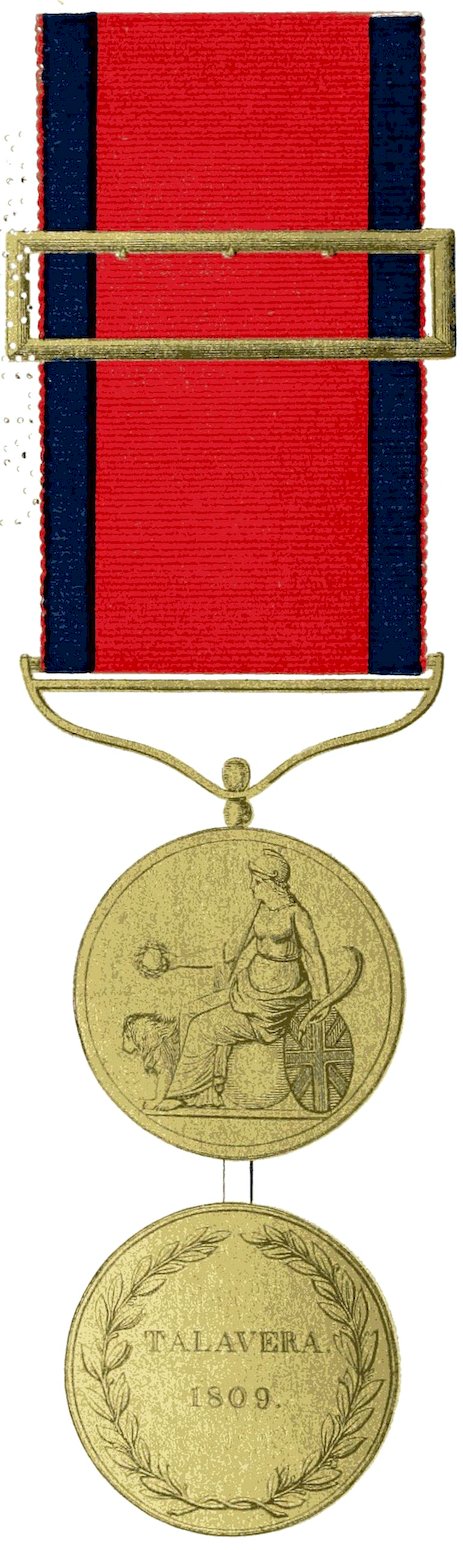
The Talavera Medal.
103
Gold Medal for Talavera.
In consequence of the victories gained in the Peninsula during 1808 and 1809, two gold medals were struck for presentation to such superior officers as had distinguished themselves in action; the same medals were afterwards conferred for military services in other portions of the world. No corps were returned in the list for medals, which had not been engaged. This, by the Duke of Wellington’s despatches, appears to have been the rule.
A notification appeared in the “London Gazette,” dated Horse Guards, 9th. September, 1810, stating that His Majesty had been graciously pleased to command that, in commemoration of the brilliant victories obtained by divisions of his Army over the enemy in the Battles of Roleia and Vimiera, also in the several instances where the cavalry had an opportunity of distinguishing themselves against the enemy in Spain, and in the battles of Corunna and Talavera de la Reyna, the Officers of the Army present on those occasions should enjoy the privilege of wearing a Medal, and His Majesty having approved of the Medal which had been struck, was pleased to command that it should be worn by the General Officers, suspended by a Ribbon of the colour of the Sash, with a blue edge, round the neck; and by the Commanding Officers of Corps, (not being of rank inferior to Lieutenant-Colonel,) and the Chiefs of Military Departments, attached by a ribbon of the same colour to the button-hole of their uniform. His Majesty was also pleased to command that the Medals which would have been conferred upon the Officers who had fallen at or died since the above-named actions, should, as a token of respect for their memories, be deposited with their respective families.
These medals were alike except in size. On the obverse, Britannia, wearing a helmet, is seated on the globe; in her right hand extended a wreath of laurel, and in her left a palm branch; to her right the British lion, and on the left a round shield charged with the crosses of the union banner. The reverse has a wreath of laurel, within which the name 104of the event and the year were engraved, thus—Roleia and Vimiera, 1808; or Corunna, 1809; or Talavera, 1809; or Nivelle, Nive, etc. The name and rank of the officer were engraved on the edge. The large medal, of the size of that granted for Maida, was for general officers; in full dress it was worn from the neck, to a crimson ribbon with blue edges. The small medal, (of which an illustration is given,) attached to the ribbon by a gold swivel, with a gold buckle above, was conferred on field and other officers.
At this period the rules and regulations regarding the issue of medals were, 1st.—Medals are only to be bestowed upon occasions of great importance or of peculiar brilliancy. 2nd.—Medals of a larger size are conferred upon General Officers, including Brigadiers, who wear them suspended by a ribbon round the neck.[38] Medals of a smaller size are bestowed upon Colonels, and Officers of the senior ranks. 3rd.—No General or other officer is considered to be entitled to receive a Medal, except he has been personally and particularly engaged upon the occasion, in commemoration of which this distinction is bestowed, and has been selected by the Commander of the Forces upon the spot, and has been reported by him to have merited the distinction, by very conspicuous services. 4th.—The Commander of the Forces (after he shall have been informed of the intention of Government to bestow medals) shall transmit to the Secretary of State for the War Department, and to the Commander-in-Chief, returns signed by himself, specifying the names and ranks of those Officers whom he shall have selected as particularly deserving. 5th.—The Commander of the Forces, in making this selection of the most deserving Officers, will consider his choice restricted to the undermentioned ranks, as it is found to be absolutely necessary that some limitation should be put upon the grant of this honour.
The rank and situations held by Officers, to render them eligible for the distinction of Medals, were, General Officers; Commanding Officers of Brigades; Commanding Officers of Artillery or Engineers; Adjutant-General and Quartermaster-General; their Deputies having the rank of Field Officers, and their Assistants having the same rank, and being at the head of the Staff, with a detached corps or distinct division of the Army; Military Secretary, having the rank of Field Officers; Commanding Officers of Battalions, Corps equivalent thereto, and Officers who have succeeded to the actual command during the engagement, in consequence of the death or removal of the original Commanding Officer.
105