THE PENINSULA WAR MEDAL.
Reading edition
When the distribution of the Waterloo Medal both to officers and men took place, it was no wonder that the veterans who had fought through the several actions of the Peninsula war should desire to have a similar distinction. By a letter from the Duke of Wellington, dated Brussels, 13th. April, 1815, to His Royal Highness Field-Marshal the Duke of Kent, then Colonel of the Royals, it would appear that there was some general distinction intended to be conferred on the Peninsula army:—“When your Royal Highness first communicated to me your desire that the 3rd. battalion Royals should wear a distinguishing badge for their services under my command, it was in the contemplation of His Royal Highness the Commander-in-Chief, that the whole army which served in the Peninsula and in the South of France should wear one. I have not heard what has prevented His Royal Highness from carrying that intention into execution, but I will enquire, and I will recommend that the Royals shall have one, if it is not intended that one should be given to the whole army.” This design appears to have been abandoned.
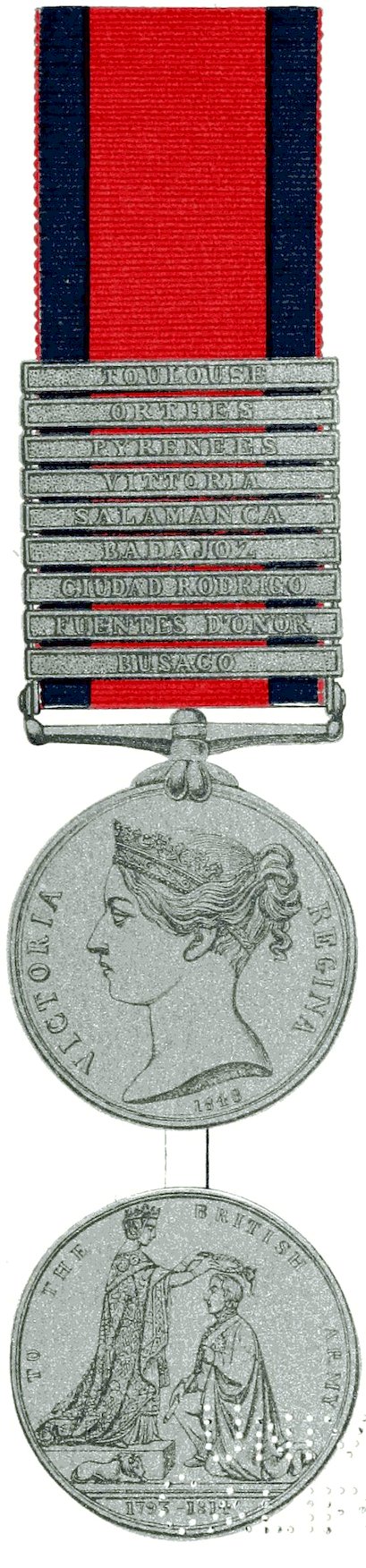
The War Medal.
55It has been shewn that during the reign of King Charles the First, and the period of the Commonwealth, the humblest soldier was eligible for a medal, and that for Waterloo is the first since that time which has been conferred by the crown on both officers and soldiers. Major Mackie, in a poem entitled “Britannia Ingrata,” made a poetical appeal in behalf of the gallant Peninsula army. There were volumes of correspondence in the several military journals, in which the grievances of veterans were set forth; officers who had passed through the fields of Corunna, Talavera, Busaco, Salamanca,[21] and other sanguinary actions, felt they deserved the red and blue-edged ribbon as well as the more fortunate Waterloo man. Even the badge of merit was defined, some thinking that it should be a cross formed of the metal of guns taken during the war.
The hardship continued for years, and there is no doubt that the Duke of Richmond in his place in Parliament, aided by public opinion, was mainly instrumental in obtaining the desired honour. So sensible were the war officers of his exertions in their cause, that a testimonial was subscribed for and presented to His Grace at a grand dinner at Willis’s Rooms, on Saturday, the 21st. of June, 1851. It was a most interesting gathering, and many of the Peninsula veterans were present. The testimonial was in solid silver, the value of the plate being about fifteen hundred guineas. The inscription was as follows: “Presented on June 21st., 1851, 38th. Anniversary of the Battle of Vittoria, to His Grace the Duke of Richmond, Lennox, and Aubigny, K.G., by the Recipients of the War Medal, in grateful remembrance of his long and unwearied exertion in their behalf, as a token of the Admiration, Respect, and Esteem, from his humbler brethren in Arms, who successfully aided in 56defending their Island Home throughout a long and sanguinary war, in which they gained a series of resplendent victories, that led to the capture of Madrid, Paris, Washington, and finally to an honourable and lasting peace.”
Queen Victoria fully repaired the omission of her predecessors, by conferring the boon so long and anxiously coveted, and on the 1st. of June, 1847 (the anniversary of a glorious naval victory), the following general order was issued, which, it is almost superfluous to add, was read with delight by the surviving Peninsula veterans.
“Horse Guards, 1st. June, 1847.
“Her Majesty having been graciously pleased to command that a Medal should be struck to record the Services of Her Fleets and Armies during the Wars commencing in 1793, and ending in 1814, and that one should be conferred upon every Officer, Non-Commissioned Officer, and Soldier of the Army, who was present in any Battle or Siege, to commemorate which, Medals had been struck by command of Her Majesty’s Royal Predecessors, and had been distributed to the General or Superior Officers of the several Armies and Corps of Troops engaged, in conformity with the Regulations of the Service at that time in force;—General and other Officers, Non-Commissioned Officers, and Soldiers, who consider that they have claims to receive this mark of their Sovereign’s gracious recollection of their Services, and of her desire to record the same, are each to apply to the Secretary of the Board of General Officers, Whitehall, London, and to send in writing to the same Officer, a statement of his claim, for what Action, at what period of time, and the Names of the Persons, or the titles of the Documents by which the Claim can be proved.
“These Claims are to be sent, by General Officers having such Claims, through the hands of the Commander-in-Chief of the Army:—
“The Staff Officers having such Claims, through the General Officers under whom they served, if alive;—if not alive, through the Adjutant-General of the Army:—
“Officers, Non-Commissioned Officers, and Soldiers of 57Regiments, Battalions, and Detachments, through the Commanding Officer of the Regiment, Battalion, or Detachment, at the time, if still alive.[22] This will be known by enquiry at the Agents of the Regiments resident in London. If such Commanding Officer should not be alive, the Application, in writing, must be sent through the Adjutant-General of the Army.
“The Board of General Officers is hereby, by Her Majesty’s Command, directed to take into consideration,—to investigate the facts stated in each of these several applications,—and to report to the Commander-in-Chief upon the same, for the information of Her Majesty, and to enable those commanded by Her Majesty to deliver to the Claimants the Medals accordingly.
“The Adjutant-General, and the Military Secretary of the Commander-in-Chief will transmit to the Secretary of the Board of General Officers, such information as they may have been able to acquire, to assist in the investigations which the Board will have to make.
“The Commander-in-Chief has been required to desire, that the Board of General Officers will have Alphabetical Lists made out of the names of the Claimants to one of these Medals, with his Rank, and the name of the particular Battle or Siege for which he claims to receive the same inserted in the Margin,—and at which the Board of General Officers may consider that he was present.
“The occasions for which Medals have been granted by the Sovereign are specified in the annexed page for general information and guidance, as at page 73 of the Annual Army List.
“By Command of Field-Marshal,
The Duke of Wellington, Commander-in-Chief,
John Macdonald, Adjutant-General.”
58“Honorary Distinctions have been granted to Officers in Commemoration of their Services in the following Battles or Actions:—Maida, July 4th., 1806; Roleia, August 17th., 1808; Vimiera, August 21st., 1808; Sahagun, Benevente, etc., December, 1808, and January, 1809; Corunna, January 16th., 1809; Martinique, February, 1809; Talavera, July 27th. and 28th., 1809; Guadaloupe, January and February, 1810; Busaco, September 27th., 1810; Barrosa, March 5th., 1811; Fuentes d’Onor, May 5th., 1811; Albuhera, May 16th., 1811; Java, August and September, 1811; Cindad Rodrigo, January, 1812; Badajoz, March 17th. and April 6th., 1812; Salamanca, July 22nd., 1812; Fort Detroit, America, August, 1812; Vittoria, June 21st., 1813; Pyrenees, July 28th. to August 2nd., 1813; St. Sebastian, August and September, 1813; Chateauguay, America, October 26th., 1813; Nivelle, November 10th., 1813; Chrystler’s Farm, America, November 11th., 1813; Nive, December 9th. to 13th., 1813; Orthes, February 27th., 1814; Toulouse, April 10th., 1814.”
A similar order was issued regarding naval services, these commenced with Lord Howe’s action on the 1st. of June, 1794, but the earliest military service thus decorated was the campaign in Egypt, 1801, a general order, dated the 12th. of February, 1850, being issued, by which the war medal was to be conferred on the surviving Egyptian veterans; and if they had already received it, an additional bar, bearing the word “Egypt,” was to be granted.
The Medal has on the obverse the head of the Queen, with the date 1848; and on the reverse Her Majesty, as the representative of the country or people, is in the act of crowning with a laurel wreath the Duke of Wellington, in a kneeling attitude, as emblematic of the army. In the exergue is engraved 1793–1814, (the former date only applying to the navy,) and by the side of the dais is the British lion. The inscription is “To the British Army.” In the illustration only a few of the bars are given, but all the services enumerated in the foregoing list were of course commemorated by their names being placed on the bars. Fifteen is the greatest number of bars known to have been worn by any recipient of the medal. The rank and names of recipients were engraved round the edge of the medal. The ribbon is red, with blue edges.[23]
The first service then, in the order of date, is
59