THE SARDINIAN WAR MEDAL.
Reading edition
The King of Sardinia, following the example of the Emperor of the French, presented four hundred war medals for military valour to the British troops; and fifty to the Royal Navy and Marines. This medal was distributed both to officers and men. It has a watered, dark blue ribbon. On the obverse are the arms (white cross of Savoy) and crown of Sardinia, with a branch of laurel and of palm, and the inscription “Al Valore Militare,” For Military Valour. The reverse bears two laurel branches, with the words “Spedizione d’Oriente,” Expedition of the East, and the date 1855–1856. The following officers and men were selected for the Sardinian Medal, on account of the services specified against their names:—
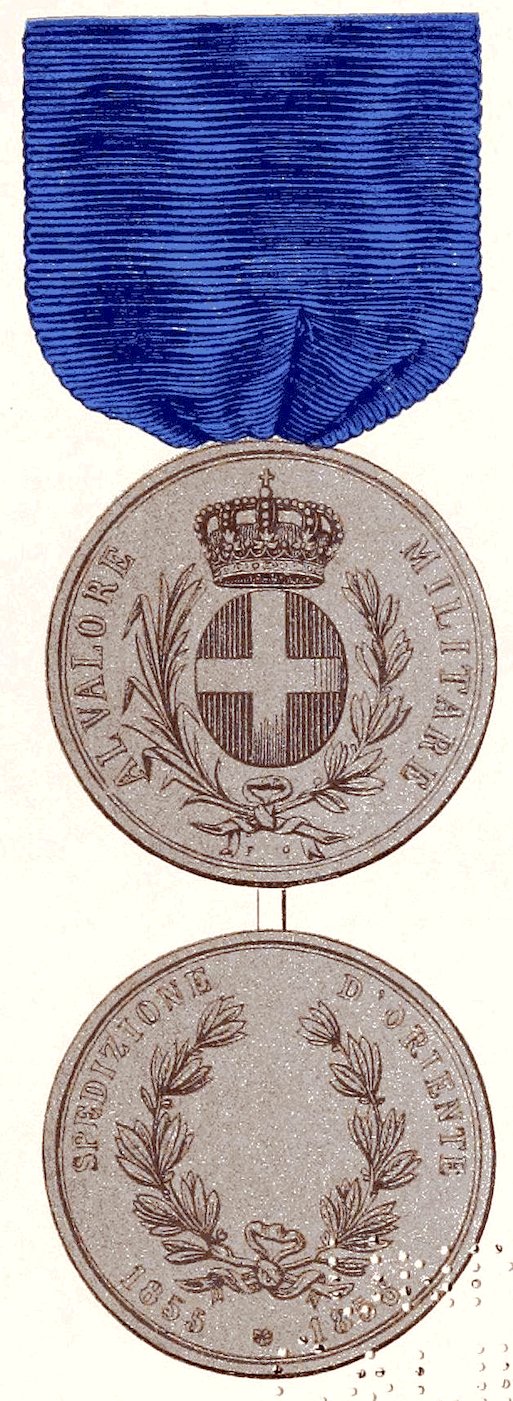
Sardinian War Medal.
479GENERAL OFFICERS.—General Sir George Brown, G.C.B., commanded the light division at the battles of the Alma and Inkermann, and was severely wounded on the last-named occasion; commanded the expedition to Kertch; was in command of the light division, except while absent on account of his wound, and while in command of the expedition to Kertch; served also during the siege of Sebastopol up to the 27th. of June, 1855, when he was compelled to return to England by severe illness. Lieutenant-General Sir Richard England, G.C.B., commanded the third division at the battles of the Alma and Inkermann, and the siege of Sebastopol, till August, 1855, when he was compelled to return to England by severe illness. Major-General Sir Henry John William Bentinck, K.C.B., commanded the brigade of Guards at the battles of the Alma and Inkermann, and was severely wounded on the last-named occasion; on his return to the army he commanded the fourth division during the remainder of the siege of Sebastopol. Major-General Lord Rokeby, K.C.B., commanded the brigade of Guards from February, 1855, till the end of the siege of Sebastopol; for part of the time also was in command of the first division. Major-General the Honourable Sir James Yorke Scarlett, K.C.B., commanded the heavy cavalry brigade at the Alma, Balaklava, and Inkermann; subsequently in 1855, the cavalry division. Major-General Sir Harry David Jones, K.C.B., Royal Engineers, commanded the Royal Engineers during the siege of Sebastopol, from March, 1855. Major-General Sir William Eyre, K.C.B., commanded a brigade at the battles of the Alma, Balaklava, and Inkermann, and the siege of Sebastopol. Major-General John Edward Dupuis, C.B., Royal Artillery, served the Eastern Campaign of 1854–5, including the battles of the Alma, Balaklava, and Inkermann, and siege of Sebastopol.
STAFF.—Brevet-Lieutenant-Colonel George Wynel Mayow, unattached; served as a Staff officer attached to the cavalry in the campaign of 1854–5, and was present at the battles of the Alma, Balaklava, and Inkermann, and siege of Sebastopol. Lieutenant-Colonel Honourable Adrian Hope, 93rd. regiment; served on the Staff of the third division at the Alma, Inkermann, and siege of Sebastopol, till April, 1855, when he was ordered to join his regiment at home, in consequence of regimental promotion. Brevet-Lieutenant-Colonel Honourable Leicester Curzon, Rifle Brigade; served the Eastern Campaign of 1854–5 as Assistant Military Secretary to the Field Marshall (Lord Raglan); and afterwards, in the same capacity, to General Sir James Simpson, G.C.B.; was present at the battles of the Alma, Balaklava, and Inkermann, and siege of Sebastopol. Brevet-Lieutenant-Colonel Kenneth Douglas Mackenzie, 92nd. regiment; served the Eastern Campaign of 1854–5; served at the battles of the Alma and Inkermann 480as a brigade-major attached to the light division; afterwards as an assistant quartermaster-general at Balaklava. Brevet-Lieut.-Colonel Hugh Smith, 3rd. regiment; served the Eastern Campaign of 1854–5; at the Alma, Balaklava, and Inkermann as a deputy-assistant quartermaster-general attached to the fourth division; afterwards, during the siege of Sebastopol, as assistant adjutant-general to that division; and in the same capacity with the expedition to Kinburn. Brevet-Lieutenant-Colonel Joseph Edwin Thackwell, unattached; served the Eastern Campaign of 1854–5; at the battles of the Alma and Inkermann, and sortie of the 26th. of October, 1854, and till August, 1855, as a brigade-major attached to the second division; subsequently as assistant adjutant-general to the third division. Brevet-Lieutenant-Colonel Robert Lockhart Ross, served the Eastern Campaign of 1854–5 as a captain with the 93rd. regiment at the battles of the Alma and Balaklava; and subsequently on the Staff as an assistant adjutant-general at Balaklava. Brevet-Lieutenant-Colonel Lawrence Shadwell, unattached; served the Eastern Campaign of 1854–5; at the battles of the Alma, Balaklava, and Inkermann, and part of the siege of Sebastopol, as aide-de-camp to Lieutenant-General Sir Colin Campbell, G.C.B., subsequently, during the remainder of the service, as an assistant adjutant-general. Lieutenant-Colonel Edward Bruce Hamley, Royal Artillery; served the Eastern Campaign of 1854–5, including the battles of the Alma, Balaklava, and Inkermann, sortie of the 26th. of October, 1854, and the siege of Sebastopol. Brevet-Lieutenant-Colonel Honourable Augustus Murray Cathcart, unattached; served the Eastern Campaign of 1854–5; at the battles of the Alma and Inkermann as aide-de-camp to Major-General the Honourable Sir George Cathcart, K.C.B.; during the siege of Sebastopol as deputy-assistant quartermaster-general to the light division. Brevet-Lieutenant-Colonel John Agmondisham Vesey Kirkland, unattached; served the Eastern Campaign of 1854–5, including the battles of the Alma and Inkermann, and siege of Sebastopol, up to August, 1855, as deputy-assistant adjutant-general. Brevet-Major Vincent Wing, 95th. regiment; served the Eastern Campaign of 1854–5; was severely wounded at the battle of the Alma, when he was on the Staff of Major-General Sir John Lysaght Pennefather, K.C.B.; was afterwards with his regiment during part of the siege of Sebastopol. Brevet-Major Edward Fellowes, 11th. Hussars; served the Eastern Campaign of 1854–5 as deputy-assistant quartermaster-general attached to the cavalry division; was present at the battles of the Alma, Balaklava, and Inkermann, and siege of Sebastopol. Brevet-Major John Hackett, unattached; served the Eastern Campaign of 1854–5 as deputy-assistant quartermaster-general; was present at the battles of Balaklava and Inkermann, and the early part of the siege of Sebastopol, till ordered to proceed to Scutari, where the services of an officer of the quartermaster-general’s department were required. Brevet-Major Archibald 481Henry Plantagenet Stuart Wortley, unattached; served the Eastern Campaign of 1854–5 as a deputy-assistant quartermaster-general attached to the third division; was present at the battles of the Alma and Inkermann, and siege of Sebastopol, including the attack by Sir William Eyre’s column on the Cemetery on the 18th. of June, 1855. Brevet-Major Honourable Gilbert Elliot, Rifle Brigade; served the Eastern Campaign of 1854–5; at the battles of the Alma and Balaklava as aide-de-camp to Major-General the Honourable Sir George Cathcart, K.C.B.; was compelled by ill-health to be sent to England, but returned after a short absence, and served during the remainder of the siege of Sebastopol, and till the army broke up, as a deputy-assistant quartermaster-general. Brevet-Major William Faussett, 44th. regiment; served the Eastern Campaign of 1854–5 as a brigade-major attached to the third division; was present at the battles of the Alma and Inkermann, and during the siege of Sebastopol, including the attack on the Cemetery by Major-General Eyre’s column on the 18th. of June, 1855. Brevet-Major Archibald Campbell Snodgrass, 38th. regiment; served the campaign of 1854–5; was present at the battles of the Alma and Inkermann, expedition to Kertch, and siege of Sebastopol, and was severely wounded at the assault on the Redan on the 18th. of June, 1855, as aide-de-camp to Major-General Sir John Campbell, K.C.B.; rejoined the 38th. regiment on his recovery, and served with it till the conclusion of the war. Brevet-Major the Honourable William James Colville, Rifle Brigade; served the Eastern Campaign of 1854–5; with the Rifle Brigade at the battle of the Alma, and subsequently as aide-de-camp to General Sir James Simpson, G.C.B., during the siege of Sebastopol. Brevet-Major Algernon Robert Garrett, 46th. regiment; served as brigade-major attached to the fourth division, during the siege of Sebastopol. Brevet-Major Frederick Augustus Thesiger, Grenadier Guards; served during part of the siege of Sebastopol with his regiment, and as aide-de-camp to Major-General Markham till that officer’s return to England at the end of the siege. Major Andrew Pitcairn, 42nd. regiment; served the campaign of 1854–5; including the battles of the Alma and Balaklava, expedition to Kertch, and siege of Sebastopol. Brevet-Major Richard George Amherst Luard, 77th. regiment; served at the siege of Sebastopol from March, 1855, as a deputy-assistant adjutant-general. Brevet-Major Richard Lyons Otway Pearson, Grenadier Guards; served the campaign of 1854–5 as aide-de-camp to Lieutenant-General Sir George Brown, G.C.B., including the battles of the Alma and Inkermann, expedition to Kertch, and siege of Sebastopol. Brevet-Major Frederick Hammersley, 14th. regiment; served during the siege of Sebastopol, in the early part with his regiment, and subsequently as a deputy-assistant quartermaster-general. Brevet-Major Charles William St. Clair, 57th. regiment; served the Eastern Campaign of 1854–5, including the battles of the Alma and Inkermann, and siege of Sebastopol; 482was severely wounded at the attack on the Redan, on the 18th. of June, 1855. Captain Arthur Edward Valette Ponsonby, Grenadier Guards; served as aide-de-camp to General Sir George Brown at the expedition to Kertch, and subsequently at the siege of Sebastopol, till Sir George Brown’s return to England after the 18th. of June; after that, till the end of the war, as aide-de-camp to Lieutenant-General Sir William Codrington, K.C.B. Captain Henry Clarke Jervoise, Coldstream Guards; served the campaign of 1854–5 with the 42nd. regiment at the Alma and Balaklava, and as aide-de-camp to Major-General Sir Richard Airey, K.C.B., the Quartermaster-General of the army during the siege of Sebastopol. Captain the Honourable Charles James Keith, 4th. Light Dragoons; served the campaign of 1853–5 as aide-de-camp to Lieutenant-General Sir Richard England, G.C.B.; was present at the battle of Inkermann and during the siege of Sebastopol. Captain Roger Swire, 17th. regiment; served at the siege of Sebastopol from December, 1854; was severely wounded at the assault on the Redan on the 8th. of September; served subsequently as aide-de-camp to Major-General Wyndham, C.B. Captain Charles Edward Mansfield, 33rd. regiment; served the campaign of 1854–5 as aide-de-camp to Lieutenant-General Sir Colin Campbell, G.C.B., including the battles of the Alma and Balaklava, and siege of Sebastopol. Captain Richard George Ellison, 47th. regiment; served the Eastern Campaign of 1854–5, including the battles of the Alma and Inkermann, and sortie on the 26th. of October, 1854; in the latter part of the siege as aide-de-camp to Major-General Sir John Lysaght Pennefather, K.C.B. Captain William Earle, 49th. regiment; served the Eastern Campaign of 1854–5, including the battles of the Alma and Inkermann, sortie on the 26th. of October, 1854, and siege of Sebastopol; latterly as a Brigade-major attached to the second division. Captain Henry Hooper Day, 88th., regiment; served at the battle of Inkermann and siege of Sebastopol, including the attack on the Quarries and assaults on the Redan on the 18th. of June and the 8th. of September, 1855; in the latter part of the siege as aide-de-camp to Brigadier-General Shirley. Captain George Montague Stopford, Royal Engineers; was present at the battles of the Alma, Balaklava, and Inkermann, and part of the siege of Sebastopol as aide-de-camp to General Sir John Fox Burgoyne, Bart., G.C.B.
FOURTH DRAGOON GUARDS.—Brevet-Lieutenant-Colonel William Charles Forrest, served the campaign of 1854–5, including the battles of Balaklava and Inkermann, and siege of Sebastopol. Brevet-Major Francis Rowland Forster, commanded the first squadron of the regiment at the action of Balaklava, on the 25th. of October, 1854. Lieutenant-Colonel Thomas Westropp M‘Mahon, C.B., served the campaign of 1854–5, including the battles of the Alma, Balaklava, and Inkermann, and the siege of Sebastopol; served in 1854, as Assistant Quartermaster-General of the cavalry division, and in 1855, as 483Lieutenant-Colonel commanding the 5th. Dragoon Guards. Assistant-Surgeon William Cattell, was present during the whole of the campaign in the Crimea, and shewed the greatest zeal during the time of the cholera, and during the action at Balaklava, and wherever his services were required under fire. Troop Sergeant-Major John Evans, displayed gallant conduct at the action of Balaklava, where he was wounded. Lance-Sergeant James Gamble, was under fire a considerable portion of the day on the 25th. of October, as orderly to Major-General the Honourable Sir James Yorke Scarlett, K.C.B.; had his horse shot through the thigh, but procured another, and returned to his duty immediately.
FIRST DRAGOONS.—Colonel John Yorke, C.B., served in the Crimea until the action at Balaklava, when he was so severely wounded in command of his regiment, as to oblige him to retire from active service. Captain George Campbell, displayed gallant conduct under fire in the cavalry action at Balaklava, on the 25th. of October, 1854, and continued in command of his troop, although severely wounded, until the regiment was out of fire. Sergeant John Hill, displayed coolness and intrepidity when on patrol and attacked by a party of Russians on the 10th. of October, 1854; and again on the 25th. of October, 1854, when his horse was shot under him, on which occasion, having captured one belonging to the enemy, he immediately rejoined his regiment and did duty with it for the rest of the day.
SECOND DRAGOONS.—Colonel Henry Darby Griffith, C.B.; served the campaign of 1854–5; commanded his regiment at the battle of Balaklava. Captain George Buchanan, this officer’s conduct in the heavy cavalry charge at the action of Balaklava was cool and gallant, and by his example great execution was done against the enemy; he afterwards commanded a squadron under fire in support of the light brigade charge. Sergeant-Major John Wilson, was under arrest for a minor offence, but on finding the regiment was likely to be engaged, he made ready his horse, and coming up to the adjutant, said, “I have broken my arrest, sir, as I could not see my regiment going into action and remain quiet in camp; I have come to report myself, and wish to join and do my duty.” In the heavy cavalry charge at Balaklava he fought most gallantly, using his sword with great execution, and he was afterwards wounded by a round shot when his regiment went in support of the light brigade. He was promoted to troop sergeant-major for his gallant conduct.
FOURTH LIGHT DRAGOONS.—Colonel Lord George Augustus Frederick Paget, C.B., served the campaign of 1854–5, including the battles of the Alma, Balaklava, and Inkermann, and siege of Sebastopol, and the battle of the Tchernaya; in 1854 was in command of the 4th. Light Dragoons; in 1855 in command of a brigade of light cavalry. Brevet-Lieutenant-Colonel Alexander Lowe, served the campaign of 1854–5, including the battles of the Alma, Balaklava, Inkermann, and the 484Tchernaya, and siege of Sebastopol; in 1854 as Major of the 4th. Light Dragoons; in 1855 in command of the regiment. Brevet-Major Robert Portal, served the Eastern Campaign of 1854–5; the Alma, Balaklava, Inkermann, and siege of Sebastopol. Troop Sergeant-Major William Waterson, displayed very gallant conduct at the action at Balaklava, in the light cavalry charge, particularly in the retreat of the regiment after they had sabred the artillerymen at their guns.
SIXTH DRAGOONS.—Captain Edward D’Arcy Hunt; Captain Hunt was squadron leader of the second squadron of the 6th. Dragoons, which was detached under the command of Lieutenant-Colonel Shute, during the action of Balaklava, and led the squadron with great steadiness and gallantry. Trumpeter John Hardy, acted as field trumpeter to Lieutenant-Colonel White, C.B., during the action of Balaklava, and was consequently more exposed during the whole of that day than any other man in the regiment, more particularly during the charge of the heavy brigade.
EIGHTH HUSSARS.—Lieutenant-Colonel Robert de Salis, served the campaign of 1854–5, including the battles of the Alma, Balaklava, Inkermann, and Tchernaya, and siege of Sebastopol; also commanded the cavalry in the expedition to Kertch; in 1854 as Major of the 8th. Hussars; in 1855 in command of the regiment. Brevet-Major Edward Tomkinson, advanced with the light brigade to Balaklava, and led the squadron he commanded with courage and steadiness; he had his horse shot under him; he was subsequently present at the battle of the Tchernaya. Trumpeter William Wilson, charged with the light brigade at Balaklava, and evinced great coolness and courage, being then only sixteen years of age; he was subsequently at the battle of the Tchernaya.
TENTH HUSSARS.—Colonel William Parlby, commanded a brigade of cavalry in the campaign of 1855, before Sebastopol, and at the battle of the Tchernaya.
ELEVENTH HUSSARS.—Lieutenant and Adjutant John Yates, was present in the Crimea from the commencement of the campaign until August, 1855; was present at the Alma, Balaklava, and Inkermann, and behaved gallantly; acted as brigade-major to Major-General the Earl of Cardigan, K.C.B., at Balaklava, and for a fortnight previously. Sergeant Robert Davies, after having passed through the battery in the light cavalry charge, perceiving a Russian field-piece limbered up to retreat, Sergeant Davis called Private John T. Bambrick, who was riding next him, to follow and endeavour to capture it; in going to perform this duty he was attacked by two Russian lancers, one of whom he cut down, the other shot his horse; when on the ground he received a lance wound on the right thigh; he then caught a loose horse and rejoined his regiment.
TWELFTH LANCERS.—Major Thomas George Alexander Oakes, commanded a squadron of the 12th. Lancers, detached as the escort of General La Marmora, at the battle of the Tchernaya.
485THIRTEENTH LIGHT DRAGOONS.—Captain Percy Shawe Smith, distinguished conduct in the light cavalry charge at Balaklava, on the 25th. of October, 1854. Corporal William Gardiner, distinguished conduct on the same occasion.
SEVENTEENTH LANCERS.—Colonel John Lawrenson, commanded the 17th. Lancers at the Alma, and a brigade of cavalry in the campaign of 1855. Cornet James Duncan, served the Eastern campaign of 1854–5 to the end of the war, including the affair of the Bulganak, the battles of the Alma, Balaklava (horse killed), and Inkermann (horse killed), and siege of Sebastopol; was never absent from the regiment. Sergeant A. Ranson, embarked with the regiment for foreign service; was present at the battles of the Alma, where he distinguished himself; Balaklava, where he again distinguished himself by engaging and cutting down a Russian officer; and Inkermann; siege of Sebastopol; was never absent from the regiment.
ROYAL ARTILLERY.—Major Francis Beckford Ward, served at the siege and fall of Sebastopol; commanded the Royal Artillery at the battle of the Tchernaya. Brevet-Lieutenant-Colonel John Charles William Fortescue, served at the battles of the Alma, Balaklava, and Inkermann, and was present during the whole of the siege of Sebastopol. Brevet-Lieutenant-Colonel Charles Henry Morris, C.B., joined the army in October, 1854, and remained with it until the termination of the war; was present at the sortie on the 26th. of October, at Inkermann, and in the trenches; was with Marshal Bosquet at the assault of the Mamelon and Malakoff. Brevet-Lieutenant-Colonels Samuel Enderby Gordon and the Honourable Edward Thomas Gage; served at the battles of the Alma and Balaklava, and was present during the whole of the siege of Sebastopol. Brevet-Lieutenant-Colonel Charles Stuart Henry, the siege of Sebastopol; was severely wounded (with siege train.) Brevet-Lieutenant-Colonel Henry John Thomas; the siege of Sebastopol. Brevet-Major Philip Gosset Pipon, the campaign of 1854–5; battles of the Alma and Balaklava; siege of Sebastopol. Brevet-Majors Gaspard Le Marchant Tupper and Charles Henry Ingilby, the campaign of 1854–5; Balaklava and Inkermann, where they were wounded; sortie on the 26th of October, 1854; and siege of Sebastopol. Brevet-Major Henry Peel Yates, the campaign of 1854–5; battles of the Alma and Inkermann; sortie on the 26th. of October, 1854; and siege of Sebastopol. Brevet-Major James Farrell Pennycuick, the campaign of 1854–5; battle of Inkermann and siege of Sebastopol. Brevet-Majors Alexander Cæsar Hawkins and George Shaw, served in the trenches to the fall of Sebastopol, the former from March, and the latter from January, 1855. Brevet-Major Edward Moubray, Eastern Campaign of 1854–5; battle of Inkermann; siege of Sebastopol; commanded a battery in the Tchernaya. Brevet-Major William Wigram Barry, Eastern Campaign of 1854–5; battles of the Alma, Balaklava, and Inkermann, and siege of Sebastopol. Brevet-Major 486John Edward Michell, Eastern Campaign of 1854–5; the Alma, Balaklava, and siege of Sebastopol. Brevet-Majors George Cecil Henry, James Sinclair, and Lewis William Penn (with siege train); Eastern Campaign of 1854–5; Inkermann; and siege of Sebastopol; Major Sinclair was very severely wounded during the siege. Brevet-Major Edward Taddy, Eastern Campaign of 1854–5; the Alma, Balaklava, and Inkermann; siege of Sebastopol. Brevet-Major Paget Walter L’Estrange, Eastern Campaign of 1854–5; the siege of Sebastopol (with siege train.) Brevet-Majors Reginald Henry Champion (with siege train), and William Gilly Andrews, the campaign of 1854–5; battle of Inkermann and siege of Sebastopol. Brevet-Major William George Le Mesurier, the Alma, Balaklava, and siege of Sebastopol. Lieutenants Benjamin Geale Humfrey, Sir John William Campbell, Bart., Edward John Ward, Frederick Augustus Anley, Charles Orde Browne, Henry Barlow Maule, and Charles Fyshe Roberts; all served in the trenches to the fall of Sebastopol; the first, second, fourth, and seventh from March, 1855; the third and sixth from May; and the fifth from April. Staff-Surgeon William Perry, served at the battle of the Alma, the repulse of the sortie on the 26th. of October, 1854, and the battle of Inkermann; was also present throughout the whole of the siege of Sebastopol. Assistant-Surgeon Essex Bowen, served at the battle of Inkermann; was also present throughout the whole of the siege of Sebastopol; served in the trenches from October, 1854 (the first bombardment) to May, 1855. Troop Sergeant-Major J. Beardsley, was present during the whole of the campaign, and served at the battles of the Alma and Balaklava with great zeal and gallantry. Company Sergeant-Major J. Hamilton, recommended for his bravery and distinguished conduct in the trenches; was also remarkable for the example of coolness and intrepidity he offered to others; received the medal for distinguished conduct in the field. Sergeant John Hamilton, served in the trenches without intermission from December, 1854, to the fall of Sebastopol. Sergeant Samuel Ewing, served in the first, second, third, and fourth bombardments against Sebastopol; when in command of a gun in the bombardment between the 6th. and the 10th. of June, 1855, he exposed himself freely in the embrasures, and encouraged the men; was a volunteer for the spiking party which left the trenches to assail the Redan on the 18th. of June, 1855, on which occasion he lost a leg. Sergeant Daniel Dowling, afterwards Lieutenant, military train; served throughout the whole of the Crimean Campaign; was present at the battles of the Alma, Balaklava, sortie on the 26th. of October, 1854, and Inkermann; served as a volunteer in the second and third bombardments against Sebastopol; was wounded on the 7th. of June, 1855, and noticed for his gallant conduct on two occasions. Sergeant George Symons, served with great gallantry with the eighteen-pounders at the battle of Inkermann, and distinguished himself repeatedly in the trenches during the siege by his 487great zeal, gallantry, and good conduct; was severely wounded in June, 1855. Sergeant Moses Hunter and Bombardier Daniel Cambridge, served in the trenches throughout the whole of the siege of Sebastopol; the former was distinguished for his good conduct and bravery in the trenches, and the latter formed one of the spiking party on the 8th. of September, 1855, on which occasion he was severely wounded; Bombardier Cambridge received the Victoria Cross. Bombardier W. Ramsey, served with zeal and distinction in the trenches throughout the whole siege of Sebastopol; particularly distinguished himself in the June bombardment in the advanced batteries of the left attack, where he took charge of the gun on which the heaviest fire was directed, and performed the duties required of him in a most gallant and able manner. Acting Bombardier H. Collier, was present at the battles of the Alma, Balaklava, and Inkermann, and during the whole of the siege of Sebastopol; as a driver he was constantly engaged in taking ammunition to the trenches; also accompanied the expedition to Kinburn. Gunner and Driver Edward O’Brien, served in the trenches in five bombardments against Sebastopol, and with the spiking party (as volunteer) upon two different occasions, namely, the 18th. of June and the 8th. of September, 1855. Gunner and Driver Jacob M‘Garry, served at the battle of the Alma, and was detached with the Turks in one of the advanced redoubts in front of Balaklava, on the 25th. of October, 1854; upon the Turks retiring from the redoubts on the advance of the Russians he remained to spike the guns in his charge, for which conduct he received the approval of Her Majesty, conveyed through the Secretary of State for War. Gunner and Driver Thomas Arthur, was present at five bombardments against Sebastopol, and formed one of the spiking party of artillery on the 18th. of June, 1855, as a volunteer, on which occasion he was severely wounded. Gunner and Driver John Death, served in the trenches throughout the whole of the siege of Sebastopol, and was present with one of the two eighteen-pounders at the battle of Inkermann. Gunner and Driver John Barrett, served at the battle of the Alma, and was detached with the Turks in one of the advanced redoubts in front of Balaklava, on the 25th. of October, 1854; when the Turks retired from the redoubts on the advance of the Russians, he remained to spike the guns in his charge, for which conduct he received the approval of Her Majesty, conveyed through the Secretary of State for War.
ROYAL ENGINEERS.—Colonel John William Gordon, C.B., the Eastern Campaign of 1854–5, the battle of the Alma, and the siege of Sebastopol; was second in command of the Royal Engineers; was severely wounded on the night of the 22nd. of March, 1855. Colonel Frederick Edward Chapman, C.B., and Lieutenant-Colonel Edward Stanton, C.B.; the Eastern Campaign of 1854–5, battles of the Alma, and Inkermann, and the whole siege of Sebastopol. Lieutenant-Colonel James Frankfort Manners Browne, C.B., the 488siege of Sebastopol; was engaged at the capture of the Quarries; was very severely wounded in the trenches on the 24th. of August, 1855. Major Horace William Montague, the Eastern Campaign of 1854–5; the siege of Sebastopol till taken prisoner on the 22nd. of March, 1855; rejoined the army shortly before the termination of the siege. Major Fairfax Charles Hassard, the siege of Sebastopol; expedition to Kertch. Major Charles Brisbane Ewart, the Eastern Campaign of 1854–5; the Alma, Balaklava, Inkermann, and siege of Sebastopol. Major Francis Horatio De Vere, the Eastern Campaign of 1854–5; the Alma, Balaklava, and the siege of Sebastopol. Lieutenant Wilbraham Oates Lennox, rendered distinguished service during the siege of Sebastopol; has received the decoration of the Victoria Cross. Lieutenant Arthur Leary, rendered distinguished service during the early part of the siege of Sebastopol. Lieutenant Francis Edward Pratt, rendered distinguished service during the siege of Sebastopol. Private A. M‘Caughey, rendered distinguished service on various occasions during the siege of Sebastopol, particularly at Egerton’s rifle-pit. Second Corporal W. Baker, distinguished for his courage and coolness on the morning after breaking ground in the trenches before Sebastopol. Private W. Tumble, rendered distinguished service during the siege in the trenches before Sebastopol, particularly on the 5th. of November, 1854.
GRENADIER GUARDS.—Colonel Charles William Ridley, C.B., commanded the Grenadier Guards for the first six months of the siege of Sebastopol, in 1855, and subsequently a brigade in the first division during the remainder of the siege, and till the end of the year. Lieutenant-Colonel Lord Arthur Hay, served during the siege of Sebastopol from the end of 1854 until the termination of the war; a great part of the time as assistant adjutant-general to the first division. Captain Charles Napier Sturt, served during the Eastern Campaign, including the battles of the Alma, Balaklava, and Inkermann; at the latter was severely wounded; and siege of Sebastopol. Captain Henry William Verschoyle, served through the whole of the campaign, and carried the regimental colours at Inkermann, when surrounded by the enemy. Captain Robert William Hamilton, was wounded when carrying the colours at the Alma, but continued with them throughout that day; was with the colours again at Inkermann, when surrounded by the enemy. Colour-Sergeant Richard Minor, was with the colours when surrounded by the enemy at Inkermann. Private Thomas Sharpe, served with distinction both at the Alma and Inkermann.
COLDSTREAM GUARDS.—Lieutenant-Colonel Clement William Strong; served in the Eastern Campaign, including the battles of the Alma, Balaklava, and Inkermann, and siege of Sebastopol. Lieutenant-Colonel Lord Augustus Charles Lennox Fitz Roy; served at the battles of Balaklava and Inkermann, and at the latter was very severely wounded; siege of Sebastopol. Brevet-Majors Philip Sambrook 489Crawley and Sir James Dunlop, Bart.; were present at the Alma, Balaklava, and Inkermann, and the whole of the trench duty. Brevet-Major John Augustus Connolly; served during the Eastern Campaign of 1854, with the 49th. regiment, including the battle of the Alma and siege of Sebastopol; was highly distinguished and severely wounded at the repulse of the sortie made on the second division on the 26th. of October, 1854; has received the decoration of the Victoria Cross. Sergeant G. Haynes and Lance-Sergeant F. File; were present at the Alma, Balaklava, Inkermann, and the whole of the trench duty. After the battle of Inkermann, Lance-Sergeant File was sent with a party of four men to collect the wounded; having sent the party to camp with the wounded men, he found, when alone, twenty-nine Russians (three of them severely wounded) in a quarry; he took them prisoners, without resistance, and brought them to camp.
SCOTS FUSILIER GUARDS.—Colonel Edward Walker Forestier Walker, C.B.; Commanded the Scots Fusilier Guards in the Crimea from the 22nd. of September to the end of the war; was at the action of Balaklava and Inkermann (where he was severely wounded), and the siege of Sebastopol. Brevet-Major the Honourable Wenham Clarence Walpole Coke; served with zeal at the siege of Sebastopol, and distinguished himself by his coolness under fire in the trenches. Brevet-Major the Honourable Alexander Edward Frazer; served during the Eastern Campaign of 1854 and part of 1855, including the battles of the Alma, Balaklava, Inkermann, and siege of Sebastopol. Captain Seymour John Blane; served during the Eastern Campaign of 1854–5, including the action of Balaklava and battle of Inkermann, where he was severely wounded. Siege of Sebastopol. Captain John Scott; served the Crimean Campaign with distinction, especially at the battle of the Alma; he was then in the 79th. regiment. He afterwards served before Sebastopol in the Scots Fusilier Guards, with credit to himself and benefit to the service. Sergeant John McBlain; served throughout the whole campaign; he was present at the Alma, Balaklava, Inkermann, and siege of Sebastopol. Sergeant J. Stewart; distinguished himself by his gallantry at the battles of the Alma, Balaklava, and Inkermann, and siege of Sebastopol.
FIRST REGIMENT, FIRST BATTALION.—Lieutenant-Colonel Alexander Barry Montgomery, C.B.; served through the Eastern Campaign of 1854, including the battles of the Alma and Inkermann, and siege of Sebastopol, up to the 23rd. of August, 1855. Brevet-Lieutenant-Colonel the Honourable Charles Dawson Plunkett; served during the Eastern Campaign of 1854–5, including the battles of the Alma and Inkermann, and siege of Sebastopol. Captains William Frederick John Rudd, and William Spicer Cookworthy; faithful, zealous, and active in the discharge of their duties throughout the whole campaign. Lieutenant Frederick Harry Hope; served the Eastern Campaign of 1854–5, including the battles of the Alma and 490Inkermann, and siege of Sebastopol. Sergeant-Major R. Henshall and Colour-Sergeant William M‘Dowell; faithful, zealous, and active in the discharge of arduous duties throughout the whole campaign.
FIRST REGIMENT, SECOND BATTALION.—Brevet-Lieutenant-Colonel Francis Gregor Urquhart; was present at the siege of Sebastopol from the 22nd. of April, 1855. Major William James Gillum; rendered constant, zealous, and efficient service in the trenches before Sebastopol from the 22nd. of April to the 8th. of September, 1855, on which day, during the attack on the Redan, he was severely wounded (lost a leg). Private G. Woodhouse; rendered constant, active, willing, and efficient service in the trenches before Sebastopol from the 22nd. of April to the 8th. of September, 1855. His claims to distinction were considered to entitle him to receive the French Military War Medal had there been more for distribution.
THIRD REGIMENT.—Colonel Charles Thomas Van Straubenzee, C.B.; served during the siege of Sebastopol from the 22nd. of April, 1855, and commanded a brigade of the light division at the assault on the Redan on the 8th. of September, 1855. Brevet-Major George James Ambrose; displayed conspicuous bravery when in command of a party (two hundred) of the Buffs on the 7th. of June, 1855, in repelling a sortie of the enemy in their endeavour to retake the Quarries, when he was dangerously wounded; was also present at the attack and capture of the Quarries in the earlier part of the day; promoted to be Brevet-Major for his services on that occasion; was mentioned in the despatch of the 20th. of June, 1855. Private John Fahey; on the night of the 14th. of August, 1855, was one of a picket posted at the head of a ravine in front of a working party; the picket was in the open; a very heavy fire was commenced by the enemy upon the working party; Private Fahey was the only one of the picket who stood his ground, which he did all night.
FOURTH REGIMENT.—Lieutenant-Colonel John Josiah Hort and Captain Francis Fisher Hamilton; served the Eastern Campaign, including the battles of the Alma and Inkermann and siege of Sebastopol; Captain Hamilton was wounded at the Alma. Captain Augustus Joseph Sykes; was present with the head-quarters of his regiment during the whole Eastern Campaign; was cheerful and zealous in the performance of his duties during the period of the siege operations. Lieutenant John Howley; joined the head-quarters of his regiment in the Crimea on the 8th. of November, 1857; was remarkable for zeal and activity in the discharge of his duty on all occasions when under fire; remained with his regiment until the embarkation of the army for England in 1856. Sergeant J. M‘Ardell; served continuously with his regiment throughout the Eastern Campaign; was always most conspicuous for the active, cheerful, and zealous performance of his duty in the trenches during the winter of 1854–5; frequently volunteered and went on the trenches night after night 491with readiness, when (owing to excessive sickness), sufficient non-commissioned officers could not be found for duty. Private Thomas Scannells; served continuously with his regiment during the whole of the Eastern Campaign. On the night of the 5th. of May, 1855, this man was on sentry in front of the advanced trench before Sebastopol, when a small party of the 4th. regiment, under the command of Captain Arnold, was surprised by a large body of Russians, who fired upon them (mortally wounding and taking prisoner Captain Arnold) and compelled them to retire; when consequent on the surprise and confusion which existed, some of the sentries on adjacent posts ran into the trench; Private Scannells, however, remained firm at his post, and by his example encouraged the other sentries to stand fast.
SEVENTH REGIMENT.—Lieutenant-Colonel Reginald Yonge Shipley; was present at the battle of the Alma, where he was very severely wounded. Brevet-Lieutenant-Colonel John Rowley Heyland; served in the siege of Sebastopol in 1855; he was very severely wounded at the attack on the Redan on the 8th. of September, 1855. Brevet-Major Hugh Robert Hibbert; served the Eastern Campaign of 1854–5; the Alma (wounded), Inkermann, siege of Sebastopol, assaults on the Redan on the 18th. of June and the 8th. of September; was wounded in the trenches, and very severely on the 8th. of September, 1855. Lieutenant William Hope; at the great explosion of the French siege train, on the 15th. of November, 1855, Lieutenant Hope was conspicuous for his coolness and activity when in charge of a fatigue party to cover the mill with wet blankets; the roof had been blown off, and one hundred and sixty tons of gunpowder were exposed to the fire of burning materials, rockets, etc.; he mounted the mill and by his courage and example saved the magazine, which was momentarily expected to explode, and preserved the lives of probably hundreds of the light division. He had previously distinguished himself at the assault and taking of the Quarries. He received the decoration of the Victoria Cross. Private William Barrack; volunteered for sharpshooting on the 17th. of October, 1854, and continued with the sharpshooters until the battle of Inkermann, where he was severely wounded; on the 17th. of October, 1854, he was taken prisoner while out with the sharpshooters, and made his escape the same day. Private John M‘Guire; on the 6th. of May, 1855, Private John M‘Guire, at the risk of his own life, brought in a wounded comrade who was lying in the Woronzoff road; to perform this meritorious act he was obliged to cross a considerable space of open ground, exposed to the fire of the Russian sharpshooters. Private John M‘Guire was also present at the battles of the Alma and Inkermann, the storming of the Quarries, and both the assaults on the Great Redan. Deserted since he was recommended for the medal, which he, in consequence, forfeited.
NINTH REGIMENT.—Lieutenant-Colonel Frederick D. Lister; served during the siege of Sebastopol, from the 27th. of November, 4921854, till the capture of the place. Captain William Nugent; displayed gallant conduct in the trenches on several occasions between the 27th. of November, 1854, and the 8th. of September, 1855; also during the attack on the Cemetery on the 18th. of June, 1855. Sergeant P. Donohue; displayed gallant conduct in the trenches on many occasions during the siege of Sebastopol; also on the 18th. of June, 1855, during the attack on the Cemetery.
FOURTEENTH REGIMENT.—Colonel Maurice Barlow, Brevet-Lieutenant-Colonel Sir James Edward Alexander, and Brevet-Major W. C. Trevor; served in the siege of Sebastopol from January, 1855. Colonel Barlow was in command of a brigade at the fall of the place. Captain John Gittens Maycock; was present with the 47th. regiment at the battles of the Alma, sortie on the 26th. of October, 1854, and Inkermann; wounded at the Alma. Sergeant W. Hopkins; particularly recommended by the officers of the regiment for zealous and exemplary conduct in the trenches.
SEVENTEENTH REGIMENT.—Brevet-Major Alexander M‘Kinstry; displayed gallant conduct on the 18th. of June, 1855, at the assault on the Great Redan. Colour-Sergeant H. Gibson; displayed remarkable intelligence and general gallantry in the trenches throughout the whole time the regiment served at the siege of Sebastopol.
EIGHTEENTH REGIMENT.—Lieutenant-Colonel John Clark Kennedy, C.B.; served in the siege of Sebastopol from December, 1854, including the attack on the Cemetery on the 18th. of June, 1855. Brevet-Lieutenant-Colonel George Frederick Stevenson Call; siege of Sebastopol in 1855. Lieutenant Thomas Durand Baker; displayed great gallantry on the 18th. of June, 1855, at the assault of Sebastopol, and zeal in the trenches. Private J. Weir; displayed gallant conduct at the assault of Sebastopol on the 18th. of June, 1855, specially, and on several previous occasions.
NINETEENTH REGIMENT.—Lieutenant-Colonel Robert Warden; served the campaign of 1844 and 1855, including the battles of the Alma and Inkermann, at both of which he was wounded; the whole of the siege of Sebastopol; and was also engaged at the attack on the Quarries, and on the Redan on the 8th. of September, 1855. Captain Henry Turner Uniacke; served the campaign of 1854 and 1855, present at the battle of the Alma and the whole of the siege of Sebastopol, including the attack on the Redan on the 8th. of September, 1855. Captain George Alexander Warburton; landed in the Crimea on the 17th. of January, 1855; served during the siege of Sebastopol, including the assault of the Redan on the 8th. of September, 1855; was never absent from his duty during this period from sickness or any other cause. Lieutenant and Adjutant Thomas Thompson; landed with his regiment in the Crimea; was present at the battles of the Alma and Inkermann, and during the siege of Sebastopol, until ordered to England on duty on the 14th. of February, 1855; was 493never absent from his duty during the period of his service with the Eastern expedition. Sergeant John Sherlock, and Private John Halloran; served during the whole of the campaign of 1854–5, during which period they were never absent from duty, from sickness or any other cause. The former was present at the Alma, Inkermann, the taking of the Quarries, and at the two assaults on the Redan on the 8th. of September, 1855, when he was slightly wounded. The latter was present at the Alma, Inkermann, and the assault of the 8th. of September, 1855.
TWENTIETH REGIMENT.—Colonel Frederick Horn, C.B.; served the campaign of 1854–5, including the battles of the Alma and Inkermann, at the last of which he was wounded; commanded a brigade during the siege of Sebastopol. Major William Pollexfen Radcliffe; served the campaign of 1854–5, including the battles of the Alma and Inkermann, and the whole of the siege of Sebastopol. Captain Charles Edward Parkinson; landed in the Crimea on the 14th. of September, 1854; was present at the battles of the Alma, Balaklava, and Inkermann, and through the whole of the siege (except twenty-one days’ sick leave at Balaklava); discharged his duty at all times with zeal and activity. Lieutenant Hector Barlow Vaughan; landed in the Crimea on the 14th. of September, 1854; was present at the battles of the Alma and Inkermann, and throughout the whole of the siege of Sebastopol (except ten days sick on the heights). Colour-Sergeant J. Whybrow and Private Peter Rowe; both landed with the expedition on the 14th. of September, 1854, and were present at all the actions. Colour-Sergeant Whybrow was wounded at Inkermann, and served through the whole of the siege operations, performing his duty with zeal. Private Rowe brought himself prominently to notice at the battle of Inkermann, in a position against a considerable force of the enemy, where he behaved in a very gallant manner, and was conspicuously in the front of the small party of which he was one. Was afterwards severely wounded in the trenches.
TWENTY-FIRST REGIMENT.—Colonel Charles Richard Sackville (Lord West), C.B.; served the campaign of 1854–5, including the battles of the Alma and Inkermann, and the whole of the siege of Sebastopol. Brevet-Major George Neeld Boldero; served the campaign of 1854, including the battles of the Alma and Inkermann, at the last of which he was severely wounded, and siege of Sebastopol. Captains Henry King and Richard Stephens; both landed with the regiment at Old Fort, on the 14th. of September, 1854. The former was present at the battles of the Alma, Balaklava, and Inkermann; was dangerously wounded through the neck at the latter engagement. The latter was present at the battles of the Alma and Inkermann, and was very severely wounded (arm amputated) when carrying the Queen’s colours in the latter battle. Each did duty in the trenches to the 5th. of November, 1854. Captain S. H. Clerke; served in the Crimea from 494the 14th. of September to the 26th. of October, 1854, and from the 27th. of December to the end of the war. Present at the Alma and Kinburn. Sergeant-Major W. Fowler and Colour-Sergeant R. Ellis; both landed with the regiment at Old Fort. The former was present at the battles of the Alma, Balaklava, and Inkermann; did duty in the trenches, and was present with his regiment throughout the war. The latter was present at the Alma and Inkermann (wounded in the arm at the latter), and did his duty in the trenches till the 11th. of May, 1855.
TWENTY-THIRD REGIMENT.—Colonel Daniel Lysons, C.B.; served the campaign of 1854–5, including the battles of the Alma and Inkermann, and the whole siege of Sebastopol; engaged in the assaults on the Redan on the 18th. of June and the 8th. of September, 1855; on the latter occasion he was severely wounded. Major Francis Edward Drewe; for going out to the front under a heavy fire on the evening of the 8th. of September, 1855, to assist in bringing in Lieutenant and Adjutant Dyneley, 23rd. Fusiliers, who was lying mortally wounded near the Redan, where he had fallen during the unsuccessful assault that day. This voluntary duty Major Drewe performed with the assistance of Corporal Shields and a party of four other volunteers. Major Drewe further served with credit throughout the whole of the siege, including the battles of the Alma and Inkermann; capture of Egerton’s Rifle-pits; capture of the Quarries; sortie on the 22nd. of March; assaults on the Redan, the 18th. of June and the 8th. of September, 1855. Wounded on the 8th. of September. Captain Sydney Crohan Millett; served the campaign of 1854–5, the battles of the Alma and Inkermann, and the whole of the siege of Sebastopol. Was severely wounded on the 8th. of September, 1855, at the assault on the Redan. Lieutenant Luke O’Connor and Corporal E. Luby; services at the Alma as already detailed; the former also behaved with great gallantry in the assault on the Redan, the 8th. of September, 1855, where he was severely wounded through both thighs. The latter served throughout the siege, and displayed great coolness and courage at the assault on the Redan on the 8th. of September, 1855, where he acted as Orderly to Lieutenant-Colonel Bunbury, and made himself very useful while on the parapet and in the ditch of the Redan. Corporal Thomas Symonds; for going out to the front of the trenches, right attack, with another man (since dead), and bringing in a wounded corporal of the 97th. regiment. Was mentioned for it by Lieutenant-General Sir William Codrington, K.C.B., in Divisional Orders, 7th. of September, 1855, as follows:—“The Lieutenant-General has great pleasure in referring to the good conduct of two men of the 23rd. regiment, named James Brown and Thomas Symons, who brought in from the front a corporal of the 97th. regiment, who had been severely wounded, and left in a very exposed position, to which they went out most gallantly and humanely at the risk of their own lives. The 495Commander of the Forces, in wishing their names to be publicly noticed, desires they may receive a gratuity of £3 each.”
TWENTY-EIGHTH REGIMENT.—Colonel Frank Adams, C.B., and Lieutenant-Colonel Robert Julian Baumgartner, C.B.; served the campaign of 1854–5, the battles of the Alma and Inkermann, the whole siege of Sebastopol, and engaged in the attack on the Cemetery on the 18th. of June, 1855. Brevet-Lieutenant-Colonel Edmund Gilling Hallewell, unattached; served the campaign of 1854–5, the battles of the Alma and Inkermann, and the whole siege of Sebastopol. Major Thomas Maunsell; served with the 28th. regiment in Turkey; landed in the Crimea on the 14th. of September, 1854; was present at the battles of the Alma and Inkermann. Volunteered as captain to command the sharpshooters of the third division; was employed as such from the opening of the siege before Sebastopol till he was severely wounded on the 30th. December, 1854. Captain Sussex Lennox Aubrey Beauclerk Messiter; served the campaign of 1854–5, battles of the Alma and Balaklava, and the whole siege of Sebastopol. Captain Thomas Lynden Bell; served with the 28th. regiment in Turkey; landed in the Crimea on the 14th. of September, 1854; was present at the battles of the Alma and Inkermann; served at the siege before Sebastopol from the commencement of the operations till August, 1855, when he was obliged to leave on account of sickness. Was at the attack and occupation of the Cemetery before Sebastopol, on the 18th. of June, 1855. Corporal J. M‘Loughlin and Private W. Gleeson; both served with the regiment in Turkey; landed in the Crimea on the 14th. September, 1854; were present at the battles of the Alma and Inkermann, the fall of Sebastopol, and at the attack and occupation of the Cemetery before Sebastopol on the 18th. of June, 1855. During the whole siege Corporal M‘Loughlin was never sick or absent from his duty one day, and took his regular tour of the trench duty. On the 18th. of June he volunteered to carry a letter to the advanced party from Major-General Sir William Eyre, then commanding the attack, which duty was performed in a most gallant manner, under a very heavy and galling fire from the enemy. Private Gleeson on the same occasion volunteered for the advanced party as sharpshooter, and distinguished himself by carrying to the rear, from an advanced post, a wounded comrade, under a very heavy and galling fire from the enemy.
THIRTIETH REGIMENT.—Lieutenant-Colonel James Thomas Mauleverer, C.B.; served the campaign of 1854–5; battles of the Alma, Inkermann (severely wounded); sortie on the 26th. of October; the whole siege of Sebastopol; and was wounded in the assault on the Redan on the 8th. of September, 1855. Brevet-Lieutenant-Colonel Thomas Henry Pakenham; displayed especial gallant conduct in leading his company to the attack at the battle of the Alma, where he was dangerously wounded. Major Robert Dillon; rendered good 496and gallant service in the trenches before Sebastopol, and on Inkermann heights during the winter of 1854–5. Lieutenant and Adjutant Gilbert Howard Sanders; the siege of Sebastopol; was twice wounded and lost a leg at the assault on the Redan on the 8th. of September, 1855. Sergeant T. Shaw; displayed distinguished conduct in the field in making a Russian mounted officer prisoner, for which service he was specially thanked in orders, by the General, on the 13th. November, 1854. Private J. Andrews; for distinguished conduct in the field in having aided Sergeant Shaw to capture a Russian mounted officer, for which service he (in conjunction with the Sergeant) was specially thanked in orders, by the General, on the 13th. of November, 1854.
THIRTY-FIRST REGIMENT.—Colonel George Staunton; served in the siege of Sebastopol from May, 1855, to the capture of the place.
THIRTY-THIRD REGIMENT.—Lieutenant-Colonel George Valentine Edward Mundy, C.B.; served the campaign of 1854–5, the Alma, Inkermann, and the whole siege of Sebastopol; was engaged in the attack on the Redan on the 18th. of June, 1855. Brevet-Lieutenant-Colonel John Elias Collings; served the campaign of 1854–5, the Alma, Inkermann and siege of Sebastopol; was engaged in the attack on the Redan on the 18th. of June. Captain Alexander Bruce Wallis; was present with his company at the battle of the Alma, and was called upon during the action to carry one of the regimental colours; while so employed he was severely wounded through the right thigh, and although suffering much he remained with the colours until the close of the action. Lieutenant the Honourable R. H. De Montmorency; on the 8th. of September, 1855, Lieutenant De Montmorency went most gallantly over the parapet of the Redan at the commencement of the assault, cheering on the men; and on the same day he volunteered to lead a party to occupy some rifle-pits, in order to prevent their being taken by the Russians, which he held for some time after the attacking party had been withdrawn. Assistant-Surgeon Thomas Clark; served the campaign of 1854–5, battles of the Alma and Inkermann, and the whole siege of Sebastopol. Private P. Leary; was one of the first men to enter the Redan on the 8th. of September, 1855, and after having been severely wounded in the head, he volunteered to assist in taking some rifle-pits, to prevent their being occupied by the Russians. This man was recommended for the French Military War Medal. Private James Bond; behaved very gallantly after the attack on the Redan on the 18th. of June, 1855, by volunteering to go out between the advanced works and the Redan, under a very heavy fire, to bring in the Honourable Edward Fitzclarence, of the 7th. Fusiliers, who was severely wounded.
THIRTY-FOURTH REGIMENT.—Brevet-Lieutenant-Colonel John Simpson and Brevet-Major Joseph Jordan; both served during the siege of Sebastopol from the 9th. of December, 1854; the former 497was engaged at the capture of the Quarries and assault on the Redan on the 8th. of September, 1855; and the latter was engaged in the sortie on the 22nd. of March; at the capture of the rifle-pits, 19th. of April; and assault on the Redan on the 18th. of June, 1855, when he was severely wounded. Lieutenant Abel Woodroffe Boyce; for having at the assault on the Redan, on the 18th. of June, 1855, after the troops had retired to the trenches, gone out in front of the advanced trenches under a heavy fire of grape, and rendered great assistance in bringing in Lieutenant and Adjutant Hobson, 7th. Fusiliers, who was lying outside, severely wounded. Lieutenant Francis Peel; for cool and gallant conduct at the assault on the Redan on the 18th. of June, 1855, on which occasion he was wounded. Colour-Sergeant J. Pratt; displayed gallant conduct at the assault on the Redan, in encouraging the men and assisting to carry a scaling ladder to the abattis, on which occasion he was wounded. Corporal D. Coughlan; displayed gallant conduct at the assault on the Redan on the 18th. of June, 1855, in assisting to carry a scaling ladder to the abattis, when the rest of the bearers first employed were either killed or wounded. He also brought in a wounded comrade to the trenches under a heavy fire.
THIRTY-EIGHTH REGIMENT.—Lieutenant-Colonel James Pattoun Sparkes, C.B., and Brevet-Lieutenant-Colonel William James Loftus; Eastern Campaign of 1854–5; the Alma and whole siege of Sebastopol; engaged in the attack on the Cemetery on the 18th. of June, 1855. Lieutenant Constantine William Septimus Gaynor; rendered good and zealous service in the trenches before Sebastopol, till he was wounded severely by a rifle-ball on the 21st. of February, 1855. Lieutenant Arthur Johnson Allix Ewen; was in advance on the 18th. of June, 1855, in the attack and capture of the Cemetery by the second brigade, third division. Privates P. McGuire and T. Reynolds; both were in advance on the 18th. of June, 1855, in the attack and capture of the Cemetery by the second brigade, third division. Was one of those who reached close under the Russian batteries. Private M‘Guire, though severely wounded in the left hand, remained at his post during the whole day, firing on the Russian embrasures; and Private Reynolds always behaved well in the trenches during the siege.
THIRTY-NINTH REGIMENT.—Major Thomas Wright Hudson; served throughout the siege of Sebastopol from the 19th. of December, 1854. Lieutenant and Adjutant Thomas Westropp Bennett; displayed general zealous and good conduct in the trenches before Sebastopol during the bombardments, and was present at the attacks on the 18th. of June and the 8th. of September, 1855. Private J. M‘Cluskey; on the 18th. of June, 1855, when a party of the 39th. regiment was stationed in the trenches overlooking the Cemetery, which had that day been taken possession of by the brigade under Sir William Eyre, cries and groans of a wounded man attracted attention. 498Lieutenant Smith, in command of the party, asked for volunteers to accompany him to ascertain the cause. This man and another (who has received the French War Medal), came forward, and they brought in a wounded sergeant of the 38th. regiment, who had been lying there for several hours. This act was performed under a heavy fire, and very close to the Russian sentries.
FORTY-FIRST REGIMENT.—Lieutenant-Colonel Robert Pratt; served throughout the siege of Sebastopol, and was wounded at the attack on the Redan on the 18th. of September, 1855. Major George Skipworth; campaign of 1854–5; the Alma, sortie on the 26th. of October, and Inkermann; the whole siege of Sebastopol. Major Henry Stratton Bush; for having gallantly led men of his company to an advanced position, which he succeeded in holding against a superior force, at the battle of Inkermann (severely wounded.) Captain George Peddie; for having commanded a working party, under a heavy fire, with zeal, determination, and courage, on duty, to reverse the enemy’s trenches, after the taking of the Quarries. Corporal W. Crawford; for having on the 26th. of October, 1854, volunteered and been conspicuous in cutting off and taking prisoners a Russian officer and fourteen soldiers. Private P. Collins; for being conspicuous in going to the front to carry off the late Colonel Carpenter, when mortally wounded, under a heavy fire, at the battle of Inkermann, and for repeated zeal in the discharge of a similar arduous duty.
FORTY-SECOND REGIMENT.—Colonel Duncan Alexander Cameron, C.B.; served the Eastern Campaign of 1854–5; commanded the 42nd. regiment at the battle of the Alma, and the Highland Brigade at Balaklava, and during the remainder of the siege of Sebastopol; served on the expedition to Kertch. Lieutenant-Colonel Alexander Cameron; served the Eastern Campaign of 1854–5, including the battles of the Alma and Balaklava, and siege of Sebastopol. Captain Henry Montgomery; served the whole campaign in the Crimea, the greater part of the time on the Staff as Aide-de-Camp to Major-General Cameron, C.B. Was present at the battles of the Alma and Balaklava, and throughout the siege of Sebastopol. Captain Sir Peter Arthur Halkett, Bart.; served with the 42nd. regiment in the Crimea to the 24th. of October, 1855; was present at the battles of the Alma, Balaklava, and siege of Sebastopol. Colour-Sergeant D. Dalgleish and Private E. M‘Millan; served the whole campaign in the Crimea; were present at the battles of the Alma and Balaklava, and siege of Sebastopol.
FORTY-FOURTH REGIMENT.—Colonel the Honourable Augustus Almeric Spencer, C.B.; served the Eastern Campaign of 1854–5; commanded the 44th. regiment at the Alma and Inkermann, and siege of Sebastopol, including the attack on the Cemetery on the 18th. of June, 1855. Commanded the troops on the expedition to Kinburn. Lieutenant-Colonel Charles William Dunbar Staveley, C.B.; served 499the Eastern Campaign of 1854–5, including the battles of the Alma and Balaklava, siege of Sebastopol, and attack on Cemetery on the 18th. of June, 1855. Brevet-Lieutenant-Colonel William M‘Mahon, and Brevet-Major William Fletcher; served the Eastern Campaign of 1854–5, including the battles of the Alma and Inkermann, siege of Sebastopol, and attack on Cemetery, on the 18th. of June, 1855. Captain Robert Baillie; landed in the Crimea with the 44th. regiment; served throughout the whole campaign. Was present at the capture of Kinburn. Lieutenant William Arthur Wood; landed in the Crimea with the 44th. regiment; served throughout the whole campaign with it, until the regiment returned to England. Was present and in advance at the affair of the Cemetery on the 18th. of June. Served as Adjutant to the regiment from the 29th. of January, 1855, till the end of the siege. Private William Doole; served throughout the campaign, except for four months, on account of wounds. Volunteered as a sharpshooter at the commencement of the siege, and was wounded in October, 1854. He again volunteered on the 18th. of June, 1855, for the advance guard of Major-General Sir William Eyre’s brigade, when he was again wounded, and particularly noticed. Private William Woodgate; served throughout the whole war in the trenches. He was present at the attack on the Cemetery, where his gallantry was particularly noticed. Always set a good example to his comrades by his readiness and cheerfulness under the most trying circumstances during the bad winter of 1854.
FORTY-SIXTH REGIMENT.—Colonel Sir Robert Garrett, K.C.B, K.H.; the siege of Sebastopol; in command of a brigade in the fourth division from the 8th. of November, 1854, till the end of the service. Brevet-Lieutenant-Colonel Colin Frederick Campbell; the siege of Sebastopol; was wounded in the trenches. Captain Nicholas Dunscombe; landed with the regiment in the Crimea on the 8th. of November, 1854, and served uninterruptedly till the end of the campaign. Captain George Henry Knapp; was present at the battles of the Alma, Inkermann, and Balaklava, and served uninterruptedly till the end of the campaign. Colour-Sergeant P. Cullen; landed with the regiment in the Crimea on the 8th. of November, 1854, and was particularly noticed for gallantry in the trenches and attention to his duties during the campaign. Private P. Flinn; never missed a duty in the trenches from the 8th. of November, 1854, and was remarkable on all occasions for gallantry and daring.
FORTY-SEVENTH REGIMENT.—Lieutenant-Colonel Richard Thomas Farren, C.B.; served the Eastern Campaign of 1854–5, including the battles of the Alma and Inkermann, sortie on the 26th. of October, 1854, and the whole siege of Sebastopol. Brevet-Lieutenant-Colonels James Villiers and John Henry Lowndes; served the Eastern Campaign of 1854–5, including the Alma, Inkermann, sortie on the 26th. of October, 1854, the whole of the siege of Sebastopol, 500and was engaged in the attack and capture of the Quarries on the 7th. of June, 1855. Captain the Honourable Bernard Matthew Ward; distinguished himself on the morning of the 5th. of November, 1854, in support of the pickets of the second brigade, second division. The conduct of this officer was particularly noticed by Lieutenant-Colonel Fordyce, C.B. Captain Henry James Buchanan; served the Eastern Campaign of 1854–5, the Alma, Inkermann, sortie of the 26th. of October, 1854, and siege of Sebastopol. Sergeant W. Grant and Private Edward M‘Mahon; distinguished themselves particularly on the night of the 7th. of June, 1855, by their cool and gallant conduct in assisting to drive the enemy from the Quarries, and repulsing his attacks.
FORTY-EIGHTH REGIMENT.—Captain Wm. Henry Cairnes; for steadiness and soldier-like conduct whilst in command of a party of his regiment, sent to relieve and reinforce a party of the fourth regiment on the night of the 22nd. of June, 1855, in the trenches before Sebastopol. Sergeant Richard Batlin; for volunteering to join the party above referred to, and accompanying his captain.
FORTY-NINTH REGIMENT.—Lieutenant-Colonel John Thornton Grant, C.B.; served the Eastern Campaign of 1854 and 1855, including the Alma, Inkermann, sortie of the 26th. of October, 1854, the whole siege of Sebastopol, and rendered important service in command of strong working parties of the second and light divisions at the attack on the Quarries on the 7th. of June, 1855. Lieutenant-Colonel John Hynde King; served the Eastern Campaign of 1854–5, including the Alma, Inkermann, sortie on the 26th. of October, 1854, the whole siege of Sebastopol; was engaged in the attack and capture of the Quarries on the 7th. of June, 1855; was severely wounded at the attack on the Redan on the 8th. of September (arm amputated.) Captain George Kemp Chatfield; joined the service companies on the 14th. of November, 1854, and was present during the whole of the siege of Sebastopol; also at the assault and capture of the Quarries on the 7th. of June, 1855. Was mentioned in Field-Marshal Lord Raglan’s despatch on the 18th. of June, 1855, at the first attack on the Redan. Was wounded in the trenches on the 7th. of September, 1855. Captain William Young; joined the service companies on the 14th. of November, 1854, and was present in the Crimea during the whole siege of Sebastopol; the attack and capture of the Quarries on the 7th. of June, 1855 (wounded); attacks on the Redan on the 18th. of June and the 8th. of September, 1855. Surgeon John Davies; landed in the Crimea in medical charge of the 49th. regiment. Was present at the battles of the Alma and Inkermann, and siege of Sebastopol, with the exception of the last attack on the Redan. During the period the Army occupied Bulgaria, Surgeon Davies’s unceasing solicitude and attention to the sick of the regiment was attended with the most beneficial results, and during the whole of the campaign in the Crimea, up 501to the month of July, 1855, he was scarcely ever out of his hospital tending the sick and wounded. Sergeant-Major R. Holden; was present at the battles of the Alma and Inkermann, and repulse of sortie on the 26th. of October, 1854. Was with his regiment during the whole siege of Sebastopol. Private J. Gibbons; greatly distinguished himself on the 26th. of October, 1854, in personal encounter with the Russians. Was mentioned in division orders on the occasion by Lieutenant-General Sir De Lacy Evans, G.C.B. Was present during the whole campaign, including the battles of the Alma and Inkermann, and siege of Sebastopol.
FIFTIETH REGIMENT.—Colonel Richard Waddy, C.B., and Lieutenant-Colonel John Lucas Wilton, C.B.; served the Eastern Campaign of 1854–5, including the Alma, Inkermann, and siege of Sebastopol. Brevet-Lieutenant-Colonel Henry Edward Weare; served the Eastern Campaign of 1854 as Deputy-Assistant Adjutant-General, and was severely wounded at the Alma; also was present at the latter part of the siege of Sebastopol. Major Edward George Hibbert; served the Eastern Campaign of 1854–5, including the battles of the Alma and Inkermann, and siege of Sebastopol. Lieutenant Montague De Salis M‘Kenzie George Augustus Clarke; this officer was in command of a company in the advanced trench of the left attack before Sebastopol, in December, 1854, when the Russians made a sortie. He was engaged in a personal encounter with a Russian officer, whom he cut down with his sword, but being wounded in two places, he was overpowered and taken prisoner. His sword was found next day in front of the trench, broken in two and covered with blood. Lieutenant James Lamb; this officer served throughout the Crimean Campaign, and his conduct was conspicuous on the occasion of a sortie made by the Russians on the advanced trench of the left attack before Sebastopol in December, 1854, when a few companies of the 50th. regiment suffered severely in repelling the attack. Private A. O’Leary; this man (with another, since dead) volunteered to go out to look for the body of the captain of his company, who was supposed to have been killed in December, 1854, when the Russians made a strong sortie on the advanced trench of the left attack. The Russians were repelled, but (the night being very dark) it was some time before it was ascertained that the works were completely cleared of them. However, this man at once proposed to go out from the second parallel to look for his captain; he was permitted to do so. His captain had been taken prisoner. Private Thomas Reghan; served throughout the Crimean Campaign, and was remarkable for his coolness under fire when in the trenches before Sebastopol.
FIFTY-FIFTH REGIMENT.—Colonel Charles Warren, C.B.; served the Eastern Campaign of 1854, including the battles of the Alma, and Inkermann (where he commanded a brigade and was severely wounded), and took part in the sortie on the 26th. of October, 1854; 502was present during the latter part of the siege of Sebastopol in 1855. Lieutenant-Colonel Alfred Capel Cure; the siege of Sebastopol in 1855. Commanded the regiment in the assaults on the 18th. of June and the 8th. of September, 1855. Lieutenant William Byrne Johnson; served from the 22nd. of November, 1854, to the end of the war, including the siege of Sebastopol and the trenches; was severely wounded at the final assault on the Redan on the 8th. of September, 1855, where he distinguished himself, as on several other occasions, by his forward gallantry. Lieutenant James Scott; landed in Turkey with the regiment in May, 1854; served at the battles of the Alma and Inkermann, siege of Sebastopol, and in the trenches, including the repulse of the sortie on Inkermann heights on the 26th of October, 1854, and the attack on the Quarries on the 7th. of June, 1855; was wounded, and mentioned in the despatches for his distinguished gallantry. Sergeant J. Meara; landed with the regiment in Turkey, in May, 1854; served in the Crimea during the whole campaign, including the battles of the Alma and Inkermann; took part in the repulse of the sortie at Inkermann on the 26th. of October, 1854, and served in the trenches generally; distinguished himself particularly by his gallantry at the storming of the Redan on the 8th. of September, 1855, where he was severely wounded. Lance-Sergeant J. O’Donnell; landed with the regiment in Turkey, in May, 1854; was present at the battle of the Alma (severely wounded); served in the trenches, and distinguished himself at the storming of the Redan on the 8th. of September, 1855, when he was again severely wounded.
FIFTY-SEVENTH REGIMENT.—Lieutenant-Colonel John Alfred Street, C.B.; served the Eastern Campaign of 1854–5, including the battles of the Alma and Inkermann, the whole of the siege of Sebastopol, and expedition to Kinburn. Brevet-Major Gerald John Forsyth; this officer’s conduct on every occasion when under fire, from the 23rd. of September, 1854, to the end of the siege, on the 8th. of September, 1855; was most conspicuous for gallantry and coolness. On the 18th. of June, when one of the assaulting party, he remained with three or four men of his company close under the abattis of the Redan, awaiting reinforcements. These men kept up a constant fire at the embrasures, and Captain Forsyth himself remained with them until the whole of their ammunition was exhausted, when, finding no support come to their aid, he retired to the trenches. Lieutenant Alfred Frederick Adolphus Slade; this officer volunteered to join the service companies in the field on the 15th. of November, 1854, and obtained permission to do so without joining the depôt. His conduct was marked by conspicuous bravery during his service in the trenches from the above date to the 18th. of June, 1855, when he was severely wounded in front of the Redan. Although suffering from a severe wound in the shoulder, and directed to go back to the trenches, he continued to encourage the men to advance under a heavy fire from 503the Russian batteries, until he was struck again, and, the attack having failed, he retired with the remainder of the regiment. Drummer M. Norton; landed with the regiment at Katcha River on the 22nd. of September, 1854, and was present at Inkermann, Balaklava, and during the siege of Sebastopol; at the assaults on the 18th. of June and the 8th. of September, 1855. Private J. Healy; was recommended for the medal and gratuity for his very distinguished conduct throughout the whole period of his service in the Crimea, namely, from the 23rd. of September, 1854, to June, 1856, and more particularly at the assault of the Redan on the 18th. of June, 1855, when he remained in advance of the trenches, with Major Forsyth and two or three other men, until the whole of his ammunition was expended. He did not receive the medal on that occasion, because the whole amount of gratuities allowed the regiment were expended.
SIXTY-SECOND REGIMENT.—Colonel Charles Trollope, C.B., and Lieutenant-Colonel William Lennox Ingall, C.B.—Both served the siege of Sebastopol from the 13th. of November, 1854. Colonel Trollope was in command of a brigade in the second division up to July, and afterwards as a Brigadier-General; also in command of one in the third division. Lieutenant-Colonel Ingall was severely wounded at the storming of the Quarries on the 7th. of June, 1855. Brevet-Major Charles Cooch and Captain George Hampden Wilkieson; for long service in the trenches before Sebastopol. Major Cooch was mentioned in the despatches of General Sir James Simpson, G.C.B. Sergeant J. Warren and Private J. Farrell; for capturing a French soldier who was deserting to the enemy from the advanced trenches on the 22nd. of February, 1855, they being at the time exposed to a heavy fire from the enemy’s advanced posts, and for which service they received the thanks of the Commander-in-Chief in the Crimea.
SIXTY-THIRD REGIMENT.—Lieutenant-Colonel the Honourable Robert Alexander George Dalzell, C.B.; served the Eastern Campaign of 1854, including the battles of the Alma and Inkermann, and the first part of the siege of Sebastopol in 1855. Lieutenant-Colonel Charles Edward Fairclough; served the Eastern Campaign of 1854; the Alma, and Inkermann; at the latter he was severely wounded. Captain F. T. Logan Paterson; served the Eastern Campaign of 1854–5, including the battles of the Alma, Balaklava, and Inkermann; siege of Sebastopol; also in expeditions to Kertch and Kinburn. Private P. Ceaton; served the Eastern Campaign of 1854–5, including the battles of the Alma, Balaklava, and Inkermann; expedition to Kertch; assault and fall of Sebastopol; capture of Kinburn. At the battle of Inkermann, Private Ceaton attacked and stabbed two Russians. Was himself wounded, but refused to leave the field.
SIXTY-EIGHTH REGIMENT.—Colonel Henry Smith, C.B.; served the Eastern Campaign of 1854–5, including the battles of the Alma and Inkermann, and the whole siege of Sebastopol. Lieutenant-Colonel 504George Macbeath, C.B.; served the Eastern Campaign of 1854–5, including the battles of the Alma and Inkermann, and siege of Sebastopol. Lieutenant Sheffield Grace; under the command of a captain in the 63rd. regiment, Lieutenant Grace took post at the chevaux-de-frize, in front of the position in the Woronzoff road, with only one man to support him, the remainder (of a party of twelve) having fallen back in consequence of the heavy fire. Lieutenant Francis De Luttrell Saunderson; on the 11th. of May, 1855, Lieutenant Saunderson was actively engaged repelling a sortie. The night was wet and stormy, and some of the rifles were difficult to load, and this officer particularly distinguished himself by assisting the men in loading. Private Samuel Burrows; on the morning of the 22nd. of November, 1854, in broad daylight under a heavy fire from the enemy, he proceeded from the rifle-pits, in company with another man, to bring in a wounded officer of the rifle brigade. This occurred in the left attack of the siege of Sebastopol. Private J. Magner; when on duty in the trenches before Sebastopol on the 11th. of May, 1855, during a sortie, when volunteers were called for by Captain Hamilton to charge the enemy, Private Magner was one of the first to leap on the parapet, and say, “Here is one, sir.” He afterwards volunteered to go out on patrol to see that the enemy had all retired. On another occasion, when on duty in the fourth parallel, he was wounded in the hip, and though told by an officer and surgeon to go home, he refused, saying, “The Russians are coming out, and I would sooner stay with my company.”
SEVENTY-FIRST REGIMENT.—Captains Frederick J. Colin Halkett and John Otway Wemyss; rendered general good service in the trenches before Sebastopol, and at Kertch. Privates H. Gourley and J. Cathcart; rendered general good service; both slightly wounded.
SEVENTY-SECOND REGIMENT.—Lieutenant-Colonel Parke; in the Crimea from the 13th. of June, 1855, to the end of the war.
SEVENTY-SEVENTH REGIMENT.—Brevet-Lieutenant-Colonel George Harry Smith Willis and Captain Richard Butler Willington; served the Eastern Campaign of 1854–5, including the battles of the Alma and Inkermann, and siege of Sebastopol. Assistant-Surgeons Robert Graves Burton and Alexander Humfrey; for distinguished courage in the trenches during the whole siege of Sebastopol, where they were exposed, under fire, and in presence of the enemy, to as much danger as executive officers, and where their humanity to the wounded was valuable and constant. Sergeant R. Bushell and Lance-Corporal G. Brown; for conspicuous courage under fire in the presence of the enemy, in every action, sortie, or attack during the whole war.
SEVENTY-NINTH REGIMENT.—Lieutenant-Colonels John Douglas, C.B., and Richard Chambre Hays Taylor, C.B., and BrevetLieutenant-Colonel 505Robert Douglas Clephane; served the Eastern Campaign of 1854–5, including the battles of the Alma and Balaklava, and siege of Sebastopol. Lieutenant-Colonels Douglas and Clephane served in the expedition to Kertch. Captain Henry Holford Stevenson; was employed on important duty in the advanced trenches the night preceding the fall of Sebastopol, while on the Staff of Lieutenant-General Sir Colin Campbell, G.C.B. Also present at the battles of the Alma and Balaklava. Quartermaster R. Jameson; was present at the battle of the Alma; acted as a volunteer subaltern at the action of Balaklava; rendered constant good and gallant service under fire in the trenches before Sebastopol. Sergeant J. Anderson and Private W. Campbell; were present at the battles of the Alma and Balaklava, and rendered constant good and gallant service in the trenches before Sebastopol.
EIGHTY-EIGHTH REGIMENT.—Colonel Horatio Shirley, C.B., and Lieutenant-Colonel George Vaughan Maxwell, C.B.; served the Eastern Campaign of 1854–5; the battles of the Alma and Inkermann; siege of Sebastopol; attack on the Quarries. The former was general officer in the trenches at the attack on the Quarries on the 7th. of June, 1855, and at the attack on the Redan on the 18th. of June, and commanded a brigade at the assault on the 8th. of September. Lieutenant-Colonel Maxwell also commanded the 88th. regiment at the assaults on the Redan on the 18th. of June, and the 8th. of September, 1855, and at the last he was severely wounded. Lieutenant-Colonel Edward John Vesey Brown and Brevet-Major Thomas Gore; served the Eastern Campaign of 1854–5; the Alma, Inkermann, and siege of Sebastopol. Brevet-Major Edward Gilling Maynard; for leading the men under his orders into the Russian works (called the Quarries) in a most gallant manner, on the night of the 7th. of June, 1855. Captain John Edward Riley; for gallant conduct at Inkermann. He was most active in rallying his men when retreating; also was most active during the action, as Adjutant. He likewise behaved exceedingly well on picket, in the Middle Ravine, in the beginning of October, 1854, when the enemy advanced upon him on a certain occasion. Lieutenant George Priestly; was very conspicuous in the attack on the Redan, leading the Grenadier company in a dashing manner. Private J. Sullivan; displayed general activity and gallantry during the night of the 7th. of June, 1855, in the attack on the Quarries. Private W. Durwoode; this man, with only one other, answered to the call of Lieutenant-Colonel Maxwell, to rally round a gun, when the regiment was repulsed at the beginning of the battle of Inkermann. He served throughout the whole campaign, and was at last wounded in the attack on the Redan.
EIGHTY-NINTH REGIMENT.—Lieutenant-Colonel Caledon Richard Egerton and Major Robert B. Hawley; served the siege of Sebastopol till the end of the service; the former from the 17th. of 506December, 1854, and the latter from the 31st., of January, 1855. Major Leslie Skynner; landed in the Crimea on the 15th. of December, 1854, and performed good service in the trenches during the whole campaign. Corporal P. Scott; landed with the regiment in the Crimea on the 15th. of December, 1854. Never missed a tour of duty in the trenches until after the 5th. of December, 1855, when he was wounded severely by a piece of shell in the right knee.
NINETIETH REGIMENT.—Brevet-Lieutenant-Colonel Thomas Smith; served the siege of Sebastopol from the 5th. of December, 1854, till the end of the service. Brevet-Major James Perrin; rendered uninterrupted service with his regiment from its arrival in the Crimea until its embarkation for England, in June, 1856. Never missed a tour of duty in the trenches. In reserve during the attack on the Quarries on the 7th. of June, 1855. Assault on the Redan, on the 8th. of September. Captain James Herne Wade; landed in the Crimea with his regiment; was always present, except during a short period when laid up with fever at Scutari. Was at the assault of the Redan on the 8th. of September, 1855, where he was severely wounded. Sergeant-Major A. Kirkland; displayed gallant conduct at the assault of the Redan on the 8th. of September, 1855, he being one of the first soldiers who entered that battery. Went to the assistance of Sergeant-Major Moynihan (afterwards Ensign) and Major Rowlands, 41st regiment, when attacked by five or six of the enemy, and shot three Russians dead as fast as he could load and fire. Also went to the assistance of Lieutenant Swift, 90th regiment. Was wounded in the Redan and left there after the troops had retired, but subsequently fought his way out. Private W. Smith; accompanied his regiment to the Crimea, and served uninterruptedly till the fall of Sebastopol. Was present at the capture of the rifle-pits on the 18th. of April, 1855, and at the attack on the Redan on the 8th. of September, 1855, where he was wounded.
NINETY-THIRD REGIMENT.—Lieutenant-Colonel William Bernard Ainslie, C.B.; served the Eastern Campaign of 1854 and part of 1855; the Alma, Balaklava, and latter part of the siege of Sebastopol. Brevet-Lieutenant-Colonel John Alexander Ewart; served the Eastern Campaign of 1854–5; the Alma, Balaklava, and entire siege of Sebastopol, except while employed in the expedition to Kertch. Captain James Dalzell, Lieutenant Richard Augustus Cooper, and Colour-Sergeant G. Allan; served without interruption throughout the campaign, and showed on all occasions conspicuous zeal and gallantry. Lance-corporal J. Robertson: served throughout the whole campaign, and was conspicuous as a volunteer upon two occasions, once in repairing damages in an advanced trench under a heavy fire, and once in accompanying his captain by night to reconnoitre a trench near the Redan, believed to be occupied by the enemy.
NINETY-FIFTH REGIMENT.—Lieutenant-Colonel Alfred 507Thomas Hayland, C.B., served the Eastern Campaign of 1854–5 at the Alma, where he was severely wounded, and arm amputated; siege of Sebastopol. Brevet-Major Julius Augustus Robert Raines; served with zeal and distinction from the opening of the Crimean Campaign. Was engaged at the battle of the Alma; was present at the repulse of a sortie on the 26th. of October, 1854, and battle of Inkermann as an assistant engineer, and in the trenches; also at the battle of the Tchernaya. Brevet-Major Alexander James John Macdonald; ordered Private James Murphy, who had volunteered to protect him, when wounded, to retire and leave him, when overpowered by numbers of the enemy, by whom he was afterwards wounded in eighteen different parts of the body on the 5th. of November, 1854. Captain Basil Charles Boothby; served the campaign of 1854. Severely wounded at the battle of the Alma (foot amputated.) Colour-Sergeant F. Cluney; discovered and dug out of the ground a number of fougasses laid by the enemy, and by the explosion of some of which several men were wounded on the 9th. of June, 1855. Private James Keenan; seized the Queen’s colours, and planted them in a Russian battery on the 20th. of September, 1854, the officer who had previously carried them having been wounded.
NINETY-SEVENTH REGIMENT.—Major Fowler Burton; served in the siege of Sebastopol from the 20th. of November, 1854. Captain George Henry Hibbert Ware; for having highly distinguished himself (when Lieutenant) on the night of the 30th. of August, 1855, having been ordered out with a party under Captain Brinkley to retake a sap, and bring in the wounded who were lying under the enemy’s rifle-pits, which duty he was performing in a gallant manner, when he received a severe wound which obliged him to retire. This officer did duty in the trenches from the 28th. of November, 1854, to the 30th. of August, 1855, under trying circumstances, in a most unflinching manner. Lieutenant Charles Henry Browne; distinguished himself at the assault on the Redan on the 8th. of September, 1855, having entered that work, where he was slightly wounded. He did duty in the trenches from the 4th. of May, 1855, to the end of the siege, and was remarkable for the soldier-like manner in which he always did his duty, although a young officer, with but little experience. Sergeants M. Kemmy and W. Moore; for having highly distinguished themselves on the 8th. of September, 1855, at the assault on the Redan, having been severely wounded inside that work. The former was mentioned in General Simpson’s despatch for his general gallantry on that occasion; did duty in the trenches from November, 1854, to the end of the siege, and was distinguished on several other occasions; and the latter was taken prisoner inside the Redan. Sergeant Moore likewise did duty in the trenches from November, 1854, to the end of the siege, and was remarkable for the unflinching manner in which he did his duty under very trying circumstances.
508RIFLE BRIGADE, FIRST BATTALION.—Colonel William Sherbrook Ramsay Norcott, C.B.—Served in the Eastern Campaign of 1854–5, including the Alma and entire siege of Sebastopol. Lieutenant-Colonel Alfred Hastings Horsford, C.B., (now Deputy Adjutant-General to the Forces, and K.C.B.); served in the Eastern Campaign of 1854, including the Alma and Inkermann, and first part of the siege of Sebastopol, until compelled to return to England on account of ill-health, after which he commanded the third battalion. Lieutenant-Colonel Alexander Macdonell, C.B., and Brevet-Lieutenant-Colonel Charles John Woodford; served in the Eastern Campaign of 1854–5, the battles of the Alma and Inkermann, and siege of Sebastopol. Brevet-Lieutenant-Colonel Lord Alexander George Russell; served in the siege of Sebastopol in 1855. Brevet-Major the Honourable James Stuart; was present with the army during the whole war, having embarked with the second battalion for Varna, and was afterwards promoted into the first battalion. He was present at the Alma as aide-de-camp to Colonel Norcott, in command of the left wing of the second battalion. Served during the siege in the first battalion, and commanded the storming party on the 18th. of June, for which he received his brevet rank. Lieutenant George Robert Saunders; joined the battalion in December, 1854, before Sebastopol, and performed his duties without interruption to the end of the war; was present (under Major Stuart), with the covering party on the 18th. of June, 1855. Corporal J. Rudling; was present at the Alma, Inkerman, Balaklava, sortie on the Woronzoff road, the storming party on the 18th. of June, and when the advanced party in the graveyard was attacked; also accompanied Major-General Windham on a reconnoitring party at the commencement of the siege. Was present at the front with the battalion from the landing in the Crimea until the withdrawal of the army. Corporal Thomas Tarrant; volunteered, on the 17th. of October, to lie out in front of the works, to keep down the enemy’s fire. He was present at the sorties on the 13th. of August, 1855, and served through the whole of the campaign without leaving the front.
RIFLE BRIGADE, SECOND BATTALION.—Lieutenant Fitz Roy William Fremantle; joined in the Crimea on the 1st. of December, 1854, and did duty in the trenches from that date until the 18th. of June, 1855. Was present at the last sortie made on the Quarries on the 8th. of June. Commanded the woolsack party of the right column of attack on the 18th. of June, 1855, on which occasion he was severely wounded. Lieutenant John Croft Moore; joined in the Crimea on the 10th. of June, 1855, and served in the trenches until the fall of Sebastopol. On the attack of the 8th. of September he commanded an advanced party of about thirty men, which was pushed forward for the purpose of keeping down the fire of some embrasures on the proper right of the Redan, which enfiladed the attack. He was mentioned in General Simpson’s despatch. Sergeant J. Cherry; two men employed as sharpshooters having ventured down to the gardens near the Woronzoff road, in July, 1855, one of them was wounded and disabled. Sergeant Cherry went to his assistance under a heavy fire, and returned to report that it was impossible to remove him during daylight. When it was sufficiently dark, he headed a party, and brought in the wounded man. Volunteered for secret service on the 6th. of September, 1855. Was wounded in four places. Served during the whole campaign. Private E. Tarvish; served with great gallantry during the whole campaign in the Crimea, especially in the assault of the 8th. of September, 1855, on which occasion he entered the Redan and was taken prisoner.
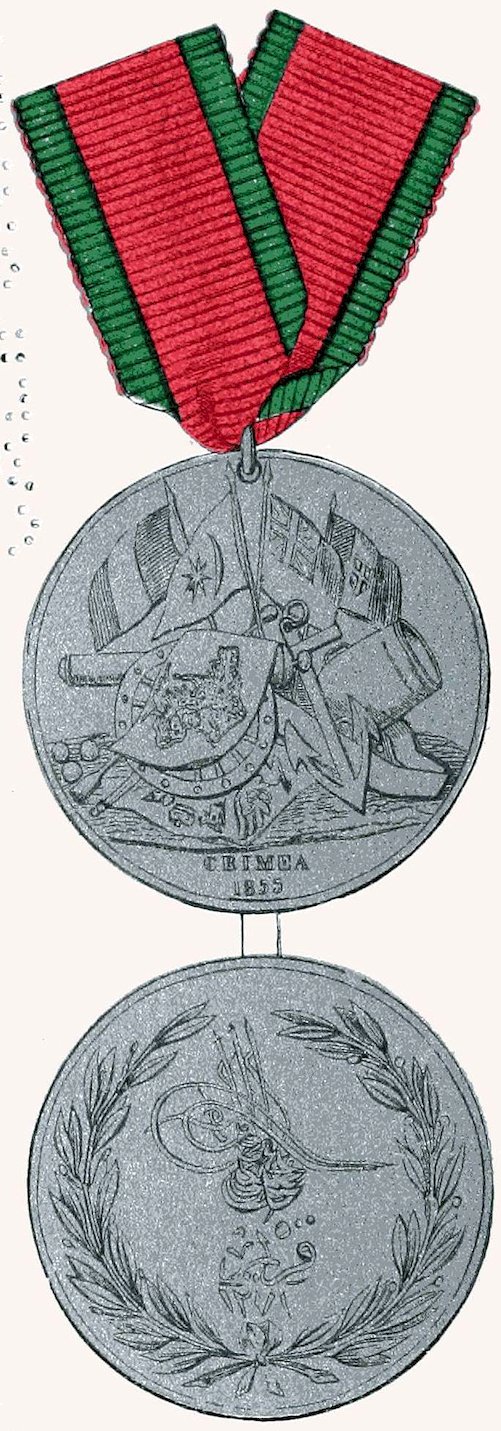
Turkish War Medal.
509