THE CRIMEAN MEDAL AND CAMPAIGN. 1854–56.
Reading edition
In December, 1854, the Queen was pleased to command that a medal, bearing the word “Crimea,” with an appropriate device, should be conferred on all the officers, non-commissioned officers, and private soldiers of Her Majesty’s Army, who had been engaged in the arduous and brilliant campaign in the Crimea; and that clasps, with the words “Alma” or “Inkermann” thereon, were to be also awarded to such as were present in either of those battles. In February, 1855, Her Majesty granted a clasp for the action at Balaklava, and in October following, a clasp inscribed “Sebastopol” was added to the Crimean medal, and was awarded to all present between the 1st. of October, 1854, the day on which the Army sat down before the place, and the 9th. of September, 1855, when the town was taken. Alma, Balaklava, Inkermann, and Sebastopol, are, therefore, the services to be most prominently described, as they are commemorated not only by the clasps above referred to, but likewise by inscriptions authorized by Royal Authority to be borne on the Regimental Colours of the corps entitled thereto; those having no standards or colours bearing these distinctions on their cap or helmet-plates, and Rifle Regiments on their breast-plates and cap-plates. The following are the Regiments in question:—
Alma.—4 Light Dragoons; 8, 11 Hussars; 13 Light Dragoons; 17 Lancers; Grenadier, Coldstream, and Scots Fusilier Guards; 1, 4, 7, 19, 20, 21, 23, 28, 30, 33, 38, 41, 42, 44, 47, 49, 50, 55, 63, 68, 77, 79, 88, 93, and 95 Foot; Rifle Brigade.
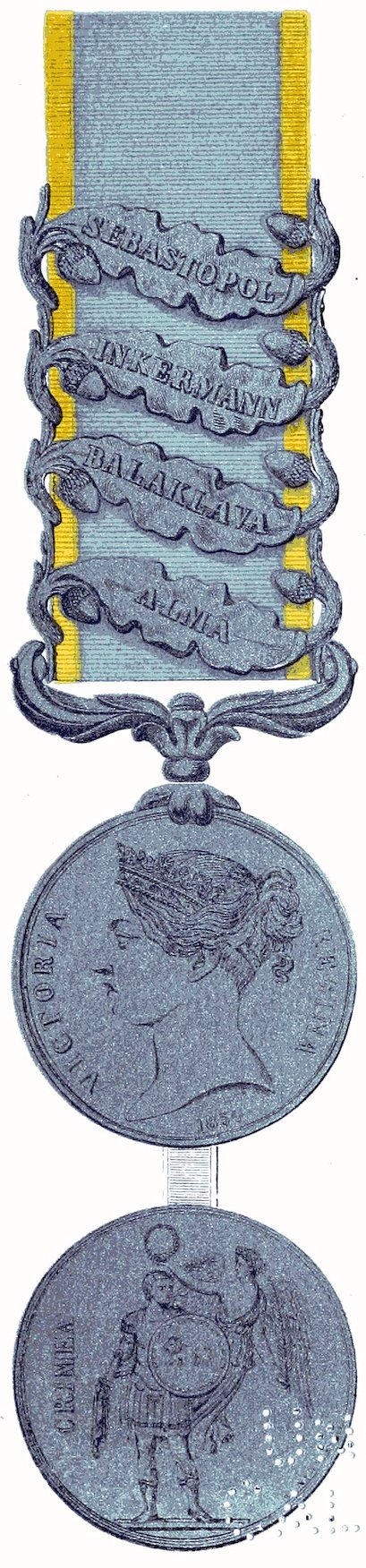
The Crimean Medal.
379Balaklava.—4, 5 Dragoon Guards; 1, 2, 4, 6, 8, 11, 13, 17 Dragoons; 93 Foot.
Inkermann.—4 Light Dragoons; 8, 11 Hussars; 13 Light Dragoons; 17 Lancers; Grenadier, Coldstream, and Scots Fusilier Guards; 1, 4, 7, 19, 20, 21, 23, 28, 30, 33, 38, 41, 44, 47, 49, 50, 55, 57, 63, 68, 77, 88, and 95 Foot; Rifle Brigade.
Sebastopol.—1, 4, 5, 6 Dragoon Guards; 1, 2, 4, 6 Dragoons; 8, 10, 11 Hussars; 12 Lancers; 13 Light Dragoons; 17 Lancers; Grenadier, Coldstream, and Scots Fusilier Guards; 1, 3, 4, 7, 9, 13, 14, 17, 18, 19, 20, 21, 23, 28, 30, 31, 33, 34, 38, 39, 41, 42, 44, 46, 47, 48, 49, 50, 55, 56, 57, 62, 63, 68, 71, 72, 77, 79, 82, 88, 89, 90, 93, 95, and 97 Foot; Rifle Brigade.
Two companies of the 46th., which preceded the Regiment, were present at Alma and Inkermann, and obtained medals for those victories, but the head-quarters and remainder of the corps did not arrive until the day following the last-named battle, and therefore did not receive these inscriptions for the colours. Six officers and two hundred and twenty-five men were granted the medal for the first-named battle, and six officers and two hundred and one men obtained the clasp for Inkermann.
The Crimean medal, designed by W. Wyon, has on its obverse the effigy of Her Majesty, from the die of the Peninsular medal, with the legend “Victoria Regina,” and in the exergue, the date 1854; the reverse has a figure of Fame about to place a wreath upon the brows of a stalwart hero, in classic military costume, bearing a round shield on his left arm, on which is shown the British Lion, with the word “Crimea” on the right of the figure. The ribbon is of pale blue with yellow edges. The clasps are of silver, with acorn ornaments, and severally inscribed “Alma,” “Balaklava,” “Inkermann,” and “Sebastopol.” The name and regiment of recipient are indented or engraved on the edge of the medal. A special clasp for “Azoff” was issued to the Navy, and the Marines received medals with clasps for “Balaklava,” “Inkermann,” and “Sebastopol.” The medal was also given to a selection of the French, Sardinian, and Turkish troops engaged in the campaign.
380