THE EGYPTIAN AND SOUDAN MEDALS.
Reading edition
By a General Order in October, 1882, a medal was granted to all troops who landed in Egypt, and served there, between July 16th. and September 14th., 1882. Obverse, head of the Queen, veiled and crowned, with the inscription, “Victoria Regina et Imperatrix.” Reverse, a Sphinx, on a pedestal, above which is the word “Egypt” and the date “1882” below. The name and regiment, or ship of the recipient, are engraved on the edge. Ribbon, alternate stripes of blue and white. Two clasps were issued with this medal, “Alexandria,[213] 11th. July,” and “Tel-el-Kebir.” The first was given to the seamen and marines engaged in the action of July 11th., and who landed in Alexandria after the bombardment; and the other to all who were present at Tel-el-Kebir—soldiers, sailors, and marines.
At the end of the first Soudan War, 1884, a similar medal, but without a date, was given to all men of both services who took part in the operations against the Arabs in the neighbourhood of Suakim, from July 19th. to March 26th., 1884. Ribbon, blue and white. Four bars were issued with this medal:—“Suakim, 1884”; “El Teb—Tamaai”; to those who were present at both these battles; “El Teb,” to those present there only; and “Tamaai,” to those who were only in that action.
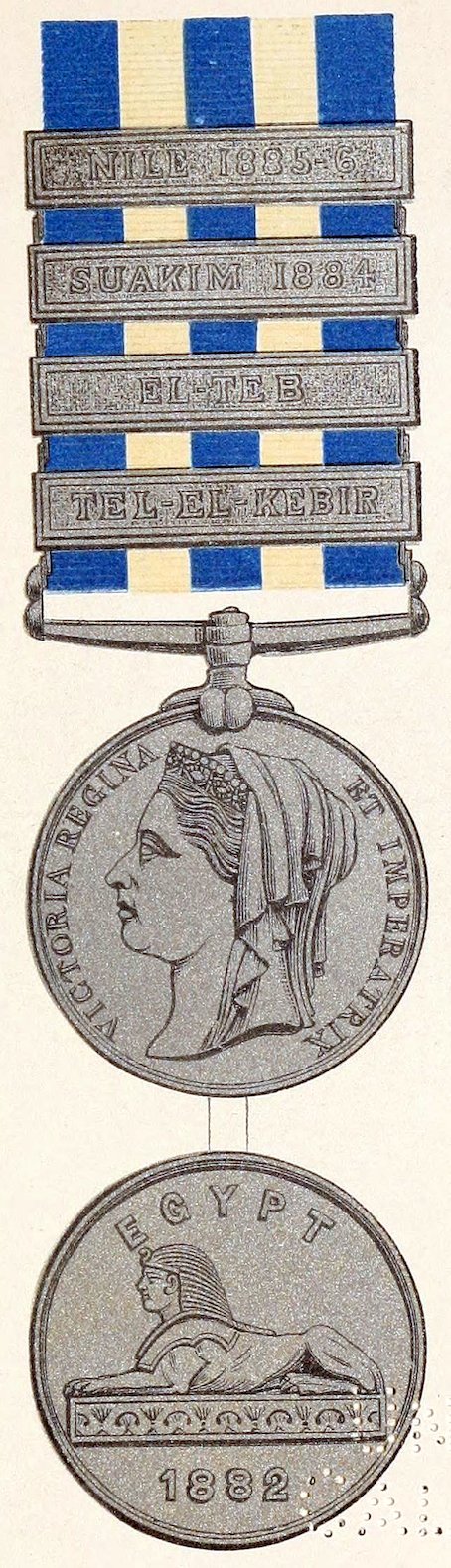
The Egyptian Medal.
By a General Order in 1885, at the close of the second Soudan campaign, the same medal was granted to the troops and Naval Brigade, with five additional bars. Ribbon, the 603same. The order specified that—“Individuals already in possession of the decoration will only be eligible to receive such of the clasps specified hereafter, as they may be entitled to. All officers and soldiers who served south of Assouan on or before March 7th., 1885, will be held entitled to the medal, except those who are already in possession of it. All officers and soldiers who were on duty at Suakim between 27th. March, 1884, and 14th. May, 1885, will also be entitled to the medal, except those already in possession of it. Her Majesty has further approved of clasps being issued as follows: a clasp, inscribed ‘The Nile, 1884–85,’ to those officers and soldiers who served south of Assouan on or before March 7th., 1885. A clasp, inscribed ‘Abu Klea,’ to those officers and soldiers who took part in the action fought there on 17th. January, 1885, under the late Major-General Sir H. Stewart, K.C.B. A clasp, inscribed ‘Kirbekan,’ to those officers and soldiers who took part in the action fought there on the 10th. February, 1885, under the late Major-General Earle, C.B. A clasp, inscribed ‘Suakim, 1885,’ to those officers and soldiers who were engaged in the operations at Suakim between the 1st. March and 14th. May, 1885, both inclusive. A clasp, inscribed ‘Tofrek,’ to those officers and men who were actually present at the action fought there on the 22nd. March, 1885.” No medals were issued with single clasps for Tofrek, Abu Klea, or Kirbekan, as all who were present at Tofrek received also the clasp for Suakim, 1885; and all present at the other two actions, were given the clasp for the Nile, 1884–5. The medals without a bar, dating from 1882 to 1885–86, were also given to the captains of all ships employed as transports, and to others who shared in the campaign, not belonging to the service. The whole number issued was forty-four thousand. The medal, without clasp, was also given to all officers and soldiers who served at, and to the South of Wady Halfa, between November 30th., 1885, and January 11th., 1886, under Lieutenant-General Sir J. Stephenson, if they had not received it for any previous campaign.
A General Order of January 2nd., 1890, granted a further issue of the Soudan medal, with a clasp, inscribed “Gemaizah, 1888,” to all troops who were at Suakim before December 20th., 1888, and who were present at the action on that day. By the same order, the medal was given to all troops who were employed on the Nile, at, and south of Korosko, on August 3rd., 1889, and a clasp, inscribed “Toski, 1889,” was given to all who were present at that action on August 3rd. of the same year. The total number of clasps already issued with this medal is thirteen.[214]
The Khedive of Egypt gave a bronze star, to every officer and man of both services who was entitled to the English medal. The star is five-pointed, and suspended by a ring and bar, on which is a small star and a crescent. On the obverse is a Sphinx, with the Pyramids in the background, surrounded by a band, with the word “Egypt,” and the date 1882, 1884, or 1884–6 above, and the same in Arabic below. On the reverse is the Khedive’s monogram in a circle, surmounted by a crown. Ribbon, dark blue. The decoration was issued without names, but some of the recipients had their names and regiments engraved on the reverse at their own expense.
604