BRITISH WAR MEDALS.
Reading edition
The highest rewards in all ages and nations have invariably been bestowed upon deeds of valour and martial daring; and no renown has generally been considered equal to that honorably gained by Arms in face of an enemy. The most noble families are proud to trace their descent from some celebrated warrior, and any distinction or trophy won by him is usually more treasured and prized than any other dignity or mark of honour. The custom of striking medals to commemorate victories, important events, or in honour of remarkable persons or deeds, dates from the times of the Greeks and Romans; but only in modern times have medals been issued as a reward of martial services, and worn as personal decorations.
Gold chains and medals were frequently bestowed by Princes in the XV. and XVI. centuries on Ambassadors, and others whom they wished to honour, and these marks of favor were certainly intended to be worn by the recipients; Queen Elizabeth[1] gave medals for naval achievements; but not until the next century can instances be found of such rewards being conferred for distinguished services in the field. Probably the earliest Medal in existence struck by, or for an Englishman, is a war medal dated 1480, of large size, and in the early Italian style. On the obverse is a head with “Jo Kendal Rhodi. Turcupellarius,” and on the reverse the arms of Kendal, with the inscription “Tempore obsidionis Turcorum, mcccclxxx.” The first medals given in England for Military services were 2struck by order of Charles I., by a warrant dated from the Court at Oxford, May 18th. 1643; to reward such soldiers as distinguished themselves in forlorn hopes. The warrant was issued to the Wardens of the Mint:—
“Charles R.,
“Trusty and well-beloved, we greet you well: whereas we have received information that those soldiers which have been forward to serve us in the Forlorn-hope, are not looked upon according to their merited valour and loyal service. We do therefore require, that from henceforward, the Commander-in-Chief, both of Horse and Foot, which lead up the Forlorn-hope, upon whom also we mean to bestow special tokens of our princely favour, do signify in writing the names of those soldiers whom they find most forward in serving us, their King and country, that care may be taken to reward their deservings, and make them specially known to all our good subjects. For which end we have thought fit to require Sir William Parkhurst, Kt., and Thomas Bushell, Esq., Wardens of our Mint, to provide from time to time certain Badges of Silver, containing our Royal image, and that of our dearest son, Prince Charles, to be delivered to wear on the breast of every man who shall be certified under the hands of their Commander-in-Chief to have done us faithful service in the Forlorn-hope.
“And we do therefore, most straightly command, that no soldier at any time do sell, nor any of our subjects presume to buy, or wear, any of these said Badges, other than they to whom we shall give the same, and that under such pain and punishment as our Council of War shall think fit to inflict, if any shall presume to offend against this our Royal command. And we further require the said Commanders and Wardens of our Mint, to keep several Registers of the names of those, and of their country, for whom they shall give their certificate. Given at our Court at Oxford the 18th. day of May, 1643.”
These Medals had the effigy of the King on one side, and of Prince Charles on the other.
On Sunday, October 23rd., 1642, was fought the battle of Edgehill, in which Robert Welsh or Walsh, an Irish gentleman, who commanded a troop of horse, succeeded in recovering from 3the Parliamentary forces, the standard of the King’s own regiment, taken by them, and also captured two pieces of cannon, and a waggon belonging to the Earl of Essex. The following morning, the king, upon the top of Edgehill, knighted Mr. Walsh, who was presented to him with these trophies by Prince Rupert; and on the 1st. of June, 1643, a gold medal was ordered for this officer, the obverse to bear the royal figure and his son Prince Charles, the reverse to have the royal banner used in the above battle, to be inscribed “Per Regale Mandatum Caroli Regis hoc assignatur Roberto Welch Militi.” Sir Harris Nicolas states that a copy of the warrant, with a drawing of the medal, which is oval, having on one side the effigies of the king and of Prince Charles, inscribed Car. Rex. M. B. F. et H. Car. Princeps; and on the reverse the royal standard, in bend sinister, inscribed “Per Regale Mandatv’ Caroli Regis hoc assignatur Rob: Welch Militi,” was recorded in the College of Arms, on the 14th. of August, 1685. This medal was worn on the breast, as appears by the knight’s own narrative, printed for himself in 1679. The long parliament passed an act in 1649, enacting that the tenth of all prizes due to the Lord High Admiral, should be appropriated for medals or other rewards for eminent service at sea, which ordinance was repeated in the succeeding year.[2]
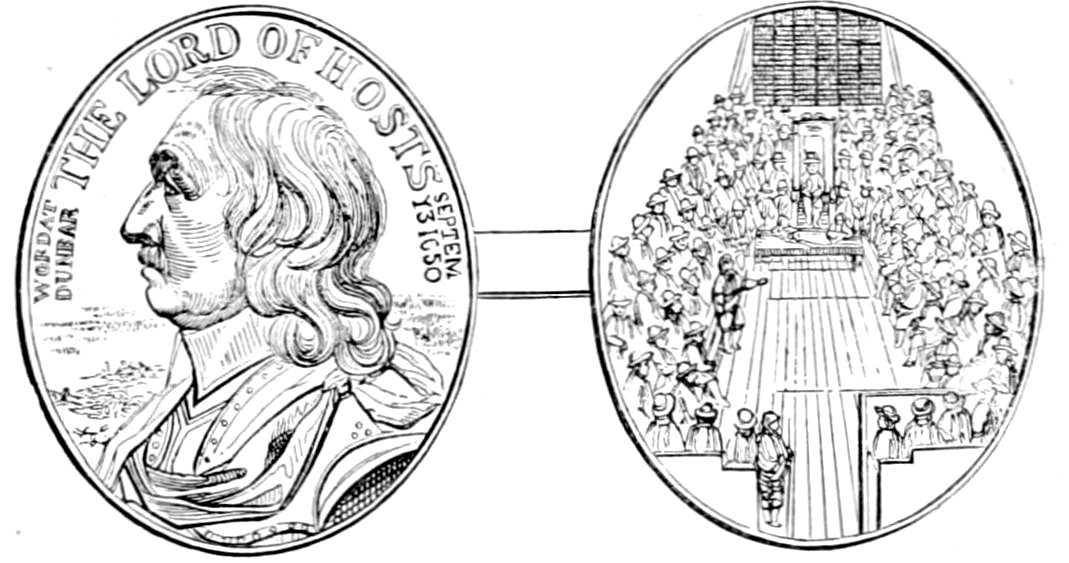
After the defeat of the Scots at Dunbar, by Cromwell, on the 3rd. of September, 1650, the House of Commons “ordered that it be referred to the committee of the army, to consider what medals may be prepared for officers and soldiers, that were in this service in Scotland, and set the proportions and the values of them, and their number, and present the estimate of them to the House.” The house voted that the officers and men “which did this excellent service” should be presented with gold and silver medals. Simon, an eminent engraver of that day, was sent to Cromwell, to consult with him as to the device for this medal. Dr. Harris, in the appendix to his “Historical and Critical Account of Oliver Cromwell,” page 538, has printed an original letter of Cromwell’s to the parliament (then in the possession of James 4Lamb, Esq., of Fairford, in Gloucestershire, and subsequently of John Raymond Barker, of the same place), on Symond’s (Simon) proceeding as above stated. The letter is highly characteristic, and is as follows.—
“For ye Honble the Committee for the Army, these.
“Gentl.,—It was not a little wonder to me to see that you should send Mr. Symonds so great a journey about a business importinge so little, as far as it relates to me when, as if my poore opinion may not be rejected by you, I have to offer to that wch I thinke the most noble end, to witt, the commemoracon of that great mercie at Dunbar, and the gratuitie to the army, wch might better be expressed upon the meddal by engraving as on the one side the Parliamt, wch I heare was intended, and will do singularly well; so, on the other side, an army wth this inscription over the head of it, The Lord of Hosts, wch was or word that day: wherefore, if I may begg it as a favor from you, I most earnestly beseech you, if I may do it wth out offence, that it may be soe; and if you thinke not fitt to have it as I offer, you may alter it as you see cause, only I doe thinke I may truely say it will be verie thankfully acknowledged by me, if you will spare the having my effigies in it.
“The gentlemans paynes and trouble hither have been verie great, and I shall make it my seconde suite unto you that you will please to conferr upon him that imploymt in yr service wch Nicholas Briott had before him; indeed, the man is ingenious and worthie of encouragemt. I may not presume much, but if at my request and for my sake he may obteyne this favor, I shall put it upon the accompt of my obligacons, wch are not a few, and I hope shal be found readie gratefully to acknowledge and to approve myself, Gentl.,
“Yor most reall servant,
“Edinburgh, 4th. of Feb., 1650–1.” “O. Cromwell.”
Cromwell’s modesty was over-ruled, and the medal bears his bust. On the obverse is the head of Cromwell, profile; under the shoulder, Tho: Simon F.; the motto about the 5head, Word at Dunbar,—The Lord of Hosts,—Septem ye 3, 1650; behind the head a prospect of the battle. The reverse has the House of Commons sitting, as represented on the Parliament Great Seal, 1648, and also on that of the Commonwealth, 1651. It is remarkable also for Cromwell’s likeness when Lieutenant-General. This is engraved in “The Medallick History of England,” and in “Simon’s Medals and Coins.” The Dunbar Medal is of two sizes,[3] and is the first given generally to officers and men, as is the present practice, and no instance occurred of a general distribution of medals by the Sovereign’s command until that for Waterloo was authorised.[4]
In the two works immediately referred to there are engravings of several medals, probably worn by officers and soldiers as honorary badges; some contain the effigy of King Charles the First or Prince Rupert, or Sir Thomas Fairfax or his son, or the Earls of Essex, Manchester, or Dumferline, General Rossiter, or of other Parliamentary commanders; on 6the reverse were their names or arms, or a representation of the Parliament, or the words Meruisti, or Pro Religione Lege et Parliamento, or For King and Parliament. It now seems impossible to discover the precise history of these medals. The victory of Naseby, on the 14th. of June, 1645, was commemorated by a silver-gilt medal, with a ring: on one side was the effigy of Sir Thomas Fairfax, inscribed, Tho: Fairfax miles Milit. Parl. Dux. Gen.; the reverse bore Meruisti, within a circle, and Post Hæc Meliora, 1645. The Parliamentary medal, which was distinct from the naval medal, before adverted to, cannot be described with certainty; but it is supposed to have had the effigies of the victorious generals on one side, and the Parliament on the other. It appears to have been instituted soon after that for Dunbar, as the House of Commons conferred it on Colonel Mackworth, by resolution dated the 27th. of August, 1651, with a chain of gold to the value of one hundred pounds. This officer was governor of Shrewsbury, and his service consisted in refusing to surrender the castle and garrison when summoned by the forces of the royalists.
With these exceptions the medals of the Commonwealth era appear to have been given for naval services against the Dutch, such distinctions being granted to Generals Blake and Monk, Vice-Admiral Penn, and Rear-Admiral Lawson, and certain officers of the fleet. Blake’s medal for the victory over the Dutch fleet off the Texel, in 1653, was purchased by William the Fourth for one hundred and fifty guineas. At this period the position of these officers was scarcely defined, for at times they appear to have fought on land as well as at sea.[5]
The medals of succeeding reigns appear to have been confined to naval services: although medals were struck in commemoration of the victories of the great Duke of Marlborough, it is certain that they were not worn by either officers or soldiers.
After the battle of Culloden, on the 16th. of April, 1746, a gold medal was struck, having on the obverse, the head of the 7Duke of Cumberland; the reverse had a figure of Apollo, and a dragon pierced by an arrow, inscribed, Actum est ilicet perit, and in the exergue, Præl. Colod. Ap. xvi., MDCCXLVI. This medal was given to officers who commanded regiments at the battle, and was worn round the neck by a crimson ribbon with a green border.
The medals granted by the Honourable East India Company[6] are next in order of time.
A medal was issued to Officers and men, by the East India Company, for the Campaigns in the Deccan, against Hyder Ali and his son Tippoo Sahib, 1780–84. This medal was granted by an order in Council, January 19th., 1784, and was in gold, silver, and inferior metal. Obverse, Britannia, seated upon a trophy of Arms, holding a wreath in her outstretched hand towards a fortress in the distance. Reverse, an inscription in Persian, which may thus be translated: “The courage and exertions of those valiant men by whom the name of Englishmen has been celebrated and exalted from Hindostan to the Deccan, having been established throughout the world, this has been granted by the Government of Calcutta, in commemoration of the excellent services of the brave. Year of the Hegira, 1199,” i.e., 1784. Within a circle is the following legend, also in Persian: “As coins are current in the world, so shall the bravery and exploits of those heroes by whom the names of the victorious English nation was carried from Bengal to the Deccan.” Suspended from a yellow cord.
In 1793, June 4th., by an order in Council, the East India Company granted a medal to the Officers and men under Lord Cornwallis, General Meadows, and General Abercromby, engaged in the war in Mysore, 1791–92, against Tippoo Sahib. The medal was issued in gold, silver, etc., as the Deccan Medal. Obverse, a Sepoy in the Military costume of the time, holding the British flag in his right hand, in his left the Mysore banner reversed, in the background a view of Seringapatam. Reverse, within a wreath, “For services in the Mysore, 1791–1792”; surrounded by a Persian inscription, “A token of the bravery of the troops of the English Government in the war in the Mysore, in the year of the Hegira, 1205–1206.”
8There were two sizes of this medal in silver, and it was worn suspended from a yellow silk cord.
One of the most dashing exploits in the war of Mysore was the capture of Bangalore, the second city in the dominions of Tippoo. It was enclosed by a high wall and a deep ditch, and the gate was covered by a close thicket of Indian thorns. The attack was made without any examination of the ground, and the troops in advancing and endeavouring to force an entrance, were exposed to a destructive fire of musketry. Colonel Moorhouse, one of the best officers in the service, fell mortally wounded. At length Lieutenant Ayre, a man of diminutive stature, succeeded in forcing his way through the shattered gate; which gallant action, being observed by General Meadows, he shouted to the stormers, “Well done! now whiskers, try if you can follow and support the little gentleman.” This animated appeal succeeded, the troops rushed through the gate into the town, and drove out the enemy at the point of the bayonet.
By an order in Council, Fort William, May 15th. 1807, a medal was granted to the troops engaged in the capture of Ceylon from the Dutch, 1795–96. Obverse, “For services in the Island of Ceylon, A.D. 1795–96.” Reverse, an inscription in Persian, “This medal was given by way of acknowledgement of services in Ceylon, in the year of the Hegira, 1209–1210,” suspended from a yellow silk cord. (Seringapatam Medal, see post).
A medal for services in Egypt was granted by general order, July 31st., 1802. In 1801, General Sir David Baird was dispatched from India in command of a force of 2,800 British troops, 2,000 Sepoys, and 400 picked artillerymen, to Egypt, to join the army under Sir Ralph Abercromby, landed them from England, to act against the French. Sir David was joined on the 17th. of May, at Jeddah, in the Red Sea, by an expedition from the Cape of Good Hope, consisting of the 61st. Regiment, some light cavalry and artillery, and on June 8th. landed at Cossier. (See Egyptian Campaign, post). Obverse, a Sepoy holding a Union Jack in his right hand, in rear, a camp, with an inscription in Persian: “This medal has been presented in commemoration of the defeat of the 9French armies in the Kingdom of Egypt, by the bravery and ability of the victorious army of England.” Reverse, a ship in full sail, with the Union Jack flying; pyramids and obelisk in the back ground. In the exergue, the date, 1801. Worn as the preceding.
In 1850 a clasp was added to this medal, which was sanctioned by the Queen in 1848.
In July, 1810, a small Anglo-Indian force, under the command of Colonel Keating, with a squadron of ships of the Royal Navy, under Commodore Rowley, captured the Isle of Bourbon from the French.
On the 29th. of November of the same year, an army of about 10,000 men from India, commanded by General J. Abercromby, assisted by a squadron of ships, under the command of Vice-Admiral Bertie, landed in the Isle of France, and after a smart action, in which the French were defeated, General Decaen, the French Governor, proposed terms of capitulation, and on December 3rd., surrendered the Island to Great Britain. Two hundred and nine pieces of heavy ordnance, with ample stores of ammunition, five French frigates, and a corvette, with twenty-four merchant ships, were captured. From that time, the Isle of France, henceforth known by its older name of Mauritius, has remained a dependency of the British crown.
For these services a medal was granted, by general order, dated, Fort William, September 10th., 1811. Obverse, a Sepoy holding the Union Jack, trampling on the French colours and Eagle; by his side a gun; in the back ground, ships at anchor. Reverse, within a wreath a Persian inscription: “This medal was conferred in commemoration of the bravery and accustomed fidelity exhibited by the Sepoys of the English company in the capture of the Mauritius Islands, in the year of the Hegira, 1223.” Round the wreath, “Rodrigues, 6th. July, MDCCCIX. Bourbon, 8th. July, and Isle of France, 3rd. December, MDCCCX.” The medal is worn as the preceding.
Her Majesty’s 69th. and 86th. Regiments were engaged in this service.
By a general order, February 11th., 1812, a medal was conferred on the troops, numbering about 12,000, engaged in 10the reduction of Java, under the command of General Sir S. Auchmuty. (See capture of Java, post). Obverse, Sepoys carrying Fort Cornelis; on the flag-staff is the British flag over the Dutch, above, the word Cornelis. Reverse, a Persian inscription: “This medal was given in commemoration of the valour and courage displayed by the Sepoys of the East India Company, in the capture of Java, in the year of the Hegira, 1228.” The legend is in English, “Java, conquered, 26th. August, MDCCCXI.” Worn as the preceding.
Her Majesty’s 14th., 59th., 69th., 78th., and 89th. Regiments of foot were present at the capture of Java.
A medal was granted by general order, March 20th., 1816, for the two campaigns in Nepaul, 1814–16, under Generals Marley, Wood, Gillespie (who was killed), and Ochterlony. Obverse, troops marching across hills crowned with stockades; on the left, a field gun. Reverse, inscription in Persian: “This medal was given by the Nawab Governor-General Bahadur, in testimony of the energy, good service, skill, and intrepidity which were displayed during the campaigns on the hills, in the year of the Hegira, 1229–1230.”
Worn as the preceding. A clasp for Nepaul was granted with the “Army of India” Medal in 1851. (See War in Nepaul, post).
In 1826, April 22nd., a medal was granted for the first Burmese War, 1824–26, troops commanded by Sir Archibald Campbell and General Morrison. Obverse, the white Elephant of Burmah crouching to the British Lion; the Burmese colours lowered to the Union Jack, palm-trees in the back ground. A Persian inscription: “The Elephant Ava submitting to the British Lion, 1826.” Reverse, a storming party advancing towards the Great Pagoda of Rangoon, a steam-boat and boats on the river Irrawaddy; Sir A. Campbell directing the movement in the foreground, under a palm-tree. An inscription in Persian: “The Standard of the victorious army of England in Ava.” This medal is by Wyon, and worn with a crimson ribbon with blue edge. A clasp for “Ava,” was given with the “Army of India” Medal in 1851. (See War in Ava, post).
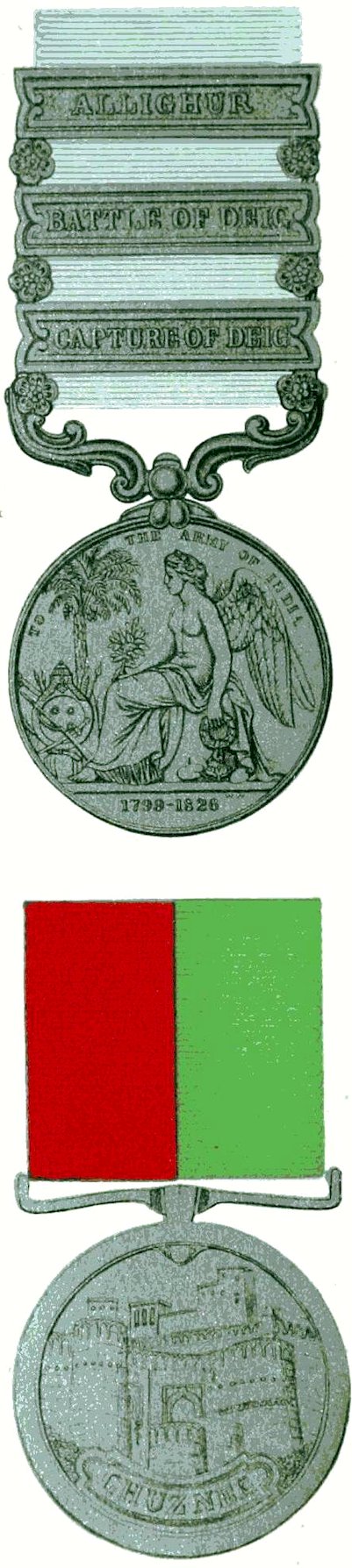
The Indian War Medal.—1799–1826 The Ghuznee Medal.—1830
11