MEDAL FOR LONG SERVICE AND GOOD CONDUCT.
Reading edition
This Medal was first instituted by King William IV., on July 30th., 1830, for non-commissioned officers and men who had been discharged in receipt of gratuities, under the provisions of the Royal Warrant of November 14th., 1829. The men recommended must have served twenty-one years in the Infantry, Artillery, or Engineers, or twenty-four years in the Cavalry, with irreproachable characters. A gratuity not exceeding £5 for a European soldier, or £3 for a black soldier, is given to each recipient. On the obverse of the medal is a military trophy, with a shield bearing the royal arms, with a smaller shield in the centre bearing the arms of Hanover. The reverse has the inscription “For long service and good conduct.” Ribbon: crimson, suspended by a steel loop. The name and regiment of the recipient, with the date, were indented on the edge of the medal. After the accession of Queen Victoria the arms of Hanover were omitted on the medal, and some years subsequently, but before the Crimean War, the steel suspender was replaced by a silver clasp, similar to other medals.
By a Royal Warrant of January 16th., 1860, the medal, without gratuities, was in future to be given to such soldiers as might fulfil the conditions previously required, but who were precluded from becoming recipients of the medal with a gratuity, in consequence of the aggregate amount to be annually awarded having been already appropriated. No soldier is entitled to the medal unless he has specially distinguished himself, or has, at least, three good conduct badges. A record of the recipients of these medals is kept in the office of the Secretary of State for War.
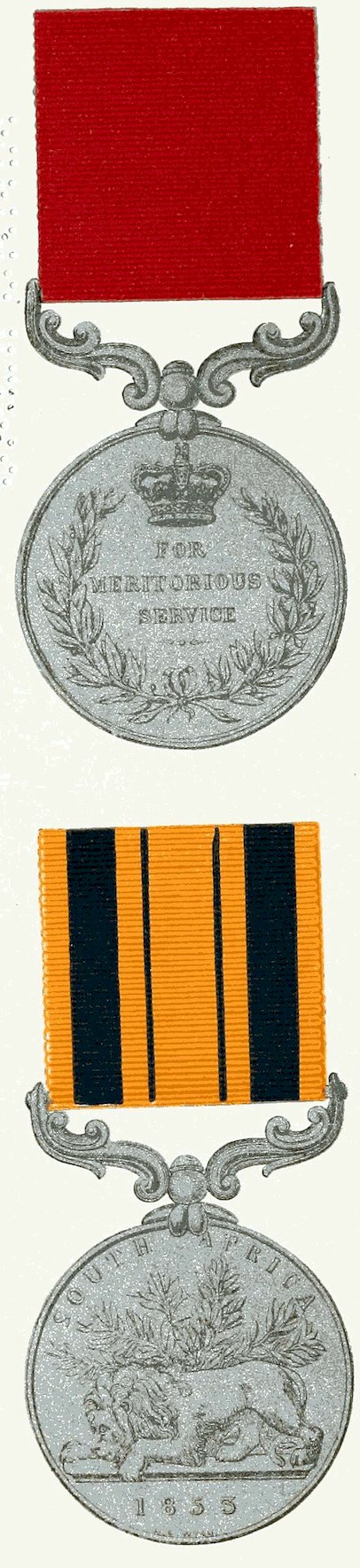
Meritorious Service Medal. The Cape Medal.
637