THE INDIAN GENERAL SERVICE MEDAL.
Reading edition
Since the publication of the first edition of this work, the medal granted for the “Second Burmese War, 1852–3,” and the war with Persia, 1856–7, has been designated the “Indian General Service Medal,” and is now always given as a reward for the almost perpetual expeditions[137] against the native tribes on the frontiers of India, and in adjoining territories. The medal, designed by L. C. Wyon, was first issued in 1854, with a clasp “Pegu,” to commemorate the services against the Burmese in 1852–3; and was also given for the Persian campaign, 1856–57, with clasp “Persia.” By a general order, July 1, 1869, the medal with a clasp inscribed “North West Frontier,” was granted for services on the North West Frontier of India, dating from 1849 to 1863. On the obverse of this medal is the diademed head of the Queen, with the legend “Victoria Regina.” On the reverse is a figure of Victory crowning a seated classic warrior with a laurel wreath. In the exergue is the lotus flower, but neither legend nor date. Ribbon: alternate stripes of crimson and blue. The name and regiment, or ship, are indented on the edge of the medal.
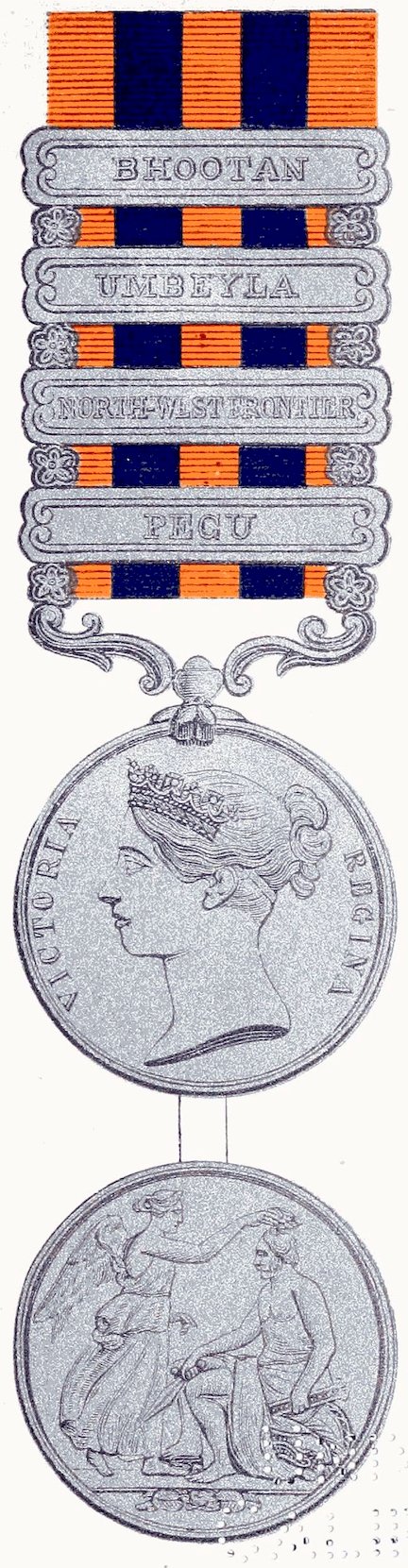
The Indian General Service Medal.
Generally, but not invariably, where the recipient had served in two or more expeditions, and had previously gained the medal, a bar or clasp only was added to those already worn, instead of giving another medal; but subsequent to 1876 instances occur of men having two medals, with bars for different campaigns. Since 1869, by a series of general orders, twelve bars have been issued with this medal, inscribed—“Umbeyla,”—“Bhootan,”—“Looshai,”—“Perak,”—“Jowaki, 1877–8”—“Naga,”—“Burma, 1885–7”—“Sikkim, 1888”—“Hazara, 1888”—“Burma, 1887–89”—“Chin-Lushai, 1889–90”—“Samana, 1891”—the medal in all cases being the same.
347