THE EGYPTIAN WAR. BOMBARDMENT OF ALEXANDRIA.
Reading edition
July 11th., 1882.
Early in the year 1882, what may be styled a revolution took place in Egypt. The army, headed by Arabi Pasha, set aside the authority of the Khedive, and assumed the supreme power, with the intention of emancipating the country from all foreign control. Arabi had entered the Egyptian army, and had risen from the ranks to the position of colonel. Being the idol of the ignorant soldiers, he imprisoned the Khedive in his own palace, and compelled him to bestow the post of Minister of War on himself. He next made himself Pasha, and the bulk of the Egyptian people supporting the army, Arabi became the head of the national movement, and inscribed on his banners: “Egypt for the Egyptians.” These proceedings were viewed with apprehension in England. The Khedive had always been favourable to British interests, and the support afforded him by the British so excited the hostility of Arabi and his party, that they threatened to seize the Suez Canal, and so block the highway to India. The Egyptians beginning to show the greatest animosity towards all foreigners, an English and French fleet appeared before Alexandria, to give moral support to the Khedive, and to protect the European inhabitants. In June, serious riots broke out in the city, many Europeans were killed and wounded, and the remainder driven to seek shelter on board the ships in the harbour. Preparations for war were made on both sides. The fortifications of Alexandria were strengthened, new batteries constructed, and the garrison increased. Sir Beauchamp Seymour, the British Admiral, ordered the Egyptians to discontinue these operations, with no effect; upon which he sent in an ultimatum threatening an immediate bombardment, unless the working on the fortifications was suspended, and the forts surrendered to him. No attention was paid to this demand, and the fleet prepared for action.
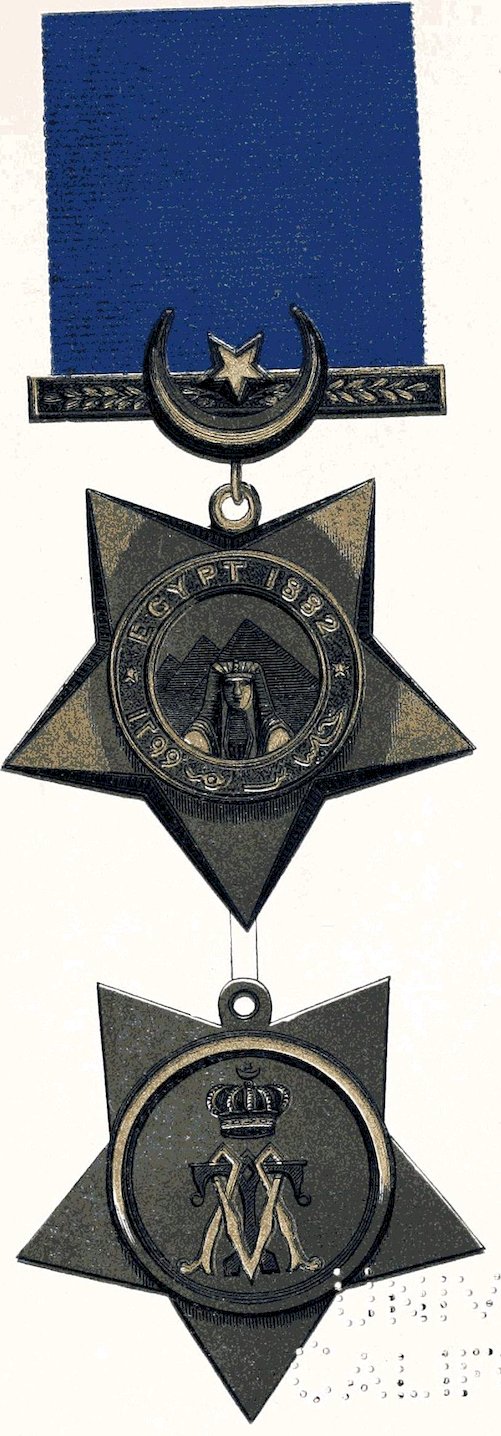
The Khedive’s Star.
605The French fleet had already left Alexandria; all neutral vessels were warned to leave the harbour, and the British fleet steamed out and took its position opposite the outer forts. On the evening of July 10th., the “Invincible” (10), “Monarch” (6), and “Penelope” (10), anchored to the west of Fort Mex, and by daybreak on the 11th. all the other ironclads were in the positions assigned to them. At 6.30 all the ships cleared for action, which was begun by the “Alexandra” pitching a shell into Fort Ada. It was immediately replied to, upon which all the ships and the forts opened fire, and the engagement became general. The “Sultan” (13), “Alexandra” (12), “Superb” (4), and “Inflexible” (4), were opposed to the forts at Pharos Point and Ras-el-Tin, 606and the “Téméraire” (8), supported the Invincible, Monarch, and Penelope, in the attack on Fort Mex, and the adjoining batteries. The gunboats “Bittern,” “Condor,” “Decoy,” “Cygnet,” and “Beacon” were placed in a second line behind the ironclads, with orders to hold themselves at the disposal of the Admiral.
The wind was favourable to the Egyptians, and after the first broadside or two a thick cloud of smoke enveloped the ships, making it impossible to see the effects of their firing, which could only be directed from the tops.
The gunboats were not willing to remain idle spectators, so, without orders, the “Cygnet” opened fire, and the “Condor,” with two 64-pounders, and one 7-inch rifled gun, steamed away to the west, and alone engaged the Marabout Fort, armed with two 18-ton, and two 12-ton guns, twenty 32-pounders, and five mortars; for nearly two hours. Sir B. Seymour, seeing the disproportion of force, signalled the “Bittern” and “Beacon” to join her, and the other gunboats also moved off to assist the “Condor.”
About 8.30, Fort Marsa-el-Kanat was blown up by shells from the “Invincible” and “Monarch,” and by nine o’clock, the “Téméraire,” “Monarch,” and “Penelope” had disabled all the guns but four, in Fort Mex. It was difficult through the smoke to hit on the locality of these guns, but by 11 a.m. the Fort was almost in ruins, and silent. About the same time the gunboats had silenced Fort Marabout, and joined the ironclads before Fort Mex, which was entered by a small party of volunteers from the “Invincible,” covered by the “Bittern” and “Condor,” and found deserted by all but the dead. The guns in the Fort were blown up and destroyed, and the party returned to the ships without loss.
The Egyptians stood to their guns well, but before five o’clock all their guns were disabled, and soon after all firing from the fleet ceased, and the ships drew off the shore. The “Alexandra” suffered the most, she was hit fourteen times in her hull, and a shell burst in the captain’s cabin. All the ships except the “Monarch” were struck more or less, but none of the projectiles of the enemy pierced the armour of one of them. The casualties of the British were five men killed and twenty-seven wounded, those of the Egyptians were estimated at nine hundred or a thousand.
During the night Alexandria was seen to be in flames. The convicts had been liberated, and with the Arabs, had set fire to, and plundered the European quarter, and massacred all the Europeans they could find.
Next day, a force of six hundred seamen and marines landed, and found that Arabi with his troops, and most of the inhabitants, had left the town. Captain Lord C. Beresford, of the “Condor,” was appointed chief of the British forces acting as police in Alexandria, the streets were cleared of rioters, all incendiaries shot on the spot, and natives entering the place, disarmed[215] For his services, Admiral Sir F. B. Seymour received the thanks of both Houses, and was raised to the peerage by the title of Lord Alcester, with a grant of £25,000.
607