RE-CAPTURE OF GHUZNEE. 6th. September, 1842.
Reading edition
Major-General Sir William Nott, on the morning of the 5th. of September, moved upon Ghuznee. Lieutenant-Colonel Palmer, Political Agent, commanding at Ghuznee, upon promise of honourable treatment and safety on the march to Cabool, and by the orders of Major Pottinger and Major-General Elphinstone, had, in March, 1842, capitulated. The garrison, which only occupied the citadel, was exhausted by fatigue and want of water, and the men had suffered greatly from cold, the thermometer having been fourteen degrees below zero. Upon Shumshoodeen, Nephew of Dost Mahomed Khan, swearing on the Koran that he would give the Sepoys a safe escort to Hindoostan, they consented to deliver up their arms; but had scarcely marched out of the citadel, when they were attacked by the fanatical Ghazees. An English officer, his wife, and their servants, were massacred on the spot, and native women, children, and Sepoys were butchered in heaps. Colonel Palmer was put to the torture, after which, he and nine only surviving officers were thrown into a dungeon. The city was found to be full of men, and a range of mountains running north-east of the fortress was covered by heavy bodies of cavalry and infantry; the gardens and ravines in the vicinity being likewise occupied. Major Sanders, of the Bengal Engineers, was directed to reconnoitre the works; this brought on some smart skirmishing, and Captain White, of the 40th., commanding the light companies, was pushed forward, when the Major-General determined to carry the enemy’s mountain positions before encamping his force. This was effectively performed by the troops, and the Afghans were driven before them until every point was gained. Two regiments and some guns were sent from the camp, (which had been pitched,) to occupy the village of Bullool, about six hundred yards from the walls of Ghuznee, upon the spur of the mountain to the north-east, as this appeared to be a desirable spot for preparing a heavy battery.
During the night of the 5th. of September, the engineers sappers, and miners, and infantry working parties were employed 257in erecting breaching batteries; before the guns, however, had reached the position on the morning of the 6th., it was ascertained that the fortress had been evacuated, and at daybreak the British colours were flying from the citadel. The 40th. had one private killed and three privates wounded; the 41st had the same number wounded. In these operations the loss was much less than might have been expected, from the numbers and positions of the enemy, and from the fact of the troops being obliged to move under the range of the guns of the fortress. Three hundred and twenty-seven Sepoys of the 27th. Native Infantry were here released from the state of slavery to which they had been reduced by the Afghans. A party was detained, under Lieutenant G. White, to take down the celebrated gates of Somnauth, concerning which so much discussion afterwards arose.
On the 10th. of September the troops continued their march on Cabool, when Shumshoodeen, Sultan Jan, and other chiefs having assembled about twelve thousand men, occupied, on the 14th. and 15th. of September, a succession of strong mountains, intercepting the advance at Beenee Badam, and Mydan, but they were dislodged, and driven from their position. No further opposition was encountered, and on the 17th. the troops, under Major-General Nott, reached Cabool, and joined the force under Major-General Pollock.
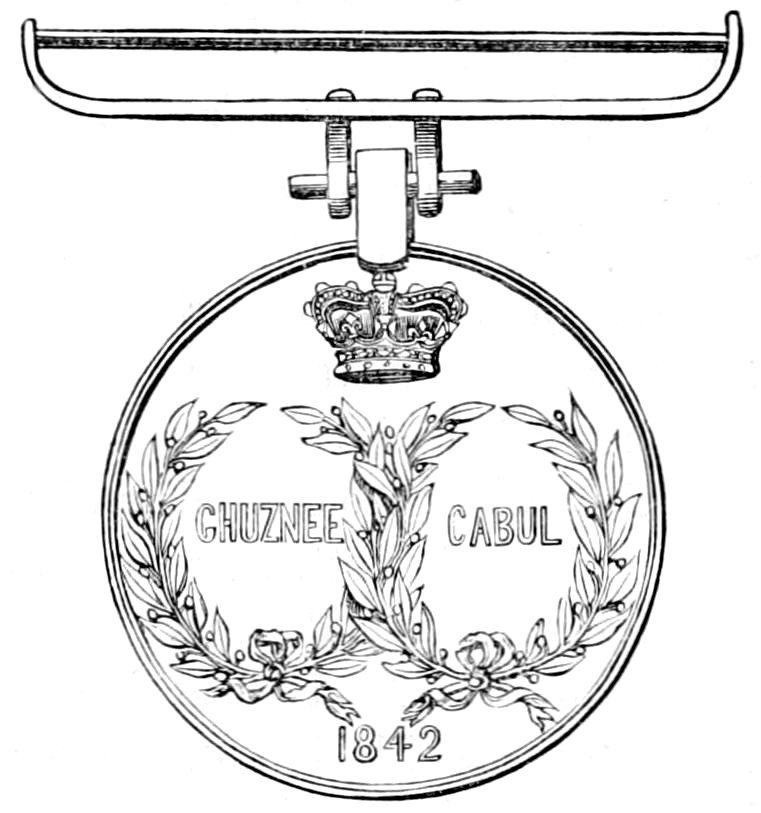
After the strong town of Istalif had been captured by the troops under Major-General McCaskill, on the 29th. of September, in which the 9th. Foot and the light companies of the 41st. bore a gallant part, the army broke ground on its return to India on the 12th. of October, the grand bazaar at Cabool, named the Chahar Chuttah, where the remains of the British envoy had been exposed to public insult, having been first destroyed. On arriving at Jellalabad, the fortress was destroyed.[90] During the march through the Passes several attacks of the Afghans were repulsed. According to the wish of Lord Ellenborough, the Governor-General, the garrison of Jellalabad proceeded in advance of the rest of the troops, in order to make a triumphant entry. The medals (mural crown pattern) granted to the garrison for the defence and battle near Jellalabad had been forwarded a few days previously, in order that they might be worn on its entrance into Ferozepore, which took place on the 17th. of December.
The following Queen’s regiments took part in these campaigns:—Cabool, 1842.—3rd. Light Dragoons, 9th., 13th., 31st., 40th., and 41st. regiments. Candahar and Ghuznee.—40th. and 41st. regiments. Jellalabad.—13th. Light Infantry.
258