BATTLE OF WATERLOO. 18th. June, 1815.
Reading edition
The position which was taken up in front of Waterloo, crossed the high-roads from Charleroi and Nivelles, its right being thrown back to a ravine near Merke Braine, which was occupied; its left extended to a height above the hamlet of Ter la Haye, which was also occupied. In front of the right centre, and near the Nivelles road, the house and garden of Hougomont, which covered the return of that flank, was made available for defence, and in front of the left centre the farm of La Haye Sainte was put to a similar use. By the left a communication was maintained with Marshal Prince Blucher, at Wavre, through Ohain, who had promised that in case of an attack, he would advance in support, not with one or more corps, but with his whole army.
On a range of heights in front of the British, were collected during the night the whole of Napoleon’s army, with the exception of the third corps, under Marshal Grouchy, who had been detached to watch the movements of the Prussians. At about half-past ten on the morning of the 18th., a furious attack was made upon the post at Hougomont, occupied by a detachment from Major-General Byng’s brigade of Guards, which was in position in its rear, and it was for some time under the command of Lieutenant-Colonel (afterwards Sir James) Macdonell, and subsequently under Colonel Home. It was maintained throughout the day with the utmost gallantry by these brave troops, although repeated efforts of large bodies vainly endeavoured to obtain possession of the place.
“About one o’clock a cart of ammunition, which had been 187sent for early in the day, was brought into the farm-yard of Hougomont, and proved most seasonable. The men had only time to fill their pouches, when a discharge of artillery suddenly burst upon them, mingled with the shouts of a column rushing on to a fresh attack. A cloud of tirailleurs pushed through the wood and cornfields: they were aimed at with fatal certainty from the loopholes, windows, and summit of the building. But the enemy eventually compelled the few men that remained outside to withdraw into the chateau by the rear gate. In the meantime the French redoubled their efforts against it, and the fire of the immediate defenders of that point for a moment ceased. The gate was then forced. At this critical moment Macdonell rushed to the spot with the officers and men nearest at hand, and not only expelled the assailants, but re-closed the gate. The enemy, from their overwhelming numbers, again entered the yard, when the guards retired to the house, and kept up from the windows such a destructive fire, that the French were driven out, and the gate once more was closed.” Such is the description given by Colonel MacKinnon, in his valuable “Record of the Origin and Services of the Coldstream Guards.” Captain Siborne thus narrates the circumstances “The French, however, succeeded in forcing the gate; but the defenders betook themselves to the nearest cover, whence they poured a fire upon the intruders, and then rushing forward, a struggle ensued, which was distinguished by the most intrepid courage on both sides. At length Lieutenant-Colonel Macdonell, Captain Wyndham, Ensigns Gooch and Hervey, and Sergeant Graham, of the Coldstream Guards, by dint of great personal strength and exertions, combined with extraordinary bravery and perseverance, succeeded in closing the gate against their assailants. Those of the latter who had entered the courtyard fell a sacrifice to their undaunted and conspicuous gallantry.”
Alluding to Sergeant Graham, he adds, “This individual deserves honourable mention, having greatly distinguished himself during the memorable defence of Hougomont. At a later period of the day, when in the ranks along the garden wall facing the wood, and when the struggle was most severe 188in that quarter, he asked Lieutenant-Colonel Macdonell’s permission to fall out. The Colonel, knowing the character of the man, expressed his surprise at the request made at such a moment. Graham explained that his brother lay wounded in one of the buildings then on fire, that he wished to remove him to a place of safety, and that he would then lose no time in rejoining the ranks. The request was granted: Graham succeeded in snatching his brother from the horrible fate which menaced him, laid him in a ditch in rear of the enclosures, and, true to his word, was again at his post.”
Finding Hougomont so stubbornly defended, the French artillery opened upon the house, which was quickly in a blaze. The Guards however, about 2000 men, with 1100 German troops, maintained the post to the end of the day, against the repeated attacks of nearly 30,000 men. The loss of the enemy was fearful, the killed and wounded lying in heaps round the chateau, in the woods, and in every avenue leading to it. The division of General Foy alone lost 3000 men, and the total loss of the French in their attacks upon this position, was not far short of 10,000 killed and wounded.
This attack upon the right of the British centre was accompanied by a heavy cannonade upon the whole line, which was destined to support the repeated attacks of cavalry and infantry, occasionally mixed, but sometimes separate, that were made upon it. In one of these the French carried the farmhouse of La Haye Sainte, as the detachment of the light battalion of the German Legion, which held it, had expended all its ammunition, and the enemy occupied the only communication there was with them. Repeated charges were made by the French cavalry upon the infantry, but these attacks were uniformly unsuccessful, and they afforded opportunities to the British cavalry to charge, in one of which Lord Edward Somerset’s brigade, consisting of the Life Guards, Royal Horse Guards, and 1st. Dragoon Guards, highly distinguished itself, with that of Major-General Sir William Ponsonby, having taken many prisoners and an eagle.
Soon after four o’clock a grand onslaught was made on the British front by the whole of the French cavalry; cuirassiers, 189lancers, and chasseurs à cheval of the Imperial Guard, consisting of about forty squadrons, supported by a tremendous fire of artillery. As they advanced, every discharge of the British guns, double shotted, fearfully shattered their ranks; but they rushed on, with shouts of “Vive l’Empereur!” to the very faces of the infantry squares, inside of which the gunners were lying down for shelter, and swept round the flanks, till they recoiled in disorder and confusion before the close and destructive fire under which men and horses fell in heaps.
These attacks continued to be repeated until about seven o’clock in the evening, and the Prussians were fast approaching Planchenoit, on the right rear of the enemy, with about 30,000 men and sixty-four guns, when Napoleon made a last desperate effort with his Imperial Guard in two columns, supported by the fire of artillery, to force the left centre, near the farm of La Haye Sainte. Led by Ney, the veterans of Jena and Wagram, in spite of a decimating fire of case and grape shot, advanced to within fifty yards of Halkett’s brigade, and the Foot Guards, who were lying down to avoid the cannonade which covered the onset of Napoleon’s chosen troops. On the word being given, the Guards in a line four deep, sprang to their feet, and poured in such a destructive volley that the front of the column of the Imperial Guard seemed to melt away. Their officers vainly strove to rally them, when the British with a ringing cheer charged, and the enemy were driven down the hill in wild confusion. The second column of the Imperial Guard, rent and torn by close discharges of case shot, and assailed with volleys of musketry in front and flank, also broke, turned, and fled, only two rear battalions retaining their ranks.
Having observed that the enemy retired from this attack in great confusion, and that the march of General Bulow’s corps upon Planchenoit and La Belle Alliance had begun to take effect, the fire of his cannon being perceived, and as Marshal Prince Blucher had joined in person with a corps of his army to the left of the British line by Ohain, the Duke immediately advanced the whole line of infantry, supported by the cavalry and artillery. The Anglo-allied army formed line, and with one impetuous charge decided the fortune of 190the day. The enemy was forced from his position on the heights, and fled in the utmost confusion. The pursuit was continued until long after dark, and then, in consequence of the fatigue of the British troops, which had been engaged during twelve hours, Marshal Blucher was left to follow the enemy, from whom he captured sixty pieces of cannon, belonging to the Imperial Guard, together with several carriages, baggage, etc., belonging to Napoleon. About one hundred and fifty pieces of cannon, with their ammunition, had been taken by the British, together with two eagles.
Sir Thomas Picton,[67] the hero of so many Peninsula actions, fell, and Major-General the Honourable Sir William Ponsonby. The Earl of Uxbridge, after having passed unscathed throughout the day, lost his right leg by nearly the last shot fired, and His Royal Highness the Prince of Orange was wounded. Lieutenant-General Sir Charles Baron Alten, Major-Generals Sir Colin Halkett, Sir Edward Barnes, (Adjutant-General,) Fred: Adam, Sir James Kempt, and Cooke, and Colonel Sir William 191De Lancey[68] (Deputy-Quartermaster-General,) were wounded. Lieutenant-Colonel Lord Fitz Roy Somerset (the late Lord Raglan) had his right arm amputated.
Vain would it be to select regiments on this glorious occasion. “It gives me the greatest satisfaction (so wrote the Duke to Earl Bathurst,) to assure your Lordship, that the army, never, upon any occasion, conducted itself better. The division of Guards, under Major-General Cooke, who is severely wounded; Major-General Maitland, and Major-General Byng, 192set an example which was followed by all; and there is no officer nor description of troops, that did not behave well.”
At Waterloo the Anglo-allied army consisted of sixty-seven thousand six hundred and sixty-one men, and one hundred and fifty-six guns;[69] and the French had seventy-one thousand nine hundred and forty-seven men, and two hundred and forty-six guns, composed of fifteen thousand seven hundred and sixty-five cavalry, seven thousand two hundred and thirty-two artillery, and forty-eight thousand nine hundred and fifty infantry.
Both Houses of Parliament voted their thanks to the army with the greatest enthusiasm, “for its distinguished valour at Waterloo;” and the following regiments engaged, also the battalions to which they are now linked, but which took no part in the battle, bear the word “Waterloo” on their colours and appointments, in commemoration of their distinguished services on the 18th. of June, 1815, namely, 1st. and 2nd. Life Guards, Royal Horse Guards, 1st. Dragoon Guards, 1st., 2nd., 6th., 7th., 10th., 11th., 12th., 13th., 15th., and 16th. Light Dragoons, Grenadier Guards, Coldstream Guards, Scots Fusilier Guards, 1st., 4th., 14th., 23rd., 27th., 28th., 30th., 32nd., 33rd., 40th., 42nd., 44th., 51st., 52nd., 69th., 71st., 73rd., 79th., and 92nd., Foot, Rifle Brigade, and Royal Artillery. Every subaltern officer and soldier present in this battle, or in either of the actions immediately preceding it, received permission to count two years additional service.
The oft-mooted question as to the share taken in this momentous contest by the Prussians, and to their presence on the field in gaining the victory, must be met by the Duke’s opinion, as expressed in his despatch:—“I should not do justice to my own feelings, or to Marshal Blucher and the Prussian 193army, if I did not attribute the successful result of this arduous day to the cordial and timely assistance I received from them. The operation of General Bulow upon the enemy’s flank was a most decisive one; and, even if I had not found myself in a situation to make the attack which produced the final result, it would have forced the enemy to retire if his attacks should have failed, and would have prevented him from taking advantage of them if they should unfortunately have succeeded.” There are, however, even now, some prejudiced people, who exclaim, like Solomon Probity, in “The Chimney Corner,” “Don’t tell me! it was Blucher as won Waterloo.”
The meeting of the Duke and Blucher at La Belle Alliance after the battle is apocryphal. In the concluding volume of the Wellington Dispatches, (page 332,) there is a letter to Mr. Mudford, in which occurs the following passage in reference to this and other mis-statements:—“Of these a remarkable instance is to be found in the report of a meeting between Marshal Blucher and me at La Belle Alliance; and some have gone so far as to have seen the chair on which I sat down in that farmhouse. It happens that the meeting took place after ten at night, at the village of Genappe; and anybody who attempts to describe with truth the operations of the different armies will see that it could not be otherwise. In truth, I was not off my horse till I returned to Waterloo, between eleven and twelve at night.”
The following anecdote is illustrative of the effect produced by the irresistible attack of the Life Guards:[70]—Immediately after the first charge, while the Life Guards were pursuing the French, three of their cuirassiers turned down a narrow lane, with a view of escaping that way, and they were pursued by Private John Johnson, of the 2nd. regiment. There proved to be no thoroughfare at the end of the road, when Johnson, though alone, attacked the three, and, after a slight resistance, they surrendered themselves prisoners. 194Several instances of distinguished bravery displayed by individuals of the Life Guards, have been recorded; amongst others, Corporal Shaw and Private Godley, of the 2nd. regiment. The former for his great prowess, and the number of cuirassiers he slew; and the latter for a distinguished act of bravery, namely, when his horse was killed, himself wounded, and his helmet knocked off, bareheaded as he was, he attacked a cuirassier, slew him, and mounted his horse. Shaw was killed in the first charge. Godley lived several years after, and a stone was erected to his memory by his comrades in the burial ground of St. John’s Wood, London, with appropriate devices and inscription. During the engagement the Duke of Wellington came to the head of the 1st. regiment of Life Guards, and thanked the squadrons for their gallant behaviour.
Colonel Ferrier, of the 1st. Life Guards, before he fell had eleven times led his regiment to the charge. Several of these charges were made after his head was laid open by a sabre cut, and his body had been pierced by a lance.
During the heat of the conflict Captain Alexander Kennedy Clark (now Lieutenant-General A. K. Clark Kennedy, C.B.) commanding the centre squadron of the 1st. Royal Dragoons, having led his men about two hundred yards beyond the second hedge on the British left, perceived, in the midst of a crowd of infantry, the eagle of the French 105th. regiment, with which the bearer was endeavouring to escape to the rear. Against this body of men Captain Clark instantly led his squadron at full speed, and, plunging into the midst of the crowd, overtook, and slew the French officer who carried the eagle. Several men of the Royal Dragoons coming up at the moment of its capture, Captain Clark gave the eagle to Corporal Stiles, and ordered him to carry it to the rear. The corporal was afterwards rewarded with an ensigncy in the 6th. West India Regiment.
Another eagle, that of the French 45th. regiment, was captured by Sergeant Charles Ewart, of the 2nd. Royal North British Dragoons. This gained for the gallant sergeant an ensigncy in the 3rd. Royal Veteran Battalion.
The following is a remarkable instance of preservation:—Lieutenant 195George Doherty, of the 13th. Light Dragoons, besides being severely wounded in the head, was struck by a ball, which was stopped and flattened by the interposition of his watch. He had taken out his watch to remark the time, when the regiment was ordered to advance, and not being able to return it, he put it into the breast of his jacket, and thus, providentially, his life was saved.
In one of the charges made by the 28th. regiment at Waterloo, a flag belonging to the 25th. French regiment was taken by Private John O’Brien, of the eighth company, who the moment after received a severe wound, which ultimately occasioned the loss of his leg. The trophy, however, was preserved, and sent to Major-General Sir James Kempt, who commanded the division, when the regiment arrived at Paris.
In the “Letters of Colonel Sir Augustus Simon Frazer, K.C.B.,” commanding the Royal Horse Artillery in the army under the Duke of Wellington, edited by Major-General Edward Sabine, from which the above has been extracted, is this allusion to Waterloo:—“Never was there a more bloody affair, never so hot a fire. Bonaparte put in practice every device of war. He tried us with artillery, with cavalry, and, last of all, with infantry. The efforts of each were gigantic, but the admirable talents of our Duke, seconded by such troops as he commands, baffled every attempt.”
There is some difference of opinion as to the exact time the battle commenced. In the “Life of Lord Hill,” by the Rev. Edwin Sidney, A.M., occurs the following:—“In reading the various accounts of this battle, it is curious to observe the discrepancies as to the time it commenced. Lord Hill has, however, settled this point. On arriving in London the autumn after the conflict, he passed his first evening at the house of his friend Lord Teignmouth. ‘Can you tell me,’ said Lord Teignmouth, ‘at what time the action commenced?’ Lord Hill replied, ‘I took two watches into action with me. On consulting my stop-watch after the battle was over, I found that the first gun was fired at ten minutes before twelve.’”
Captain Moorsom, in his “History of the 52nd. Light Infantry,” gives the following characteristic account of the commencement of the action:—“The night was wet and disagreeable, 196as usual before—the Duke of Wellington’s battles. As the morning broke, between four and five o’clock, Captain Diggle’s company of the 52nd., and two or three companies of the 95th. Rifles, were sent into the enclosures of the village of Merbe Braine, with their front towards Braine-le-Leud. At twenty minutes past eleven a cannon-shot was fired. Diggle, a cool old officer of the Peninsula, took out his watch, turned to his subaltern Gawler, who was another of the same Peninsula mould, and quietly remarked, ‘There it goes.’ The leaders, in fact, had then opened the ball.”
In the “Life of Lord Hill,” before quoted, occurs the following account of the final struggle:—“Sir Digby Mackworth, who was on the staff of Lord Hill, has kindly communicated what he witnessed of his General’s efforts at the grand crisis of the day. ‘He placed himself,’ Sir Digby states, ‘at the head of his Light Brigade, 52nd., 71st., and 95th., and charged the flank of the Imperial Guard, as they were advancing against our Guards. The Light Brigade was lying under the brow of the hill, and gave and received volleys within half-pistol-shot distance. Here Lord Hill’s horse was shot under him, and, as he ascertained the next morning, was shot in five places. The general was rolled over and severely bruised, but in the mêlée this was unknown to us for about half an hour. We knew not what was become of him; we feared he had been killed; and none can tell you the heart-felt joy which we felt when he rejoined us, not seriously hurt.’ When the tremendous day was over, Lord Hill and his staff again re-occupied the little cottage they left in the morning. His two gallant brothers, Sir Robert Hill and Colonel Clement Hill, had been removed wounded to Brussels; the party was, nevertheless, nine in number. A soup made by Lord Hill’s servant, from two fowls, was all their refreshment, after hours of desperate fighting without a morsel of food. Lord Hill himself was bruised and full of pain. All night long, the groans and shrieks of sufferers were the chief sounds that met their ears. It was to them all a night of the greatest misery. The men whom the nations of Europe were about to welcome with acclamations, and to entertain in palaces, could only exchange sigh for sigh with each other in a wretched cottage. Such is war even to the winners. May a gracious God soon make it to cease in all the earth!”
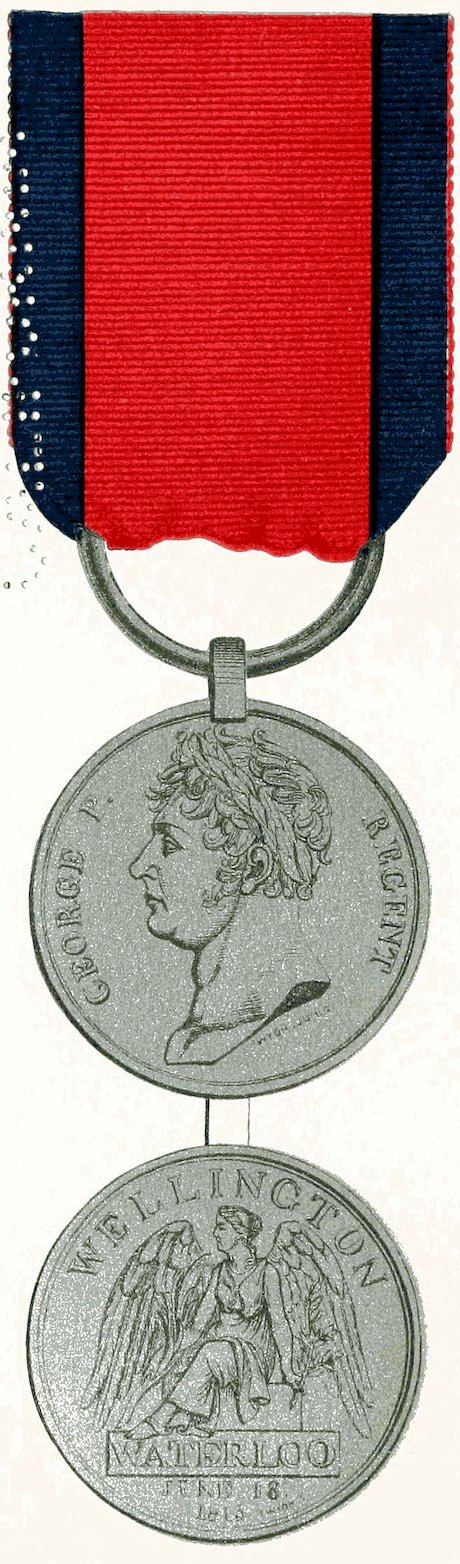
The Waterloo Medal
The casualties amongst the officers of the British army, (including the King’s German Legion,) amounted to one hundred and thirty-nine killed, five hundred and eighty-five wounded, and fifteen missing. The Hanoverian troops had twenty officers, and three hundred and eight men killed, seventy-seven officers and one thousand two hundred and forty-four men wounded. The Brunswick troops had seven officers and one hundred and forty-seven men killed, and twenty-six officers and four hundred and thirty men wounded. The Nassau contingent had five officers and two hundred and forty-nine men killed, and nineteen officers and three hundred and seventy men wounded. Numerous as these casualties were, those of the French far exceeded them, amounting, according to the most correct calculations, to about thirty thousand.
197