CAPTURE OF GHUZNEE. 23rd. July, 1839.
Reading edition
Breaking up from Candahar on the 27th. of June, to reduce the remainder of the Shah’s dominions to obedience, the army advanced along a valley of dismal sterility to the Turnuk river; then proceeding up the right bank, traversed the country of the Western Ghilzees, and arrived on the 21st. of July before Ghuznee, a strong fortress garrisoned by three thousand Afghans under Prince Mahomed Hyder Khan, who were well provided with stores and had determined on a desperate defence, having blocked up every gate with masonry excepting one.
Not having a battering train of sufficient power to proceed by the regular method of breaching the walls, Lieutenant-General Sir John Keane resolved to storm the place without delay, and a reconnoissance was made on the 21st. of July, when it was determined to blow open the gate, and accordingly 238during the night of the 22nd. of July a quantity of gunpowder was secretly brought to the one not blocked up with masonry, which was to be destroyed by an explosion before daylight on the following morning.
To the 13th. Foot was assigned the duty of covering the operations, in blowing open the gate, and they paraded at two o’clock, a.m. Three hundred pounds of gunpowder (in twelve sandbags) were used for this purpose. The regiment proceeded in advance of the storming party to the causeway of the gate under cover of the darkness of the night, and the fire of the batteries of the assailants, six men of the leading company being told off to assist in carrying the powder-bags. On reaching the causeway, the 13th. extended in light order along the ditch, and by their fire distracted the enemy’s attention from the gate. After the explosion a company of the regiment, under Lieutenant Jennings, moved up with the engineer officer to ascertain if the operation had been attended with success; on which the light company of the 2nd. (or Queen’s Royal,) No. 9 company of the 13th., under Captain Vigors, the light companies of the 17th., and of the Bengal European Regiment, which had been named to form the advance of the storming column, immediately pressed forward under the command of Brigadier Dennie, and despite a heavy fire gained an entrance into the fort. These were quickly followed by the main storming column under Brigadier Sale, (who was severely wounded on this occasion,) which consisted of the 2nd. Queens, under Major Carruthers, and the Bengal European Regiment, under Lieutenant-Colonel Orchard; to these succeeded the 13th. Light Infantry, under Major Fraser, as they collected from the duty of skirmishing, with which they were directed to commence, and the 17th., under Lieutenant-Colonel Croker. The whole were soon established in possession of the fort.
After this the garrison rushed some to the citadel and others to the houses, from which they kept up an annoying fire, when the 13th. and 17th. regiments were directed against the former, which unexpectedly was found evacuated. Large supplies of grain, ammunition of all kinds, and several guns with about two thousand horses, fell into the hands of the 239victors. A company of the 13th., under Lieutenant Arthur Wilkinson, succeeded in capturing the redoubt, (or outwork,) and took two standards and about sixty prisoners. A standard was captured by the 17th., but was afterwards lost by the wreck of a transport, in which a part of the regiment was embarked.
The loss sustained in the assault of Ghuznee by the Queen’s regiments, (the 2nd., 13th., and 17th. Foot,) was limited to five men killed, and six officers and sixty-three men wounded.
When the Afghan horsemen, who had assembled in the neighbourhood, learnt the fate of the fortress, they abandoned their camp equipage and baggage, and fled towards Cabool, the capital of Eastern Afghanistan, in the direction of which city the British forces immediately advanced.
Dost Mahomed Khan, the ruler of the country, assembled a formidable host in position near Ughundee; but ascertaining that his soldiers had resolved to abandon him, he fled with a body of select cavalry, leaving his artillery in position; and the British army advancing to the capital, replaced Shah Soojah-ool-Moolk, on the 7th. of August, in the possession of the palace of his forefathers, from which he had been an exile many years. The conquest of a kingdom was thus achieved with trifling loss, and the troops pitched their tents in a rich valley near Cabool.
An order of merit was instituted by the Shah, called the Order of the Dooranée Empire, the decorations[84] of which were conferred on the general and field officers. The following regiments of the Queen’s army were engaged in this service:—the 2nd. Queen’s, the 13th. and 17th. Foot, and the Bengal European Regiment, (now the 101st.,) the 4th. Light Dragoons, and the 16th. Lancers.
Shah Soojah’s government became so unpopular, that the Afghans determined to expel the British, by whose aid he had been reinstated, and whose presence in Cabool was rendered necessary to support him on the throne. The crisis arrived in 2401841. In October the Afghans broke out into open insurrection; the British envoy, Sir William Macnaughten, and Sir Alexander Burnes, were treacherously murdered, and the troops, including the 44th. regiment,[85] which occupied Cabool, being compelled to evacuate that place, and retreat towards Jellalabad, were cut to pieces on the march, Dr. Brydon of the Shah’s forces, being the only officer who succeeded in reaching that place. It is remarkable that this officer was one of the heroes of Lucknow.
The 13th. regiment was more fortunate; under its gallant Lieutenant-Colonel, Sir Robert Sale, (serving with the local rank of Major-General), it reached Jellalabad, having at the breaking out of the insurrection been detached from Cabool with a force in order to reduce the insurgents, and after much hard fighting in the passes, had taken possession of Jellalabad, the successful defence of which by his small garrison, forms so bright a feature in this terrible and gloomy history. Before describing this heroic defence, only equalled by that of Lucknow, it is necessary to show the manner in which the gallant band reached the place of safety. The 13th. and other troops left Cabool on the 11th. of October, in consequence of a body of insurgents having possessed themselves of the Khoord Cabool pass,[86] about ten miles from the capital, with a view to expel the rebels, and re-open the communication 241with India. On the 12th. of October the pass was forced, the troops under Sir Robert penetrating to Khoord (Little) Cabool.
Major-General Sir Robert Sale, Captain Hamlet C. Wade, (Major of Brigade,) Lieutenant George Mein, and Ensign Oakes were wounded. Lieutenant Mein being dangerously wounded, was obliged to be sent back in a litter to Cabool. Upon Sir Robert Sale being compelled to quit the field from the severity of his wound, the command of the troops devolved upon Lieutenant-Colonel Dennie, C.B., also of the 13th. The regiment then faced about, to return through the pass according to the plan for executing the operation, leaving the other corps at Khoord Cabool. Possession was then taken of Bootkhak, where the regiment was stationed until the 18th. of October. During this delay, incessant night attacks were made by the enemy, called by them Shub Khoon, (night slaughter;) Sir Robert Sale’s precaution in ordering the men to lie down on their alarm posts, as soon as the fire was opened on the camp, prevented much loss: his orders prohibiting any return-fire likewise saved many, and all the enemy’s attempts to force an entrance therein were successfully resisted by the bayonet alone. Meanwhile the rebellion continued of a formidable character, and the 13th. were ordered to march to Tezeen, where they arrived on the 22nd. of October, and were engaged with a body of insurgents, whom they drove from some heights and strong positions.
In consequence of orders from Cabool, the force under Major-General Sir Robert Sale marched for Gundamuck, and were continually pressed day and night, by insurgent bands hovering on their flanks and rear, which occasioned the fatigues and duties of the troops to be particularly harassing; the way led along defiles and over mountains, and when the soldiers halted, breastworks had to be thrown up to defend the bivouac ground from sudden attacks of the Afghan cavalry.
On the 29th. of October the rebels were found in force at the Jugdulluck Pass, and for some time they checked the advance of the column; but the skirmishers of the 13th. sprang forward, and driving the Afghans from almost inaccessible heights protected by breastworks, enabled the British force to surmount every obstacle in the defile, and to arrive at Gundamuck on the following day.
Sir Robert Sale remained at Gundamuck with his troops until the 5th. of November, when they proceeded and captured the fort of Mamoo Khail in the neighbourhood, and returned on the 6th. to Gundamuck. There intelligence was received of the breaking out of a violent insurrection at Cabool, on the 2nd. of November, and of the probability that the rebellion would become general. Under these circumstances, two forced marches on Jellalabad were made, with a numerous enemy pressing on the flanks and rear; a body of insurgents were beaten at Futtehabad by the rear-guard under Lieutenant-Colonel Dennie; and Jellalabad, the chief town in the valley of Ningrahar, was seized by the British troops on the 12th. of November, to establish a post upon which the corps at Cabool might retire, if necessary, and thus restore a link in the chain of communication with India.
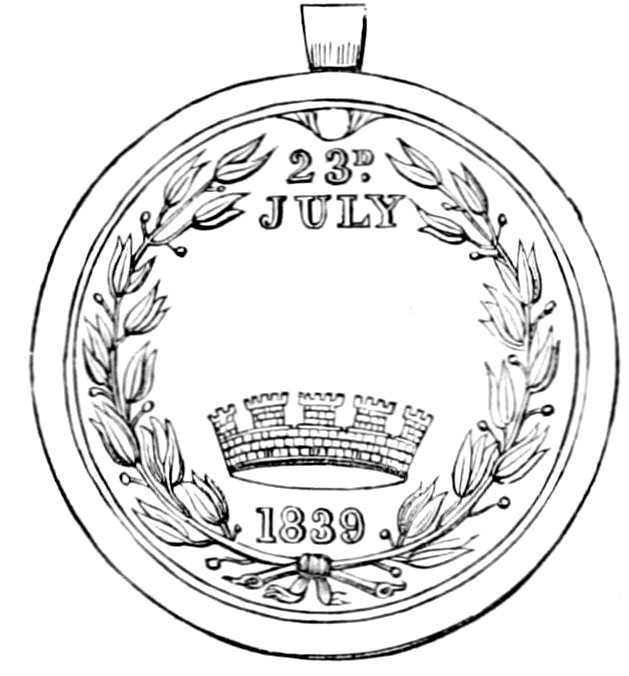
MEDAL FOR THE CAPTURE OF GHUZNEE.
242