THE MYSORE WAR AND SIEGE OF SERINGAPATAM. February to May, 1799.
Reading edition
Although the reduction of the power and resources of Tippoo Sahib, effected by the treaty of Seringapatam, which terminated the campaign of 1792, had weakened his influence, yet it had not extinguished his intense hatred of the British. 12The Sultan had entered into a negotiation with the Governor of the Isle of France, in 1798, and sent an embassy to Zemaun Shah, Sovereign of Cabool, for the purpose of inducing him to attack the possessions of the Company. Having also derived encouragement from the successes of the French arms in Egypt, from which country the Directory intended to act against the British dominions in India, Tippoo commenced augmenting his military force, and his hostile designs became every day more apparent. The Governor-General the Earl of Mornington (afterwards Marquis of Wellesley) perceiving a rupture inevitable, resolved to anticipate the attack, and ordered the army to take the field, and march into the heart of Tippoo’s territory.
Major-General George (afterwards Lord) Harris, who was serving with the local rank of Lieutenant-General, in conformity to these orders, advanced with the army under his command on the 11th. of February, 1799, and entered the Mysore territory on the 5th. of March. On the 27th. the troops arrived at Mallavelly, and on approaching the ground of encampment the forces of Tippoo were seen drawn up on a height a few miles off. The enemy attacked the advanced pickets, and a general action ensued, in which the 33rd. regiment highly distinguished itself. A body of two thousand men moved forward in the best order towards the regiment, which, firmly standing its ground, coolly reserved its fire until within a distance of about sixty yards, and then led by its Lieutenant-Colonel, the Honourable Arthur Wellesley, in person, boldly advanced, and charging with the bayonet, compelled the approaching column to give way. This movement being seconded by Major-General Floyd, who made a rapid charge with the cavalry, completed the disorder, and the enemy retreated before the whole of the British line, which immediately moved forward.
While this attack was being made by the left wing, under Lieutenant-Colonel the Honourable Arthur Wellesley, with the Nizam’s contingent, the 33rd., and Major-General Floyd’s cavalry, Lieutenant-General Harris with the troops, which formed the right wing, had been also engaged.[7]
13In this affair Tippoo sustained a loss of nearly two thousand, including some of his most valuable officers; whilst the British casualties amounted to only sixty-six men.
On the following morning the army advanced, and arrived before Seringapatam on the 5th. of April, when preparations for the siege were at once commenced.
An attack was made on an entrenchment of the enemy about six o’clock in the evening of the 20th. of April, in which the flank companies of the 12th. and 73rd. regiments were employed. This was successful, and although the enemy had two hundred and fifty men killed and wounded, and the entrenchment was occupied by about eighteen hundred of Tippoo’s infantry, the British had but one man wounded.
The siege was prosecuted with vigour, and a breach being reported practicable on the 3rd. of May, the assault was ordered to take place in the heat of the following day, as the besieged would then be the least prepared to oppose the attack. On this service were employed the ten flank companies of the European corps necessarily left to guard the camp, and outposts, followed by the 12th., 33rd., 73rd., and 74th. regiments, three corps of grenadier Sepoys, two hundred of the Nizam’s 14troops, a hundred of the artillery, and the corps of pioneers, the whole under the orders of Major-General (afterwards Sir David) Baird. The assault took place about half-past one o’clock in the afternoon of the 4th. of May, and in a short space of time the British colours waved over the fortress.[8] The Major-General had divided his force for the purpose of clearing the ramparts to the right and left; one division was commanded by Colonel Sherbrooke, and the other by Lieutenant-Colonel Dunlop; the latter was wounded, but both corps, although strongly opposed, were completely successful. The spirited attack, led by Lieutenant-Colonel Campbell, of the 74th. Highlanders, was particularly mentioned in general orders, in which all the officers and men were thanked for this memorable achievement. The body of Tippoo Sultan was found among heaps of slain, and was afterwards interred in the magnificent mausoleum which he had erected over the tomb of his father, the once powerful Hyder Ali, a portion of the victorious troops attending the ceremony.
In this manner terminated the siege of Seringapatam, and the fall of the capital placed the kingdom of Mysore at the disposal of the British government, and destroyed a power in India which had proved itself a formidable enemy.
The following regiments were engaged in the storming and capture of Seringapatam on the 4th. of May, 1799; namely, the 19th. and 22nd. (late 25th.) Light Dragoons, (both since disbanded;) the 12th., 33rd., 73rd., 74th., 75th., 77th. regiments, the Scots Brigade, afterwards the 94th.[9] regiment, and the 103rd.
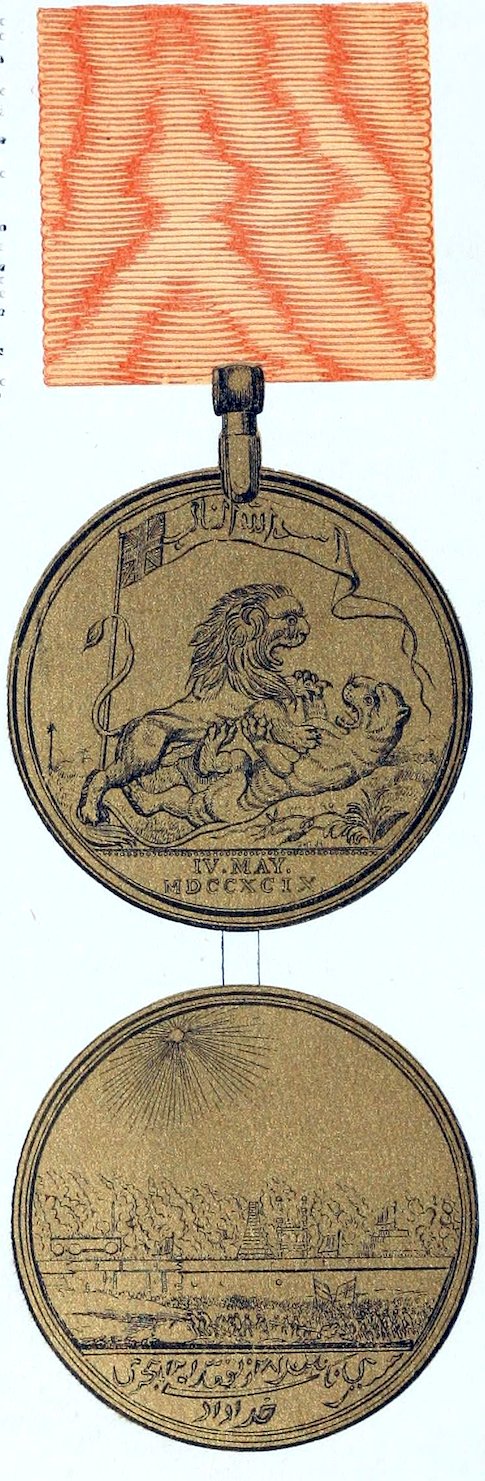
The Seringapatam Medal.—1799.
15