REGIMENTAL MEDALS.
Reading edition
Towards the end of the last century the officers of a few regiments instituted Orders of Merit, and gave medals to their men as rewards for particular acts of gallantry, distinguished service in the field, long service, good conduct, etc. These medals were not issued by the Government, but were presented by the officers of the different regiments at their own expense. They were generally discontinued on the institution of the medal for long service and good conduct by William IV. in 1830.
Subjoined is a List of the principal Regimental Medals known. It is not exhaustive, and exigences of space compel the omission of detailed descriptions of each medal. Of some of them, especially those struck in gold, and given as a reward for a special act of bravery, but a single specimen was ever issued, and of many of those in silver but one or two specimens are known. When bestowed as a reward for gallant conduct, the names of the battles in which the recipient had been engaged were usually engraved on the medal. They were generally in silver, but were sometimes struck in bronze and white metal.
One of the first regiments to introduce a system of honourable distinction in its ranks was the 5th. Fusiliers. The medals were of three classes—worn, suspended by a green 646ribbon, from a button-hole of the left lapel. The first, or lowest class, which was given to such men as had served irreproachably for seven years, was made of bronze, having on the obverse the badge of the regiment, St. George and the Dragon, with the motto “Quo fata vocant”; and on the reverse, within a laurel wreath, “Vth. Foot, Merit, March 10th., 1767.” The second class was silver, having on the reverse the words “Reward of fourteen years’ Military Merit.” The third was similar to the second, but was inscribed with the name of the individual whose conduct had earned it,—“A. B., for twenty-one years’ good and faithful service as a soldier, has received from his commanding officers this honourable testimony of his merit.” These medals were bestowed only upon soldiers who, for the respective periods of seven, fourteen, or twenty-one years, had never incurred the censure of a court-martial. They were given by the commanding officer at the head of the assembled battalion; and if, which rarely happened, the owner of a medal subsequently forfeited his pretensions to enrolment among the men of merit, his medal was cut from his breast by the drum-major as publicly as he had been invested with it. Those who obtained the third, or twenty-one years’ medal, had also an oval badge of the colour of their facings on the right breast, embroidered round with gold and silver wreaths, and inscribed in the centre with the word “Merit” in gold letters.[232]
The 5th. Fusiliers being one of the earliest, if not the first 647regiment to reward meritorious soldiers with medals, has been placed first in the list, as a typical example how regimental decorations were commonly won and conferred.
Royal Artillery.—In 1813 a troop of the Royal Horse Artillery was armed with rockets, and served in the battle of Vittoria, and afterwards at Leipsic, in the German Allied Army, against the French. A silver medal was given to the men of the rocket troop, who were present at these battles, inscribed “Vittoria and Leipsic,” but by whom is not known.
Ninth Lancers.—1837. Silver. Two sizes. Ribbon, red with blue edges.
Tenth Hussars.—1843–46. Silver. Ribbon, dark blue.
Twelfth Lancers.—Silver.
Fourteenth Hussars.—1812. Silver. Ribbon, red.
Sixteenth Lancers.—1813. A large Maltese cross. Silver. Given by Lieutenant-General Sir J. Vandeleur.
Seventeenth Lancers.—A small engraved gold medal, presented by the non-commissioned officers and privates of Captain Willett’s troop to Troop Sergeant-Major Farley.
Twenty-Second Light Dragoons.—“Reward of Merit.” 1815. Silver. Ribbon, yellow.
First Foot.—1847. Silver. Ribbon, red.
Second Foot.—A Maltese cross, in bronze for six years’ service; in silver for ten years. Ribbon, dark blue.
Third Buffs.—Gold medal given to Lieutenant Latham. (See page 129).
Seventh Foot.—1788. Silver and bronze. Ribbon, dark blue.
Ninth Foot.—Silver. Ribbon, yellow.
Tenth Foot.—“For Expertness in Ball-firing.” Bronze. Ribbon, yellow.
Thirteenth Foot.—Medal of Merit. Gold for twenty years’ good conduct; silver for fourteen, ten, and seven year. Also a silver badge of a bugle and sphinx. Ribbon, yellow with red edges.
Sixteenth Foot.—1838. A Temperance Medal. Silver.
Seventeenth Foot.—1816. Reward of Merit. Silver. Ribbon, blue.
648Twentieth Foot.—1838. Gold and silver, with an ornamental clasp. Ribbon, yellow. The silver medal was a reward for good shooting.
Twenty-Second Foot.—Order of Merit. 1785. Silver gift for twenty-one years’ good conduct; silver for fourteen years; and bronze for seven. Ribbon, blue or yellow.
Twenty-Third Foot.—1816. Silver. Engraved. Ribbon, red, blue edges.
Twenty-Sixth Foot.—1823. Silver and bronze. Ribbon, red with yellow edges.
Thirty-First Foot.—In 1804 a gold medal was presented to Private W. Pentency and his two companions, for their bravery in extinguishing a fire in the powder magazine at St. Heliers, Jersey.
Thirty-Fourth Foot.—1836–43. Silver, of large size, with a bar.
Thirty-Seventh Foot.—1843. Gold and silver for the best marksmen. Also a large oval badge. Silver. Ribbon, red, with blue edges.
Thirty-Eighth Foot.—Silver and bronze.
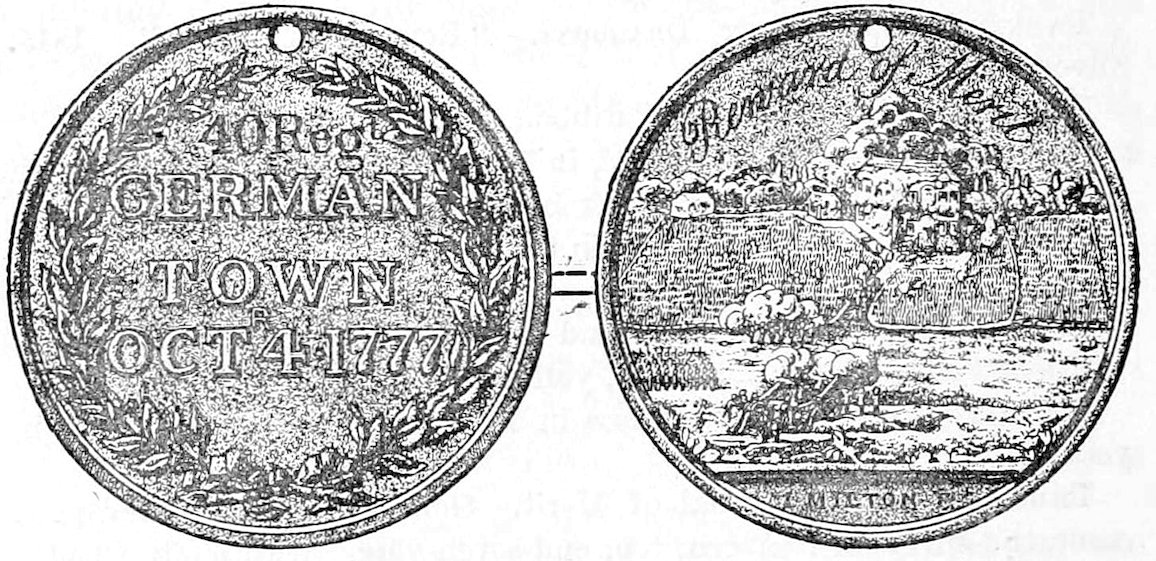
Fortieth Foot.—Silver. Struck to commemorate the gallant defence of German Town, a village six miles from Philadelphia, and repulse of the Americans, by this regiment, under Lieutenant-Colonel Musgrave. October 4th., 1777. Suspended by a narrow dark blue string.
Forty-Second Foot.—1819. Silver. Three varieties.[233] Ribbon, red, with blue edges; also a circular badge in the form of a garter, given to the best marksman.
Forty-Third Foot.—Medal “Presented by the officers of the regiment to Private Henry Wharton,”—who served seven campaigns in Spain and France.
Forty-Fourth Foot.—1812. Silver. A Forlorn Hope medal.
649Forty-Fifth Foot.—A gold oval medal, presented by the inhabitants of Wexford, 1793, to Lieutenant-Colonel Oliver Nicolls.
Forty-Sixth Foot.—Silver.
Forty-Eighth Foot.—1819. Silver. Engraved. Ribbon, red with blue edges.
Forty-Ninth Foot.—1837. Silver. A temperance medal.
Fifty-Second Foot.—1812–13. Silver. A Forlorn Hope medal, given to volunteers in the assault on Badajoz and San Sebastian. Ribbon, red, with blue edges.
Fifty-Third Foot.—1812. A silver plate, with an engraved clasp. Ribbon, blue and red. This decoration was given to fifteen sergeants for distinguished conduct in the Peninsula.
Fifty-Fifth Foot.—A small Maltese cross. Silver. Given to marksmen.
Fifty-Sixth Foot.—Silver. A temperance medal, with a bar.
Fifty-Seventh Foot.—1798. A social medal for officers.
Fifty-Eight Foot.—“Gibraltar, 1782.” A gilt medal.
Sixty-Second Foot.—Silver. A good conduct medal.
Seventieth Foot.—Silver. Given to marksmen.
Seventy-First Foot.—Silver. Given for long service. Four varieties. Also, a silver star—a prize for marksmen. Ribbon, red with blue edges.
Seventy-Third Foot.[234]—Silver. “Prize for the best marksman.”
Seventy-Fourth Foot.—1814. Silver. Given in three classes. First, to men who had been in eight or nine general actions. Second, to those present in six or more. Third, to those who had been in four or upwards. The different classes vary slightly in size, and the names of the battles are engraved on the medal. Specimens were also issued in bronze. Ribbon, yellow. Permission was granted by the Commander-in-Chief to wear this medal.
Seventy-Sixth Foot.—1837. Silver. Prize for best shot.
Seventy-Seventh Foot.—1818. Silver. For services in the Peninsula. Ribbon, red, with blue edges.
Seventy-Ninth Foot.—1819. Silver, for fourteen years’, and bronze for seven years’ good conduct. Ribbon, dark green.
Eighty-Eighth Foot.—1818. Silver. In three classes. First class, a large Maltese cross, given to men present in twelve general actions; the names of the battles being inscribed on the arms of the cross. Second class, a medal bestowed on men present in six to eleven general actions. Third class, a similar medal, but smaller, given to men present in six, or less number of actions. All the medals had a bar for suspension. Ribbon, red, with blue edges. Seventy first class crosses, one hundred and forty-five second class, and two hundred and seventeen third class medals, were issued.
Ninety-Fourth Foot.—Silver; with a clasp inscribed “Peninsula,” Ribbon, red, with blue edges.
Ninety-Fifth Foot (Rifle Brigade).—1807–13. Silver medals were given to eleven sergeants for their gallant conduct at the storming of Monte Video, 1807. A Forlorn Hope medal for San Sebastian, 1813. Also, a Maltese cross (silver), a prize for marksmen.
Ninety-Sixth Foot.—A silver star. Prize for the best marksman.
Ninety-Seventh Foot (Queen’s German Regiment).—1801. Silver.
One Hundred and First Foot (First Bengal Europeans).—1837. Silver. Good conduct medal.
One Hundred and Fifth Foot.—1780. Silver.
Second West India Regiment.—1846. Bronze, silver-gilt.
650