THE MARCH TO KANDAHAR. August, 1880.
Reading edition
For some time after the arrival of General Stewart at Cabul things remained quiet. Negociations were going on with Abdur Rahman Khan, a nephew of Shere Ali, and grandson of Dost Mahommed, who for several years had been living in Russian Turkestan, and receiving a pension from the Czar. Abdur Rahman seeming to have the best and strongest claims to the Ameership of Afghanistan, he was recognised by the British government, and on his approach to Cabul the troops were ordered to return to India. But their work was not yet finished. On learning of the recognition of Abdul Rahman, Ayoub Khan, a younger brother of Yakoob Khan, resolved to strike a blow for the Ameership, and started from Herat, of which place he was the Governor, with a strong force, thirty-six guns, and a large body of irregulars, the most fierce and warlike of the western Afghan tribes, with the intention of seizing Kandahar. When General Stewart marched from Kandahar to Cabul, a British force was left at the former place under General Primrose.
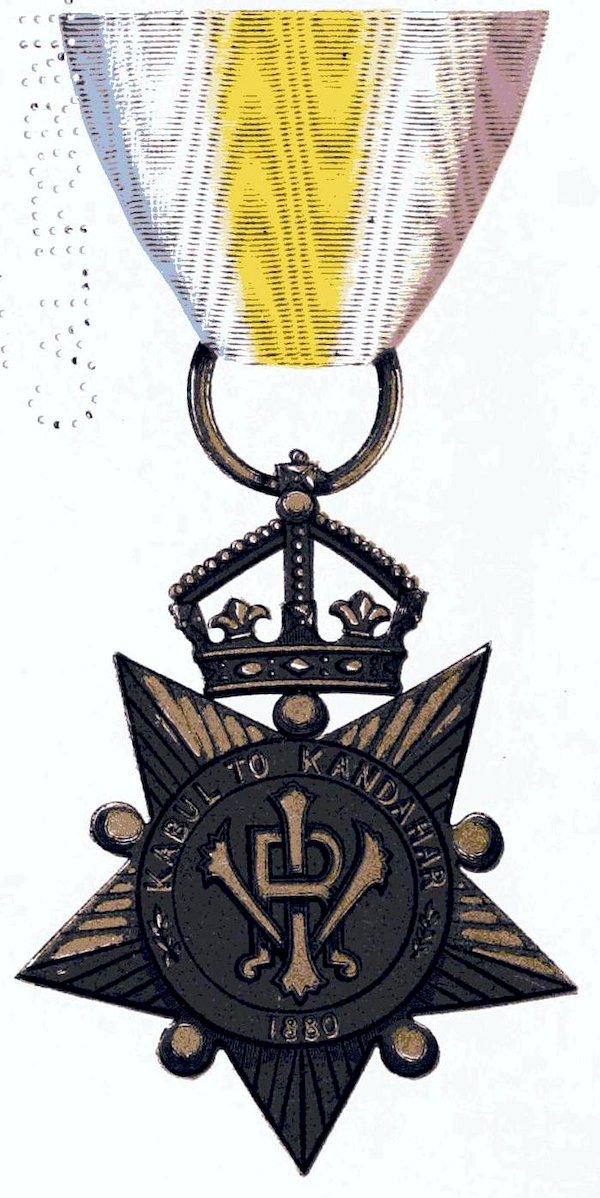
The Star for General Roberts’ March.
275To check the advance of Ayoub Khan, a British brigade of about two thousand men and six guns moved from Kandahar, under Brigadier-General Burrows, and on July 27th. encountered the vastly superior army of the enemy at Maiwand. Instead of vigorously attacking, Burrows remained on the defensive for some hours, and the Ghazis rushing on in overwhelming numbers, regardless of their losses, rolled up the British troops from left to right, and drove them from the field; with a loss of half their number and two guns.
The remainder of the Brigade reached Kandahar after a terrible retreat, no water being obtainable on the route, and the fugitives being fired on from every village they passed. General Primrose immediately evacuated the cantonments and concentrated his troops in the citadel of Kandahar, in which from August 11th. he was beleaguered by the Afghans.
On August 16th. a sortie was made on the besiegers, but the affair was mismanaged, Brigadier-General Brooke, who commanded, and many officers and men of the 7th. Fusiliers and Native Infantry being killed and wounded. After this, the garrison remained on the defensive till relieved, Ayoub making no serious attack, but endeavouring to starve the defenders into submission.
The news of the disaster at Maiwand came upon the Governor of India like a thunderbolt, and measures were at once taken for the relief of Kandahar.
Sir F. Roberts who was at the time with Sir D. Stewart at Cabul, arranging for the withdrawal of the British troops to India, immediately offered to march to Kandahar in command 276of a force of ten thousand men, and his offer was accepted by the government. General Phayre was to advance with another force from Quettah, but being delayed by want of a commissariat train, did not reach Kandahar till after the force from Cabul had arrived there, though Roberts had a very much greater distance to march. The army of General Roberts was composed of three Batteries of Artillery, the 9th. Lancers, 3rd. Bengal Cavalry, 3rd. Punjaub Cavalry, Central India Horse, under Brigadier-General Gough; 2nd. Battalion 60th. Rifles, 72nd. and 92nd. Highlanders, 23rd. Pioneers, 24th. and 25th. Punjaub Infantry, the 15th. Sikhs; 2nd., 4th., and 5th. Ghoorkas; 2nd. and 3rd. Sikh Infantry; forming three brigades, under Brigadiers Baker, Macpherson, and Macgregor; and about eight thousand camp followers. Three days only were occupied in preparations, and on August 8th. the march began, a distance of more than three hundred miles, through a mountainous and difficult country, peopled with fierce and warlike tribes, for the most part hostile.
On August 15th. Ghuznee was reached, and the next day the army passed over the battle-field of Ahmed Khel, the scene of General Stewart’s victory in the preceding April. On August 23rd. Sir F. Roberts arrived at, and relieved the strong fort of Khelat-i-Ghilzie, held by a small garrison, under Colonel Tanner, one hundred and thirty-six miles from Cabul. A halt was here made for a day or so, and then taking the garrison with him, the General pushed on for Kandahar, and on August 27th opened communications with General Primrose by his cavalry. As the relieving force advanced, Ayoub withdrew from before Kandahar, and took up a position on some hills near the city, his head-quarters being at a place called Mazra.
On August 31st., Sir F. Roberts entered Kandahar, and the same day made a reconnaissance in force, in which Generals Gough and Macpherson, after some sharp fighting, carried several of the enemy’s defences at the point of the bayonet, and fully discovered the positions and strength of the Afghan army. At half-past five on the morning of September 1st., all officers commanding brigades were summoned to the tent of the General, and received his final orders and directions. 277He informed them that he meant to attack the south-west part of the ridge occupied by the enemy, with three brigades of infantry massed in rear of the Piquet Hill, while his forty-pounders on the right, supported by the 7th. Fusiliers and Rifles, engaged and silenced Ayoub’s guns posted on the Baba Wali. The Kandahar garrison were to hold the city and threaten the Murcha Pass, while Gough’s cavalry were to act on the left and cut off the retreat of the enemy to Giriskh. The real attack was to be made by storming the village of Gundi Moollah Sahibdab, turning the Paimal Hill, and finally taking the Baba Wali in reverse. The General concluded by saying: “If the ridge of Pie Paimal can be turned then the Baba Wali Kotal will be untenable. I look, gentlemen, to you to carry out my instructions, and I leave the details to you.” At nine o’clock, all was ready for the advance. The village of Gundi Moollah was stormed by the 92nd. and the 2nd. Ghoorkas, in spite of a hot fire from garden walls and windows of houses; while the 72nd., the 2nd. Sikhs, supported by the 3rd. Sikhs and the 5th. Ghoorkas, worked round the end of the Pie Paimal and carried village after village. The fighting among the enclosures with loopholed walls was desperate in the extreme, as the Ghazis, reckless of death, fought with the ferocity of tigers, hurling themselves upon the British rank till their shields clashed with the bayonets, in spite of the withering volleys poured into them at the distance often of a few yards. After a very severe contest, the 1st. and 2nd. brigades swept the enemy through the closely wooded gardens and orchards on the west of the hill, and the village of Pie Paimal was taken soon after noon. Behind the northern hill the country is cut up by canals and watercourses, and here between a river and the slopes, in an entrenched camp the Afghans made their final stand. This position was taken by a rush of the 92nd., under Major White,[94] supported by the Ghoorkas and 23rd. Pioneers. Of this advance, General Roberts said: “Nothing could be finer than the rush made by the Ghoorkas and the Highlanders, and how well the 23rd. and 24th. worked up in support.”
In four hours from the time the battle began, the enemy were totally defeated and in full flight; their camp and all their artillery (thirty-two guns), including the two taken at Maiwand, being abandoned to the victors. Their tents, including Ayoub’s, were left standing, and in front of one of them was found the still bleeding body of Lieutenant Maclaine, R.H.A., who had been taken prisoner at Maiwand. His ruffianly captors finding the battle going against them, and their camp taken, had deliberately cut his throat and fled. Ayoub, leaving about twelve hundred of his army of thirteen thousand in killed alone behind, fled towards Herat with a handful of men.
The British loss was three officers killed, among them Colonel Brownlow, commanding the 72nd., and eleven wounded; and forty-six men killed and about two hundred wounded, the 72nd. suffering most severely. After the battle was over, the General rode up to the head of every battalion, and personally thanked it for its share in gaining the victory, which concluded the campaign.
The relieving force was broken up in September, but before returning to India, Sir F. Roberts distributed medals for distinguished service to the men of the 72nd., the 82nd., and the 5th. Ghoorkas. Kandahar, in accordance with the promise of the Indian Government, was evacuated, and the Afghan war was ended. The entire force engaged at Kandahar on September 1st., 1889, was composed of the 9th. Lancers, 3rd. Bengal Cavalry, 3rd. Bombay Cavalry, 3rd. Punjaub Cavalry, 3rd. Scinde Horse, Central India Horse, the Poona Horse; the 7th. Fusiliers, 60th. Rifles, the 66th., 72nd., and 92nd. Foot; 15th., 23rd., 24th. and 25th. Bengal Infantry; the 1st., 4th., 19th., 28th. and 29th. Bombay Infantry; the 2nd., 4th., and 5th. Ghoorkas; the 2nd. and 3rd. Sikh Infantry, and three Batteries of Artillery.
278