BATTLE OF MAIDA. 4th July, 1806.
Reading edition
A squadron of British and Russian vessels having, in November, 1805, landed some troops at Naples, without any opposition from the Neapolitan court, shortly afterwards departed. On receiving intelligence of this transaction, the French Emperor issued a proclamation, that “the Neapolitan dynasty had ceased to reign,” and his brother Joseph, assisted by Marshal Massena, proceeded with an army to that country. The French entered Naples on the 15th. of February, and shortly obtained possession of the whole kingdom, excepting Gaeta. Meanwhile the Court had retired to Sicily. A decree was soon issued, by which the crown of Naples was conferred by Napoleon on his brother Joseph, who was proclaimed king on the 30th. of May.
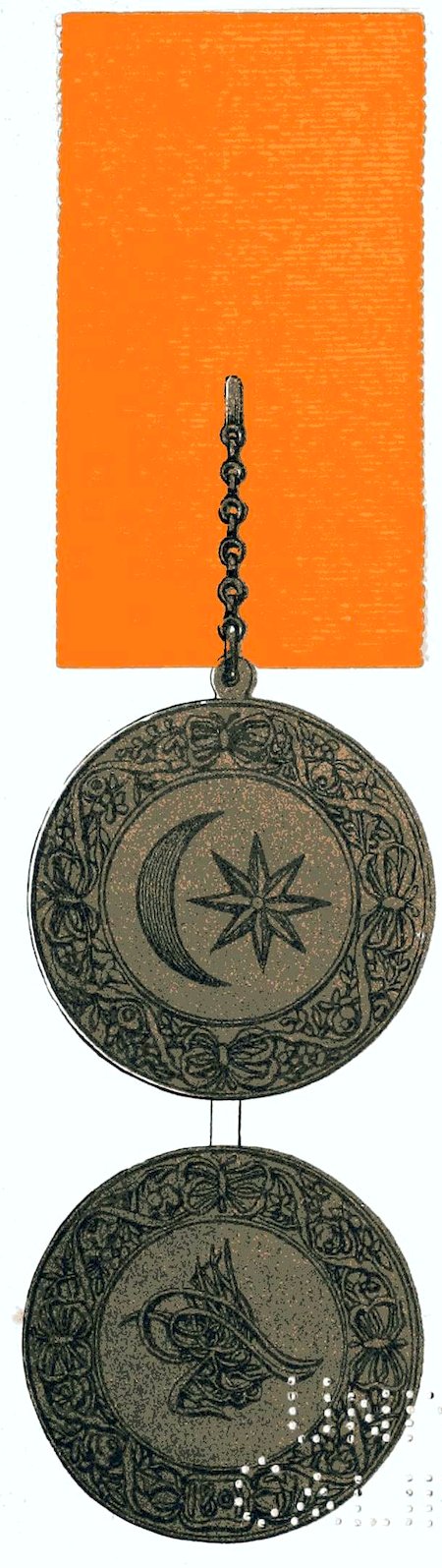
Turkish Medal for Egypt.—1801
A body of troops was assembled by the French in Calabria, and extensive preparations were made for the invasion of Sicily. Major-General Stuart, who then commanded the British troops in Sicily, formed the design of penetrating Calabria, and attacking the French division, under General Regnier: the result was 71the Battle of Maida, Upper Calabria, which was fought on the 4th. of July, 1806. On hearing of the disembarkation of the British at St. Euphemia, General Regnier made a rapid march from Reggio, uniting, as he advanced, his detached corps. seven-pounders Stuart resolved to anticipate the attack, and the army commenced its march on the morning of the 4th. of July. By nine o’clock in the morning the opposing fronts were warmly engaged. The right of the advanced line consisted of the battalion of light infantry, commanded by Lieutenant-Colonel, afterwards Sir James, Kempt, consisting of the light companies of the 20th., 27th., 35th., 58th., 61st., 81st., and Watteville’s, (since disbanded,) together with one hundred and fifty chosen battalion men of the 35th. regiment, under Major Robinson. Directly opposed to them was the favourite French regiment, the Ire. Légére. The two corps, at the distance of about one hundred yards, fired reciprocally a few rounds, when, as if by mutual consent, the firing was suspended, and in close compact order and dreadful silence they advanced towards each other, until their bayonets began to cross. This momentous crisis appalled the enemy; they broke and endeavoured to fly, but it was too late, and they were overtaken, when the most terrible slaughter ensued.
Brigadier-General Acland, whose brigade, consisting of the 78th. and 81st. regiments, was immediately on the left of the light infantry, availed himself of this favourable moment to press instantly forward upon the corps in his front, when the 78th., under Lieutenant-Colonel Macleod, and the 81st., under Major Plenderleath, had an opportunity of distinguishing themselves. The enemy fled in dismay and disorder, leaving the plain covered with their dead and wounded.
Being thus completely discomfited on his left, General Regnier commenced a new effort in the hope of recovering the day. The grenadier battalion and the 27th. regiment, which formed the first brigade, under Brigadier-General Cole resisted the enemy most gallantly. Nothing could shake the undaunted firmness of the grenadiers, under Lieutenant-Colonel O’Callaghan, and of the 27th. regiment, under Lieutenant-Colonel Smith. The cavalry successively repelled from before their front, attempted to turn their left, when Lieutenant-Colonel Ross, who 72had that morning landed from Messina with the 20th. Foot, and was coming up to the army during the action, having observed this movement, threw his regiment opportunely into a small cover upon their flank, and by a heavy and well-directed fire completely frustrated the attempt. The 20th., with natural pride, always commemorated this day’s glory. The enemy having succeeded with his cavalry in turning the British left, owing to the total deficiency of that arm on the part of the English, might possibly have retrieved the day, but for this movement. This was the final struggle, and the French began precipitately to retire; leaving above seven hundred of their dead upon the field of battle.
The British infantry continued in pursuit as long as they were able, but as the enemy dispersed in every direction, and the victors were under the necessity of preserving order, the trial of speed became unequal. The total loss sustained by the French was estimated at four thousand men.
For this victory Major-General Stuart received the thanks of Parliament, with a vote of a thousand pounds a year for life; the approbation of his Sovereign, and the dignity of a Knight of the Bath; he was created Count of Maida by the King of Naples, and the city of London voted him its freedom and a sword.
In the official communication from the British minister at Palermo, the battle of Maida was thus adverted to:—“There is not to be found in the annals of military transactions an enterprise prepared with more deliberate reflection, or executed with greater decision, promptitude, and success, than the late invasion of Calabria by Sir John Stuart. I trust, therefore, you will not think me presumptuous for venturing to add my testimony of the high sense entertained by this Court, of the merits of the British General, and of his gallant army, who, on the fertile plains of Maida, have added new trophies to those which the same troops had formerly earned, from the same enemy, on the sandy regions of Egypt.”
The following regiments were engaged in this action, the 20th., 27th., 35th., 58th., 61st., (flank companies,) 78th., and 81st. Foot.
73
Gold Medal for Maida.
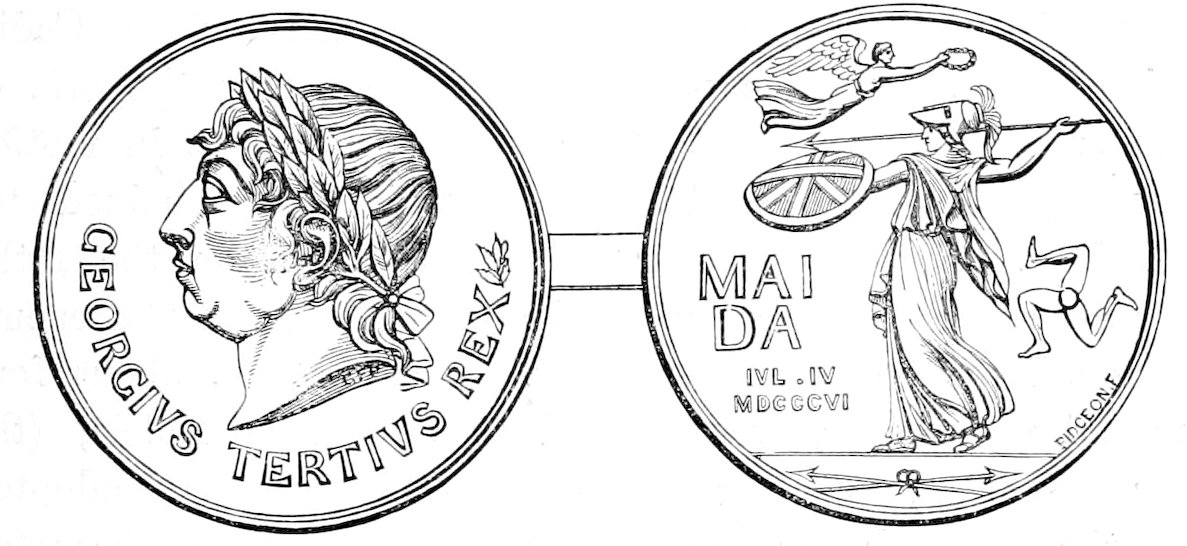
In commemoration of this victory a gold medal was struck, and conferred upon all the superior officers who were present. On the obverse is the lauriated head of the Sovereign, inscribed Georgius Tertius Rex. The reverse has Britannia brandishing a spear with her right hand, and on her left a shield charged with the crosses of the Union banner. A flying figure of Victory is crowning her with a wreath of laurel; behind Britannia is the triquetra, or trinacria, the ancient symbol of Sicily, and before her is inscribed Maida IVL. IV. MDCCCVI. Round the edge the name and rank of the officers were engraved. There was only one size of this medal, which was worn both by General and Field officers from the button-hole of their uniform, to a red ribbon, with blue edges, and a gold buckle. The issue was limited to the Commander of the Forces engaged, officers in command of brigades, battalions, or of corps equivalent to a battalion, or the officer who succeeded on the removal from the field of the original commander, and the Deputy Quartermaster-General. As a general rule, no officer below the rank of Major was considered eligible, unless he succeeded to the command of a battalion during the action. Only seventeen officers received this medal.
74