Volume 2 / Part 3 — CHAPTER XXIV.
Henry Yule translation
Concerning the Kingdom of Eli.
Eli is a kingdom towards the west, about 300 miles from Comari. The people are Idolaters and have a king, and are tributary to nobody; and have a peculiar language. We will tell you particulars about their manners and their products, and you will better understand things now because we are drawing near to places that are not so outlandish.{1}
There is no proper harbour in the country, but there are many great rivers with good estuaries, wide and deep.{2} Pepper and ginger grow there, and other spices in quantities.{3} The King is rich in treasure, but not very strong in forces. The approach to his kingdom however is so strong by nature that no one can attack him, so he is afraid of nobody.
And you must know that if any ship enters their estuary and anchors there, having been bound for some other port, they seize her and plunder the cargo. For they say, “You were bound for somewhere else, and ’tis God has sent you hither to us, so we have a right to all your goods.” And they think it no sin to act thus. And this naughty custom prevails all over these provinces of India, to wit, that if a ship be driven by stress of weather into some other port than that to which it was bound, it is sure to be plundered. But if a ship come bound originally to the place they receive it with all honour and give it due protection.{4} The ships of Manzi and other countries that come hither in summer lay in their cargoes in 6 or 8 days and depart as fast as possible, because there is no harbour other than the river-mouth, a mere roadstead and sandbanks, so that it is perilous to tarry there. The ships of Manzi indeed are not so much afraid of these roadsteads as others are, because they have such huge wooden anchors which hold in all weather.{5}
There are many lions and other wild beasts here and plenty of game, both beast and bird.
Rashiduddin mentions “the country of Hili,” between Manjarúr (Mangalore) and Fandaraina (miswritten in Elliot’s copy Sadarsa). Ibn Batuta speaks of Hili, which he reached on leaving Manjarúr, as “a great and well-built city, situated on a large estuary accessible to great ships. The vessels of China come hither; this, Kaulam, and Kalikut, are the only ports that they enter.” From Hili he proceeds 12 miles further down the coast to Jor-fattan, which probably corresponds to Baliapatan. Elly appears in the Carta Catalana, and is marked as a Christian city. Nicolo Conti is the last to speak distinctly of the city. Sailing from Cambay, in 20 days he arrived at two cities on the sea-shore, Pacamuria (Faknúr, of Rashid and Firishta, Baccanor of old books, and now Bárkúr, the Malayálim Vákkanúr) and Helli. But we read that in 1527 Simon de Melo was sent to burn ships in the River of Marabia and at Monte d’Elli.[1] When Da Gama on his second voyage was on his way from Baticala (in Canara) to Cananor, a squall having sprung his mainmast just before reaching Mt. d’Ely, “the captain-major anchored in the Bay of Marabia, because he saw there several Moorish ships, in order to get a mast from them.” It seems clear that this was the bay just behind Mt. d’Ely.
Indeed the name of Marabia or Máráwí is still preserved in Mádávi or Mádái, corruptly termed Maudoy in some of our maps, a township upon the river which enters the bay about 7 or 8 miles south-east of Mt. d’Ely, and which is called by De Barros the Rio Marabia. Mr. Ballard informs me that he never heard of ruins of importance at Madai, but there is a place on the river just mentioned, and within the Madai township, called Payangádi (“Old Town”), which has the remains of an old fort of the Kolastri (or Kolatiri) Rajas. A palace at Madai (perhaps this fort) is alluded to by Dr. Gundert in the Madras Journal, and a Buddhist Vihara is spoken of in an old Malayalim poem as having existed at the same place. The same paper speaks of “the famous emporium of Cachilpatnam near Mt. d’Ely,” which may have been our city of Hili, as the cities Hili and Marawi were apparently separate though near.[2]
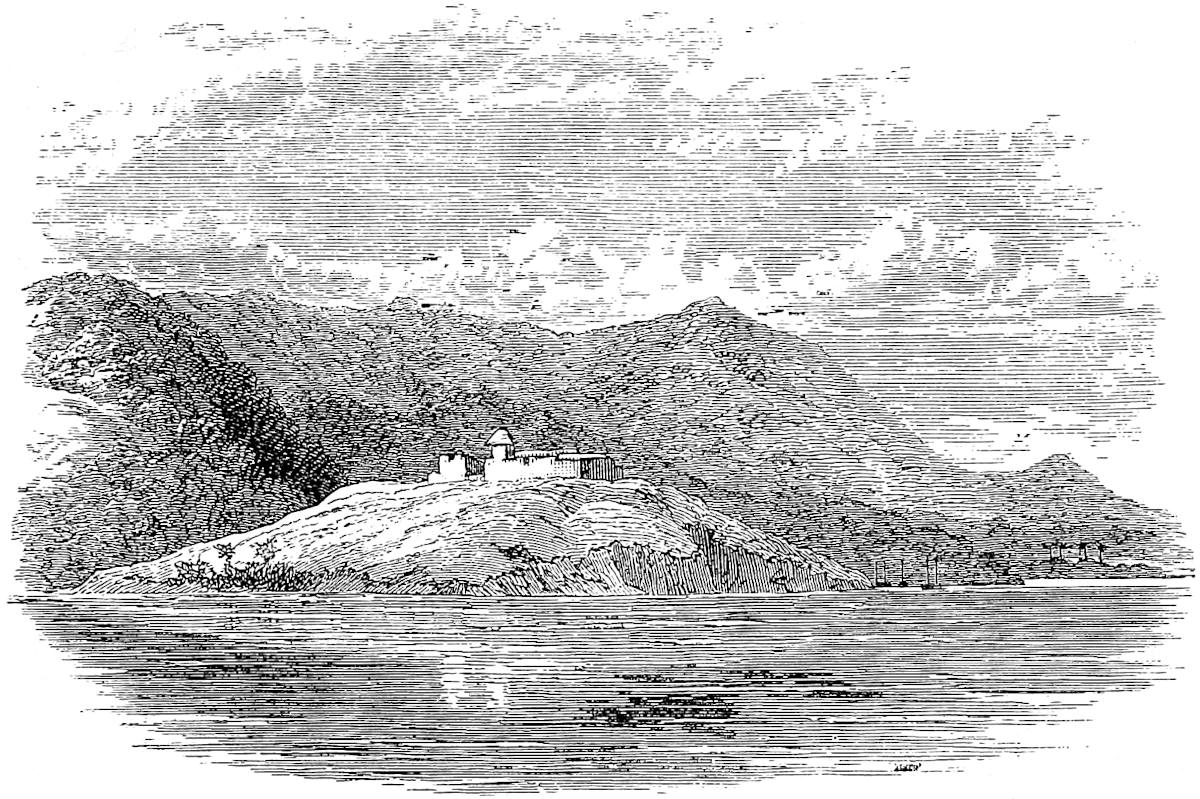
Mount d’Ely, from the Sea, in last century.
The state of Hílí-Máráwi is also mentioned in the Arabic work on the early history of the Mahomedans in Malabar, called Tuhfat-al-Mujáhidín, and translated by Rowlandson; and as the Prince is there called Kolturee, this would seem to identify him either in family or person with the Raja of Cananor, for that old dynasty always bore the name of Kolatiri.[3]
The Ramusian version of Barbosa is very defective here, but in Stanley’s version (Hak. Soc. East African and Malabar Coasts, p. 149) we find the topography in a passage from a Munich MS. clear enough: “After passing this place” (the river of Nirapura or Nileshwaram) “along the coast is the mountain Dely (of Ely) on the edge of the sea; it is a round mountain, very lofty, in the midst of low land; all the ships of the Moors and Gentiles that navigate in this sea of India sight this mountain when coming from without, and make their reckoning by it; ... after this, at the foot of the mountain to the south, is a town called Marave, very ancient and well off, in which live Moors and Gentiles and Jews; these Jews are of the language of the country; it is a long time that they have dwelt in this place.”
(Stanley’s Correa, Hak. Soc. pp. 145, 312–313; Gildem. p. 185; Elliot, I. 68; I. B. IV. 81; Conti, p. 6; Madras Journal, XIII. No. 31, pp. 14, 99, 102, 104; De Barros, III. 9, cap. 6, and IV. 2, cap. 13; De Couto, IV. 5, cap. 4.)
“There was eke wexing many a spice, As clowe gilofre and Licorice, Ginger and grein de Paradis, Canell and setewale of pris, And many a spice delitable To eaten when men rise from table.”—R. of the Rose.
The Hely ginger is also mentioned by Conti.