Volume 2 / Part 3 — CHAPTER LXXVI.
Henry Yule translation
Description of the Great City of Kinsay, which is the Capital of the whole Country of Manzi.
When you have left the city of Changan and have travelled for three days through a splendid country, passing a number of towns and villages, you arrive at the most noble city of Kinsay, a name which is as much as to say in our tongue “The City of Heaven,” as I told you before.{1}
And since we have got thither I will enter into particulars about its magnificence; and these are well worth the telling, for the city is beyond dispute the finest and the noblest in the world. In this we shall speak according to the written statement which the Queen of this Realm sent to Bayan the conqueror of the country for transmission to the Great Kaan, in order that he might be aware of the surpassing grandeur of the city and might be moved to save it from destruction or injury. I will tell you all the truth as it was set down in that document. For truth it was, as the said Messer Marco Polo at a later date was able to witness with his own eyes. And now we shall rehearse those particulars.
First and foremost, then, the document stated the city of Kinsay to be so great that it hath an hundred miles of compass. And there are in it twelve thousand bridges of stone, for the most part so lofty that a great fleet could pass beneath them. And let no man marvel that there are so many bridges, for you see the whole city stands as it were in the water and surrounded by water, so that a great many bridges are required to give free passage about it. [And though the bridges be so high the approaches are so well contrived that carts and horses do cross them.{2}]
The document aforesaid also went on to state that there were in this city twelve guilds of the different crafts, and that each guild had 12,000 houses in the occupation of its workmen. Each of these houses contains at least 12 men, whilst some contain 20 and some 40,—not that these are all masters, but inclusive of the journeymen who work under the masters. And yet all these craftsmen had full occupation, for many other cities of the kingdom are supplied from this city with what they require.
The document aforesaid also stated that the number and wealth of the merchants, and the amount of goods that passed through their hands, was so enormous that no man could form a just estimate thereof. And I should have told you with regard to those masters of the different crafts who are at the head of such houses as I have mentioned, that neither they nor their wives ever touch a piece of work with their own hands, but live as nicely and delicately as if they were kings and queens. The wives indeed are most dainty and angelical creatures! Moreover it was an ordinance laid down by the King that every man should follow his father’s business and no other, no matter if he possessed 100,000 bezants.{3}
Inside the city there is a Lake which has a compass of some 30 miles: and all round it are erected beautiful palaces and mansions, of the richest and most exquisite structure that you can imagine, belonging to the nobles of the city. There are also on its shores many abbeys and churches of the Idolaters. In the middle of the Lake are two Islands, on each of which stands a rich, beautiful and spacious edifice, furnished in such style as to seem fit for the palace of an Emperor. And when any one of the citizens desired to hold a marriage feast, or to give any other entertainment, it used to be done at one of these palaces. And everything would be found there ready to order, such as silver plate, trenchers, and dishes [napkins and table-cloths], and whatever else was needful. The King made this provision for the gratification of his people, and the place was open to every one who desired to give an entertainment. [Sometimes there would be at these palaces an hundred different parties; some holding a banquet, others celebrating a wedding; and yet all would find good accommodation in the different apartments and pavilions, and that in so well ordered a manner that one party was never in the way of another.{4}]
The houses of the city are provided with lofty towers of stone in which articles of value are stored for fear of fire; for most of the houses themselves are of timber, and fires are very frequent in the city.
The people are Idolaters; and since they were conquered by the Great Kaan they use paper-money. [Both men and women are fair and comely, and for the most part clothe themselves in silk, so vast is the supply of that material, both from the whole district of Kinsay, and from the imports by traders from other provinces.{5}] And you must know they eat every kind of flesh, even that of dogs and other unclean beasts, which nothing would induce a Christian to eat.
Since the Great Kaan occupied the city he has ordained that each of the 12,000 bridges should be provided with a guard of ten men, in case of any disturbance, or of any being so rash as to plot treason or insurrection against him. [Each guard is provided with a hollow instrument of wood and with a metal basin, and with a time-keeper to enable them to know the hour of the day or night. And so when one hour of the night is past the sentry strikes one on the wooden instrument and on the basin, so that the whole quarter of the city is made aware that one hour of the night is gone. At the second hour he gives two strokes, and so on, keeping always wide awake and on the look out. In the morning again, from the sunrise, they begin to count anew, and strike one hour as they did in the night, and so on hour after hour.
Part of the watch patrols the quarter, to see if any light or fire is burning after the lawful hours; if they find any they mark the door, and in the morning the owner is summoned before the magistrates, and unless he can plead a good excuse he is punished. Also if they find any one going about the streets at unlawful hours they arrest him, and in the morning they bring him before the magistrates. Likewise if in the daytime they find any poor cripple unable to work for his livelihood, they take him to one of the hospitals, of which there are many, founded by the ancient kings, and endowed with great revenues.{6} Or if he be capable of work they oblige him to take up some trade. If they see that any house has caught fire they immediately beat upon that wooden instrument to give the alarm, and this brings together the watchmen from the other bridges to help to extinguish it, and to save the goods of the merchants or others, either by removing them to the towers above mentioned, or by putting them in boats and transporting them to the islands in the lake. For no citizen dares leave his house at night, or to come near the fire; only those who own the property, and those watchmen who flock to help, of whom there shall come one or two thousand at the least.]
Moreover, within the city there is an eminence on which stands a Tower, and at the top of the tower is hung a slab of wood. Whenever fire or any other alarm breaks out in the city a man who stands there with a mallet in his hand beats upon the slab, making a noise that is heard to a great distance. So when the blows upon this slab are heard, everybody is aware that fire has broken out, or that there is some other cause of alarm.
The Kaan watches this city with especial diligence because it forms the head of all Manzi; and because he has an immense revenue from the duties levied on the transactions of trade therein, the amount of which is such that no one would credit it on mere hearsay.
All the streets of the city are paved with stone or brick, as indeed are all the highways throughout Manzi, so that you ride and travel in every direction without inconvenience. Were it not for this pavement you could not do so, for the country is very low and flat, and after rain ’tis deep in mire and water. [But as the Great Kaan’s couriers could not gallop their horses over the pavement, the side of the road is left unpaved for their convenience. The pavement of the main street of the city also is laid out in two parallel ways of ten paces in width on either side, leaving a space in the middle laid with fine gravel, under which are vaulted drains which convey the rain water into the canals; and thus the road is kept ever dry.]{7}
You must know also that the city of Kinsay has some 3000 baths, the water of which is supplied by springs. They are hot baths, and the people take great delight in them, frequenting them several times a month, for they are very cleanly in their persons. They are the finest and largest baths in the world; large enough for 100 persons to bathe together.{8}
And the Ocean Sea comes within 25 miles of the city at a place called Ganfu, where there is a town and an excellent haven, with a vast amount of shipping which is engaged in the traffic to and from India and other foreign parts, exporting and importing many kinds of wares, by which the city benefits. And a great river flows from the city of Kinsay to that sea-haven, by which vessels can come up to the city itself. This river extends also to other places further inland.{9}
Know also that the Great Kaan hath distributed the territory of Manzi into nine parts, which he hath constituted into nine kingdoms. To each of these kingdoms a king is appointed who is subordinate to the Great Kaan, and every year renders the accounts of his kingdom to the fiscal office at the capital.{10} This city of Kinsay is the seat of one of these kings, who rules over 140 great and wealthy cities. For in the whole of this vast country of Manzi there are more than 1200 great and wealthy cities, without counting the towns and villages, which are in great numbers. And you may receive it for certain that in each of those 1200 cities the Great Kaan has a garrison, and that the smallest of such garrisons musters 1000 men; whilst there are some of 10,000, 20,000 and 30,000; so that the total number of troops is something scarcely calculable. The troops forming these garrisons are not all Tartars. Many are from the province of Cathay, and good soldiers too. But you must not suppose they are by any means all of them cavalry; a very large proportion of them are foot-soldiers, according to the special requirements of each city. And all of them belong to the army of the Great Kaan.{11}
I repeat that everything appertaining to this city is on so vast a scale, and the Great Kaan’s yearly revenues therefrom are so immense, that it is not easy even to put it in writing, and it seems past belief to one who merely hears it told. But I will write it down for you.
First, however, I must mention another thing. The people of this country have a custom, that as soon as a child is born they write down the day and hour and the planet and sign under which its birth has taken place; so that every one among them knows the day of his birth. And when any one intends a journey he goes to the astrologers, and gives the particulars of his nativity in order to learn whether he shall have good luck or no. Sometimes they will say no, and in that case the journey is put off till such day as the astrologer may recommend. These astrologers are very skilful at their business, and often their words come to pass, so the people have great faith in them.
They burn the bodies of the dead. And when any one dies the friends and relations make a great mourning for the deceased, and clothe themselves in hempen garments,{12} and follow the corpse playing on a variety of instruments and singing hymns to their idols. And when they come to the burning place, they take representations of things cut out of parchment, such as caparisoned horses, male and female slaves, camels, armour suits of cloth of gold (and money), in great quantities, and these things they put on the fire along with the corpse, so that they are all burnt with it. And they tell you that the dead man shall have all these slaves and animals of which the effigies are burnt, alive in flesh and blood, and the money in gold, at his disposal in the next world; and that the instruments which they have caused to be played at his funeral, and the idol hymns that have been chaunted, shall also be produced again to welcome him in the next world; and that the idols themselves will come to do him honour.{13}
Furthermore there exists in this city the palace of the king who fled, him who was Emperor of Manzi, and that is the greatest palace in the world, as I shall tell you more particularly. For you must know its demesne hath a compass of ten miles, all enclosed with lofty battlemented walls; and inside the walls are the finest and most delectable gardens upon earth, and filled too with the finest fruits. There are numerous fountains in it also, and lakes full of fish. In the middle is the palace itself, a great and splendid building. It contains 20 great and handsome halls, one of which is more spacious than the rest, and affords room for a vast multitude to dine. It is all painted in gold, with many histories and representations of beasts and birds, of knights and dames, and many marvellous things. It forms a really magnificent spectacle, for over all the walls and all the ceiling you see nothing but paintings in gold. And besides these halls the palace contains 1000 large and handsome chambers, all painted in gold and divers colours.
Moreover, I must tell you that in this city there are 160 tomans of fires, or in other words 160 tomans of houses. Now I should tell you that the toman is 10,000, so that you can reckon the total as altogether 1,600,000 houses, among which are a great number of rich palaces. There is one church only, belonging to the Nestorian Christians.
There is another thing I must tell you. It is the custom for every burgess of this city, and in fact for every description of person in it, to write over his door his own name, the name of his wife, and those of his children, his slaves, and all the inmates of his house, and also the number of animals that he keeps. And if any one dies in the house then the name of that person is erased, and if any child is born its name is added. So in this way the sovereign is able to know exactly the population of the city. And this is the practice also throughout all Manzi and Cathay.{14}
Hang-chau-Fu with The Lake compiled from various Chinese Sources.
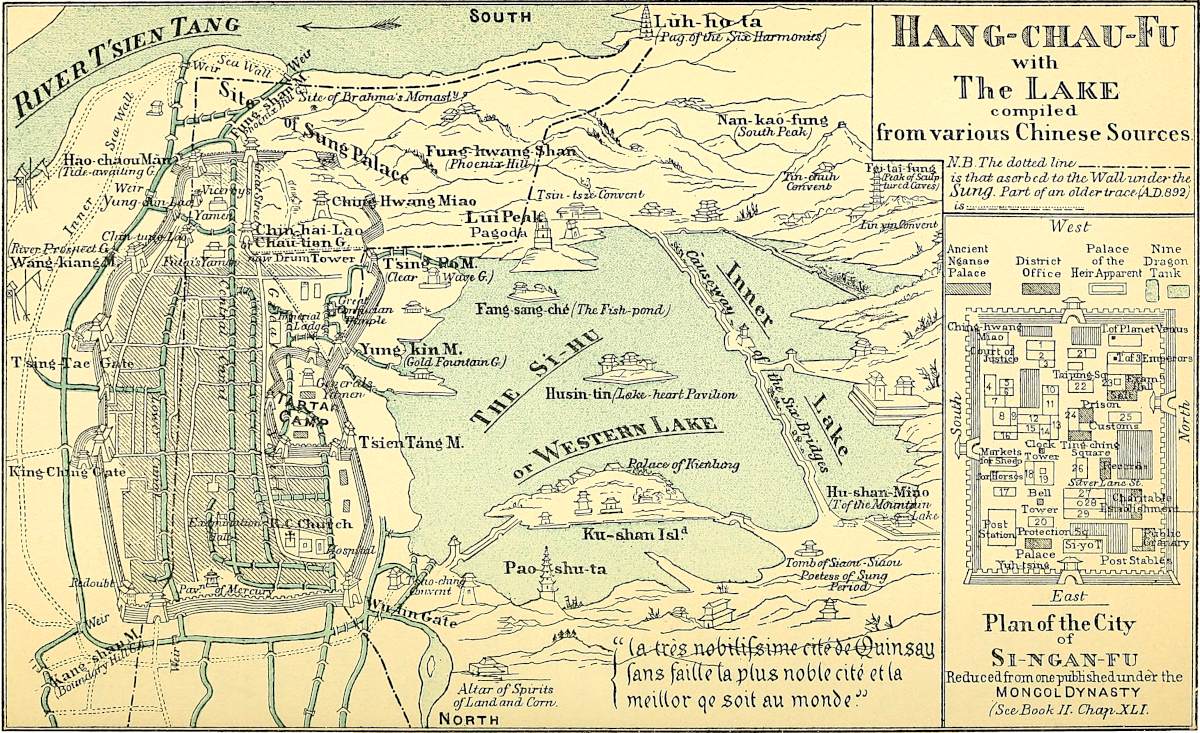
Lit. Frauenfelder, Palermo
Plan of the City of
Si-ngan-fu
Reduced from one published under the
Mongol Dynasty
(See Book II.
Chap. XLI.
)
“la très nobilissime cité de Quinsay sans faille la plus noble cité et la meillor qe soit au monde.”
And I must tell you that every hosteler who keeps an hostel for travellers is bound to register their names and surnames, as well as the day and month of their arrival and departure. And thus the sovereign hath the means of knowing, whenever it pleases him, who come and go throughout his dominions. And certes this is a wise order and a provident.
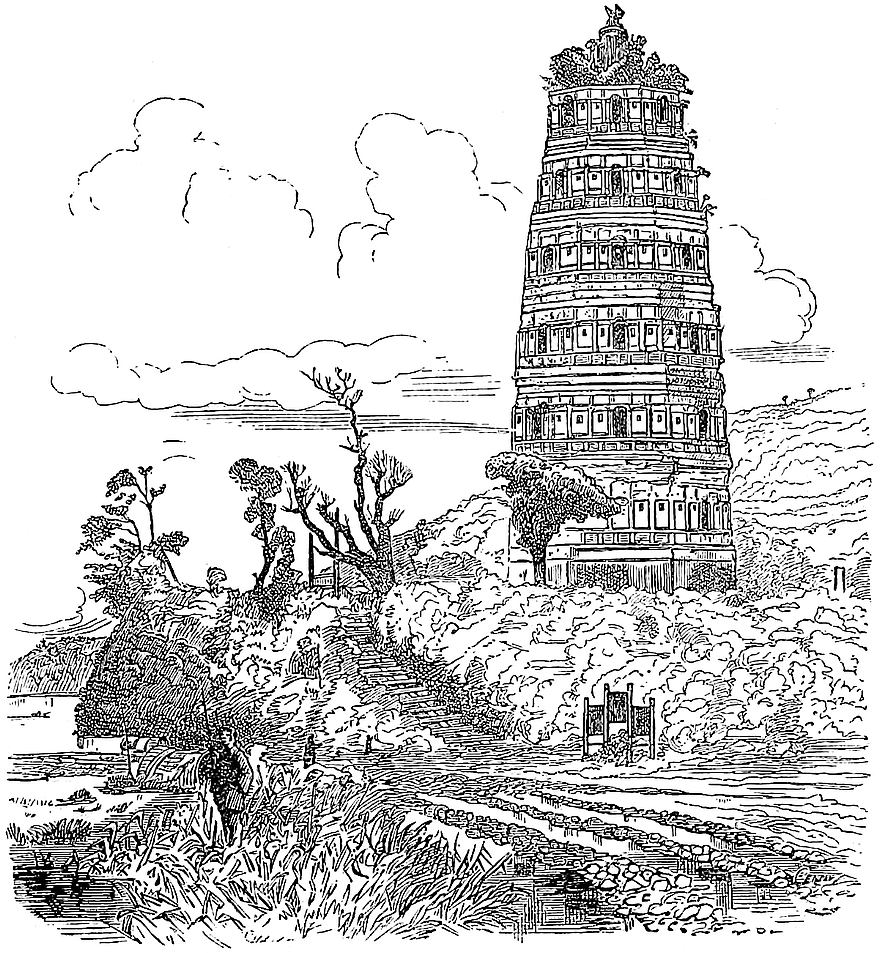
The ancient Lun-ho-ta Pagoda at Hang-chau.
Under the Mongols the walls were allowed to decay; and in the disturbed years that closed that dynasty (1341–1368) they were rebuilt by an insurgent chief on a greatly reduced compass, probably that which they still retain. Whatever may have been the facts, and whatever the origin of the estimate, I imagine that the ascription of 100 miles of circuit to Kinsay had become popular among Westerns. Odoric makes the same statement. Wassáf calls it 24 parasangs, which will not be far short of the same amount. Ibn Batuta calls the length of the city three days’ journey. Rashiduddin says the enceinte had a diameter of 11 parasangs, and that there were three post stages between the two extremities of the city, which is probably what Ibn Batuta had heard. The Masálak-al-Absár calls it one day’s journey in length, and half a day’s journey in breadth. The enthusiastic Jesuit Martini tries hard to justify Polo in this as in other points of his description. We shall quote the whole of his remarks at the end of the chapters on Kinsay.
[Dr. F. Hirth, in a paper published in the T’oung Pao, V. pp. 386–390 (Ueber den Schiffsverkehr von Kinsay zu Marco Polo’s Zeit), has some interesting notes on the maritime trade of Hang-chau, collected from a work in twenty books, kept at the Berlin Royal Library, in which is to be found a description of Hang-chau under the title of Mêng-liang-lu, published in 1274 by Wu Tzu-mu, himself a native of this city: there are various classes of sea-going vessels; large boats measuring 5000 liao and carrying from five to six hundred passengers; smaller boats measuring from 2 to 1000 liao and carrying from two to three hundred passengers; there are small fast boats called tsuan-fêng, “wind breaker,” with six or eight oarsmen, which can carry easily 100 passengers, and are generally used for fishing; sampans are not taken into account. To start for foreign countries one must embark at Ts’wan-chau, and then go to the sea of Ts’i-chau (Paracels), through the Tai-hsü pass; coming back he must look to Kwen-lun (Pulo Condor).—H. C.]
The 12,000 bridges have been much carped at, and modern accounts of Hang-chau (desperately meagre as they are) do not speak of its bridges as notable. “There is, indeed,” says Mr. Kingsmill, speaking of changes in the hydrography about Hang-chau, “no trace in the city of the magnificent canals and bridges described by Marco Polo.” The number was no doubt in this case also a mere popular saw, and Friar Odoric repeats it. The sober and veracious John Marignolli, alluding apparently to their statements, and perhaps to others which have not reached us, says: “When authors tell of its ten thousand noble bridges of stone, adorned with sculptures and statues of armed princes, it passes the belief of one who has not been there, and yet peradventure these authors tell us no lie.” Wassáf speaks of 360 bridges only, but they make up in size what they lack in number, for they cross canals as big as the Tigris! Marsden aptly quotes in reference to this point excessively loose and discrepant statements from modern authors as to the number of bridges in Venice. The great height of the arches of the canal bridges in this part of China is especially noticed by travellers. Barrow, quoted by Marsden, says: “Some have the piers of such an extraordinary height that the largest vessels of 200 tons sail under them without striking their masts.”
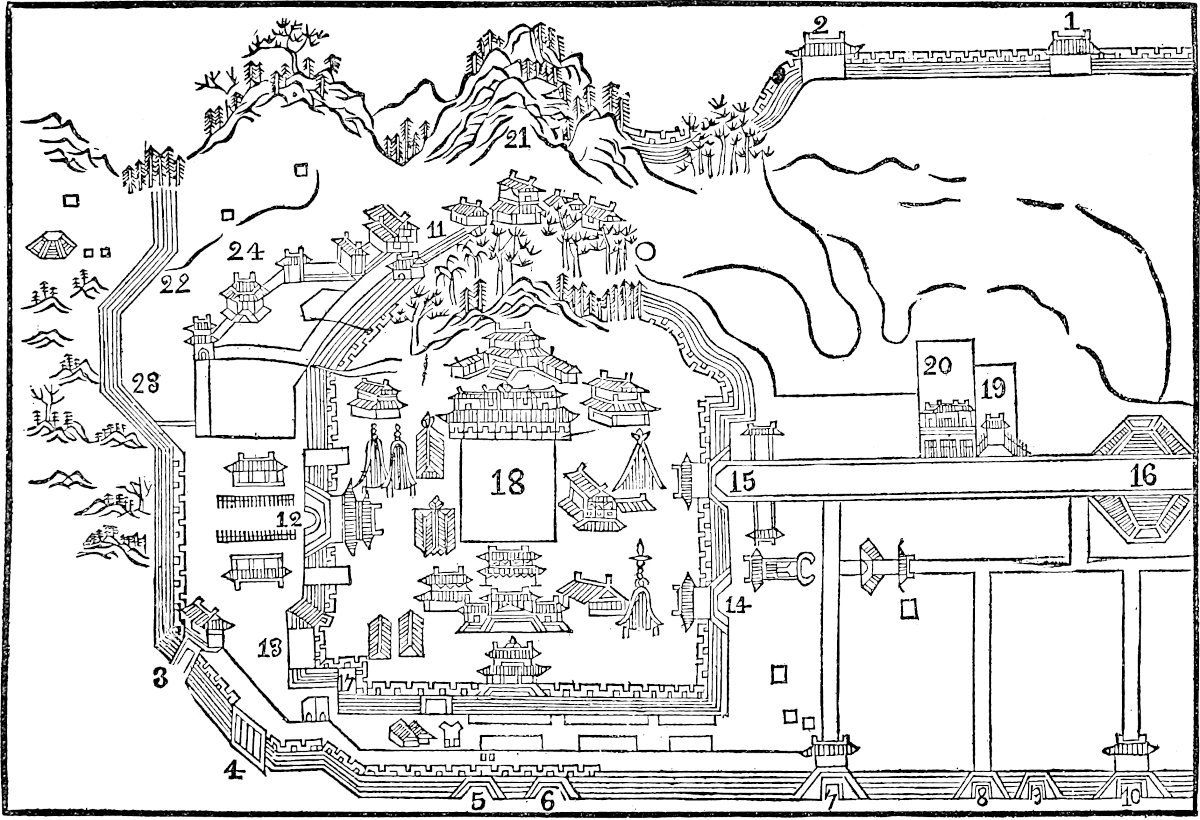
Plan of the Imperial City of Hangchow in the 13th Century. (From the Notes of the Right Rev. G. E. Moule.) 1–17, Gates; 18, Ta-nuy; 19, Woo-Foo; 20, T’aï Miao; 21, Fung-hwang shan; 22, Shĭh fŭh she; 23, Fan t’ien she; 24, Koo-shing Kwo she.
Mr. Moule has added up the lists of bridges in the whole department (or Fu) and found them to amount to 848, and many of these even are now unknown, their approximate sites being given from ancient topographies. The number represented in a large modern map of the city, which I owe to Mr. Moule’s kindness, is 111.
Polo’s ascription of a circumference of 30 miles to the lake, corroborates the supposition that in the compass of the city a confusion had been made between miles and li, for Semedo gives the circuit of the lake really as 30 li. Probably the document to which Marco refers at the beginning of the chapter was seen by him in a Persian translation, in which li had been rendered by míl. A Persian work of the same age, quoted by Quatremère (the Nuzhát al-Ḳulúb), gives the circuit of the lake as six parasangs, or some 24 miles, a statement which probably had a like origin.
Polo says the lake was within the city. This might be merely a loose way of speaking, but it may on the other hand be a further indication of the former existence of an extensive outer wall. The Persian author just quoted also speaks of the lake as within the city. (Barrow’s Autobiog., p. 104; V. Braam, II. 154; Gardner in Proc. of the R. Geog. Soc., vol. xiii. p. 178; Q. Rashid, p. lxxxviii.) Mr. Moule states that popular oral tradition does enclose the lake within the walls, but he can find no trace of this in the Topographies.
Elsewhere Mr. Moule says: “Of the luxury of the (Sung) period, and its devotion to pleasure, evidence occurs everywhere. Hang-chow went at the time by the nickname of the melting-pot for money. The use, at houses of entertainment, of linen and silver plate appears somewhat out of keeping in a Chinese picture. I cannot vouch for the linen, but here is the plate.... ‘The most famous Tea-houses of the day were the Pa-seen (“8 genii”), the “Pure Delight,” the “Pearl,” the “House of the Pwan Family,” and the “Two and Two” and “Three and Three” houses (perhaps rather “Double honours” and “Treble honours”). In these places they always set out bouquets of fresh flowers, according to the season.... At the counter were sold “Precious thunder Tea,” Tea of fritters and onions, or else Pickle broth; and in hot weather wine of snow bubbles and apricot blossom, or other kinds of refrigerating liquor. Saucers, ladles, and bowls were all of pure, silver!’ (Si-Hu-Chi.)”
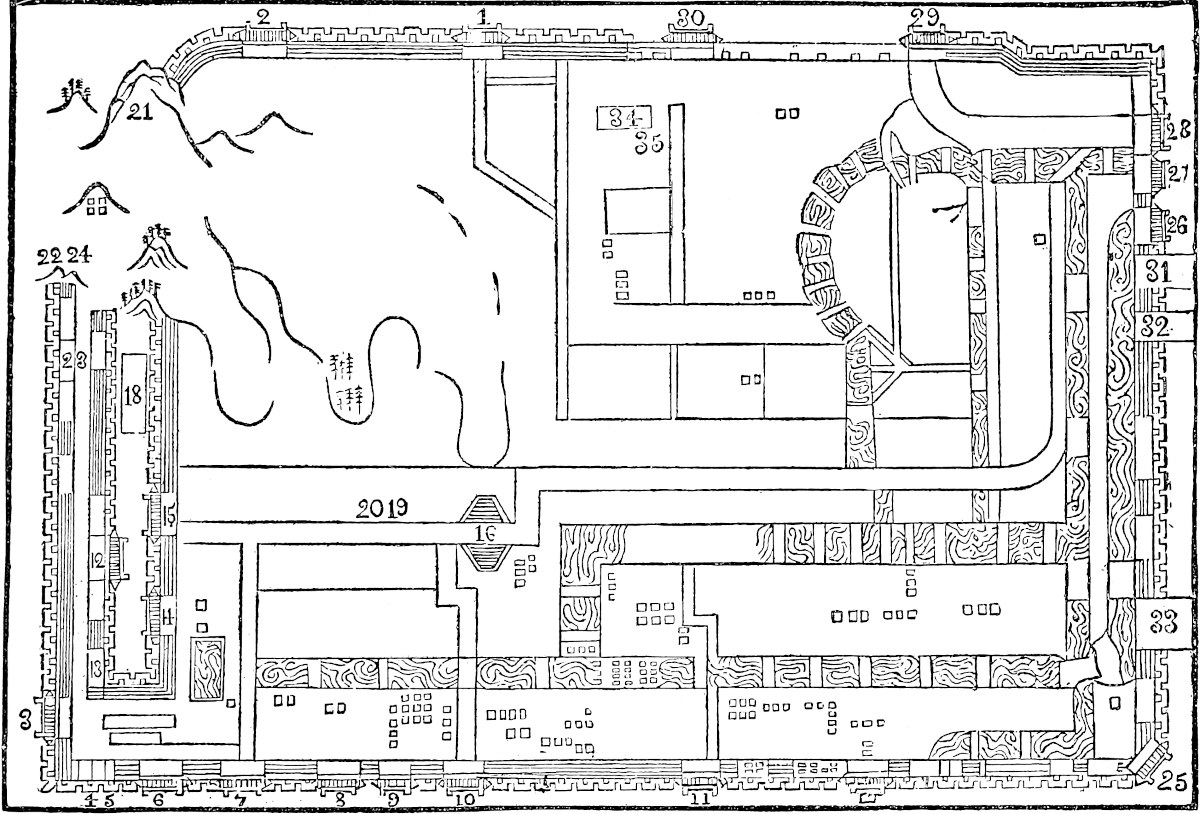
Plan of the Metropolitan City of Hangchow in the 13th Century. (From the Notes of the Right Rev. G. E. Moule.) 1–17, Gates; 18, Ta-nuy, Central Palace; 19, Woo-Foo, The Five Courts; 20, T’aï Miao, The Imperial Temple; 21, Fung-hwang shan, Phœnix Hill; 22, Shĭh fŭh she, Monastery of the Sacred Fruit; 25–30, Gates; 31, T’ien tsung yen tsang, T’ien tsung Salt Depot; 2, T’ien tsung tsew koo, T’ien tsung Wine Store; 33, Chang she, The Chang Monastery; 34, Foo che, Prefecture; Foo hio, Prefectural Confucian Temple.
The Topography quoted by Mr. Moule says that in the year 1272 the Governor renewed the pavement of the Imperial road (or Main Street), “after which nine cars might move abreast over a way perfectly smooth, and straight as an arrow.” In the Mongol time the people were allowed to encroach on this grand street.
A note from Mr. C. Gardner says: “There are numerous public baths at Hang-chau, as at every Chinese city I have ever been in. In my experience natives always take hot baths. But only the poorer classes go to the public baths; the tradespeople and middle classes are generally supplied by the bath-houses with hot water at a moderate charge.”
It is supposed by Klaproth that Kanp’u was the port frequented by the early Arab voyagers, and of which they speak under the name of Khánfú, confounding in their details Hang-chau itself with the port. Neumann dissents from this, maintaining that the Khanfu of the Arabs was certainly Canton. Abulfeda, however, states expressly that Khanfu was known in his day as Khansá (i.e. Kinsay), and he speaks of its lake of fresh water called Sikhu (Si-hu). [Abulfeda has in fact two Khânqû (Khanfû): Khansâ with the lake which is Kinsay, and one Khanfû which is probably Canton. (See Guyard’s transl., II., ii., 122–124.)—H. C.] There seems to be an indication in Chinese records that a southern branch of the Great Kiang once entered the sea at Kanp’u; the closing of it is assigned to the 7th century, or a little later.
[Dr. F. Hirth writes (Jour. Roy. As. Soc., 1896, pp. 68–69): “For centuries Canton must have been the only channel through which foreign trade was permitted; for it is not before the year 999 that we read of the appointment of Inspectors of Trade at Hang-chou and Ming-chou. The latter name is identified with Ning-po.” Dr. Hirth adds in a note: “This is in my opinion the principal reason why the port of Khanfu, mentioned by the earliest Muhammadan travellers, or authors (Soleiman, Abu Zeid, and Maçoudi), cannot be identified with Hang-chou. The report of Soleiman, who first speaks of Khanfu, was written in 851, and in those days Canton was apparently the only port open to foreign trade. Marco Polo’s Ganfu is a different port altogether, viz. Kan-fu, or Kan-pu, near Hang-chou, and should not be confounded with Khanfu.”—H. C.]
The changes of the Great Kiang do not seem to have attracted so much attention among the Chinese as those of the dangerous Hwang-Ho, nor does their history seem to have been so carefully recorded. But a paper of great interest on the subject was published by Mr. Edkins, in the Journal of the North China Branch of the R. A. S. for September 1860 [pp. 77–84], which I know only by an abstract given by the late Comte d’Escayrac de Lauture. From this it would seem that about the time of our era the Yang-tzŭ Kiang had three great mouths. The most southerly of these was the Che-Kiang, which is said to have given its name to the Province still so called, of which Hang-chau is the capital. This branch quitted the present channel at Chi-chau, passed by Ning-Kwé and Kwang-té, communicating with the southern end of a great group of lakes which occupied the position of the T’ai-Hu, and so by Shih-men and T’ang-si into the sea not far from Shao-hing. The second branch quitted the main channel at Wu-hu, passed by I-hing (or I-shin) communicating with the northern end of the T’ai-Hu (passed apparently by Su-chau), and then bifurcated, one arm entering the sea at Wu-sung, and the other at Kanp’u. The third, or northerly branch is that which forms the present channel of the Great Kiang. These branches are represented hypothetically on the sketch-map attached to ch. lxiv. supra.
(Kingsmill, u.s. p. 53; Chin. Repos. III. 118; Middle Kingdom, I. 95–106; Bürck. p. 483; Cathay, p. cxciii.; J. N. Ch. Br. R. A. S., December 1865, p. 3 seqq.; Escayrac de Lauture, Mém. sur la Chine, H. du Sol, p. 114.)
“The great bulk of the revenue of the cities, which enters the exchequer of the Great Kaan, is expended in maintaining these garrisons. And if perchance any city rebel (as you often find that under a kind of madness or intoxication they rise and murder their governors), as soon as it is known, the adjoining cities despatch such large forces from their garrisons that the rebellion is entirely crushed. For it would be too long an affair if troops from Cathay had to be waited for, involving perhaps a delay of two months.”
Friar Odoric calls the number of fires 89 tomans; but says 10 or 12 households would unite to have one fire only!