Volume 2 / Part 2 — CHAPTER XLV.
Henry Yule translation
Concerning the Province of Tebet.
After those five days’ march that I spoke of, you enter a province which has been sorely ravaged; and this was done in the wars of Mongu Kaan. There are indeed towns and villages and hamlets, but all harried and destroyed.{1}
In this region you find quantities of canes, full three palms in girth and fifteen paces in length, with some three palms’ interval between the joints. And let me tell you that merchants and other travellers through that country are wont at nightfall to gather these canes and make fires of them; for as they burn they make such loud reports that the lions and bears and other wild beasts are greatly frightened, and make off as fast as possible; in fact nothing will induce them to come nigh a fire of that sort. So you see the travellers make those fires to protect themselves and their cattle from the wild beasts which have so greatly multiplied since the devastation of the country. And ’tis this great multiplication of the wild beasts that prevents the country from being reoccupied. In fact but for the help of these canes, which make such a noise in burning that the beasts are terrified and kept at a distance, no one would be able even to travel through the land.
I will tell you how it is that the canes make such a noise. The people cut the green canes, of which there are vast numbers, and set fire to a heap of them at once. After they have been awhile burning they burst asunder, and this makes such a loud report that you might hear it ten miles off. In fact, any one unused to this noise, who should hear it unexpectedly, might easily go into a swound or die of fright. But those who are used to it care nothing about it. Hence those who are not used to it stuff their ears well with cotton, and wrap up their heads and faces with all the clothes they can muster; and so they get along until they have become used to the sound. ’Tis just the same with horses. Those which are unused to these noises are so alarmed by them that they break away from their halters and heel-ropes, and many a man has lost his beasts in this way. So those who would avoid losing their horses take care to tie all four legs and peg the ropes down strongly, and to wrap the heads and eyes and ears of the animals closely, and so they save them. But horses also, when they have heard the noise several times, cease to mind it. I tell you the truth, however, when I say that the first time you hear it nothing can be more alarming. And yet, in spite of all, the lions and bears and other wild beasts will sometimes come and do much mischief; for their numbers are great in those tracts.{2}
You ride for 20 days without finding any inhabited spot, so that travellers are obliged to carry all their provisions with them, and are constantly falling in with those wild beasts which are so numerous and so dangerous. After that you come at length to a tract where there are towns and villages in considerable numbers.{3} The people of those towns have a strange custom in regard to marriage which I will now relate.
No man of that country would on any consideration take to wife a girl who was a maid; for they say a wife is nothing worth unless she has been used to consort with men. And their custom is this, that when travellers come that way, the old women of the place get ready, and take their unmarried daughters or other girls related to them, and go to the strangers who are passing, and make over the young women to whomsoever will accept them; and the travellers take them accordingly and do their pleasure; after which the girls are restored to the old women who brought them, for they are not allowed to follow the strangers away from their home. In this manner people travelling that way, when they reach a village or hamlet or other inhabited place, shall find perhaps 20 or 30 girls at their disposal. And if the travellers lodge with those people they shall have as many young women as they could wish coming to court them! You must know too that the traveller is expected to give the girl who has been with him a ring or some other trifle, something in fact that she can show as a lover’s token when she comes to be married. And it is for this in truth and for this alone that they follow that custom; for every girl is expected to obtain at least 20 such tokens in the way I have described before she can be married. And those who have most tokens, and so can show they have been most run after, are in the highest esteem, and most sought in marriage, because they say the charms of such an one are greatest.{4} But after marriage these people hold their wives very dear, and would consider it a great villainy for a man to meddle with another’s wife; and thus though the wives have before marriage acted as you have heard, they are kept with great care from light conduct afterwards.
Now I have related to you this marriage custom as a good story to tell, and to show what a fine country that is for young fellows to go to!
The people are Idolaters and an evil generation, holding it no sin to rob and maltreat: in fact, they are the greatest brigands on earth. They live by the chase, as well as on their cattle and the fruits of the earth.
I should tell you also that in this country there are many of the animals that produce musk, which are called in the Tartar language Gudderi. Those rascals have great numbers of large and fine dogs, which are of great service in catching the musk-beasts, and so they procure great abundance of musk. They have none of the Great Kaan’s paper money, but use salt instead of money. They are very poorly clad, for their clothes are only of the skins of beasts, and of canvas, and of buckram.{5} They have a language of their own, and they are called Tebet. And this country of Tebet forms a very great province, of which I will give you a brief account.
Tibet was always reckoned as a part of the Empire of the Mongol Kaans in the period of their greatness, but it is not very clear how it came under subjection to them. No conquest of Tibet by their armies appears to be related by either the Mahomedan or the Chinese historians. Yet it is alluded to by Plano Carpini, who ascribes the achievement to an unnamed son of Chinghiz, and narrated by Sanang Setzen, who says that the King of Tibet submitted without fighting when Chinghiz invaded his country in the year of the Panther (1206). During the reign of Mangku Kaan, indeed, Uriangḳadai, an eminent Mongol general [son of Subudai] who had accompanied Prince Kúblái in 1253 against Yunnan, did in the following year direct his arms against the Tibetans. But this campaign, that no doubt to which the text alludes as “the wars of Mangu Kaan,” appears to have occupied only a part of one season, and was certainly confined to the parts of Tibet on the frontiers of Yunnan and Sze-ch’wan. [“In the Yuen-shi, Tibet is mentioned under different names. Sometimes the Chinese history of the Mongols uses the ancient name T’u-fan. In the Annals, s.a. 1251, we read: ‘Mangu Khan entrusted Ho-li-dan with the command of the troops against T’u-fan.’ Sub anno 1254 it is stated that Kúblái (who at that time was still the heir-apparent), after subduing the tribes of Yun-nan, entered T’u-fan, when So-ho-to, the ruler of the country, surrendered. Again, s.a. 1275: ‘The prince Al-lu-chi (seventh son of Kúblái) led an expedition to T’u-fan.’ In chap. ccii., biography of Ba-sz’-ba, the Lama priest who invented Kúblái’s official alphabet, it is stated that this Lama was a native of Sa-sz’-kia in T’u-fan.” (Bretschneider, Med Res. II. p. 23.)—H. C.] Koeppen seems to consider it certain that there was no actual conquest of Tibet, and that Kúblái extended his authority over it only by diplomacy and the politic handling of the spiritual potentates who had for several generations in Tibet been the real rulers of the country. It is certain that Chinese history attributes the organisation of civil administration in Tibet to Kúblái. Mati Dhwaja, a young and able member of the family which held the hereditary primacy of the Satya [Sakya] convent, and occupied the most influential position in Tibet, was formerly recognised by the Emperor as the head of the Lamaite Church and as the tributary Ruler of Tibet. He is the same person that we have already (vol. i. p. 28) mentioned as the Passepa or Báshpah Lama, the inventor of Kúblái’s official alphabet. (Carpini, 658, 709; D’Avezac, 564; S. Setzen, 89; D’Ohsson, II. 317; Koeppen, II. 96; Amyot, XIV. 128.)
With the caution that Marco’s Travels in Tibet were limited to the same mountainous country on the frontier of Sze-ch’wan, we defer further geographical comment till he brings us to Yunnan.
[Dr. Bretschneider (Hist. of Bot. Disc. I. p. 3) says: “In corroboration of Polo’s statement regarding the explosions produced when burning bamboos, I may adduce Sir Joseph Hooker’s Himalayan Journals (edition of 1891, p. 100), where in speaking of the fires in the jungles, he says: ‘Their triumph is in reaching a great bamboo clump, when the noise of the flames drowns that of the torrents, and as the great stem-joints burst, from the expansion of the confined air, the report is as that of a salvo from a park of artillery.’”—H. C.]
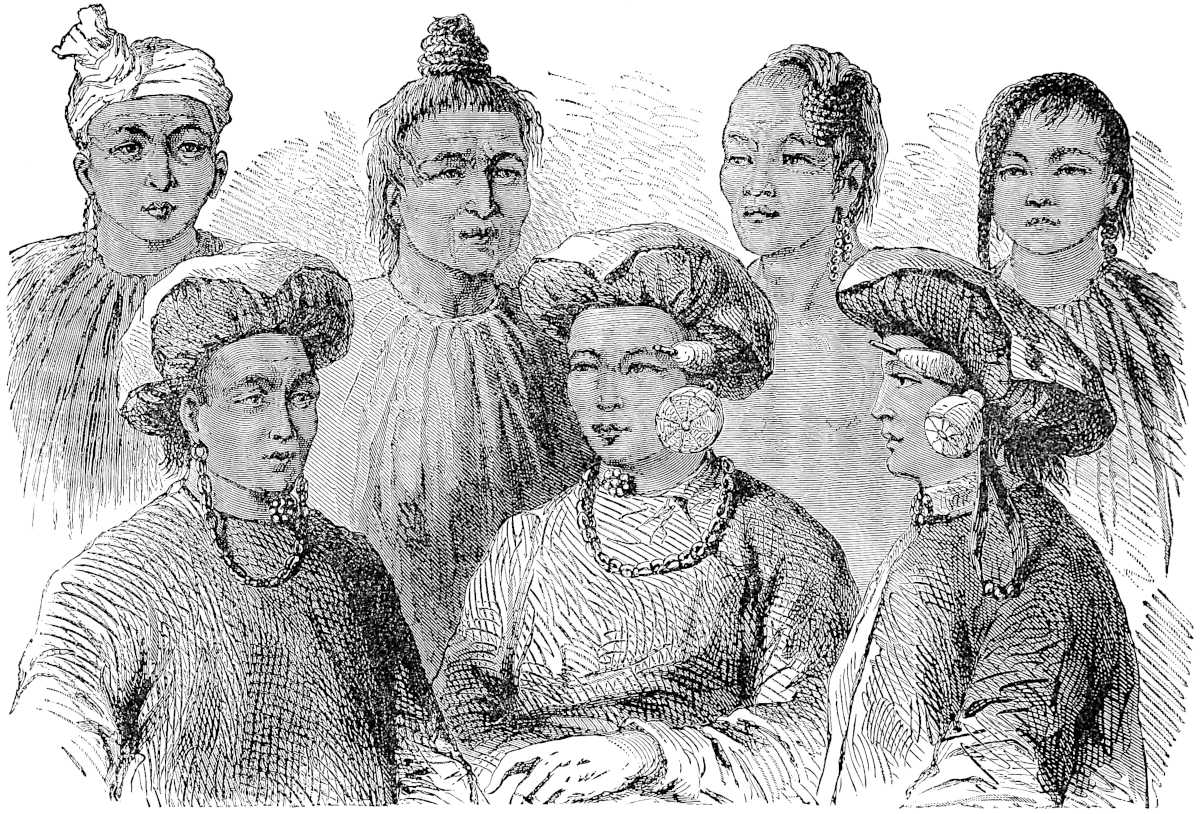
Mountaineers on the Borders of Sze ch’wan and Yun-nan.
Richthofen remarks that nowhere in China does the bamboo attain such a size as in this region. Bamboos of three palms in girth (28 to 30 inches) exist, but are not ordinary, I should suppose, even in Sze-ch’wan. In 1855 I took some pains to procure in Pegu a specimen of the largest attainable bamboo. It was 10 inches in diameter.
[“Among some uncivilised peoples, women having many gallants are esteemed better than virgins, and are more anxiously desired in marriage. This is, for instance, stated to be the case with the Indians of Quito, the Laplanders in Regnard’s days, and the Hill Tribes of North Aracan. But in each of these cases we are expressly told that want of chastity is considered a merit in the bride, because it is held to be the best testimony to the value of her attractions.” (Westermarck, Human Marriage, p. 81.)—H. C.]
Mr. Cooper’s Journal, when on the banks of the Kin-sha Kiang, west of Bathang, affords a startling illustration of the persistence of manners in this region: “At 12h. 30m. we arrived at a road-side house, near which was a grove of walnut-trees; here we alighted, when to my surprise I was surrounded by a group of young girls and two elderly women, who invited me to partake of a repast spread under the trees.... I thought I had stumbled on a pic-nic party, of which the Tibetans are so fond. Having finished, I lighted my pipe and threw myself on the grass in a state of castle-building. I had not lain thus many seconds when the maidens brought a young girl about 15 years old, tall and very fair, placed her on the grass beside me, and forming a ring round us, commenced to sing and dance. The little maid beside me, however, was bathed in tears. All this, I must confess, a little puzzled me, when Philip (the Chinese servant) with a long face, came to my aid, saying, ‘Well, Sir, this is a bad business ... they are marrying you.’ Good heavens! how startled I was.” For the honourable conclusion of this Anglo-Tibetan idyll I must refer to Mr. Cooper’s Journal. (See the now published Travels, ch. x.)