Volume 2 / Part 3 — CHAPTER XXII.
Henry Yule translation
Description of Rosia and its People. Province of Lac.
Rosia is a very great province, lying towards the north. The people are Christians, and follow the Greek doctrine. There are several kings in the country, and they have a language of their own. They are a people of simple manners, but both men and women very handsome, being all very white and [tall, with long fair hair]. There are many strong defiles and passes in the country; and they pay tribute to nobody except to a certain Tartar king of the Ponent, whose name is Toctai; to him indeed they pay tribute, but only a trifle. It is not a land of trade, though to be sure they have many fine and valuable furs, such as Sables, in abundance, and Ermine, Vair, Ercolin, and Fox skins, the largest and finest in the world [and also much wax]. They also possess many Silver-mines, from which they derive a large amount of silver.{1}
There is nothing else worth mentioning; so let us leave Rosia, and I will tell you about the Great Sea, and what provinces and nations lie round about it, all in detail; and we will begin with Constantinople.—First, however, I should tell you of a province that lies between north and north-west. You see in that region that I have been speaking of, there is a province called Lac, which is conterminous with Rosia, and has a king of its own. The people are partly Christians and partly Saracens. They have abundance of furs of good quality, which merchants export to many countries. They live by trade and handicrafts.{2}
There is nothing more worth mentioning, so I will speak of other subjects; but there is one thing more to tell you about Rosia that I had forgotten. You see in Rosia there is the greatest cold that is to be found anywhere, so great as to be scarcely bearable. The country is so great that it reaches even to the shores of the Ocean Sea, and ’tis in that sea that there are certain islands in which are produced numbers of gerfalcons and peregrine falcons, which are carried in many directions. From Russia also to Oroech it is not very far, and the journey could be soon made, were it not for the tremendous cold; but this renders its accomplishment almost impossible.{3}
Now then let us speak of the Great Sea, as I was about to do. To be sure many merchants and others have been there, but still there are many again who know nothing about it, so it will be well to include it in our Book. We will do so then, and let us begin first with the Strait of Constantinople.
But a welcome communication from Professor Bruun points out that the statement of Ibn Batuta identifies the silver-mines in question with certain mines of argentiferous lead-ore near the River Mious (a river falling into the sea of Azof, about 22 miles west of Taganrog); an ore which even in recent times has afforded 60 per cent. of lead, and ¹⁄₂₄ per cent. of silver. And it was these mines which furnished the ancient Russian rubles or ingots. Thus the original ruble was the saumah of Ibn Batuta, the sommo of Pegolotti. A ruble seems to be still called by some term like saumah in Central Asia; it is printed soom in the Appendix to Davies’s Punjab Report, p. xi. And Professor Bruun tells me that the silver ruble is called Som by the Ossethi of Caucasus.[2]
Franc.-Michel quotes from Fitz-Stephen’s Desc. of London (temp. Henry II.):—
“Aurum mittit Arabs ... Seres purpureas vestes; Galli sua vina; Norwegi, Russi, varium, grysium, sabelinas.”
Russia was overrun with fire and sword as far as Tver and Torshok by Batu Khan (1237–1238), some years before his invasion of Poland and Silesia. Tartar tax-gatherers were established in the Russian cities as far north as Rostov and Jaroslawl, and for many years Russian princes as far as Novgorod paid homage to the Mongol Khans in their court at Sarai. Their subjection to the Khans was not such a trifle as Polo seems to imply; and at least a dozen Russian princes met their death at the hands of the Mongol executioner.
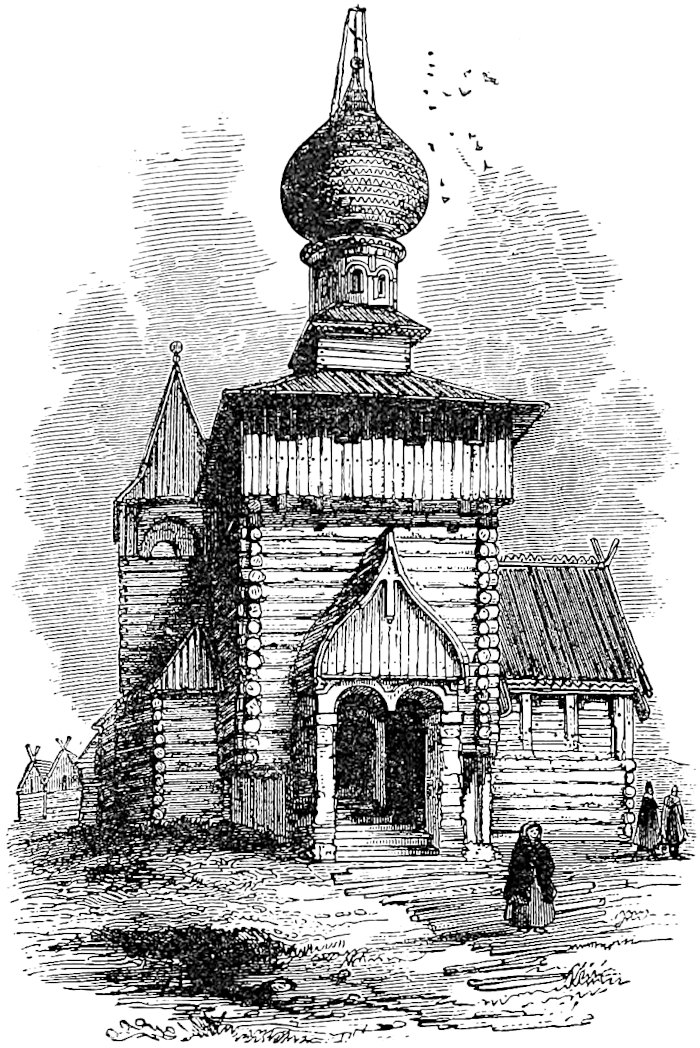
Mediæval Russian Church. (From Fergusson.)
Rubruquis is wrong in placing Illac or Wallachs in Asia; at least the people near the Ural, who he says were so-called by the Tartars, cannot have been Wallachs. Professor Bruun, who corrects my error in following Rubruquis, thinks those Asiatic Blac must have been Polovtzi, or Cumanians.
[Mr. Rockhill (Rubruck, p. 130, note) writes: “A branch of the Volga Bulgars occupied the Moldo-Vallach country in about A.D. 485, but it was not until the first years of the 6th century that a portion of them passed the Danube under the leadership of Asparuk, and established themselves in the present Bulgaria, Friar William’s ‘Land of Assan.’”—H. C.]