Volume 2 / Part 3 — CHAPTER XXII.
Henry Yule translation
Of the Kingdom of Coilum.
When you quit Maabar and go 500 miles towards the south-west you come to the kingdom of Coilum. The people are Idolaters, but there are also some Christians and some Jews. The natives have a language of their own, and a King of their own, and are tributary to no one.{1}
A great deal of brazil is got here which is called brazil Coilumin from the country which produces it; ’tis of very fine quality.{2} Good ginger also grows here, and it is known by the same name of Coilumin after the country.{3} Pepper too grows in great abundance throughout this country, and I will tell you how. You must know that the pepper-trees are (not wild but) cultivated, being regularly planted and watered; and the pepper is gathered in the months of May, June, and July. They have also abundance of very fine indigo. This is made of a certain herb which is gathered, and [after the roots have been removed] is put into great vessels upon which they pour water and then leave it till the whole of the plant is decomposed. They then put this liquid in the sun, which is tremendously hot there, so that it boils and coagulates, and becomes such as we see it. [They then divide it into pieces of four ounces each, and in that form it is exported to our parts.]{4} And I assure you that the heat of the sun is so great there that it is scarcely to be endured; in fact if you put an egg into one of the rivers it will be boiled, before you have had time to go any distance, by the mere heat of the sun!
The merchants from Manzi, and from Arabia, and from the Levant come thither with their ships and their merchandise and make great profits both by what they import and by what they export.
There are in this country many and divers beasts quite different from those of other parts of the world. Thus there are lions black all over, with no mixture of any other colour; and there are parrots of many sorts, for some are white as snow with red beak and feet, and some are red, and some are blue, forming the most charming sight in the world; there are green ones too. There are also some parrots of exceeding small size, beautiful creatures.{5} They have also very beautiful peacocks, larger than ours, and different; and they have cocks and hens quite different from ours; and what more shall I say? In short, everything they have is different from ours, and finer and better. Neither is their fruit like ours, nor their beasts, nor their birds; and this difference all comes of the excessive heat.
Corn they have none but rice. So also their wine they make from [palm-]sugar; capital drink it is, and very speedily it makes a man drunk. All other necessaries of man’s life they have in great plenty and cheapness. They have very good astrologers and physicians. Man and woman, they are all black, and go naked, all save a fine cloth worn about the middle. They look not on any sin of the flesh as a sin. They marry their cousins german, and a man takes his brother’s wife after the brother’s death; and all the people of India have this custom.{6}
There is no more to tell you there; so we will proceed, and I will tell you of another country called Comari.
Abulfeda defines the position of Kaulam as at the extreme end of Balad-ul-Falfal, i.e. the Pepper country or Malabar, as you go eastward, standing on an inlet of the sea, in a sandy plain, adorned with many gardens. The brazil-tree grew there, and the Mahomedans had a fine mosque and square. Ibn Batuta also notices the fine mosque, and says the city was one of the finest in Malabar, with splendid markets and rich merchants, and was the chief resort of the Chinese traders in India. Odoric describes it as “at the extremity of the Pepper Forest towards the south,” and astonishing in the abundance of its merchandise. Friar Jordanus of Séverac was there as a missionary some time previous to 1328, in which year he was at home; [on the 21st of August, 1329, he] was nominated Bishop of the See of Kaulam, Latinised as Columbum or Columbus [created by John XXII. on the 9th of August of the same year—H. C.]. Twenty years later John Marignolli visited “the very noble city of Columbum, where the whole world’s pepper is produced,” and found there a Latin church of St. George, probably founded by Jordanus.[2] Kaulam or Coilon continued to be an important place to the beginning of the 16th century, when Varthema speaks of it as a fine port, and Barbosa as “a very great city,” with a very good haven, and with many great merchants, Moors and Gentoos, whose ships traded to all the Eastern ports as far as Bengal, Pegu, and the Archipelago. But after this its decay must have been rapid, and in the following century it had sunk into entire insignificance. Throughout the Middle Ages it appears to have been one of the chief seats of the St. Thomas Christians. Indeed both it and Káyal were two out of the seven ancient churches which Indo-Syrian tradition ascribed to St. Thomas himself.[3]
I have been desirous to give some illustration of the churches of that interesting body, certain of which must date from a very remote period, but I have found unlooked-for difficulties in procuring such illustration. Several are given in the Life of Dr. Claudius Buchanan from his own sketches, and a few others in the Life of Bishop D. Wilson. But nearly all represent the churches as they were perverted in the 17th century and since, by a coarse imitation of a style of architecture bad enough in its genuine form. I give, after Buchanan, the old church at Parúr, not far from Cranganore, which had escaped masquerade, with one from Bishop Wilson’s Life, showing the quasi-Jesuit deformation alluded to, and an interior also from the latter work, which appears to have some trace of genuine character. Parúr church is probably Pálúr, or Pázhúr, which is one of those ascribed to St. Thomas; for Dr. Buchanan says it bears the name of the Apostle, and “is supposed to be the oldest in Malabar.” (Christ. Res. p. 113.)
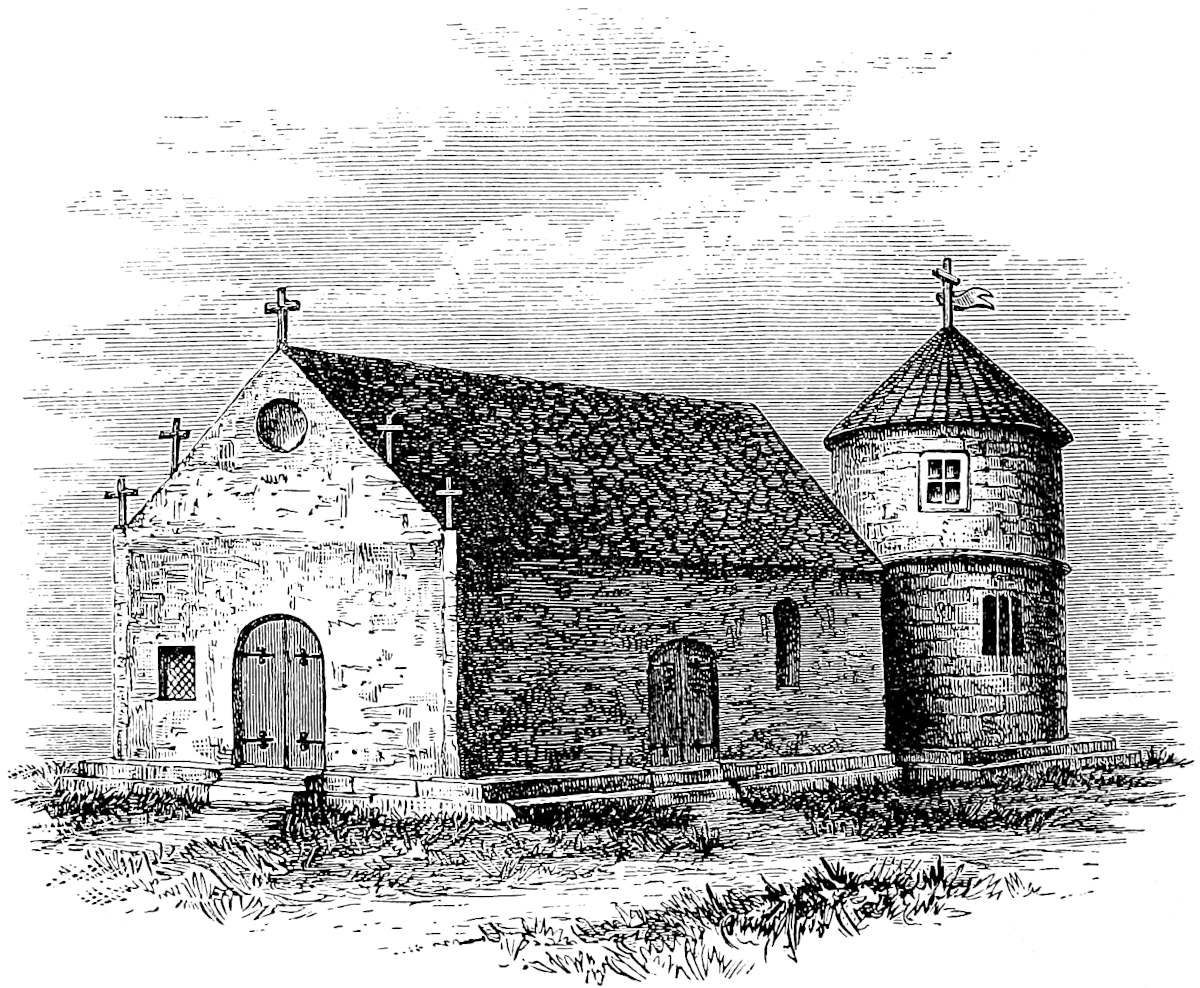
Ancient Christian Church at Parúr, on the Malabar coast. (After Claudius Buchanan.)
[Quilon is “one of the oldest towns on the coast, from whose re-foundation in 1019 A.D., Travancore reckons its era.” (Hunter, Gaz., xi., p. 339.)—H. C.]
How Polo comes to mention Coilum before Comari is a question that will be treated further on, with other misplacements of like kind that occur in succeeding chapters.
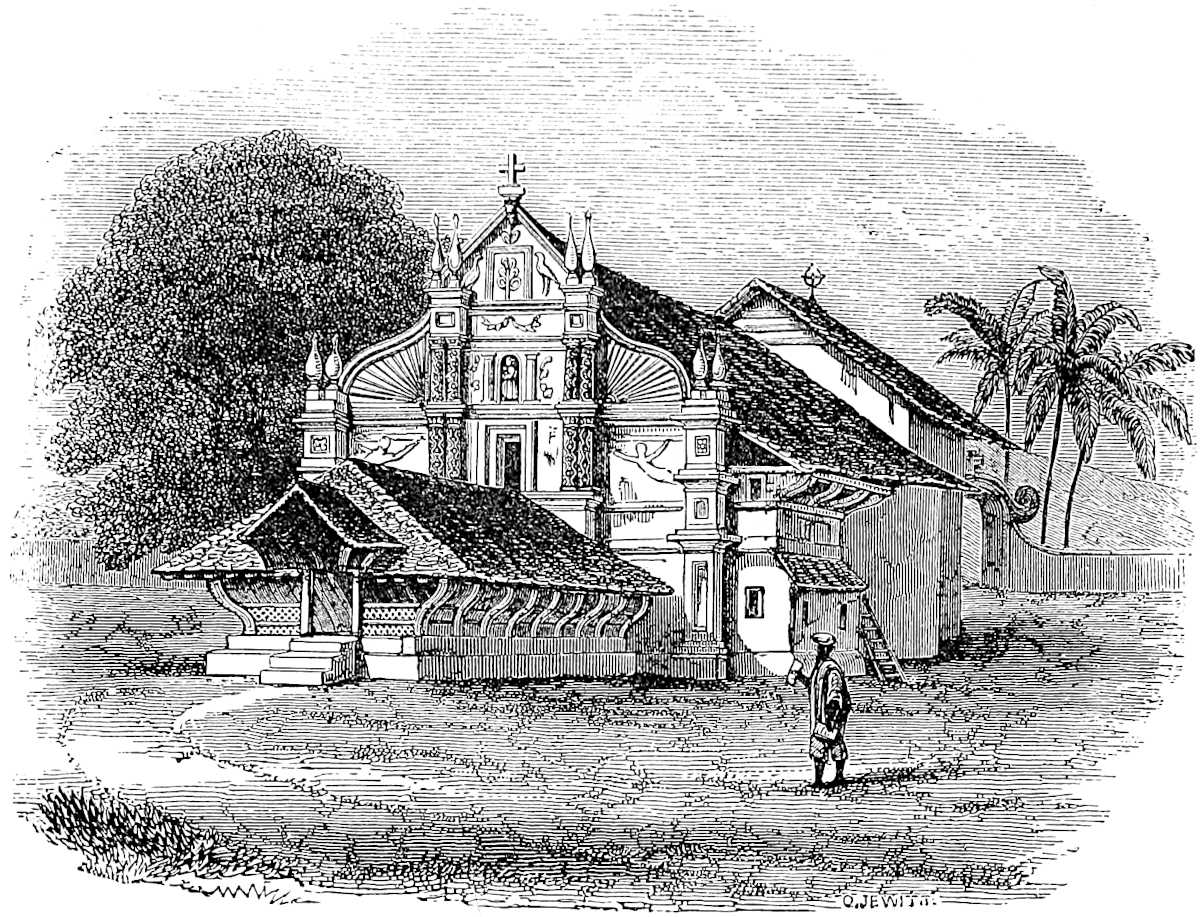
Syrian Church at Caranyachirra (from “Life of Bp. D. Wilson”), showing the quasi-Jesuit façade generally adopted in modern times.
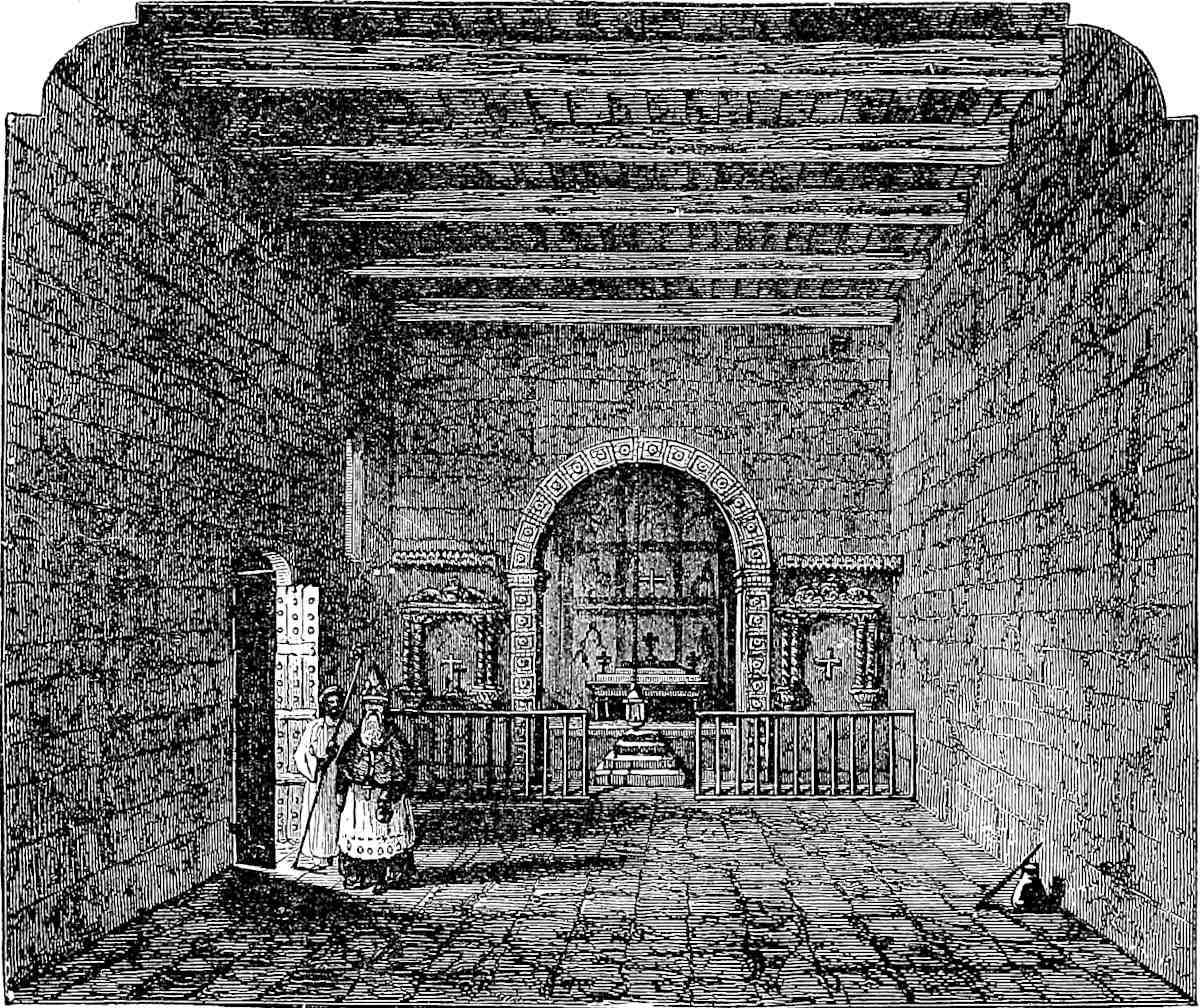
Interior of Syrian Church at Kötteiyam in Travancore. (From “Life of Bp. D. Wilson.”)
Kúblái had a good deal of diplomatic intercourse of his usual kind with Kaulam. De Mailla mentions the arrival at T’swan-chau (or Zayton) in 1282 of envoys from Kiulan, an Indian State, bringing presents of various rarities, including a black ape as big as a man. The Emperor had three times sent thither an officer called Yang Ting-pi (IX. 415). Some rather curious details of these missions are extracted by Pauthier from the Chinese Annals. The royal residence is in these called A-pu-’hota.[4] The king is styled Pinati. I may note that Barbosa also tells us that the King of Kaulam was called Benate-deri (devar?). And Dr. Caldwell’s kindness enables me to explain this title. Pinati or Benate represents Venáḍan, “the Lord of the Venáḍu,” or Venaṭṭu, that being the name of the district to which belonged the family of the old kings of Kollam, and Venáḍan being their regular dynastic name. The Rajas of Travancore who superseded the Kings of Kollam, and inherit their titles, are still poetically styled Venáḍan. (Pauthier, p. 603 seqq.; Ram. I. f. 304.)
We have seen in the last note that the Kaulam brazil is spoken of by Abulfeda; and Ibn Batuta, in describing his voyage by the back waters from Calicut to Kaulam, says: “All the trees that grow by this river are either cinnamon or brazil trees. They use these for firewood, and we cooked with them throughout our journey.” Friar Odoric makes the same hyperbolic statement: “Here they burn brazil-wood for fuel.”
It has been supposed popularly that the brazil-wood of commerce took its name from the great country so called; but the verzino of the old Italian writers is only a form of the same word, and bresil is in fact the word used by Polo. So Chaucer:—
“Him nedeth not his colour for to dien With brazil, ne with grain of Portingale.” —The Nun’s Priest’s Tale.
The Eastern wood in question is now known in commerce by its Malay name of Sappan (properly Sapang), which again is identical with the Tamil name Sappangi. This word properly means Japan, and seems to have been given to the wood as a supposed product of that region.[5] It is the wood of the Caesalpinia Sapan, and is known in Arabic (and in Hindustani) as Băḳăm. It is a thorny tree, indigenous in Western India from Goa to Trevandrum, and growing luxuriantly in South Malabar. It is extensively used by native dyers, chiefly for common and cheap cloths, and for fine mats. The dye is precipitated dark-brown with iron, and red with alum. It is said, in Western India, to furnish the red powder thrown about on the Hindu feast of the Húli. The tree is both wild and cultivated, and is grown rather extensively by the Mahomedans of Malabar, called Moplahs (Mapillas, see p. 372), whose custom it is to plant a number of seeds at the birth of a daughter. The trees require fourteen or fifteen years to come to maturity, and then become the girl’s dowry.
Though to a great extent superseded by the kindred wood from Pernambuco, the sappan is still a substantial object of importation into England. That American dye-stuff which now bears the name of brazil-wood is believed to be the produce of at least two species of Caesalpinia, but the question seems to partake of the singular obscurity which hangs over the origin of so many useful drugs and dye-stuffs. The variety called Braziletto is from C. bahamensis, a native of the Bahamas.
The name of Brazil has had a curious history. Etymologists refer it to the colour of braise or hot coals, and its first application was to this dye-wood from the far East. Then it was applied to a newly-discovered tract of South America, perhaps because producing a kindred dye-wood in large quantities: finally the original wood is robbed of its name, which is monopolised by that imported from the new country. The Region of Brazil had been originally styled Santa Cruz, and De Barros attributes the change of name to the suggestion of the Evil One, “as if the name of a wood for colouring cloth were of more moment than that of the Wood which imbues the Sacraments with the tincture of Salvation.”
There may perhaps be a doubt if the Land of Brazil derived its name from the dye-wood. For the Isle of Brazil, long before the discovery of America, was a name applied to an imaginary Island in the Atlantic. This island appears in the map of Andrea Bianco and in many others, down at least to Coronelli’s splendid Venetian Atlas (1696); the Irish used to fancy that they could see it from the Isles of Arran; and the legend of this Island of Brazil still persisted among sailors in the last century.[6] The story was no doubt the same as that of the green Island, or Island of Youth, which Mr. Campbell tells us the Hebrideans see to the west of their own Islands. (See Pop. Tales of West Highlands, IV. 163. For previous references, Della Decima, III. 298, 361; IV. 60; I. B. IV. 99; Cathay, p. 77; Note by Dr. H. Gleghorn; Marsh’s ed. of Wedgwood’s Etym. Dict. I. 123; Southey, H. of Brazil, I. 22.)
Indigo had been introduced into Sicily by the Jews during the time of Frederick II., in the early part of Polo’s century. Jews and Indigo have long vanished from Sicily. The dye is often mentioned in Pegolotti’s Book; the finest quality being termed Indaco Baccadeo, a corruption of Bághdádi. Probably it came from India by way of Baghdad. In the Barcelona Tariffs it appears as Indigo de Bagadel. Another quality often mentioned is Indigo di Golfo. (See Capmany, Memorias, II. App. p. 73.) In the bye-laws of the London Painters’ Guild of the 13th century, quoted by Sir F. Palgrave from the Liber Horne, it is forbidden to paint on gold or silver except with fine (mineral) colours, “e nient de brasil, ne de inde de Baldas, ne de nul autre mauveise couleur.” (The Merchant and the Friar, p. xxiii.) There is now no indigo made or exported at Quilon, but there is still some feeble export of sappanwood, ginger, and pepper. These, and previous particulars as to the present Quilon, I owe to the kindness of Mr. Ballard, British Resident at Trevandrum.