Volume 2 / Part 3 — CHAPTER XIX.
Henry Yule translation
How Baidu seized the Sovereignty after the Death of Kiacatu.
When Kiacatu was dead, Baidu, who was his uncle, and was a Christian, seized the throne.{1} This was in the year 1294 of Christ’s Incarnation. So Baidu held the government, and all obeyed him, except only those who were with Casan.
And when Casan heard that Kiacatu was dead, and Baidu had seized the throne, he was in great vexation, especially as he had not been able to take his vengeance on Kiacatu. As for Baidu, Casan swore that he would take such vengeance on him that all the world should speak thereof; and he said to himself that he would tarry no longer, but would go at once against Baidu and make an end of him. So he addressed all his people, and then set out to get possession of his throne.
And when Baidu had intelligence thereof he assembled a great army and got ready, and marched ten days to meet him, and then pitched his camp, and awaited the advance of Casan to attack him; meanwhile addressing many prayers and exhortations to his own people. He had not been halted two days when Casan with all his followers arrived. And that very day a fierce battle began. But Baidu was not fit to stand long against Casan, and all the less that soon after the action began many of his troops abandoned him and took sides with Casan. Thus Baidu was discomfited and put to death, and Casan remained victor and master of all. For as soon as he had won the battle and put Baidu to death, he proceeded to the capital and took possession of the government; and all the Barons performed homage and obeyed him as their liege lord. Casan began to reign in the year 1294 of the Incarnation of Christ.
Thus then you have had the whole history from Abaga to Casan, and I should tell you that Alaü, the conqueror of Baudac, and the brother of the Great Kaan Cublay, was the progenitor of all those I have mentioned. For he was the father of Abaga, and Abaga was the father of Argon, and Argon was the father of Casan who now reigns.{2}
Now as we have told you all about the Tartars of the Levant, we will quit them and go back and tell you more about Great Turkey— But in good sooth we have told you all about Great Turkey and the history of Caidu, and there is really no more to tell. So we will go on and tell you of the Provinces and nations in the far North.
The European Princes could not get over the belief that the Mongols were necessarily the inveterate enemies of Mahomedanism and all its professors. Though Gházán was professedly a zealous Mussulman, we find King James of Aragon, in 1300, offering Cassan Rey del Mogol amity and alliance with much abuse of the infidel Saracens; and the same feeling is strongly expressed in a letter of Edward II. of England to the “Emperor of the Tartars,” which apparently was meant for Oljaitu, the successor of Gházán. (Fraehn de Ilchan. Nummis, vi. and passim; Raynald. III. 619; J. A. S. B. XXIV. 490; Kington’s Frederick II. I. 396; Capmany, Antiguos Tratados, etc. p. 107; Rymer, 2d Ed. III. 34; see also p. 20.)
There are other assertions, besides our author’s, that Baidu professed Christianity. Hayton says so, and asserts that he prohibited Mahomedan proselytism among the Tartars. The continuator of Abulfaraj says that Baidu’s long acquaintance with the Greek Despina Khatun, the wife of Ábáká, had made him favourable to Christians, so that he willingly allowed a church to be carried about with the camp, and bells to be struck therein, but he never openly professed Christianity. In fact at this time the whole body of Mongols in Persia was passing over to Islam, and Baidu also, to please them, adopted Mahomedan practices. But he would only employ Christians as Ministers of State. His rival Gházán, on the other hand, strengthened his own influence by adopting Islam, Baidu’s followers fell off from him, and delivered him into Gházán’s power. He was put to death 4th of October, 1295, about seven months after the death of his predecessor. D’Ohsson’s authorities seem to mention no battle such as the text speaks of, but Mirkhond, as abridged by Teixeira, does so, and puts it at Nakshiwán on the Araxes (p. 341).
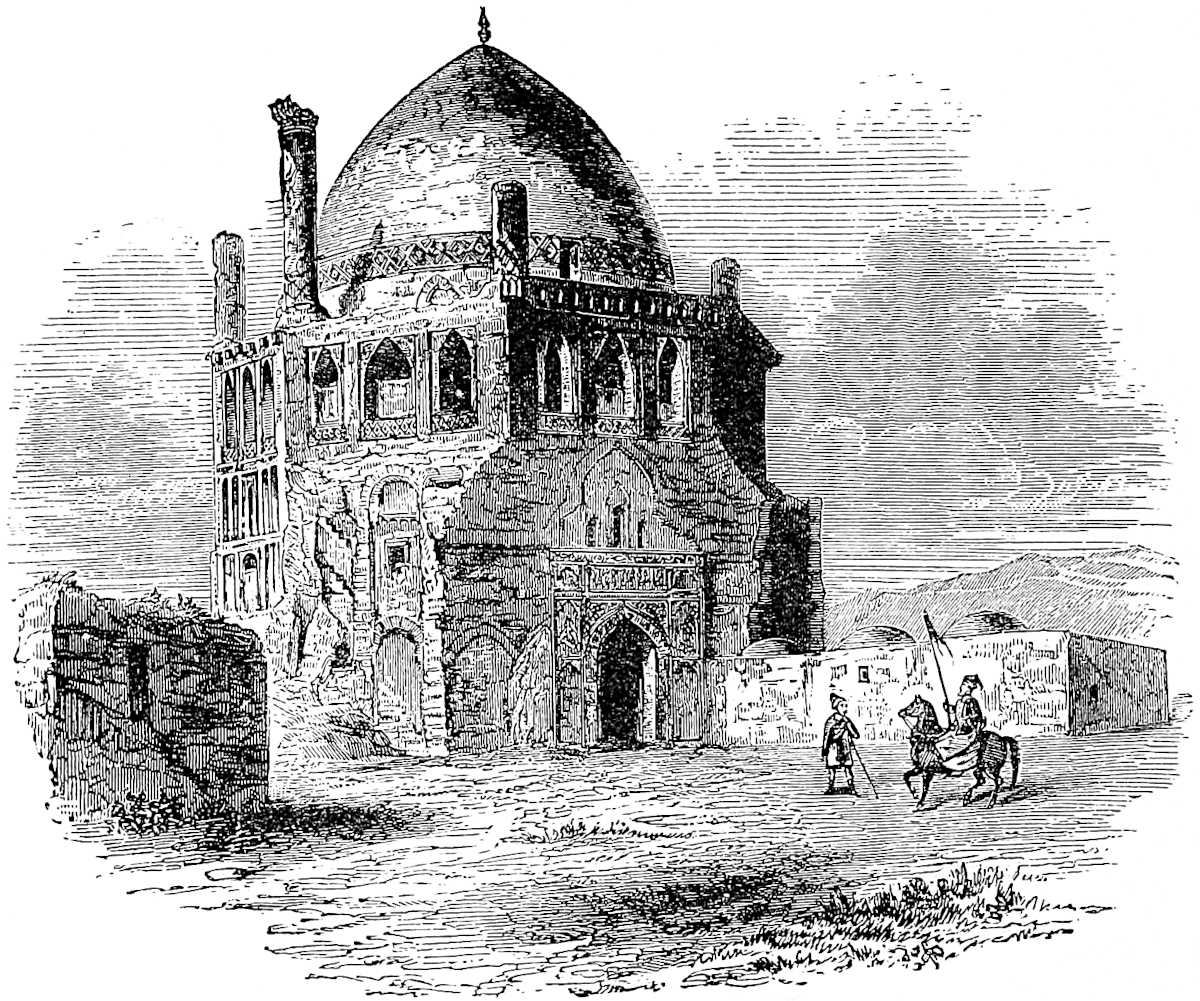
Tomb of Oljaïtu Khan, the brother of Polo’s “Casan,” at Sultaniah. (From Fergusson.)
Pachymeres says that Gházán made Cyrus, Darius, and Alexander his patterns, and delighted to read of them. He was very fond of the mechanical arts; “no one surpassed him in making saddles, bridles, spurs, greaves, and helmets; he could hammer, stitch, and polish, and in such occupations employed the hours of his leisure from war.” The same author speaks of the purity and beauty of his coinage, and the excellence of his legislation. Of the latter, so famous in the East, an account at length is given by D’Ohsson. (Hayton in Ramus. II. ch. xxvi.; Pachym. Andron. Palaeol. VI. 1; D’Ohsson, vol iv.)
Before finally quitting the “Tartars of the Levant,” we give a representation of the finest work of architecture that they have left behind them, the tomb built for himself by Oljaïtu (see on this page), or, as his Moslem name ran, Mahomed Khodabandah, in the city of Sultaniah, which he founded. Oljaïtu was the brother and successor of Marco Polo’s friend Gházán, and died in 1316, eight years before our traveller.