Volume 2 / Part 3 — CHAPTER LXXI.
Henry Yule translation
Concerning the City of Sinju and the Great River Kian.
You must know that when you leave the city of Yanju, after going 15 miles south-east, you come to a city called Sinju, of no great size, but possessing a very great amount of shipping and trade. The people are Idolaters and subject to the Great Kaan, and use paper-money.{1}
And you must know that this city stands on the greatest river in the world, the name of which is Kian. It is in some places ten miles wide, in others eight, in others six, and it is more than 100 days’ journey in length from one end to the other. This it is that brings so much trade to the city we are speaking of; for on the waters of that river merchandize is perpetually coming and going, from and to the various parts of the world, enriching the city, and bringing a great revenue to the Great Kaan.
And I assure you this river flows so far and traverses so many countries and cities that in good sooth there pass and repass on its waters a great number of vessels, and more wealth and merchandize than on all the rivers and all the seas of Christendom put together! It seems indeed more like a Sea than a River.{2} Messer Marco Polo said that he once beheld at that city 15,000 vessels at one time. And you may judge, if this city, of no great size, has such a number, how many must there be altogether, considering that on the banks of this river there are more than sixteen provinces and more than 200 great cities, besides towns and villages, all possessing vessels?
Messer Marco Polo aforesaid tells us that he heard from the officer employed to collect the Great Kaan’s duties on this river that there passed up-stream 200,000 vessels in the year, without counting those that passed down! [Indeed as it has a course of such great length, and receives so many other navigable rivers, it is no wonder that the merchandize which is borne on it is of vast amount and value. And the article in largest quantity of all is salt, which is carried by this river and its branches to all the cities on their banks, and thence to the other cities in the interior.{3}]
The vessels which ply on this river are decked. They have but one mast, but they are of great burthen, for I can assure you they carry (reckoning by our weight) from 4000 up to 12,000 cantars each.{4}
Now we will quit this matter and I will tell you of another city called Caiju. But first I must mention a point I had forgotten. You must know that the vessels on this river, in going up-stream have to be tracked, for the current is so strong that they could not make head in any other manner. Now the tow-line, which is some 300 paces in length, is made of nothing but cane. ’Tis in this way: they have those great canes of which I told you before that they are some fifteen paces in length; these they take and split from end to end [into many slender strips], and then they twist these strips together so as to make a rope of any length they please. And the ropes so made are stronger than if they were made of hemp.{5}
[There are at many places on this river hills and rocky eminences on which the idol-monasteries and other edifices are built; and you find on its shores a constant succession of villages and inhabited places.{6}]
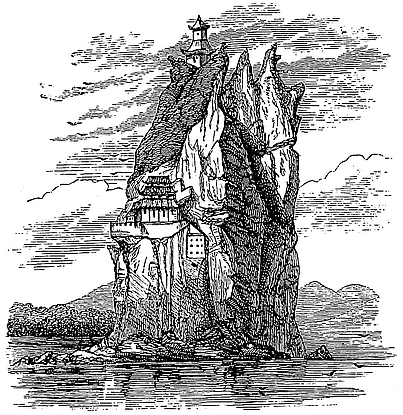
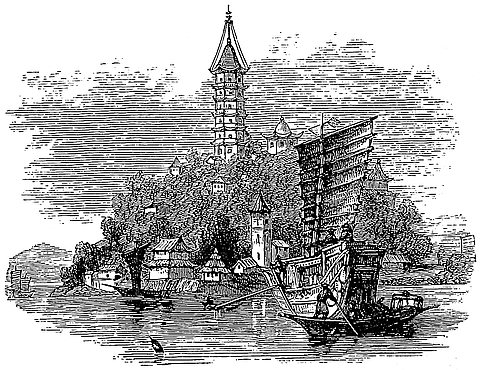
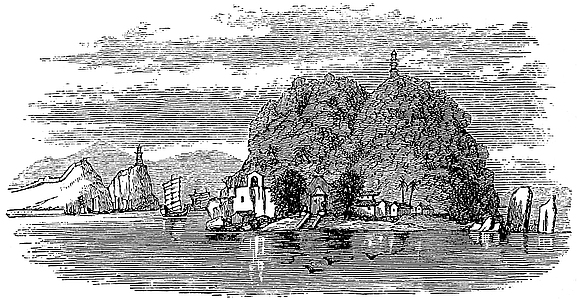
“Sono sopraquesto fiumein molti luoghi, colline e monticelli sassosi, sopra quali sono edificati monasteri d’Idoli, e altre stanze....”
I conceive Sinju to be the city which was then called Chên-chau, but now I-ching hien,[1] and which stands on the Kiang as near as may be 15 miles from Yang-chau. It is indeed south-west instead of south-east, but those who have noted the style of Polo’s orientation will not attach much importance to this. I-ching hien is still the great port of the Yang-chau salt manufacture, for export by the Kiang and its branches to the interior provinces. It communicates with the Grand Canal by two branch canals. Admiral Collinson, in 1842, remarked the great numbers of vessels lying in the creek off I-ching. (See note 1 to ch. lxviii. above; and J. R. G. S. XVII. 139.)
[“We anchored at a place near the town of Y-ching-hien, distinguished by a pagoda. The most remarkable objects that struck us here were some enormously large salt-junks of a very singular shape, approaching to a crescent, with sterns at least thirty feet above the water, and bows that were two-thirds of that height. They had ‘bright sides,’ that is, were varnished over the natural wood without painting, a very common style in China.” (Davis, Sketches, II. p. 13.)—H. C.]
[From the Returns of Trade for the Year 1900 of the Imperial Maritime Customs of China, we take the following figures regarding the navigation on the Kiang. Steamers entered inwards and cleared outwards, under General Regulations at Chung-King: 1; 331 tons; sailing vessels, 2681; 84,862 tons, of which Chinese, 816; 27,684 tons. At Ichang: 314; 231,000 tons, of which Chinese, 118; 66,944 tons; sailing vessels, all Chinese, 5139; 163,320 tons. At Shasi: 606; 453,818 tons, of which Chinese, 606; 453,818 tons; no sailing vessels. At Yochow: 650; 299,962 tons, of which Chinese, 458; 148,112 tons; no sailing vessels; under Inland Steam Navigation Rules, 280 Chinese vessels, 20,958 tons. At Hankow: under General Regulation, Steamers, 2314; 2,101,555 tons, of which Chinese, 758; 462,424 tons; sailing vessels, 1137; 166,118 tons, of which Chinese, 1129; 163,724 tons; under Inland Steam Navigation Rules, 1682 Chinese vessels, 31,173 tons. At Kiu-Kiang: under General Regulation, Steamers, 2916; 3,393,514 tons, of which Chinese, 478; 697,468 tons; sailing vessels, 163; 29,996 tons, of which Chinese, 160; 27,797 tons; under Inland Steam Navigation Rules, 798 Chinese vessels; 21,670 tons. At Wu-hu: under General Regulation, Steamers, 3395; 3,713,172 tons, of which Chinese, 540; 678,362 tons; sailing vessels, 356; 48,299 tons, of which Chinese, 355; 47,848 tons; under Inland Steam Navigation Rules, 286 Chinese vessels; 4272 tons. At Nanking: under General Regulation, Steamers, 1672; 1,138,726 tons, of which Chinese, 970; 713,232 tons; sailing vessels, 290; 36,873 tons, of which Chinese, 281; 34,985 tons; under Inland Steam Navigation Rules, 30 Chinese vessels; 810 tons. At Chinkiang: under General Regulation, Steamers, 4710; 4,413,452 tons, of which Chinese, 924; 794,724 tons; sailing vessels, 1793; 294,664 tons, of which Chinese, 1771; 290,286 tons; under Inland Steam Navigation Rules, 2920; 39,346 tons, of which Chinese, 1684; 22,776 tons.—H. C.]