Volume 2 / Part 3 — CHAPTER XXXIV. AND LAST
Henry Yule translation
Conclusion.[1]
And now ye have heard all that we can tell you about the Tartars and the Saracens and their customs, and likewise about the other countries of the world as far as our researches and information extend. Only we have said nothing whatever about the Greater Sea and the provinces that lie round it, although we know it thoroughly. But it seems to me a needless and useless task to speak about places which are visited by people every day. For there are so many who sail all about that sea constantly, Venetians, and Genoese, and Pisans, and many others, that everybody knows all about it, and that is the reason that I pass it over and say nothing of it.
Of the manner in which we took our departure from the Court of the Great Kaan you have heard at the beginning of the Book, in that chapter where we told you of all the vexation and trouble that Messer Maffeo and Messer Nicolo and Messer Marco had about getting the Great Kaan’s leave to go; and in the same chapter is related the lucky chance that led to our departure. And you may be sure that but for that lucky chance, we should never have got away in spite of all our trouble, and never have got back to our country again. But I believe it was God’s pleasure that we should get back in order that people might learn about the things that the world contains. For according to what has been said in the introduction at the beginning of the Book, there never was a man, be he Christian or Saracen or Tartar or Heathen, who ever travelled over so much of the world as did that noble and illustrious citizen of the City of Venice, Messer Marco the son of Messer Nicolo Polo.
Thanks be to God! Amen! Amen!
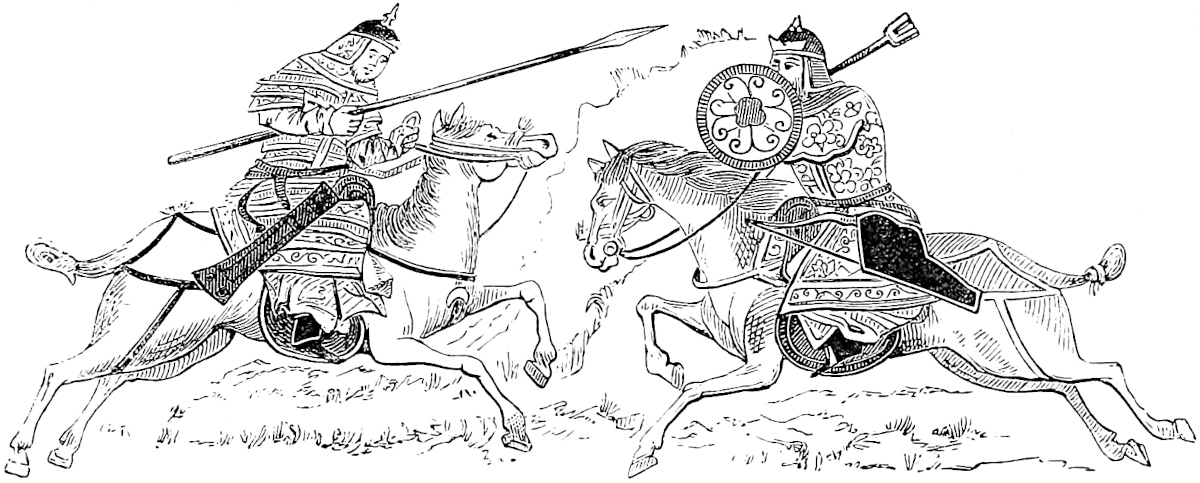
Asiatic Warriors of Polo’s Age. (From a contemporary Persian Miniature.)
APPENDICES
Appendix A.—Geneaology of the House of Chinghiz, to end of Thirteenth Century.
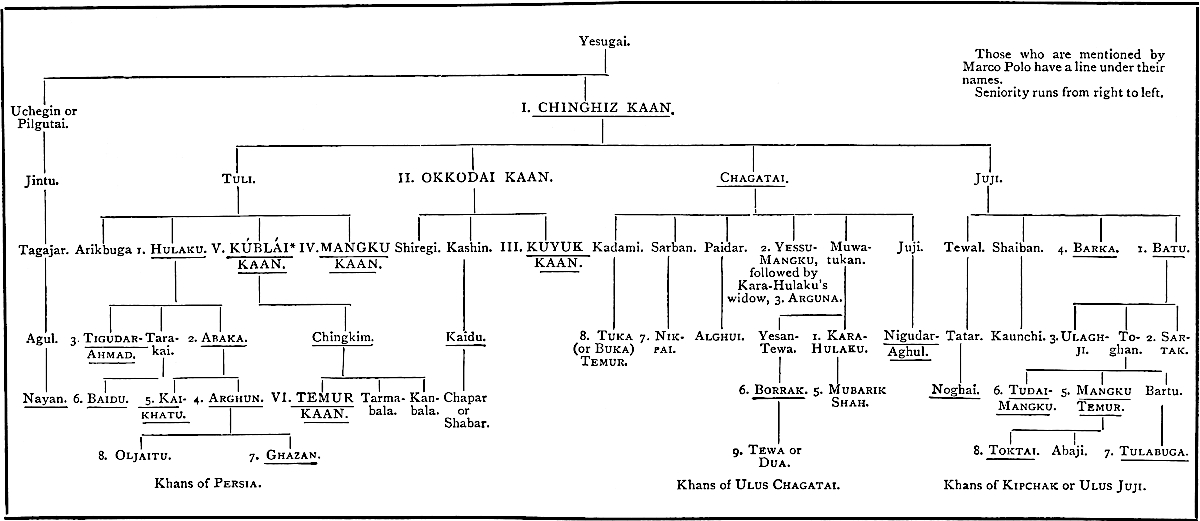
Supreme KAANS in large capitals. Khans of Kipchak, Chagatai, and Persia in small capitals. Numerals indicate order of succession. * For other sons of Kúblái, see Book II., chapter ix.
Those who are mentioned by Marco Polo have a line under their names. Seniority runs from right to left.
Appendix B.—The Polo Families.
(I.) Genealogy of the Family of Marco Polo the Traveller.
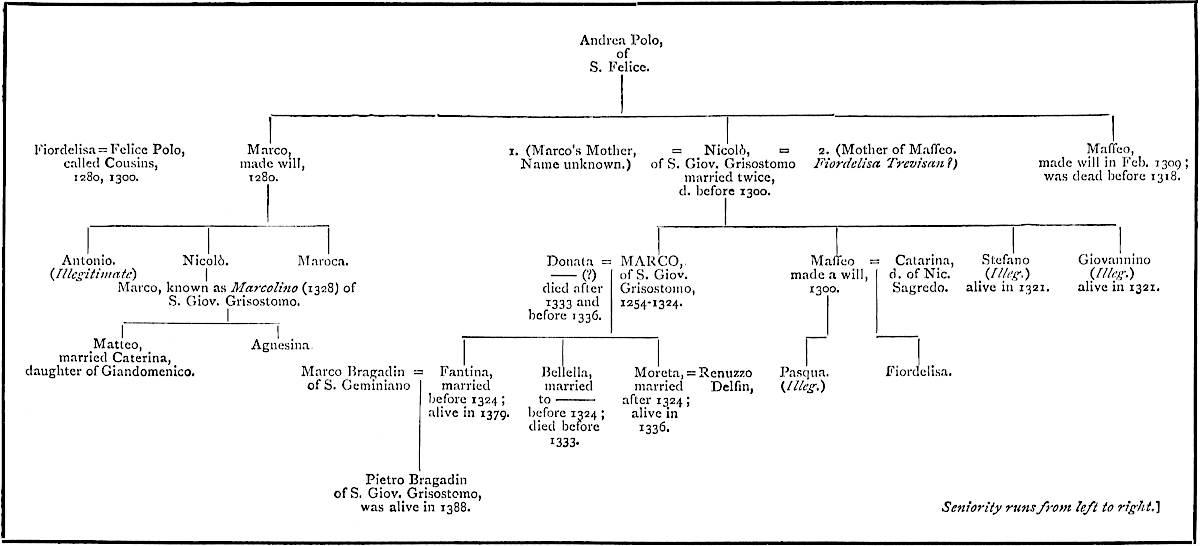
Seniority runs from left to right.
Appendix B.—continued.
(II.) The Polos of San Geremia.
The preceding Table gives the Family of our Traveller as far as I have seen sound data for tracing it, either upwards or downwards.
I have expressed, in the introductory notices, my doubts about the Venetian genealogies, which continue the family down to 1418 or 19, because it seems to me certain that all of them do more or less confound with our Polos of S. Giovanni Grisostomo, members of the other Polo Family of S. Geremia. It will help to disentangle the subject if we put down what is ascertained regarding the S. Geremia family.
To the latter with tolerable certainty belonged the following:—
1302. Marco Polo of Cannareggio, see vol. i. pp. 64–67. (The Church of S. Geremia stands on the canal called Cannareggio.)
Already in 1224, we find a Marco Polo of S. Geremia and Cannareggio. (See Liber Plegiorum, published with Archivio Veneto, 1872 pp. 32, 36).
1319. (Bianca, widow of Giovanni Polo?)[1]
1332. 24th March. Concession, apparently of some privilege in connection with the State Lake in San Basilio, to Donato and Hermorao (= Hermolaus or Almorò) Paulo (Document partially illegible).[2]
1333. 23rd October. Will of Marchesina Corner, wife of Marino Gradenigo of S. Apollinare, who chooses for her executors “my mother Dona Fiordelisa Cornaro, and my uncle (Barba) Ser Marco Polo.”[3] Another extract apparently of the same will mentions “mia cusina Maria Polo,” and “mio cusin Marco Polo” three times.[4]
1349. Marino Polo and Brothers.[5]
1348. About this time died Nicolo Polo of S. Geremia,[6] who seems to have been a Member of the Great Council.[7] He had a brother Marco, and this Marco had a daughter Agnesina. Nicolo also leaves a sister Barbara (a nun), a son Giovannino (apparently illegitimate[7]), of age in 1351,[6] a nephew Gherardo, and a niece Filippa,[6] Abbess of Sta. Catarina in Mazzorbo.
The executors of Nicolo are Giovanni and Donato Polo.[6] We have not their relationship stated.
Donato must have been the richest Polo we hear of, for in the Estimo or forced Loan of 1379 for the Genoese War, he is assessed at 23,000 Lire.[8] A history of that war also states that he (“Donado Polo del Canareggio”) presented the Government with 1000 ducats, besides maintaining in arms himself, his son, and seven others.[9] Under 1388 we find Donato still living, and mention of Cataruzza, d. of Donato:[10] and under 1390 of Elena, widow of Donato.[10]
The Testamentary Papers of Nicolo also speak of Giacomo [or Jacopo] Polo. He is down in the Estimo of 1379 for 1000 Lire;[11] and in 1371 an inscription in Cicogna shows him establishing a family burial-place in Sta. Maria de’ Servi:[12]
[M°CCC°LXXI. Die primo mensis ... S. Dn̄i IACHOBI. PAVLI. DE CFINIO. SANCTI. IEREMIE. ET. SVOR. HEREDVM.]
(1353. 2nd June. Viriola, widow of Andrea or Andrinolo Polo of Sta. Maria Nuova?)[13]
1379. In addition to those already mentioned we have Nicolo assessed at 4000 lire.[11]
1381. And apparently this is the Nicolo, son of Almorò (Hermolaus), who was raised to the Great Council, for public service rendered, among 30 elected to that honour after the war of Chioggia.[14] Under 1410 we find Anna, relict of Nicolo Polo.[15]
1379. In this year also, Almorò, whether father or brother of the last, contributes 4000 lire to the Estimo.[11]
1390. Clemente Polo (died before 1397)[15] and his wife Maddaluzia.[15] Also in this year Paolo Polo, son of Nicolo, gave his daughter in marriage to Giov. Vitturi.[16]
1408 and 1411. Chiara, daughter of Francesco Balbi, and widow of Ermolao (or Almorò) Polo, called of Sta. Trinità.[15]
1416. Giovanni, perhaps the Giovannino mentioned above.[15]
1420. 22nd November. Bartolo, son of Ser Almorò and of the Nobil Donna Chiara Orio.(?)[17] This couple probably the same as in the penultimate entry.
1474, seqq. Accounts belonging to the Trust Estate of Bartolomeo Polo of S. Geremia.[15]
There remains to be mentioned a Marco Polo, member of the Greater Council, chosen Auditor Sententiarum, 7th March, 1350, and named among the electors of the Doges Marino Faliero (1354) and Giovanni Gradenigo (1355). The same person appears to have been sent as Provveditore to Dalmatia in 1355. As yet it is doubtful to what family he belonged, and it is possible that he may have belonged to our traveller’s branch, and have continued that branch according to the tradition. But I suspect that he is identical with the Marco, brother of Nicolo Polo of S. Geremia, mentioned above, under 1348. (See also vol. i. p. 74.) Cappellari states distinctly that this Marco was the father of the Lady who married Azzo Trevisan. (See Introd. p. 78.)
We have intimated the probability that he was the Marco mentioned twice in connection with the Court of Sicily. (See vol. i. p. 79, note.)
A later Marco Polo, in 1537, distinguished himself against the Turks in command of a ship called the Giustiniana; forcing his way past the enemy’s batteries into the Gulf of Prevesa, and cannonading that fortress. But he had to retire, being unsupported.
It may be added that a Francesco Paulo appears among the list of those condemned for participation in the conspiracy of Baiamonte Tiepolo in 1310. (Dandulo in Mur. XII. 410, 490.)
[I note from the MS. of Priuli, Genealogie delle famiglie nobili di Venesia, kept in the Ro. Archivio di Stato at Venice, some information, pp. 4376–4378, which permit me to draw up the following Genealogy which may throw some light on the Polos of San Geremia:—
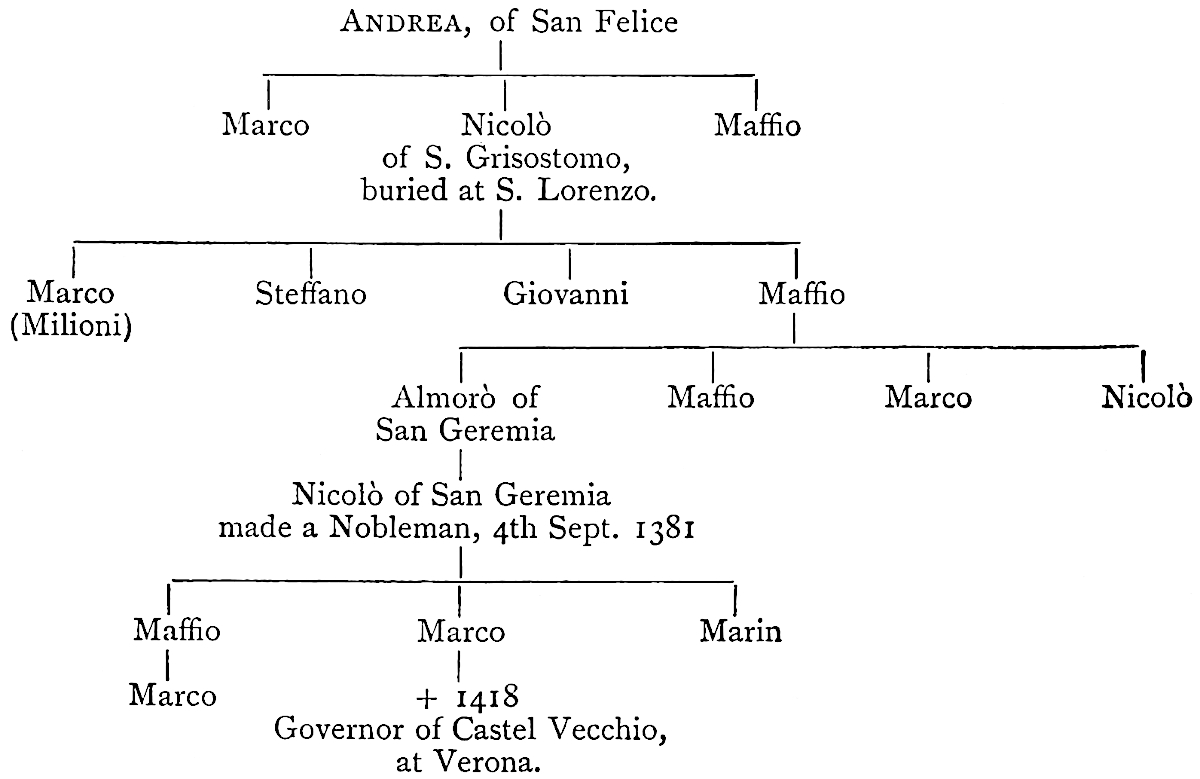
Sir Henry Yule writes above (II. p. 507) that Nicolo Polo of S. Geremia had a brother Marco, and this Marco had a daughter Agnesina. I find in the Acts of the Notary Brutti, in the Will of Elisabetta Polo, dated 14th March, 1350:—
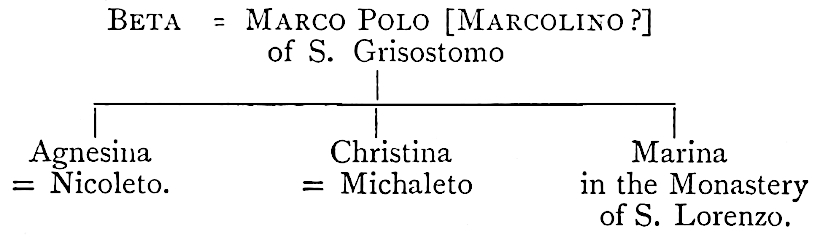
The Maffio, son of Nicolò of S. Giov. Grisostomo, and father of Pasqua and Fiordelisa, married probably after his will (1300) and had his four sons: Almorò of S. Geremia, Maffio, Marco, Nicolò. Indeed, Cicogna writes (Insc. Ven. II. p. 390):—“Non apparisce che Maffeo abbia avuto figliuoli maschi da questo testamento [1300]; ma per altro non è cosa assurda il credere che posteriormente a questo testamento 1300 possa avere avuti figliuoli maschi; ed in effetto le Genealogie gliene danno quatro, cioè Ermolao, Maffio, Marco, Nicolò. Il Ramusio anzi glien dà cinque, senza nominarli, uno de’ quali Marco, e una femmina di nome Maria; e Marco Barbaro gliene dà sei, cioè Nicolò, Maria, Pietro, Donado, Marco, Franceschino.”—H. C.]
[Sig. Ab. Cav. Zanetti gives (Archivio Veneto, XVI. 1878, p. 110). See our Int., p. 78.
Appendix C.—Calendar of Documents Relating to Marco Polo and his Family.
1.—(1280).
Will of Marco Polo of S. Severo, uncle of the Traveller, executed at Venice, 5th August, 1280. An Abstract given in vol. i. pp. 23–24.
The originals of this and the two other Wills (Nos. 2 and 8) are in St. Mark’s Library. They were published first by Cicogna, Iscrizioni Veneziane, and again more exactly by Lazari.
2.—(1300).
Will of Maffeo Polo, brother of the Traveller, executed at Venice, 31st August, 1300. Abstract given at pp. 64–65 of vol. i.
3.—(1302).
Archivio Generale—Maggior Consiglio—Liber Magnus, p. 81.[1]
1392. 13 Aprilis. (Capta est): Quod fit gratia provido viro Marco Paulo quod ipse absolvatur a penâ incursâ pro eo quod non fecit circari unam suam conductam cum ignoraverit ordinem circa hoc.
Ego Marcus Michael consiliarius m. p. s.
Ego Paulus Delphinus consiliarius m. p. s.
Ego Marcus Siboto de mandato ipsorum cancellavi.
4—(1305).
Resolution of the Maggior Consiglio, under date 10th April, 1305, in which Marco Polo is styled Marcus Paulo Milioni. (See p. 67 of vol. i.) In the Archivio Generale, Maggior Cons. Reg. M.S., Carta 82.[2]
“Item quod fiat gratia Bonocio de Mestre de illis Libris centum quinquaginta duobus, in quibus extitit condempnatus per Capitaneos Postarum, occasione vini per eum portati contra bampnum, isto modo videlicet quod solvere debeat dictum debitum hinc ad annos quatuor, solvendo annuatim quartum dicti debiti per hunc modum, scilicet quod dictus Bonocius ire debeat cum nostris Ambaxiatoribus, et soldum quod ei competet pro ipsis viis debeat scontari, et it quod ad solvendum dictum quartum deficiat per eum vel suos plegios integre persolvatur. Et sunt plegii Nobiles Viri Petrus Mauroceno et Marchus Paulo Milion̄ et plures alii qui sunt scripti ad Cameram Capitaneorum Postarum.”
5.—(1311).
Decision in Marco Polo’s suit against Paulo Girardo, 9th March 1311, for recovery of the price of musk sold on commission, etc. (From the Archives of the Casa di Ricovero at Venice, Filza No. 202. See vol. i. p. 70.)
“In nomine Dei Eterni Amen. Anno ab Incarnatione Domini Nostri Jesu Christi millesimo trecentesimo undecimo, Mensis Marci die nono, intrante Indicione Nona, Rivoalti ...
“Cum coram nobilibus viris Dominis Catharino Dalmario et Marco Lando, Judicibus Peticionum, Domino Leonardo de Molino, tercio Judice curie, tunc absente, inter Nobilem Virum Marcum Polo de confinio Sancti Johannis Grisostomi ex unâ parte, et Paulum Girardo de confinio Sancti Apollinaris ex altera parte, quo ex suo officio verteretur occasione librarum trium denariorum grossorum Venetorum in parte unâ, quas sibi Paulo Girardo petebat idem Marcus Polo pro dimidia libra muscli quam ab ipso Marco Polo ipse Paulus Girardo habuerat, et vendiderat precio suprascriptarum Librarum trium den. Ven. gros. et occasione den. Venet. gross. viginti, quos eciam ipse Marcus Polo eidem Polo Girardo pectebat pro manchamento unius sazii de musclo, quem dicebat sibi defficere de librâ unâ muscli, quam simul cum suprascriptâ dimidiâ ipse Paulus Girardo ab ipso Marco Polo habuerat et receperat, in parte alterâ de dicta, Barbaro advocatori (sic) curie pro suprascripto Marco Polo sive Johannis (sic) Polo[3] de Confinio Sancti Johannis Grisostomi constitutus in Curiâ pro ipso Marco Polo sicut coram suprascriptis Dominis Judicibus legitimum testificatum extiterat ... legi fecit quamdam cedulam bambazinam scriptam manu propriâ ipsius Pauli Girardi, cujus tenor talis, videlicet: ... “de avril recevi io Polo Girardo da Missier Marco Polo libre ½ de musclo metemelo libre tre de grossi. Ancora recevi io Polo libre una de musclo che me lo mete libre sei de grossi, et va a so risico et da sua vintura et damelo in choleganza a la mitade de lo precio.” * * * * “Quare cum ipse Paulus noluerit satisfacere de predictis, nec velit ad presens * * * * * * Condempnatum ipsum Paulum Girardo in expensis pro parte dicti Marci Paulo factis in questione, dando et assignando sibi terminum competentem pro predictis omnibus et singulis persolvendis, in quem terminum si non solveret judicant ipsi domini judices quod capi debetur ipse Paulus Gerardo et carceribus Comunis Venetiarum precludi, de quibus exire non posset donec sibi Marco Paulo omnia singula suprascripta exolvenda dixisset, non obstante absenciâ ipsius Pauli Gerardo cum sibi ex parte Domini Ducis proministeriale Curie Palacii preceptum fuisset ut hodie esset ad Curiam Peticionum.
“Ego Katharinus Dalmario Judex Peticionum manu meâ subscripsi
“Ego Marcus Lando Judex Peticionum manu meâ subscripsi
“Ego Nicolaus, Presbiter Sancti Canciani notarius complevi et roboravi.”
6.—(1319).
In a list of documents preserved in the Archives of the Casa di Ricovero, occurs the entry which follows. But several recent searches have been made for the document itself in vain.
* “No 94 Marco Galetti investe della proprietâ dei beni che si trovano in S. Giovanni Grisostomo Marco Polo di Nicolo. 1319, 10 Settembre, rogato dal notaio Nicolo Prete di S. Canciano.”
The notary here is the same who made the official record of the document last cited.
[This document was kept in the Archives of the Istituto degli Esposti, now transferred to the Archivio di Stato, and was found by the Ab. Cav. V. Zanetti, and published by him in the Archivio Veneto, XVI., 1878, pp. 98–100; parchment, 1157, filza I.; Marco Polo the traveller, according to a letter of the 16th March, 1306, had made in 1304, a loan of 20 lire di grossi to his cousin Nicolo, son of Marco the elder; the sum remaining unpaid at the death of Nicolo, his son and heir Marcolino became the debtor, and by order of the Doge Giovanni Soranzo, Marco Galetti, according to a sentence of the Giudici del Mobile, of the 2nd July, transferred to the traveller Marco on the 10th September, 1319, duas proprietates que sunt hospicia et camere posite in ... confinio sancti Ihoanis grisostomi que fuerunt Nicolai Paulo. This Document is important, as it shows the exact position of Marcolino in the family.—H. C.]
7.—(1323).
Document concerning House Property in S. Giovanni Grisostomo, adjoining the Property of the Polo Family, and sold by the Lady Donata to her husband Marco Polo. Dated May, 1323.
See No. 16 below.
8.—(1324).
Will of Marco Polo. (In St. Mark’s Library.)[4]
In Nomine Dei Eterni Amen. Anno ab Incarnatione Dni. Nri. Jhu. Xri. millesimo trecentesimo vige-
simo tertio, mensis Januarii die nono,[5] intrante Indictione septima, Rivoalti.
Divine inspiracionis donum est et provide mentis arbitrium ut antequam superve-
niat mortis iudicium quilibet sua bona sit ordinare sollicitus ne ipsa
sua bona inordinata remaneant. Quapropter ego quidem Marcus Paulo
de confinio Sancti Johannis Chrysostomi, dum cotidie debilitarer propter infirmitatem cor-
poris, sanus tamen per Dei gratiam mente, integroque consilio et sensu, timens ne ab in-
testato decederem, et mea bona inordinata remanerent, vocari ad me
feci Johanem Justinianum presbiterum Sancti Proculi et Notarium, ipsumque rogavi quatenus hoc meum
scriberet testamentum per integrum et compleret. In quo meas fidecommissarias etiam con-
stituo Donatam dilectam uxorem meam, et Fantinam et Bellelam atque Moretam
peramabiles filias meas, ut secundum quod hic ordinavero darique jussero,
ita ipse post obitum meum adimpleant. Primiter enim omnium volo et ordi-
no dari rectam decimam et volo et ordino distribui libras denariorum
venetorum duo millia ultra decimam, de quibus dimitto soldos viginti denariorum
Venet. grossorum Monasterio Sancti Laurentii ubi meam eligo sepulturam. Item di-
mitto libras trecentas den. Venet. Ysabete Quirino cognate mee quas
mihi dare tenetur. Item soldos quadraginta cuilibet monasteriorum et hospi-
taliorum a Gradu usque ad Capud Aggeris. Item dimitto conventui sanctorum Johanis
et Pauli Predicatorum illud quod mihi dare tenetur, et libras decem Fratri Renerio
et libras quinque Fratri Benvenuto Veneto Ordinis Predicatorum, ultra illud
quod mihi dare tenetur. Item dimitto libras quinque cuilibet Congregationi Rivoalti
et libras quattuor cuilibet Scolarum sive fraternitatum in quibus sum. Item dimitto
soldos viginti denariorum Venetorum grossorum Presbitero Johanni Justiniano notario pro labore
istius mei testamenti et ut Dominum pro me teneatur deprecare. Item absolvo
Petrum famulum meum de genere Tartarorum ab omni vinculo servitutis ut
Deus absolvat animam meam ab omni culpâ et peccato. Item sibi remitto omnia
que adquisivit in domo suâ labore, et insuper dimitto libras
denariorum Venetorum centum. Residuum vero dictarum duarum millia librarum absque decimâ
distribuatur pro animâ meâ secundum bonam discreptionem commissariarum mearum.
De aliis meis bonis dimitto suprascripte Donate uxori et commissarie mee
libras octo denariorum Venetorum grossorum, omni anno dum ipsa vixerit, pro suo usu, ultra
suam repromissam et stracium et omne capud massariciorum cum tribus lectis
corredatis. Omnia uero alia bona mobilia et immobilia inordinata, et si
de predictis ordinatis aliqua inordinata remanerent, quocumque modo jure et
formâ mihi spectantia, seu que expectare vel pertinere potuerunt vel possent, tam ju-
re successorio et testamentario ac hereditario aut paterno fraterno materno et
ex quâcumque aliâ propinquitate sive ex lineâ ascendenti et descendenti vel ex colaterali
vel aliâ quâcumque de causâ mihi pertinencia seu expectancia et de quibus secundum for-
mam statuti Veneciarum mihi expectaret, plenam et specialem facere mentionem seu dis-
posicionem et ordinacionem quamquam in hoc et in omni casu ex formâ statuti
specificater facio specialiter et expresse dimitto suprascriptis filiabus meis Fantine,
Bellele, et Morete, libere et absolute inter eas equaliter dividenda, ipsasque
mihi heredes instituo in omnibus et singulis meis bonis mobilibus et immobilibus
juribus et actionibus, tacitis et expressis qualitercumque ut predicitur michi pertinentibus et expec-
tantibus. Salvo quod Moreta predicta filia mea habere debeat ante partem de mo-
re tantum quantum habuit quelibet aliarum filiarum mearum pro dote et corredis
suis. Tamen volo quod si que in hoc meo testamento essent contra statuta et consilia
Communis Veneciarum corrigantur et reducantur ad ipsa statuta et consilia. Preterea do
et confero suprascriptis commissariabus meis post obitum meum plenam virtutem et po-
testatem dictam meam commissariam intromittendi administrandi et furniendi, inquirendi inter-
pellandi placitandi respondendi ad vocationem interdicta et placita tollendi, legem petendi
et consequendi si opus fuerit, in anima mea jurandi, sententiam audiendi et prosequendi,
vendendi et alienandi, intromittendi et interdicendi petendi et exigendi sive excuciendi
omnia mea bona, et habere a cunctis personis ubicumque et apud quemcumque ea
vel ex eis poterint invenire, cum cartâ et sine cartâ, in curiâ et extra curiâ, et
omnes securitatis cartas et omnes alias cartas necessarias faciendi, sicut egomet presens
vivens facere possem et deberem. Et ita hoc meum Testamentum firmum et sta-
bille esse iudico in perpetuum. Si quis ipsum frangere vel violare presumpserit male-
dicionem Omnipotentis Dei incurrat, et sub anathemate trecentorum decem et octo
Patrum constrictus permaneat, et insuper componat ad suprascriptas meas fidecommissarias
aureas libras quinque, et hec mei Testamenti Carta in suâ permaneat firmitate.
Signum suprascripti Domini Marci Paulo qui hec rogavit fieri.
“Ego Petrus Grifo testis presbiter.
Ego Nufrius Barberius testis.
Ego Johanes Justinianus presbiter Sancti Proculi et notarius complevi et roboravi.”
9.—(1325).
Release, dated 7th June, 1325, by the Lady Donata and her three daughters, Fantina, Bellella, and Marota, as Executors of the deceased Marco Polo, to Marco Bragadino. (From the Archivio Notarile at Venice.)
“In nomine Dei Eterni Amen. Anno ab Inc. Dni. Ntri. Jhu. Xri. Millesimo trecentesimo vigesimo quinto, mensis Junii die septimo, exeunte Indictione octavâ, Rivoalti.
“Plenam et irrevocabilem securitatem facimus nos Donata relicta, Fantina, Bellella et Marota quondam filie, et nunc omnes commissarie Marci Polo de confinio Sancti Joannis Grisostomi cum nostris successoribus, tibi Marco Bragadino quondam de confinio Sancti Geminiani nunc de confinio Sancti Joannis Grisostomi, quondam genero antedicti Marci Polo et tuis heredibus, de omnibus bonis mobillibus quondam suprascripti Marci Polo seu ipsius commissarie per te dictum Marchum Bragadino quoque modo et formâ intromissis habitis et receptis, ante obitum, ad obitum, et post obitum ipsius Marci Polo, et insuper de tota colleganciâ quam a dicti quondam Marco Polo habuisti, et de ejus lucro usque ad presentem diem * * * * * * si igitur contra hanc securitatis cartam ire temptaverimus tunc emendare debeamus cum nostris successoribus tibi et tuis heredibus auri libras quinque, et hec securitatis carta in sua permaneat firmitate. Signum suprascriptarum Donate relicte, Fantine, Bellelle et Marote, omnium filiarum et nunc commissarie, que hec rogaverunt fieri.
“Ego Petrus Massario clericus Ecclesie Scti. Geminiani testis subscripsi.
“Ego Simeon Gorgii de Jadra testis subscripsi.
“Ego Dominicus Mozzo presbiter plebanus Scti. Geminiani et notarius complevi et roboravi.
“Marcus Barisano presbiter Canonicus et notarius ut vidi in matre testis sum in filliâ.
“Ego Joannes Teupullo Judex Esaminatorum ut vidi in matre testis sum in filliâ.
“(L. S. N.) Ego magister Albertinus de Mayis Notarius Veneciarum hoc exemplum exemplari anno ab incarnatione domini nostri Jesu Christi Millesimo trecentesimo quinquagesimo quinto mensis Julii die septimo, intrante indictione octava, Rivoalti, nil addens nec minuens quod sentenciam mutet vel sensum tollat, complevi et roboravi.”[6]
10.—(1326).
Resolution of Counsel of XL. condemning Zanino Grioni for insulting Donna Moreta Polo in Campo San Vitale.
(Avvogaria di Comun. Reg. I. Raspe, 1324–1341, Carta 23 del 1325.)*
“mcccxxv. Die xxvi. Februarii.
“Cum Zaninus Grioni quondam Ser Lionardi Grioni contrate Sancte Heustachii diceretur intulisse iniuriam Domine Morete qm. Dni. Marci Polo, de presente mense in Campo Sancti Vitalis et de verbis iniuriosis et factis.... Capta fuit pars hodie in dicto consilio de XL. quod dictus Zaninus condemnatus sit ad standum duobus mensibus in carceribus comunis, scilicet in quarantia.
“Die eodem ante prandium dictus Zaninus Grioni fuit consignatus capitaneo et custodibus quarantie,” etc.
11.—(1328).
(Maj. Cons. Delib. Brutus, c. 77.)*
“mccxxvii. Die 27 Januarii.
“Capta. Quod quoddam instrumentum vigoris et roboris processi et facti a quondam Ser Marco Paulo contra Ser Henricum Quirino et Pauli dictum dictum Sclavo [sic] Johanni et Phylippo et Anfosio Quirino, scriptum per presbyterum Johannem Taiapetra, quod est adheo corosum quod legi non potest, relevetur et fiat,” etc.
12.—(1328).
Judgment on a Plaint lodged by Marco Polo, called Marcolino, regarding a legacy from Maffeo Polo the Elder. (See I. p. 77.)
(Avvogaria di Comun. Raspe Reg. i. 1324–1341, c. 14 tergo, del 1329.)*
“1328. Die xv. Mensis Marcii.
“Cum coram dominis Advocatoribus Comunis per D. Marcum, dictum Marcolinum Paulo sancti Johannis Grisostomi fuisset querela depositata de translatione et alienatione imprestitorum olim Domini Maphei Paulo majoris Scti. Joh. Gris., facta domino Marco Paulo de dicto confinio in mcccxviii mense Maii, die xi, et postea facta heredibus ejusdem dni. Marci Paulo post ejus mortem, ... cum videretur eisdem dominis Advocatoribus quod dicte translationes et alienationes imprestitorum fuerint injuste ac indebite facte, videlicet in tantum quantum sunt libre mille dimisse Marco dicto Marcolino Paulo predicto in testamento dicti olim dni. Mathei Paulo maioris, facti in anno domini mcccviii mense Februarii die vi intrante indictione viiia.... Capta fuit pars in ipso consilio de XLta quod dicta translactio et alienatio imprestitorum ... revocentur, cassentur, et annulentur, in tantum videlicet quantum sunt dicte mille libre,” etc.
13.—(1328).
Grant of citizenship to Marco Polo’s old slave Peter the Tartar. (See vol. i. p. 72.)
(Maj. Conc. Delib. Brutus, Cart. 78 t.)*
“mcccxxviii, die vii Aprilis.
“(Capta) Quod fiat gratia Petro S. Marie Formose, olim sclavorum Ser Marci Pauli Sancti Joh. Gris., qui longo tempore fuit Venetiis, pro suo bono portamento, de cetero sit Venetus, et pro Venetus [sic] haberi et tractari debeat.”
14.—(1328).
Process against the Lady Donata Polo for a breach of trust. See vol. i. p. 77 (as No. 12, c. 8, del 1328).*
“mcccxxviii. Die ultimo Maii.
“Cum olim de mandato ... curie Petitionum, ad petitionem Ser Bertutii Quirino factum fuerit apud Dominam Donatam Paulo Sancti Job. Gris., quoddam sequestrum de certis rebus, inter quas erant duo sachi cum Venetis grossis intus, legati et bullati, et postea in una capsellâ sigillatâ repositi, prout in scripturis dicti sequestri plenius continetur. Et cum diceretur fuisse subtractam aliquam pecunie quantitatem, non bono modo, de dictis sachis, post dictum sequestrum, et dictâ de causâ per dictos dominos Advocatores ... fuerit hodie in conscilio de XL. placitata dicta Dna. Donata Paulo, penes quam dicta capsella cum sachis remansit hucusque.
“... cum per certas testimonias ... habeatur quod tempore sequestri facti extimata fuit pecunia de dictis sacchis esse libras lxxx grossorum vel circha,[7] et quando postea numerata fuit inventam esse solummodo libras xlv grossorum et grossos xxii, quod dicta Dna. Donata teneatur et debeat restituere et consignare in saculo seu saculis, loco pecunie que ut predicitur deficit et extrata, et ablata est libras xxv [sic] grossorum. Et ultra hoc pro penâ ut ceteris transeat in exemplum condempnetur in libris ducentis et solvat eas.”
15.—(1330).
Remission of fine incurred by an old servant of Marco Polo’s.
(Reg. Grazie 3o, c. 40.)*
“mcccxxx. iiii Septembris.
“Quod fiat gratia Manulli familiari Ser Marci Polo sancti Joh. Gris. quod absolvatur a penâ librarum L pro centenariis, quam dicunt officiales Levantis incurrisse pro eo quod ignorans ordines et pure non putans facere contra aliqua nostra ordinamenta cum galeis que de Ermeniâ venerunt portavit Venecias tantum piperis et lanæ quod constitit supra soldos xxv grossorum tanquam forenses (?). Et officiales Levantis dicunt quod non possunt aliud dicere nisi quod solvat. Sed consideratis bonitate et legalitate dicti Manulli, qui mercatores cum quibus stetit fideliter servivit, sibi videtur pecatum quod debeat amittere aliud parum quod tam longo tempore cum magnis laboribus adquisivit, sunt contenti quod dicta gratia sibi fiat.”
16.—(1333).
Attestation by the Gastald and Officer of the Palace Court of his having put the Lady Donata and her daughters in possession of two tenements in S. Giovanni Grisostomo. Dated 12th July, 1333.
(From the Archivio of the Istituto degli Esposti, No. 6.)[8]
The document begins with a statement, dated 22nd August, 1390, by Morandus de Carovellis, parson of St. Apollinaris and Chancellor of the Doge’s Aula, that the original document having been lost, he, under authority of the Doge and Councils, had formally renewed it from the copy recorded in his office.
In nomine Dei Eterni Amen. Anno ab Incarn. D. N. J. C. millesimo trecentesimo tregesimo tertio mensis Julii die duodecimo, intrantis indicione primâ Rivoalti. Testificor Ego Donatus Gastaldio Dni. nostri Dni. Francisci Dandulo Dei gratiâ inclyti Venetiarum Ducis, et Ministerialis Curie Palacii, quod die tercio intrante suprascripti mensis Julii, propter preceptum ejusdem Dni. Ducis, secundum formam statuti Veneciarum, posui in tenutam et corporalem possessionem Donatam quondam uxorem, Fantinam et Moretam quondam filias, omnes commissarias Nobilis Viri Marci Paulo de confinio Scti. Johannis Grisostomi, nomine ipsius Commissarie, cum Belella olim filiâ et similiter nominatâ commissariâ dicti Marci Paulo * * * de duabus proprietatibus terrarum et casis copertis et discopertis positis in dicto confinio Scti. Johannis Grisostomi, que firmant prout inferius in infrascripte notitie cartâ continetur * * * * ut in eâ legitur:
“Hec est carta fata anno ab Inc. D. N. J. C. millesimo trecentesimo vigesimo tercio, mensis Maij die nono, exeunte Indictione sextâ, Rivoalti, quam fieri facit Dnus. Johannes Superantio D. G. Veneciarum Dalmacie atque Croacie olim Dux, cum suis judicibus examinatorum, suprascripto Marco Paulo postquam venit ante suam suorumque judicum examinatorum presenciam ipse Marcus Paulo de confinio Scti. Johannis Grisostomi, et ostendit eis duas cartas completas et roboratas, prima quarum est venditionis et securitatis carta, facta anno ab Inc. D. N. J. C. (1321) mensis Junii die decimo, intrante indictione quintâ, Rivoalti; quâ manifestum fecit ipsa Donata uxor Marci Paulo de confinio Scti. Johannis Grisostomi cum suis successoribus quia in Dei et Christi nomine dedit, vendidit, atque transactavit sibi Marco Paulo viro suo de eodem confinio et suis heredibus duas suas proprietates terre, et casas copertas et discopertas, que sunt hospicia, videlicet camere et camini, simul conjuncta versus Rivum ... secundum quod dicta proprietas sive hospicium firmat ab uno suo capite, tam superius quam inferius, in muro comuni huic proprietati et proprietati Marci Paulo et Stephani Paulo. Et ab alio suo capite firmat in uno alio muro comuni huic proprietati et predictorum Marci et Stephani Paulo. Ab imo suo latere firmat in supradicto Rivo. Et alio suo latere firmat tam superius quam inferius in salis sive porticis que sunt comunes huic proprietati et proprietati suprascriptorum Marci et Stephani Paulo fratrum. Unde hec proprietas sive hospicia habent introitum et exitum per omnes scalas positas a capite dictarum salarum sive porticuum usque ad curiam et ad viam comunem discurrentem ad Ecclesiam Scti. Johannis Grisostomi et alio. Et est sciendum quod curia, puthei, gradate, et latrine sunt comunes huic proprietati et proprietati suprascriptorum Marci et Stephani Paulo fratrum. * * * *
[The definition of the second tenement—una cusina—follows, and then a long detail as to a doubt regarding common rights to certain sale sive porticus magne que respiciunt et sunt versus Ecclesiam Scti. Johannis Grisostomi, and the discussion by a commission appointed to report; and, again, similar detail as to stairs, wells, etc.]—“declaraverunt et determinaverunt omnes suprascripti cancellarii in concordiâ quod tam putheus qui est in dictâ curiâ, quam etiam putheus qui est extra curiam ad quem itur per quamdam januam que est super calle extra januam principalem tocius proprietatis de Cha Polo, sunt communes supradictis duabus proprietatibus Marci Paulo et toti reliquo dicte proprietatis quod est indivisum.” * * * * Et ego suprascriptus Donatus Gastaldio supradicti Dni. Ducis secundum predictas declarationes et determinationes posui suprascriptas commissarias dicti Marci Paulo die suprascripto tercio intrante mensis Julii in tenutam et possessionem de suprascriptis duabus proprietatibus confiniatis in cartâ noticie supradicte. Et hoc per verum dico testimonium. Signum supradicti Donati Gastaldionis Dni. Ducis, et Ministerialis Curie Palacii, qui hec rogavit fieri.[9]
17.—(1336).
Release granted by Agnes Lauredano, sister, and by Fantina Bragadino and Moreta Dolphyno, daughters, and all three Trustees of the late Domina Donata, relict of Dominus Marcus Polo of S. Giov. Grisostomo, to Dominus Raynuzo Dolphyno of the same, on account of 24 lire of grossi[10] which the Lady Donata Polo had advanced to him on pledge of many articles. Dated 4th March, 1336. The witnesses and notary are the same as in the next.
(In the Archivio Generale; Pacta, Serie T, No. 144.)
18.—(1336).
Release by the Ladies Fantina and Moreta to their aunt Agnes Lauredano and themselves, as Trustees of the late Lady Donata, on account of a legacy left them by the latter.[11] Dated 4th March, 1336.
(In the Archivio Generale; Pacta, Serie T, No. 143.)
“Plenam et irrevocabilem securitatem facimus nos Fantina uxor Marci Bragadino de confinio Scti. Johannis Grisostomi et Moreta uxor Renuzi Delfino de dicto confinio Scti. Johannis Grisostomi, ambe sorores, et filie comdam Donate relicte Domini Marci Pollo de dicto confinio Scti. J. G. cum nostris successoribus, vobis Agneti Lauredano, comdam sorori, ac nobis preditis Fantine et Morete olim filiabus (predicte Donate) omnibus commissariabus predicte Donate relicte dicti Domini Marci Polo de predicto confinio S. J. G. et vestris ac nostris successoribus de libris denariorum Veneciarum Grossorum quadraginta quinque, que libre den. Ven. gros. quadraginta quinque sunt pro parte librarum den. Ven. gros. quadraginta octo quas suprascripta Domina Donata olim mater nostra secundum formam sui testamenti cartam nobis dimisit, in quibus libris ... sententiam obtinuimus ... anno ab Inc. D. N. J. C. Millesimo trecentesimo trigesimo quinto mensis febbruarij die ultimo (29th February, 1336) indictione, quartâ Rivoalti.
“Signum suprascriptarum Fantine et Morete que hec rogaverunt fieri.
“Ego Marcus Lovari Canonicus Sancti Marci testis subscripsi.
“Ego Nicoletus de Bonomo Canonicus Sancti Marci testis subscripsi.
“(L. S. N.) Ego Presbiter Guido Trevisano Canonicus Sancti Marcij et Notarius complevi et roboravi.”
19.—(1388).
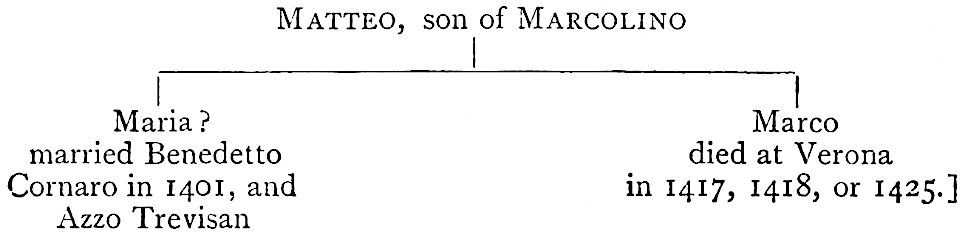
[Document dated 15th May, 1388, found at the Archives degli Esposti, now at the Archivio di Stato, by the Ab. Cav. V. Zanetti, containing a sentence of the Giudici della Curia del Procuratore in favour of Pietro Bragadin against Agnesina, sister, and Catarinuzza, widow of Matteo Polo di S. Giovanni Grisostomo, for work done. This document is interesting, as it shows that this Matteo was a son of Marcolino. Published partly in the Archivio Veneto, XVI., 1878, pp. 102–103.—H. C.]
20.—(1388).
[Document dated 15th May, 1388, found in the Archives degli Esposti, now at the Archivio di Stato, by the Ab. Cav. V. Zanetti, and mentioned by him in the Archivio Veneto, XVI., 1878, pp. 104–105, containing a sentence of the Giudici della Curia del Procuratore in favour of Pietro Bragadin against the Commissaries of the late Matteo Polo.—H. C.]
Appendix D.—Comparative Specimens of Different Recensions of Polo’s Text.
FRENCH.
1. MS. Paris Library, 7367 (now Fr. 1116).
(Geographic Text.)
Quant l’en se part de le isle de Pentam e l’en ala por ysceloc entor cent miles, adonc treuve le ysle de Java la Menor; mès si sachiés q’ele ne est pas si peitite q’ele ne gire environ plus de deus mille miles, et de ceste ysle voz conteron toute la virité. Or sachiés qe sor ceste ysle ha huit roiames et huit rois coronés en ceste ysle, e sunt tuit ydres et ont langajes por elles. Car sachiés che chascun des roiames ont langajes por eles. En ceste ysle a mout grandisme habundance de trezor et de toutes chieres especes e leingn aloe et espi, et de maintes autres especes que unques n’en vienent en nostre pais. Or vos voil conter la maineres de toutes cestes jens, cascune por soi, e vos dirai primermant une cousse qe bien senblera à cascun mervoilliose cousse. Or sachiés tout voirmant qe ceste ysle est tant à midi qe la stoille de tramontaine ne apert ne pou ne grant. Or noz retorneron à la mainere des homes, e voz conteron toute avant dou rouiame de Ferlec.
2. MS. of Paris Library, 10260 (Fr. 5631)
(Pauthier’s MS. A.)
Quant on se part de l’isle de Maliur, et on nage quatre vingt dix milles, adonc treuve en l’isle de Javva la Meneur; mais elle n’est mie si petite qu’elle n’ait de tour ii. milles. Et si vous conteray de cette isle l’affaire.
Sachiez que sus ceste isle a viij. royaumes et viij. rois courronnés. Ilz sont tuit ydolastres; et si a, chascun royaume, son langaige par soy. Il y a en ceste isle grant quantité d’espiceries. Et si vous conteray la maniere de la plus grant partie de ces huit royaumes. Mais je vous diray avant une chose. Et sachiez que ceste isle est si vers midi que l’estoille tremontainne n’y apert.
Or nous retournerons à notre matiere, et vous conterons tout avant du royaume de Falec.
3. Bern MS.
(T. de Cepoy’s Type.)
Quant l’en se part de l’isle de Malaiur, et l’en a nagie par seloc environ iiiixx et x milles, il dont treuve l’en la petite Isle de Java, mais elle n’est pas si petite qu’elle ne dure bien environ ijc milles. Et si vous conterons de ceste isle tout l’affaire et verité.
Ore sachiez que sous ceste isle y a viij. royaumes et viii. roys couronnez, car chascun roy si a couronne par soy. Il sont tout ydres et chascun royaume par soy a son langage. Il y a en ceste isle moult grant tresor, et si y a moult despeceries de moult de manieres. [Et si vous conteray la maniere][1] de la plus grant part de ces viii. royaumes chascun par soy, mais avant vous diray une chose qui moult samblera estrange à chascun. Sachiez que l’estoille de Tramontane apert ne pou ne assez.
Ore retournons nous a nostre manière.
ITALIAN.
4. Crusca.
Quando l’uomo si parte dell’isola di Petam, e l’uomo va per isciroc da c miglia, trova l’isola di Iava la Minore, ma ella non è si piccola ch’ella non giri ii. M miglia: e di questa isola vi conterò tutto il vero. Sappiate che in su questa isola hae viii. re coronati, e sono tutti idoli, e ciascuno di questi reami ha lingua per sè. Qui ha grande abbondanza di tesoro e di tutte care ispezierie. Or vi conterò la maniera di tutti questi reami di ciascuno per sè; e dirovvi una cosa che parrà maraviglia ad ogni uomo, che questa isola è tanto verso mezzodì, che la tramontana non si vede nè poco nè assai. Or torneremo alla maniera degli uomeni, e dirovvi del reame di Ferbet.
5. Bern Italian.
Se lo homo se parte da Pentan e navicha per sirocho c. mia, trova l’isola de Iana Minore che volze ben piu de iim. mia. In la qle isola è viii. regnami, e ciascun regname ha uno re. La zente de questa isola ha linguazo per si e sono idolatri e ge grande habundantia de specie che non sono mai in nostre contrade.
Questa isola è tanto verso mezodi chel non se po veder la stella tramontana ne pocho ne assai. Jo non fui in tutti li regnami de questa provincia ma fui in solo lo regname de Forletti e in quel de Basaron e in quello de Samara e in quello de Groian e in quel de Lambrin e in quello de Fanfiro. In li altri dui non fui. E pero io ne diro pur de questi dove sum stado.
6. Ramusio’s Printed Text.
Quando si parte dall’Isola Pentan, e che s’è navigato circa a cento miglia per Scirocco, si truova l’Isola di Giaua Minore. Ma non è però cosi picciola, che non giri circa due mila miglia a torno a torno. Et in quest’isola son’otto reami, et otto Re. Le genti della quale adorano gl’idoli, & in ciascun regno v’è linguaggio da sua posta, diverso dalla favella de gli altri regni. V’è abbondanza di thesoro, & di tutte le specie, & di legno d’aloe, verzino, ebano, & di molte altri sorti di specie, che alla patria nostra per la longhezza del viaggio, & pericoli del navigare non si portano, ma si portan’alla provincia di Mangi, & del Cataio.
Hor vogliamo dire della maniera di questi genti di ciascuna partitamente per se, ma primamente è da sapere, che quest’isola è posta tanto verso le parti di mezo giorno, che quivi la stella Tramontana non si puo vedere, & M. Marco fu in sei reami di quest’isola, de’ quali, qui se ne parlerà, lasciando gli altri due che non vidde.
LATIN.
7. MS. of Paris Library, 3195. (Geographic Latin.)
Quando homo recedit de insula de Pentay et vadit per silochum sentum miliaria, invenit insulam minorem de Java, et est ista insula parva et durat duo millia miliaria; et de istâ insulâ computabo vobis omnia. Super istâ insulâ sunt octo regna, in sex quorum ego Marcus fui, scilicet in regnis Ferlech, Basman, Samara, Dragoiam, Lambri et Fanfur. In aliis autem duobus non fui; et secundum quod sunt octo regna, ita sunt octo reges coronati, et sunt omnes idolatrae. Et quodlibet istorum regnorum habet linguam per se. Ibi est magna abundantia thesauri et de omnibus caris speciebus; et dicam vobis de istâ insulâ quaedam quae videbuntur mirabilia. Ista insula est tantum versus meridiem quod tramontana non videtur ibi nec parvum nec multum. Postquam diximus vobis de insulâ et de regnis ipsius, nunc computemus de moribus hominum ipsius insulae, et primo de regno Ferlech.
8. Pipino’s Version (British Museum, King’s Libr. 14 c. xiii.).
Ultra insulam Pentham per Syrocum post miliaria centum invenit insulam quæ dicitur Jaua Minor quæ in suo ambitu continet miliaria duo milia. Ibi sunt octo regna cum singulis regibus et est ibi propria lingua. Et omnis habitatores insulæ ydolatrie sectatores sunt. Ibi est omnium aromatum copia, quarum similitudinem nunquam vidimus citra mare. Hec insula in tantum est ad meridiem posita, quod de ipsâ insula Polus Articus videri non poterit stella seu illa quæ vulgariter dicitur Tramontana. Ego autem Marcus fui in sex regnis hujus insulæ, sc. in regnis Ferlech, Basman, Samara, Dragoian, Lambri et Famsur. In aliis autem duobus non fui. Et primo dicam de regno Ferlech.
9. Version of Cicogna MS. in Museo Civico, Venice.
Ab ynsulâ Pentain cerca 100 mil. versus Syroch est ynsula Jaua que licet Minor dicatur per respectum alterius supradicte est in circuitus [sic] 2000 mil. et plus. In ipsâ enim sunt 8 regna singuli[2] et reges, et habet quodlibet regnum per se proprium ydeoma, et est in ipsâ tesaurus multus valde et species magni valoris multe, et lignum aloes et spica, et multe diverse species que nunquam in nostris partibus apportantur. Et est hec ynsula in tantum versus meridiem possita quod Polus Articus breviter non apparet.
10. Version printed in the Novus Orbis of Grynæus.
Ultra insulam Petan, per Sirochum navigando, est Jaua Minor, centum distans milliaribus à Petan: et hæc in circuitu continere dicitur circiter duo millia milliarium. Dividitur insula in octo regna, habetque linguam propriam. Producit etiam varia aromata, qualia in his nostris partibus nunquam visa sunt.... Protenditur hæc insula in tantum ad Austrum, ut Polus Articus, et stelle ejus minime videri possent. Ego Marcus fui in hâc insula, lustravique sex ejus regna, nempe regnum Ferlech, Basman, Samara, Dragoiam, Lambri, et Fansur. In aliis vero duobus non fui.
Appendix E.—The Preface of Friar Pipino to his Latin Version of Marco Polo.
(Circa 1315–1320.)
“The Book of that prudent, honourable, and most truthful gentleman, Messer Marco Polo of Venice, concerning the circumstances and manners of the Regions of the East, which he conscientiously wrote and put forth in the Vulgar Tongue, I, Friar Francesco Pipino of Bologna, of the Order of the Preaching Friars, am called upon by a number of my Fathers and Masters to render faithfully and truthfully out of the vulgar tongue into the Latin. And this, not merely because they are themselves persons who take more pleasure in Latin than in vernacular compositions, but also that those who, owing to the diversity of languages and dialects, might find the perusal of the original difficult or impossible, may be able to read the Book with understanding and enjoyment.
“The task, indeed, which they have constrained me to undertake, is one which they themselves could have executed more competently, but they were averse to distract their attention from the higher contemplations and sublime pursuits to which they are devoted, in order to turn their thoughts and pens to things of the earth earthy. I, therefore, in obedience to their orders, have rendered the whole substance of the Book into such plain Latin as was suited to its subject.
“And let none deem this task to be vain and unprofitable; for I am of opinion that the perusal of the Book by the Faithful may merit an abounding Grace from the Lord; whether that in contemplating the variety, beauty, and vastness of God’s Creation, as herein displayed in His marvellous works, they may be led to bow in adoring wonder before His Power and Wisdom; or, that, in considering the depths of blindness and impurity in which the Gentile Nations are involved, they may be constrained at once to render thanks to God Who hath deigned to call His faithful people out of such perilous darkness into His marvellous Light, and to pray for the illumination of the hearts of the Heathen. Hereby, also, the sloth of undevout Christians may be put to shame, when they see how much more ready the nations of the unbelievers are to worship their Idols, than are many of those who have been marked with Christ’s Token to adore the True God. Moreover, the hearts of some members of the religious orders may be moved to strive for the diffusion of the Christian Faith, and by Divine Aid to carry the Name of Our Lord Jesus Christ, forgotten among so vast multitudes, to those blinded nations, among whom the harvest is indeed so great, and the labourers so few.
“But lest the inexperienced Reader should regard as beyond belief the many strange and unheard of things that are related in sundry passages of this Book, let all know Messer Marco Polo, the narrator of these marvels, to be a most respectable, veracious, and devout person, of most honourable character, and receiving such good testimony from all his acquaintance, that his many virtues claim entire belief for that which he relates. His Father, Messer Nicolo, a man of the highest respectability, used to relate all these things in the same manner. And his uncle, Messer Maffeo, who is spoken of in the Book, a man of ripe wisdom and piety, in familiar conversation with his Confessor when on his death-bed, maintained unflinchingly that the whole of the contents of this Book were true.
“Wherefore I have, with a safer conscience, undertaken the labour of this Translation, for the entertainment of my Readers, and to the praise of Our Lord Jesus Christ, the Creator of all things visible and invisible.”
Appendix F.—Note of MSS. of Marco Polo so far as they are known.
GENERAL DISTRIBUTION OF MSS.
Latin French Italian German Irish Total
Great Britain and Ireland ........ ........ ........ ........ ........ 16
Cambridge 3 ... ... ... ...
Dublin 1 ... ... ... ...
Lismore Castle ... ... ... ... 1
Glasgow 2 ... ... ... ...
London 4 2 1 ... ...
Oxford 1 1 ... ... ...
France ........ ........ ........ ........ ........ 12
Paris 4 7 1 ... ...
Luxemburg 1 ........ ........ ........ ........ 1
Belgium ........ ........ ........ ........ ........ 1
Brussels ... 1 ... ... ...
Italy ........ ........ ........ ........ ........ 29
Venice 4 ... 2 ... ...
Ferrara ... ... 1 ... ...
Milan 1 ... ... ... ...
Modena 1 ... ... ... ...
Florence 1 ... 8 ... ...
Lucca ... ... 1 ... ...
Siena ... ... 1 ... ...
Rome 4 1 1 ... ...
Spain ........ ........ ........ ........ ........ 3
Escurial1 1 ... ... ... ...
Toledo 1 ... 1 ... ...
Switzerland ........ ........ ........ ........ ........ 3
Bern ... 1 1 ... ...
Vevey ... 1 ... ... ...
Germany ........ ........ ........ ........ ........ 16
Munich 4 ... ... 4 ...
Wolfenbüttel 2 ... ... ... ...
Berlin 1 ... ... 1 ...
Würzburg 1 ... ... ... ...
Giessen 1 ... ... ... ...
Jena 1 ... ... ... ...
Mentz 1 ... ... ... ...
Austria ........ ........ ........ ........ ........ 2
Prague 1 ... ... ... ...
Vienna ... ... ... 1 ...
Sweden ........ ........ ........ ........ ........ 2
Stockholm ... 2 ... ... ...
41 16 21 6 1 85
I add Lists of the Miniatures in two of the finer MSS. as noted from examination.
List of Miniatures in the Great Volume of the French National Library, commonly known as ‘Le Livre des Merveilles’ (Fr. 2810) which belong to The Book of Marco Polo.
Frontispiece. “Comment les deux freres se partirent de Constantinople pour cherchier du monde.”
Conversation with the Ambassadors at Bokhara (fol. 2).
The Brothers before the G. Kaan (f. 2 v.).
The Kaan giving them Letters (f. 3).
„ „ „ „ a Golden Tablet (f. 3 v.).
The Second Departure from Venice (f. 4).
The Polos before Pope Gregory (f. 4 v.).
The two elder Polos before the Kaan presenting Book and Cross (f. 5).
The Polos demand congé (f. 6).
(Subject obscure) (f. 7).
Georgians, and Convent of St. Leonard (f. 8).
The Calif shut up in his Treasury (f. 9).
The Calif ordering Christians to move the Mountain (f. 10).
Miracle of the Mountain (God is seen pushing it) (f. 10 v.).
The three Kings en route (f. 11 v.).
„ „ „ adoring the Fire (f. 12).
(Subject obscure—Travelling in Persia?) (f. 12 v.).
Cattle of Kerman (f. 13 v.).
Ship from India arriving at Hormus (f. 14 v.).
Travelling in a Wood, with Wild Beasts (f. 15 v.).
The Old Man’s Paradise (f. 16 v.).
The Old Man administering the Potion (f. 17).
Hunting Porcupines in Badashan (f. 18).
Digging for Rubies in Badashan (f. 18).
Kashmir—the King maintaining Justice (i.e., seeing a Man’s head cut off) (f. 19 v.).
Baptism of Chagatai (f. 20 v.).
People of Charchan in the Desert (f. 21 v.).
Idolaters of Tangut with Ram before Idol (f. 22 v.).
Funeral Festivities of Tangut (f. 23).
(Subject obscure) (f. 24).
Coronation of Chinghiz (f. 25 v.).
Chinghiz sends to Prester John (f. 26).
Death of Chinghiz (f. 27).
(Subject obscure) (f. 28).
Some of Pliny’s Monsters (à propos de bottes) (f. 29 v.).
A Man herding White Cattle (?) (f. 30 v.).
Kúblái hawking, with Cheeta en croupe (f. 31 v.).
Kaan on Elephant, in Battle with Nayan (f. 33).
Nayan with his wife surprised by the enemy (f. 34).
The Kaan’s four Queens (f. 36).
The Kaan’s Palace, with the Lake and Green Mount (f. 37).
The Kaan’s Son’s Palace (f. 38).
The Kaan’s Banquet (f. 39).
„ worship of Idols (f. 40).
The Kaan travelling in Horse-litter (f. 41).
„ hunting (f. 42).
„ in Elephant-litter (f. 42 v.).
The White Feast (f. 44).
The Kaan gives Paper for Treasure (f. 45).
Couriers arrive before Kaan (f. 46 v.).
The Kaan transplants big Trees (f. 47 v.).
The Bridge Pulisangin (f. 49).
The Golden King as a Cow-herd (f. 50).
Trade on the Caramoran (f. 51).
The Girls of Tibet (f. 52 v.).
Fishing Pearls in Caindu (f. 54).
Dragons of Carajan (f. 55 v.).
Battle of Vochan (f. 58).
The Forests of Mien, Elephants in the Wood (f. 59).
„ „ and Unicorns, etc. (f. 59 v.).
Lion hunting in Coloman (f. 61).
Return from the Chase (f. 62 v.).
The Queen of Manzi surrenders (f. 64).
The City of Quinsai (f. 67).
The Receipt of Custom at Quinsai (f. 69).
Curiosities brought from India to Great Kaan (f. 71).
War with Chipangu (f. 72).
Scene at Sea (an Expedition to Chipangu?) (f. 73 v.).
Cannibals of Sumatra (f. 74 v.).
Cynocephali (rather Alopecocephali!) (f. 76 v.).
The folk of Ma’abar, without raiment (f. 78).
Idol worship of Indian girls (f. 80).
The Valley of Diamonds (f. 82).
Brahmin Merchants (f. 83).
Pepper gathering (f. 84).
Wild Beasts (f. 85).
City of Cambaia (f. 86 v.).
Male and Female Islands (f. 87).
Madagascar (f. 88).
Battle of the Abyssinian Kings (f. 89 v.)
City of the Ichthyophagi (f. 91).
Arab horses at Calatu (f. 92).
Wars of Caidu (f. 93 v.).
Prowess of Caidu’s daughter (f. 95 v.).[1]
List of Miniatures in the Bodleian MS. of Marco Polo.[2]
Frontispiece (f. 218).
The Kaan giving the Golden Tablet.
Presentation of Pope’s Letter.
Taking of Baudas.
The Bishop before the Calif.
The Three Kings at Bethlehem.
White Oxen of Kerman.
Paradise of the Old Man.
River of Balashan.
City of Campichu.
Battle with Prester John.
Tartars and their Idols.
The Kaan in his Park at Chandu.
Idol Worship.
Battle with Nayan.
Death of the Rebels.
Kaan rewarding his Officers.
„ at Table.
„ hunting.
The Kaan and his Barons.
The Kaan’s alms.
City of Kenjanfu.
„ „ Sindinfu.
People of Carajan.
The Couvade.
Gold and Silver Towers of Mien.
Funeral Customs.
The Great River Kian?
The Attack of Saianfu (with a Cannon, a Mangonel, and a Crossbow).
City of Quinsay.
Palace of Facfur.
Port of Zayton.
Cynocephali.
„
Idolaters of Little Java.
Pearl Divers.
Shrine of St. Thomas.
The Six Kings, subject to Abyssinia.
Part of the Frontispiece is engraved in vol. i. p. 18 of the present work; the whole of the Frontispiece representing the Piazzetta reduced has been poorly reproduced in Mrs. Oliphant’s The Makers of Venice, London, 1887, p. 134.
Appendix F.—List of MSS. of Marco Polo’s Book so far as they are known.[3]
The MSS. marked thus * are spoken of after Personal Inspection by the Editor.
No. Localities. Indications. Language. Description of MSS. Authorities.
Great Britain and Ireland.
1 British Museum Library Harleian MSS., No. 5115 Latin Pipino’s Version; with the work of Hayton the Armenian; Parchment; written about A.D. 1400, in a careful hand.—152 ff.—folio. *
2 British Museum Library Arundel, XIII., Plut. 163 c. Latin Pipino’s; followed by Odoric in same hand, but more carelessly written. Parchment.[4to; 51 fol., 14th century.—H. Cordier, Odoric de Pordenone, p. lxix.]. *
3 British Museum Library Bibl. Reg. XIV., c. 13.—Plut. 12 f. Latin Pipino’s.A well-written folio [311 ff.] on parchment, containing Ranulf of Chester; Praefationes Historiographorum; Gyraldus Camb. de Conq. Hyberniae; Libellus de Mirab. Sanctae Terrae; Odoric; Rubruquis; Polo; Verses of Master Michael of Cornwall; etc.—[H. Cordier, Odoric, pp. lxviii–lxix.]. *
4 British Museum Library Bib. Reg. XIX., D. I. French [Contains eight works: Le livre d’Alexandre; Jehan le Venelais, la Vengeance d’Alexandre; Marc Pol; Odoric; Ascelin, Mission chez les Tartares; le Directoire; Primat, Chronique des règnes de Louis IX. et de Philippe III.; Extraits de la Bible; Translation of Jean de Vignay. (See H. Cordier, Odoric, pp. cv.–cvi.; 14th century.)]. Paul Meyer, Doc. ms. de l’ancienne litt. de la France, 1871, pp. 69–80.
5 British Museum Library Additional MSS., No. 19, 952 Plut. cxcii. B. Latin Pipino’s. Paper, small 4to.—111 ff. Appended, f. 85 et seqq., is a notice of Mahommed and the Koran: Incipit Noticia de Machometo et de Libro Legis Sarracenorum, etc. Appears to be the work of William of Tripoli. (See vol. i. p. 23.). Purchased of D. Henry Wolff, 12th August, 1854. *
6 British Museum Library Sloane MSS., No. 251 Italian dialect Paper, small fol. 39 ff. A good deal abridged, and in a desperately difficult handwriting; but notable as being the only MS. besides the Geog. Text which contains the war of Toctai and Nogai at the end of the Book. It does not, however, contain the majority of the historical chapters forming our Book IV. At the end, f. 39 v., is “Esplizzit Liber Milionis Ziuis Veneziani Questo libro scrissi Saluador Paxuti (?) del=1457 a viazo di Baruti [Patron Misser Cabual Volanesso, chapit. Misser Polo Barbarigo].” (The latter words [in part.—H. C.] from Marsden; being to me illegible). *
7 British Museum Library Egerton, 2176 French Translated from the Latin version of Pipino. Parchment, 103 folio, 4to. Illuminated Capital Letters. Purchased of R. Townley Nordman, 22nd June, 1872. Yule, 2nd ed., II. p. 517.
8 Oxford Bodleian, No. 264 French This is bound up with the celebrated Alexander MS. It is a beautiful work, embellished with thirty-eight miniatures, some of which are exquisite, e.g., the Frontispiece, a large piece of about 9½ in. × 9 in., forming a sort of condensed view of the Field of Travel; a large part of it occupied by Venice, of which our cut (The Piazzetta) in vol. i., p. 18, Introduction, is an extract. Another fine work (f. 220) represents the three Polos presenting the Pope’s Letter to the Khan. The embroidered hands on the Khan’s robe form an inscription, in which is legible “Johannes me fecit.” This Mr. Coxe attributes to John of Cologne, a known artist of the 14th century. He considers the MS. to be of about 1380. The Alexander is dated 1338, and its illuminations as finished in 1344 by Jehan de Grise. [See supra, p. 528, note.] A comparison of a good many readings, as well as of the point where the version breaks off, and the words: “Explicit le Livre nommé du Grant Cann de la Graunt Cité de Cambaluc, Dieux ayde Amen,” indicate that this MS. is of the same type as Pauthier’s C (No. 20 in this List) and the Bern. MS. (No 63). The name given in the colophon as above has caused the work to be entered in the old Printed Catalogue under a wrong title. Hence the MS., as one of Marco Polo, has been overlooked. [P. Meyer, Romania, XI., 1882, pp. 290–301. E. W. B. Nicholson; Personal.—H. C.]
9 Oxford Merton College, No. 312 Latin Pipino’s; followed by Hayton, and Palladius de Agriculturâ. Coxe, Catal. Codd. MSS. Oxon. Pt. I., p. 123.
10 Cambridge University Library, D. d. I. 17, No. 12 Latin Pipino’s. The same folio contains Jacques de Vitry, Hayton, several works on Mahommedanism, among others that of William of Tripoli (vol. i. p. 23), Piers Plowman, etc., etc. Catal. of MSS. in Lib. of Camb. University, I. 22.
11 Cambridge University Library, D. d. VIII. 7 Latin Fragment of Marci Pauli Veneti Historia Tartarorum (probably Pipino’s.). Catal. of MSS. in Lib. of Camb. University, I. 22.
12 Cambridge Gonville and Caius College, No. 162 Latin Pipino’s; with Odoric, and other works relating to Asia. [H. Cordier, Odoric, p. lxviii.] Catal. of MSS. of Gonville and Caius Coll. Library, by Rev. J. J. Smith, 1849.
13 Glasgow Hunterian Collection, S. 5. 7 Latin Pipino’s Version, with illuminated initials, in a volume containing Guido Colonna’s Hist. destruct. Trojæ; De Gestis Alex. Magni; Turpinus de Gestis Caroli Magni; M.P.V.; Oderichus de Mirabilibus Tartariæ. Parchment, 4to. Note by Rev. Prof. W. P. Dickson, D.D.
14 Glasgow Hunterian Collection, Q. 6. 21 Latin Pipino’s also with illuminated initials, and also followed by Odoric. Parchment, 4to. Note by Rev. Prof. W. P. Dickson, D.D.
15 Ireland Lismore Castle, and a transcript in Library of Royal Irish Academy, Dublin Irish See vol. i., Introduction, Irish Version, pp. 102–103. O’Curry’s Lectures, and special Note by Mr. J. Long, Dublin.
16 Dublin Trinity College, No. 632 Latin Marco Polo: Itinerarium (ff. 43), 4to; 15th century. In a collection of “Historical and Miscellaneous Treatises” comprising: Leges S. Edwardi per Will. Conq. confirmatæ; De Fundatoribus Eccles. quarundam in Anglia, etc. Cat. of the MSS. in the Lib. Trinity College, Dublin, ... by T. K. Abbott, 1900, p. 105.
France.
17 Paris Bib. nationale, No. 7367 (now Fr. 1116) French This is the most precious of all MSS. of Polo. It has been fully spoken of (vol. i., Int., The Old French Text) under the name of the Geographic Text (or G. T.), because it was printed by the Société de Géographie in 1824. [See I, p. 83] A large 4to of thick parchment; 112 ff.; very clearly though not very neatly written in Gothic text.—14th century. A facsimile of this MS. has been made this year (1902) at Karlsruhe. (See App. H. p. 569.) *
18 Paris Bib. nationale, No. 8329 (now Fr. 2810) French “Ce Liure est des // Merueilles du Monde. Cest assavoir de la Terre // Saincte. Du Grant Kaan Empereur des tartars. // Et du pays Dynde. Le Quel // Liure Jehan Duc de Bourgoingne donna // a son oncle Jehan fils de Roy de // France duc de Berry et Dauviergne, Conte // de Poitou, Detampes. de Bouloingne. et Dauvergne. // Et contient le dit Liure six // Livres. Cest assavoir. Marc Pol. Frere Odric de lordre des // Freres meneurs. Le Liure fait à la requeste du Cardinal Taleran de // Pierregort. L’Estat du Grant Kaan. Le Liure de Messire Guillaume // de Mandeville. Le Liure de Frere Jehan Hayton de lordre de premonstre. // Le Liure de Frere Bicul de lordre des Freres Prescheurs //—Et sont en ce dit Liure Deux cens soixante six // hystoires.” Signed by N. Flamel. Then follows. 1° Marco Polo: “Cy après commence le liure de Marc Paule des merveilles daise la grant et dinde la maiour et mineur Et des diuerses regions du monde.”—Begins: “Pour sauoir la pure verite de diuerses regions du monde. Si prenez ce liure cy et le faictes lire. Si y trouuerez les grandismes merueilles qui y sont escriptes....” Ends (Fol. 96 verso): “Et a tant fine messire marc pol son liure de la diuision du monde et des merueilles dicelluy.” Of the 266 histoires or miniatures in this splendid book, 84 belong to the story of Polo. We have given engravings of several of them. Its value is estimated in the catalogue of the Library of the Duc de Berry in 1416 (quoted by Pauthier) at 125 livres, equivalent (if parisis) to about 115l. This is Pauthier’s MS. B. See vol. i., Int., Various Types of the Text. Large folio on vellum. [H. Cordier, Odoric, pp. cviii–cxiii.]. *
19 Paris Bib. Nationale, No. 10260 (now Fr. 5631) French “Ci commencent les rebriches de cest Livre qui est appelez le Deuisement du Monde, lequel je Grigoires contrefais du Livre de Messire Marc Pol le meilleur citoien de Venisse creant Crist.” At the beginning of the Text is a coarse drawing of Kúblái on his bretesche, carried by four elephants (vol. i., p. 337); and after the prologue another apparently representing the Princess Aijaruc wrestling with her wooer (vol. ii. p. 465). This is Pauthier’s MS. A. (vol. i, Int., Various Types of the Text), and also was in the Duc de Berry’s Library, valued at 6 livres 5 sols. [Second half of the 14th cent.]. *
20 Paris Bib. nationale, No. 10,270 (now Fr. 5649) French This is Pauthier’s MS. C. (See as before.) It is that which has the certificate about the original presented to the Seigneur de Cepoy; see Int., p. 69. At the end is Bertran Pichart scripsit hoc. Small 4to, parchment, in a clear enough half-current hand; 134 ff. Came from the library of the Archb. of Rheims. [Middle of the 15th century.] *
21 Paris Bib. nationale (675)? French I know nothing of this MS. except its readings of names given in the Table appended to the Geographic Text. It then belonged to the Comte d’Artois. Lazari has it entered as belonging to the Bibl. Imp., I know not if correctly. [I have been unable to find it in the Bibliothèque nationale.—H. C.] See preceding column.
22 Paris Bib. nationale, Fr. nouv. acq. 1880 French This is a copy of the time of King Louis XII., made apparently for Admiral Louis Malet de Graville, Governor of Honfleur, who died in 1516; it bears the arms of the Urfé family; it is at times modernized, but less is suppressed in it than in MSS. 5631 and 2810. The MS. ends: “Et se aucuns disoint qui a luy ...” about the middle of ch. cxcix. of Pauthier’s ed., p. 738, line 4. These are also the last words of the Stockholm MS. of which it is a copy. Purchased in 1870. L. Delisle, Bib. Ec. Chartes, xliii. p. 219.
23 Paris Bib. de l’Arsenal, No. 5219 French Translated by Robert Frescher.—Fol. 1. “Prologue du present livre, par maistre Robert Frescher, bachelier formé en theologie translateur.—Berose, ainsi que Jozephe nous a laissé par escript, fut natif de la cité de Babilone....”—Fol. 9. Begins: “Pour scavoir la pure verité des diverses regions du monde, lisés ou faictes lire ce livre....” Incomplete; ends: “... Argon fut filz de Abaga mon frere, et se aucun disoit que a luy.” (See Pauthier’s ed., p. 738.) Parchment; ff. 168; end of the 15th or beginning of 16th century. From the libraries of Charles Adrien Picard and de Paulmy. With miniatures some of which are engraved in Mœurs, Usages et Costumes du Moyen Age, par le Bibliophile Jacob, pp. 411–413. Cat. des MSS. de l’Arsenal, V. p. 163.
24 Paris Bib. nationale, No. 3195 Latin This is the old Latin version, published by the Soc. de Géog., and which I have cited as Geographic Latin or G. L. (See vol. i., Int., Various Types of the Text.) [Contains: Petri Amphusi clericalis disciplina; Odoric; Marco Polo; Bernardi cujusdam ad Raymundum Castri Ambrosii epistola de modo rei familiaris utilius gubernandae. Cf. Cat. Cod. MSS. Bib. Reg. Pars tertia., t. iii. Paris, 1744, p. 385. Parchment, small fol., 15th century.—H. Cordier, Odoric, p. lxxxiii—H. C.]. Printed Text.—H. Cordier.
25 Paris Bib. nationale, No. 1616 Latin Pipino’s. [Paper; fol. cccvii. et seqq.]. Table in the G. T.
26 Paris Bib. nationale, No. 6244 A. Latin Pipino’s. [Paper.] Table in the G. T.
27 Paris Bib. Nationale, Codd. Ital., No. 10,259 [now 434] Italian Paper, 4to, of 14th century. Seen, but not examined with any care, which I regret, as the readings suggest that it may have been that text from which Pipino translated [pp. 100.]. [Begins f. 2 recto: “Signori Imperadori Re e Duci e tutte altre gienti che // uolete sapere le diuerse gienerationi delle gienti // elle diuersità delle regioni del mondo leggiete que // sto libro doue retrouerrete tutte le grandissime marauigle,” etc. Ends: “Explicit Liber de Milione per Messe Marcho Polo di Vinegia. Deo gratias.”] I Manoscritti Italiani ... della R. Bib. Parigina ... dal Ant. Marsand, 1835, 4to.
28 Paris Former Library of Baron C. Walckenaer Latin A miscellaneous volume, containing an imperfect copy of Pipino’s version. Present locality not known. Table in the G. T.
Luxemburg.
29 Luxemburg City Library, No. 50 Latin Volume containing several works; and among them Marchi (Pauli) Veneti Liber Narrationum Morum, etc. Paper; written 1448 by Tilman Pluntsch, “canonicus ecclesie SS. Chresanti et Darie monasterii Eyfflie.” Pertz, Archiv, viii. 594.
Belgium.
30 Brussels Royal Library, No. 9309 French Derives from the Paris 5631 and 2810 and the Stockholm MS., 14th century. G. Raynaud, Romania, xi. pp. 429–430.
Italy.
31 Venice St. Mark’s Library, Cl. X. Codd. Lat. 72 Latin Pipino’s. Formerly belonged to the Monastery of St. John’s in Viridario at Padua, to which it was presented by John Marchanova, Doctor of Arts and Medicine, 1467. Paper, 4to. (It is mentioned by Marsden as at Padua, p. lv.) Lazari.
32 Venice St. Mark’s Library, Cl. X. Codd. Lat. 128 Latin Another of Pipino’s. Paper, 4to, of 15th century. Lazari.
33 Venice St. Mark’s Library, Cl. VI. Codd. Ital., 56 Italian (Ven. dialect) A rude translation of Pipino’s version, written late in the 15th century. Also contains a translation of the same Pipino’s Tract, De Locis Terrae Sanctae. Belonged to T. G. Farsetti. Paper, folio. Lazari.
34 Venice St. Mark’s Library, Cl. VI. Codd. Ital., 208 Italian (Ven. dialect) Corresponds to the Venetian edition of 1496, but even more inaccurate, with absurd interpolations. The volume contains also Odoric, A. Ca’ da Mosto, V. da Gama, Columbus, etc., being of the beginning of the 16th century. Paper, 4to. Belonged to Morelli. * Lazari.
35 Venice Museo Civico, Coll. Cicogna, No. 2389, now 2408. Latin ✛Paper, large 4to; belonged to Gian-Giuseppe Liruti, and after to E. A. Cicogna; contains also Odoric, published by G. Venni in 1761, and other matter. This is the MS. noticed at vol. i. Int., Ramusio’s Italian Version, p. 102, as containing several passages found in no other text except Ramusio’s Italian. Written in 1401 by the Notary Philip, son of Pietro Muleto of Fodan (or Fogan?)[4] in Friuli, whilst studying Rhetoric at Padua. * [H. Cordier, Odoric, pp. xci.–xcii.]
36 Venice Library of Count Donà delle Rose Italian, with a Venetian tinge It begins: “Quegli che desiderano d’entendere le maraviglose chose del mondo de l’Asia de Armenia persia e tartaria dell indie et diverse parti del mondo legano questo libro et intenderano quello chel nobelle citadino Veneciano Miss. Marcho Polo,” etc., and ends: “Explicit liber Millionis civis Veneciarum. Expleto ad CCCCXLVI mensis setembris die vigesimo-octavo.” These extracts indicate that it belongs to the same type as the Sloane MS. No. 6, in our list. Note by Comm. Nicolò Barozzi, Director of the Museo Civico at Venice.
37 Ferrara Public Library, No. 35n (336, N.B. 5) Italian, with a Venetian tinge Incipit prologus Libri qui vulgari hominum dicitur “El Milione.” This looks as if it were not Pipino’s. Note by the Abate S. B. Mondino.
38 Milan Ambrosian Library, M. 526, Sc. D. Latin Fragments extracted from Pipino’s version inserted at end of 2nd part of the Cronica Libri Ymaginis Mundi of Fr. Jacopo d’Acqui. (Vol. i. Int., Captivity of M. Polo.) Paper, folio. 14th century. Lazari.
39 Modena Este Library Latin Pipino’s Parchment of 14th century. Muratori speaks of this. (Script. VII.) as “fortassis autographum.” Muratori; and Prof. Bianconi, Degli Scritta di Marco Polo, etc.
40 Florence Bib. Magliabecchiana (now Nationale), Cl. XIII., Plut. IV. c. 104 Italian (Tuscan) The Crusca MS., of which an account has been given, vol. i. Int., Original Language of the Book. Paper, folio, early in 14th century. *
41 Florence Bib. Magliabecchiana (now Nazionale), Cl. XIII., Plut. IV. c. 73 Italian Many liberties taken with the text, and much abridged and disarranged. Thus, after the Prologue it proceeds: “Al nome di Dio io Marcho Polo Veneziano racconterò tutte le maravigliose chose ch’io trovai e vidi, etc. etc.” It ends at the chapter on Russia with the following impertinence: “E se volete sapere più innanzi dimandatene un altro ch’io Marcho Polo non cercai più avanti.” The Khalif is called Largaliffe; Reobarles, Reubarbe, with a marginal note in an old hand, “Reubarbe città di Persia, donde viene il reubarbero herba medicinale.” Completed by Dolfo Spini, 16th July, 1425. Paper. Belonged to the Strozzi Collection. *
42 Florence Bib. Magliabecchiana (now Nazionale), Cl. XIII., Plut. IV., c. 61 Italian This corresponds to the Pucci MS. noted below (No. 47). It contains the colophon quoted at vol. i. Int., Some Estimate of Polo and his Book, p. 115, note. Paper, folio, 1392, 100 ff. of which the first 40 contain Polo. Not well written. Ex. Bibl. Gaddianâ. * Baldelli-Boni.
43 Florence Bib. Magliabecchiana (now Nazionale), Cl. XIII., Plut. IV., c. 136 Italian Both beginning and end are missing. Slightly different from the Crusca. 14th century. * Baldelli-Boni.
44 Florence Riccardian Library Italian Ends with chapter on Russia. Followed by an extract of Mandevile and a valuable coll. of geographical documents of 15th century and beginning of 16th. Paper 4to, 16th century. *
45 Florence Riccardian Library Latin Pipino’s; but reaching only to Bk. III. ch. 31. Paper, 14th century. *
46 Florence Riccardian Library Italian (Ven. dialect), No. 1924 Partial and defective transcript under the title of Itinerario di Levante. G. Uzielli, Note.
47 Florence Library of Pucci family Italian See remarks at vol. i. Int., Various Types of the Text. Completed 20th Nov. 1391. *
48 Florence Bib. Palatina (now united to Nazionale), Cod. 572 Italian The language differs slightly from that of the Crusca, and, where I have compared it, is less compressed. Ends with Rossia. Paper, small 4to, 14th century. Written somewhat roughly in a very old hand. Rustician is Messer Restazo da Pisa. The Grand Kaan gives the Polo’s a “tovaglia d’Oro.” *
49 Lucca Bib. governativa, Coll. (Lucchesini, Giacomo), No. 26 (now No. 296) Italian (Ven. dialect) Corresponds to the corrupt Venice epitome published in 1496. Contains also Odorico. [Ends:—“Complito el libro de le cosse mirabile vedute per lo nobile homo Messer Marcho Polo gientelomo de Venesia a di 12 de Marzo 1465 per mi Daniele da Verona in sul Ponte de’ Berettari al onore e laude dell’Omnipotente.” Paper, 4to, 75 ff. H. Cordier, Odoric, pp. xcvi.–xcviii.] Baldelli-Boni.
50 Siena Public Library, c. V. 14 Italian This is a miscellaneous MS. which, among other things, contains a fragment of Polo, “Qui comīcio ellibro di Missere Mācho Polo da Vinegia de le cose māuiglose che trovo p̄ lo mondo,” etc. It calls Rusticiano Missere Stacio da Pisa.—N.B.—Baldelli gives a very similar description of a fragment at Sienna, but under press mark A. IV. 8. I assume that it is the same that I saw. *
51 Rome Vatican Library, Cod. 2207, Ottoboniano French A fragment, going no further than the chapter on Georgia, and ending thus: “Autre chose ne vous en scay dire parquoi je vous fois fin en ce livre; le nom de notre Seigneur soi benoist et de sa benoiste Mere. Amen. Loys de Luxembourg.” Parchment, 14 cent. Baldelli-Boni.
52 Rome Vatican Library, No. 2935 Latin An old Latin abridgment of Polo, entitled De Mirabilibus Mundi. The same volume contains a tract, De Mirabilibus Romae, to which also Polo’s name is given. Paper, 14th cent. Baldelli-Boni and Lazari.
53 Rome Vatican Library, No. 3153 Latin Pipino’s. Very neat and clean; apparently of 14th cent. Parchment. *
54 Rome Vatican Library, No. 5260 Latin Pipino’s. Very clearly and regularly written. Apparently 15th cent. *
55 Rome Barberini Library, XXXIV. 4 Latin A MS. volume, containing Ricold of Monte Croce; Tractatus divisionis et ambitûs Orbis Terrarum, etc.; Liber de divisione Orbis Terrarum; Libellus de Mirabilibus Urbis Romae; and “Incipit de Morum et Gentium Varietatibus editus a Marcho Polo Veneto.” It is very cramply written, much compressed, and has no division into books or chapters. Ends with “Roscia, provincia maxima.” “Explicit libellus editus a Dno. Marcho Polo de Venetiis de diversis provinciis et gentibus mundi, et earum ritibus et moribus diversis et artibus.” Parchment, large thin 4to, 14th cent. *
56 Rome Barberini Library, LVIII. 40 Italian (Venetian dial.) This is the fragment spoken of, vol. i. p. 101, note. It is a transcript made apparently in the 17th cent., from a MS. written in 1465. *
57 Rome Barberini Library, No. 934 Italian I give this on Baldelli’s authority. I did not see it on my visit to the Barberini. Baldelli-Boni.
58 Rome Corsini Library, No. 1111 Italian (?) . . . Baldelli-Boni.
59 Rome Chigi Library, M. VI. 140 Italian Bears a note in the handwriting of Pope Alexander VII. (Fabio Chigi of Sienna, 1655–1667), which draws attention to Sienese peculiarities in the language, and assigns the date about 1420 Sm. 4to, paper Baldelli-Boni.
Spain.
60 Escurial Library Latin Pipino’s (?)
61 Toledo Cathedral Library Latin Seems to be different from any of the other Latin versions. It has the prefatory address to Domini Imperatores, Reges, Duces, etc. 8vo, paper. Of 15th century. Baldelli-Boni.
62 Toledo Cathedral Library Italian (Venetian) This is a copy of the Soranzo MS., of which Marsden has given an ample notice after Apostolo Zeno, and which has disappeared from knowledge. Baldelli-Boni.
Switzerland.
63 Bern Canton Library, No. 125 French I have examined this MS. minutely, and am satisfied that it is a copy of Pauthier’s C. i.e., No. 20, in our List. Like that (and no other), it bears the certificate regarding the Seigneur de Cepoy. (Vol. i., Int., Notices of Marco in later life.) The MS. is fully described in Sinner’s Catalogue. It is in very beautiful condition, very clearly written on parchment, with all the initials filled up in gold and colours, and with numerous flowered scrolls. It belonged to Bongars, whose autograph is on it: “Bongars—l’a de la courtoisie de Mr. de Superville.” [Parchment, fol., ff. 286, 14th century.—H. Cordier, Odoric, pp. cxiv.–cxv.] *
64 Bern Canton Library Italian (Venetian) In a neat running hand resembling italic type. It is much abridged, especially in the latter part. Small Paper 4to. It is inscribed: “Bongars, de la courtoisie de Mr. Aurel, tiré de la biblioteque de Mr. de Vutron (?).” *
65 Vevey City Museum French [A double sheet; parchment, and of 14th century. Fragment: 1st sheet, end of chap. 121 and greater part of chap. 122; 2nd sheet, end of chap. 134, chaps. 135, 136, 137, and beginning of chap. 138 of Pauthier’s ed. Very similar to the text of the Stockholm MS. Our No. 84.—H. C.] Ernest Muret, Romania, t. xxx. 1901.
Germany.
66 Munich Royal Library, Codd. Lat. 249 Latin Pipino’s. Folio, paper, 15th century. Also Pipino’s tract, De Locis Terrae Sctae., and Boccacio’s De Casibus Virorum Illustrium. Lazari.
67 Munich Royal Library, Codd. Lat. 850 Latin Pipino’s. Paper, 4to, 15th cent. Also Pipino’s tract, De Locis Terrae Sctae., etc. Lazari.
68 Munich Royal Library? Latin Excerpta de ejus Historia, principaliter Orientalis Private Memo.
69 Munich Royal Library? Latin Narrationes ex ejus libro de partibus transmarinis Private Memo.
70 Munich Royal Library, Cod. Germ. 696 German The version published at Nuremberg in 1477. Paper, 4to. [See Bibliography, p. 554.] Lazari.
71 Munich Royal Library, 252 German Fragment. Lazari.
72 Munich ? German The whole. Private Memo.
73 Munich ? German Translated for Duke William of Bavaria, 1582. Private Memo.
74 Wolfenbüttel Ducal Library, No. 40, Weissemburg Latin [Contains: Polo (Pipino’s version) f. 1–57 verso; Odoric; Ricold; Boldensel.—Ricold was published by Mr. J. C. Laurent: Peregrinatores Medii Aevi Quatuor. Lipsiae, 1864. Paper, 15th cent., fol., ff. 110.] H. Cordier, Odoric, pp. lxxiv.–lxxv.
75 Wolfenbüttel Ducal Library, No. 41, Weissemburg Latin [Contains: Ciceronis orationes in Verrem; Chronicon Flandriae; R. Bacon, de regionibus ad papam Clementem; Marco Polo, ff. 122–160 verso; Ricold; Jacques de Vitry; Odoric; Plano Carpini. Paper 15th cent, fol., ff. 253.] H. Cordier, Odoric, pp. lxxv.–vi.
76 Berlin Royal Library Latin Pipino’s. Also contains Mappa-Mundi, Expositio Libri Mateorum, etc. I believe this is the Codex Brandenburgensis collated by Andreas Müller in his edition (1671). Private Memo.
77 Berlin Royal Library German A modern MS., said to be a copy of the Wiener MS. (?). Private Memo.
78 Würzburg Royal Library Latin Marcus Paulus de Mirabilibus Mundi. Paper. Pertz, Archiv., viii. 100.
79 Giessen University Library, No. 218 Latin M. Paulus de Venetiis de Regionibus Orientis (with other matter), probably Pipino’s. Paper, folio, 15th cent. I know not if it is a second, which is cited by Mr. Major (Notes on Russia) from Catalogus Codd. MSS. Academ. Gissenses, by J. V. Adrian, Frankfort, 1840, as bound up with Eusebius and entitled M. P. de Ven. de condit. et consuet. Orient. Regionum. Pertz, Archiv., ix. 576.
80 Jena University Library Latin Pipino’s. Followed by H. of Alexander Pertz, Archiv., viii. 698.
81 Mentz Metropolitan Chapter, No. 52 Latin Pipino’s. A collection containing in Latin, besides Polo, Odoric, Ricold, and Boldensel. [H. Cordier, Odoric, pp. lxxii.–iv.] V. F. de Gudenus, Sylloge I. Variorum Diplomatariorum, etc., Frankf. 1728, p. 381.
Austria.
82 Prague Chapter of St. Vitus Latin Pipino’s Pertz, Archiv., ix. 474.
83 Vienna . . . German? There appears to be a MS. at Vienna; for above I have registered (No. 77) one at Berlin, which is called a copy of the Vienna MS., but I have not been able to get any particulars regarding it. *
Sweden.
84 Stockholm Royal Library, French, No. 37 French This MS., published in facsimile by Baron A. E. Nordenskiöld, belongs to the “Cepoy” type of MSS. Yule wrote in The Athenæum (17th June, 1882): “I gather that it has been produced by partial abridgement from one of the earlier MSS. of the type in question.” And again (p. 766): “It will be seen that though the publication is a beautiful example of facsimile, it contributes, as far as I have been able to examine it, nothing to the amelioration or elucidation of the text or narrative.” The changes and suppressions are much less considerable than in the Paris MSS., 5631 and 2810. Cf L. Delisle, Bib. de l’Ecole des Chartes, XLIII., 1882, pp. 226–235, 424. It is incomplete, and ends: “Et se aucuns disoit quí a luí.”—Cf. Paris MS., 1880. [Our No. 22.] It belonged to the Library of the French King, Charles V. (1364–1380), and later, as marked on the recto of the last folio, “Pour Symon du Solier demorant à Honnefleu,” who was “procureur-syndic des manants et habitants de la ville de Honfleur.” H. Cordier.
85 Stockholm Royal Library, French, No. 38 French Translated from the Latin version. G. Raynaud, Romania, XI.
Appendix G.—Diagram showing Filiation of Chief MSS. and Editions of Marco Polo.
N.B.—Such MSS. as are not enclosed in Cartouches are hypothetical, or not known now to exist, but are recognized or demonstrable as links in the series. Nos. refer to List of MSS. in App. F. Printed Editions are in small capitals.
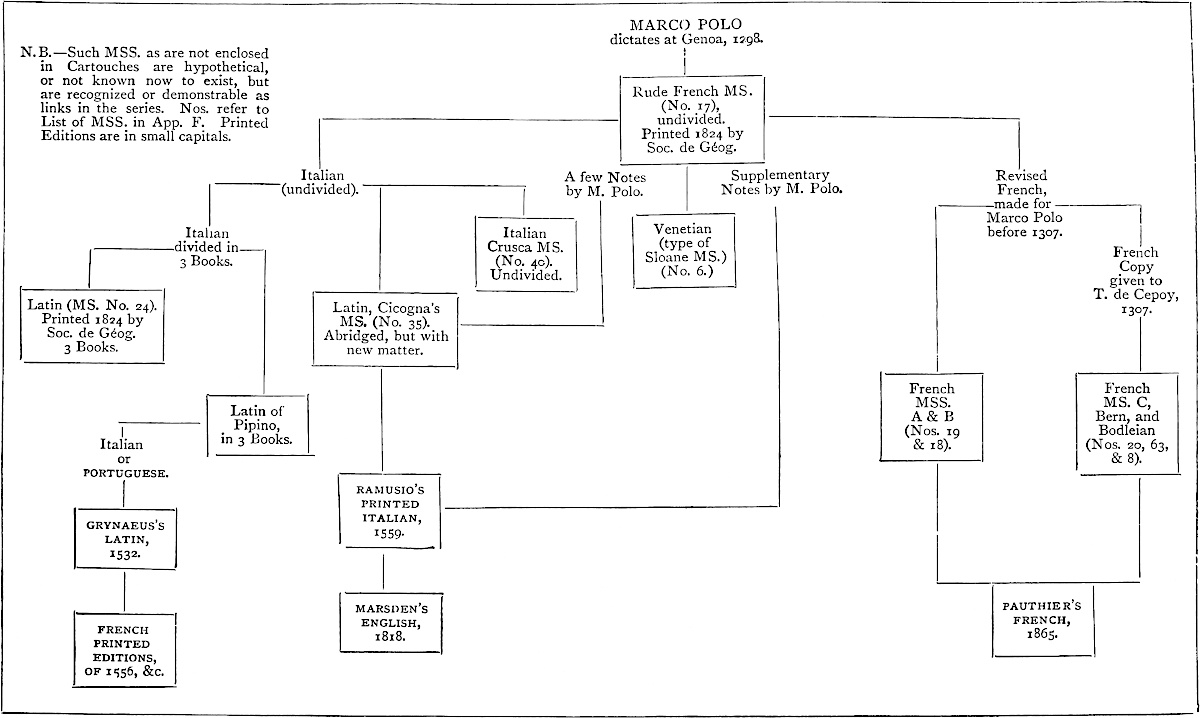
Appendix H.—Bibliography of Marco Polo’s Book.
I.—Principal Editions.
We attempt a list of all the editions of Polo; a task for which Sir Henry Yule had no advantages, and which will be found well done for the time in Lazari’s Appendix, based on Marsden. It may be also useful to mention the chief Editions, with their dates.
1477. The first Printed Edition is in German. We give a reduced Facsimile of its Frontispiece. (See p. 555.)
1481. A reproduction of the preceding at Augsburg, in the same volume with the History of Duke Leopold and his Son William of Austria.
About 1490. Pipino’s Latin; the only printed edition of that version. Without place, date, or printer’s name. (See p. 558.)
1496. Edition in Venetian Dialect, printed by J. B. da Sessa.
1500. The preceding reproduced at Brescia (often afterwards in Italy).
1502. Portuguese version from Pipino, along with the Travels of Nicolo Conti. Printed at Lisbon by Valentym Fernandez Alemao (see vol. ii. of this work, p. 295). Stated to have been translated from the MS. presented by Venice to Prince Pedro (vol. i. p. 135.)
1503. Spanish version by Rodrigo de Santaella. Sevilla.
1529. Ditto. Reprinted at Logroño.
1532. Novus Orbis—Basileæ. (See vol. i. p. 95.)
1556. French version from the Novus Orbis.
1559. Ramusio’s 2nd volume, containing his version of Polo, of which we have spoken amply.
1579. First English Version, made by John Frampton, according to Marsden, from the Spanish version of Seville or Logroño.
1625. Purchas’s Pilgrims, vol. iii. contains a very loose translation from Ramusio.
1664. Dutch Version, from the Novus Orbis. Amsterdam.
1671. Andreas Müller of Greiffenhagen reprints the Latin of the Novus Orbis, with a collation of readings from the Pipino MS. at Berlin; and with it the book of Hayton, and a disquisition De Chataiâ. The Editor appears to have been an enthusiast in his subject, but he selected his text very injudiciously. (See vol. i. p. 96.)
1735. Bergeron’s interesting collection of Mediæval Travels in Asia, published in French at the Hague. The Polo is a translation from Müller, and hence is (as we have already indicated) at 6th hand.
1747. In Astley’s Collection, IV. 580 seqq., there is an abstract of Polo’s book, with brief notes, which are extremely acute, though written in a vulgar tone, too characteristic of the time.
1818. Marsden’s famous English Edition.
1824. The Publication of the most valuable MS. and most genuine form of the text, by the Soc. de Géographie of Paris. (See vol. i. p. 83.) It also contains the Latin Text (No. 24 in our list of MSS. App. F.).
1827. Baldelli-Boni published the Crusca MS. (No. 40), and republished the Ramusian Version, with numerous notes, and interesting dissertations. The 2 volumes are cumbered with 2 volumes more containing, as a Preliminary, a History of the Mutual Relations of Europe and Asia, which probably no man ever read. Florence.
1844. Hugh Murray’s Edition. It is, like the present one, eclectic as regards the text, but the Editor has taken large liberties with the arrangement of the Book.
1845. Bürck’s German Version, Leipzig. It is translated from Ramusio, with copious notes, chiefly derived from Marsden and Ritter. There are some notes at the end added by the late Karl Friedrich Neumann, but as a whole these are disappointing.
1847. Lazari’s Italian edition was prepared at the expense of the late Senator T. Pasini, in commemoration of the meeting of the Italian Scientific Congress at Venice in that year, to the members of which it was presented. It is a creditable work, but too hastily got up.
1854. Mr. T. Wright prepared an edition for Bohn’s Antiq. Library. The notes are in the main (and professedly) abridged from Marsden’s, whose text is generally followed, but with the addition of the historical chapters, and a few other modifications from the Geographic Text.
1854–57. Voyageurs Anciens et Modernes, &c. Par M. Ed. Charton. Paris. An interesting and creditable popular work. Vol. ii. contains Marco Polo, with many illustrations, including copies from miniatures in the Livre des Merveilles. (See list in App. F. p. 528.)
1863. Signor Adolfo Bartoli reprinted the Crusca MS. from the original, making a careful comparison with the Geographic Text. He has prefixed a valuable and accurate Essay on Marco Polo and the Literary History of his Book, by which I have profited.
1865. M. Pauthier’s learned edition.
1871. First edition of the present work.
1873. First publication of Marco Polo in Russian.
1875. Second edition of this work.
1882. Facsimile of the French Stockholm MS. by Baron A. E. Nordenskiöld.
II.—Bibliography of Printed Editions.[1]
A.—German Editions.
1.—1. Nuremberg ... 1477.
The first translation of Marco Polo’s Book was printed in German, at Nuremberg, in 1477.
Collation: 58 ff. folio without pagination and without signatures.
Verso f. 1: Frontispiece: Portrait of Marco Polo with this inscription round the border: [Top] Das ist der edel Ritter. Marcho polo von [right] Venedig der grost landtfarer. der vns beschreibt die grossen wunder der welt [Foot] die er selber gesehenn hat. Von dem auffgang [left] pis zu dem nydergãg der sunnẽ. der gleychẽ vor nicht meer gehört seyn. [See p. 555.]
Recto f. 2, begins:
Hie hebt sich an das puch dés edelñ Ritters vñ landtfarers ‖ Marcho polo. In dem er schreibt die grossen wunderlichen ‖ ding dieser welt. Sunderlichen von den grossen kũnigen vnd ‖ keysern die da herschen in den selbigen landen | vnd von irem ‖ volck vnd seiner gewonheit da selbs.

Verso f. 58: Hie endet sich das puch des edelñ Ritters und lañdtfarerz ‖ Marcho polo | das do sagt võ mangerley wunder der landt ‖ vñ lewt | vñ wie er die selbigen gesehen vñ durch faren hat ‖ von dẽ auffgang pisz zu dem nydergang der sũnẽ Seliglich.
Disz hat gedruckt Fricz Creũszner zu Nurm̃berg Nach cristi ‖ gepurdt Tausent vierhundert vñ im siben vñ sibenczigtē iar.
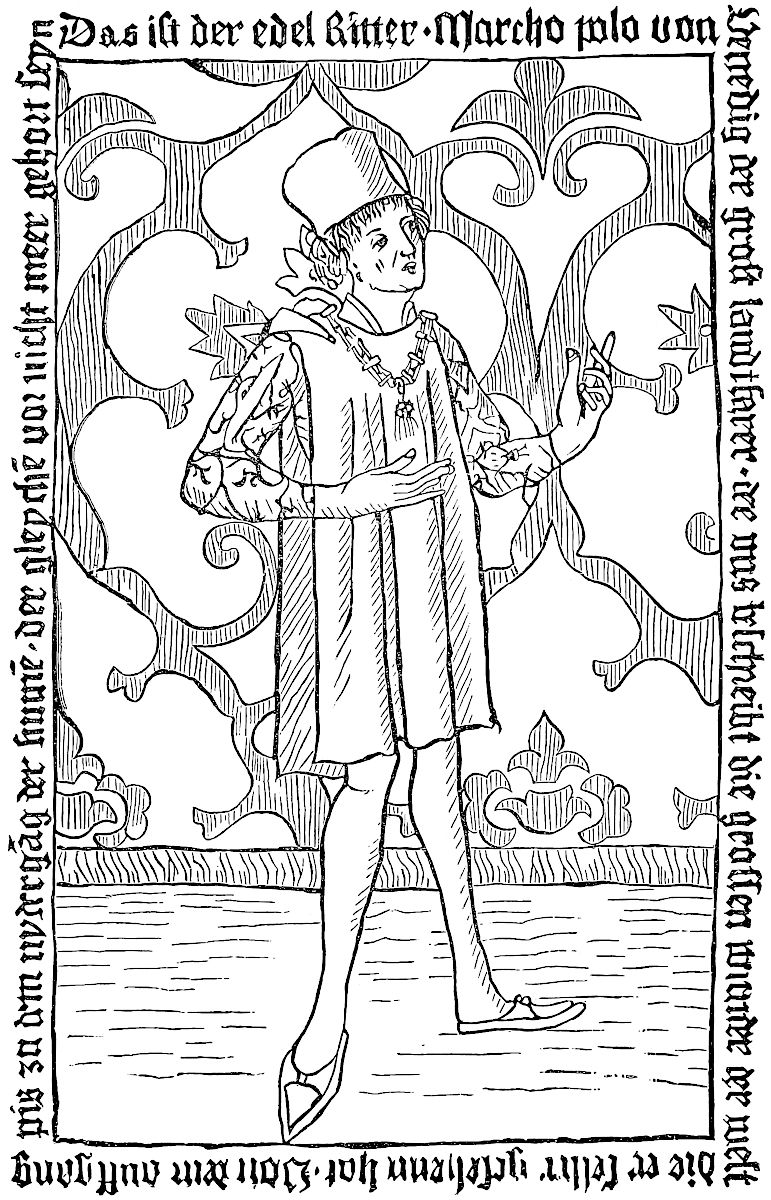
Frontispiece of the first German Edition.
The copy which I have examined is in the Grenville Library, No. 6787. (Vide Bib. Grenvilliana, Part II. p. 305.) When Marsden edited his Marco Polo, Grenville did not possess this edition. The only known copy was in the Vienna Imperial Library, but was without the portrait. Grenville had made a transcript spoken of by Marsden, pp. lxx.–lxxi., which we describe infra. “When Mr. Marsden,” says Grenville in a MS. note at the beginning of this fine volume, “published his translation of this work, the only known copy of this first German Edition was in the Imperial Library at Vienna, and I had a literal transcript made from it: Since that time a second copy was found and sold by Payne and Foss to Lord Spencer: and now I have purchased from Leipsick a third [the present] beautiful copy. I know of no fourth copy. The copy at Vienna wants the portrait.”
Vide Bib. Spenceriana, vol. vi. p. 176.
Other copies are to be found at the Imperial Library, Vienna, the Royal Library, Berlin, the Germanisches Museum, Nuremberg; a sixth copy was in the Crawford Collection (London, June, 1887, 1359) with the portrait, and was purchased by B. Quaritch. [See H. Cordier, Cent. of Marco Polo, p. 41.]
—The copy we just spoke of has No. LII. in the Grenville collection, British Museum; it is a folio of 114 pages numbered with a pencil; bound with the arms of the Rt. Honble. Thos. Grenville. Page 114, the exactness of this copy is thus certified: “Apographum collatum cum prototypo, quod in Bibliotheca Palatina Vindobonensi adservatur. Illo quidem, qui descripsit, recitante ex prototypo, me vero hoc apographum inspectante. Respondet pagina paginae, versui versus & syllaba syllabae. Vindobonae die 29. Augusti 1817. B. Kopitar, Biblioth. Palatinae Vindobon. scriptor.”
With this manuscript is bound a letter addressed to Mr. Grenville by the Chevalier Scotti, who had the copy made; it is dated “Vienne 20 nmbre 1817,” and ends with this post-scriptum: “N. B. Comme cette Edition fort peu connue du 477. est une édition non seulement précieuse, mais à la vérité fort rare aussi, elle avoit été prise par les François et portée à Paris la dernière fois qu’ils ont été à Vienne. Elle y a été rendue avec tout le reste qu’on avoit emporté à la suite des heureux succès des Coilisés, auxquels L’immortel Wellington a tant contribué en y mettant la dernière couronne dont les lauriers resteront à jamais inflétrissables.”
2.—2. Augsburg ... 1481.
—The second German edition of Marco Polo has been reprinted at Augsburg in 1481; it is as scarce as the first edition; I have examined the copy in the Imperial Library at St. Petersburg.
Collation: 60 ff. folio, without pagination nor signatures.
Recto f. 1: End of the story of William of Austria, after which is printed Marco Polo.
Verso f. 1: Frontispiece: Portrait of Marco Polo coloured with this inscription round the border: [Top] Das ist der edel ritter Marcho polo von Venedig. [right] der grõst landfarer. der vns beschreibt die grossen wunder der welt die er selber gese [foot] hen hat. Von dem auffgang biss zu dem nidergang der [left] sunnen | der geleich vor nit meer gehört seind.
Recto f. 2, begins:
Hie hept sich an das buch des edlẽ ritters vñ landtfarers Marcho polo. in dem er schreibt die grossen wunderlichen ding diser welt. sunderlichen võ den grossen künigen vnd keisern | die da herschen in den selbigen landen vnd von jrem volck vnnd seiner gewonheÿt da selbs.
Recto f. 60: Hie enndet sich herczog Wilhalm von österreich vñ das buch des edeln ritters vñ landtfarers Marcho polo | das da sagt von mengerleÿ wunder der land vnd leüt. vnd wie er die selbigẽ gesehen vñ durch faren hat von dem auffgang biss zu dem nÿdergang d’sunnen Seligklich. Diss hat gedruckt Anthonius Sorg zu Augspurg Nach xp̃i gepurt tausent vier hundert vnd jm lxxxj. jare.
No. fig. in the text.
3.—3. Die New Welt der landschaften vnnd Insulen ... gedruckt zu Strassburg durch Georgen Vlricher ... An. m.d.xxxiiii, folio.
Ff. 103–133; Marr Paulen des Venedigers Erst Buch | von den Morgenlandern.—Ff. 134–152: Haithon des Armeniers Premonstratensis ordens | von den Tartern.
Translated from the Novus Orbis Regionvm.—See 11–12.
4.—4.* M. Polus. Reise in die Tartarey und zum Grossen Chan von Chatai, uebersetzt. v. H. Megisser. Altenburg, 1609, 8vo.
H. Ternaux-Compans, Bibliothèque asiatique et africaine, No. 1031.—[Notwithstanding all my researches, I could not find this edition in any private or public library in Germany.—H. C.]
5.—5. Chorographia Tartariæ: ‖ Oder ‖ Warhafftige Beschreibung der ‖ vberaus wunderbahrlichen Reise | ‖ welche der Edle vnd weit erfahrne Venedigi—‖ sche Gentilhuomo Marcus Polus, mit dem ‖ zunahmen Million, noch vor vierthalb hundert Jah=‖ren | in die Oriental vnd Morgenlãnder | Sonderlich aber in ‖ die Tartarey | zu dem grossen Can von Cathai | zu ‖ Land vnd Wasser Persönlich verrichtet: ‖ Darinnen ausführlich vnd vmbständ=‖lich erzehlet werden | viel zuvor vnbekandte Landschaff=‖ten | Königreich vnd Städt | sampt dero Sitten vnd ‖ Gebräuchen | vnd andern seltzamen Sachen: ‖ Die Er | als der erste Erfinder der newen Welt | gegen ‖ Orient | oder den Ost Indien | gesehen vnd erfahren. ‖ In drey vnterschiedliche Bücher abge=‖[t]heilet: sampt einem Discurs Herrn Johan Bapti=‖stae Rhamnusij | der Herrschafft zu Vene=‖dig geheimen Secretarij | von dem ‖ Leben des Autoris. ‖ Alles aus dem Original | so in Italianischer ‖ Sprach beschrieben | treulich vnd mit fleis ver=‖ teutschet | auch mit Kupfferstücken ‖ geziehret | durch ‖ Hieronymum Megiserum.—‖ Anno m. dc. xi. ‖ Leipzig | in vorlegung Henning Grossen des Jüngern. Small 8vo. pp. 354 (last page numbered by mistake 351) + 36 prel. ff. for the tit., preface, etc., and 7 ff. at the end for the table.
Plates.—See p. 350: Alphabetum Tartaricúm, et Oratio Dominica Tartaricé.
6.—6. Die Reisen des Marco Polo, oder Marcus Paulus, eines Venetianers, in die Tartarey, im Jahre 1272. (Allgemeine Historie der Reisen, Leipzig, 1750, VII, pp. 423 et seq.)
7.—7. Marco Paolo’s ‖ Reise in den Orient | ‖ während der Jahre 1272 bis 1295. ‖—Nach den ‖ vorzüglichsten Original=Ausgaben verdeutscht, ‖ und ‖ mit einem Kommentar begleitet ‖ von ‖ Felix Peregrin.‖—Ronneburg und Leipzig, ‖ bei August Schumann, 1802, 8vo., pp. vi–248.
P. 248: Eisenberg, gedruckt bei Johann Wilhelm Schöne.
8.—8. Die Reisen des Venezianers Marco Polo im dreizehnten Jahrhundert.—Zum ersten Male vollständig nach den besten Ausgaben Deutsch mit einem Kommentar von August Bürck.—Nebst Zusätzen und Verbesserungen von Karl Friedrich Neumann. Leipzig, B. G. Teubner, 1845, 8vo, pp. xvi–631.
—Di un frammento inedito di Marco Foscarini intorno ai Viaggiatori Veneziani e di una nuova traduzione in tedesco dei Viaggi di Marco Polo. [By Tommaso Gar] (Archivio Storico Italiano, Appendice, T. IV, Firenze, 1847, pp. 89 et seq.)
9.—9. Die Reisen des Venezianers Marco Polo im dreizehnten Jahrhundert.—Zum ersten Male vollständig nach den besten Ausgaben Deutsch mit einem Kommentar von August Bürck. Nebst Zusätzen und Verbesserungen von Karl Friedrich Neumann. Zweite unveränderte Ausgabe.—Leipzig, Druck und Verlag von B. G. Teubner, 1855, 8vo, pp. xvi–631.
B.—Latin Editions.
10.—1. Commence; In nomine dn̄i nri ihū xp̄i filij dei viui et veri amen. Incipit plogus ī libro dn̄i marci pauli de venecijs de cōsuetudinibus et cōdicionibus orientaliū regionū.
Then the declaration of “Frater franciscus pepur. de bononia frm̃ p̄dicatorū” who translated the work from the vulgar language into Latin.
End p. 147: Explicit liber dn̄i marci de venecijs Deo gracias.
Collation: 74 f. or 148 pages; the last is blank, 4to, no title, no pagination; signatures p. 1, a. 1 = p. 141, k. 3 (a-h, par 8; i, by 4; k, by 6); maximum 33 lines by page; [1485?].
It is interesting to note that Christopher Columbus had a copy of this edition of Marco Polo, now kept in the Colombina at Seville. The margins of the following folios contain the autograph notes of the great navigator:
9 v. 31 r. & v. 46 v. 55 r. & v. 66 r. & v.
13 v. 36 v. 47 r. & v. 57 r. & v. 67 r. & v.
15 r. & v. 38 v. 48 r. & v. 59 r. & v. 68 r. & v.
17 v. 39 r. 49 r. & v. 60 r. & v. 69 r. & v.
18 r. & v. 40 r. & v. 50 r. & v. 61 r. & v. 70 r. & v.
19 r. 41 r. 51 r. & v. 62 r. & v. 71 r. & v.
23 r. & v. 42 r. & v. 52 r. & v. 63 r. 72 r. & v.
24 r. & v. 43 r. & v. 53 r. & v. 64 v. 73 r. & v.
25 r. 44 r. & v. 54 r. 65 r. & v. 74 r.
Cf. Simón de la Rosa y Lopéz, pp. XXIII, XLIII–XLIV of vol. II, Sevilla, 1891, 4to: Biblioteca Colombina.—Catálogo de sus libros impresos publicado por primera vez en virtud de acuerdo del Excmo. é Ilmo. Sr. Déan y Cabildo de la Santa Metropolitana y Patriarcal Iglesia de Sevilla bajo la immediata dirección de su Bibliotecario el Ilmo. Sr. Dr. D. Servando Arbolí y Faraudo Dignidad de Capellán Mayor de San Fernando.—See also H. Harrisse, Bibl. americana vetustissima.—Additions, p. XII.
“Edition fort rare, dit Brunet, et la plus ancienne que l’on ait de cette version latine de Marco Polo, faite par Pipino, vers 1320. Elle est imprimée avec les mêmes caractères, que l’Itinerarium de Joan. de Mandeville, c’est-à-dire par Gerard de Leeu, à Anvers, vers 1485, et non pas à Rome et à Venise, comme on l’avait supposé. Vend. 4 liv. 14 sh. 6d. Hanrott; 7 liv. Libri en 1859. (Choicer portion, 1562.)” Brunet writes elsewhere (cf. Mandeville par H. Cordier) about Mandeville from the same press: “... La souscription que nous allons rapporter semble prouver qu’elle a été imprimée à Venise; cependant Panzer, IX, 200, la croit sortie des presses de Theodoric Martin, à Aloste, et M. Grenville en trouvait les caractères conformes à ceux que Gérard Leeu a employés à Anvers, de 1484–1485. M. Campbell (Ann. de la typ. néerlandaise) la donne à Gérard Leeu, et fixe la date de l’impression à la première année du séjour de ce typographe à Anvers, après son départ de Gouda.”
It is certain from the use of the signatures a, aa, a, and the similitude of the type of the three works, that the Mandeville, the Ludolphe, and the Marco Polo come from the same printing office, and have been printed together as it seems to be proved by the copy of the Sunderland Library, which was complete and contained the three works.
Lazari, p. 460, writes: “Jo. de Mandeville itineraria: Dom. Ludolph. de itinere ad Terram Sanctam: M. Paul. Venet. de regionibus orientalibus. Liber rariss. Zwollis, 1483, in–4.