Volume 2 / Part 3 — CHAPTER XIV.
Henry Yule translation
Concerning the Island of Seilan.
When you leave the Island of Angamanain and sail about a thousand miles in a direction a little south of west, you come to the Island of Seilan,{1} which is in good sooth the best Island of its size in the world. You must know that it has a compass of 2400 miles, but in old times it was greater still, for it then had a circuit of about 3600 miles, as you find in the charts of the mariners of those seas. But the north wind there blows with such strength that it has caused the sea to submerge a large part of the Island; and that is the reason why it is not so big now as it used to be. For you must know that, on the side where the north wind strikes, the Island is very low and flat, insomuch that in approaching on board ship from the high seas you do not see the land till you are right upon it.{2} Now I will tell you all about this Island.
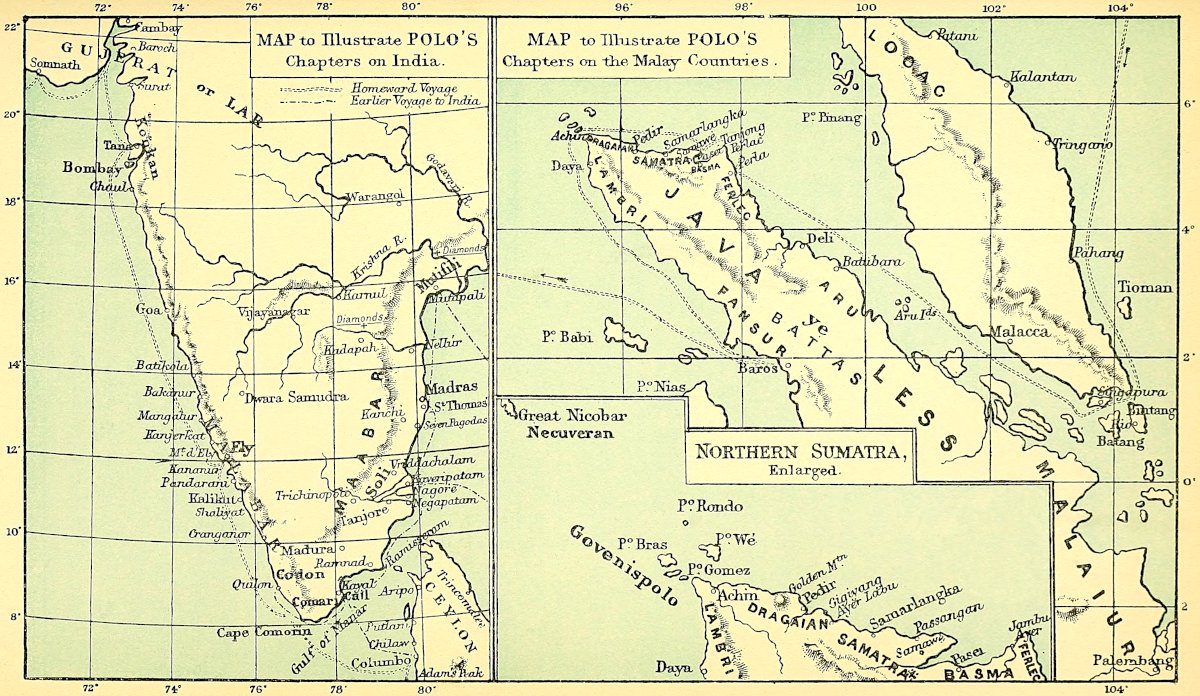
MAP to Illustrate POLO’S Chapters on India. MAP to Illustrate POLO’S Chapters on the Malay Countries.
London, John Murray, Albemarle Street.
They have a king there whom they call Sendemain, and are tributary to nobody.{3} The people are Idolaters, and go quite naked except that they cover the middle. They have no wheat, but have rice, and sesamum of which they make their oil. They live on flesh and milk, and have tree-wine such as I have told you of. And they have brazil-wood, much the best in the world.{4}
Now I will quit these particulars, and tell you of the most precious article that exists in the world. You must know that rubies are found in this Island and in no other country in the world but this. They find there also sapphires and topazes and amethysts, and many other stones of price. And the King of this Island possesses a ruby which is the finest and biggest in the world; I will tell you what it is like. It is about a palm in length, and as thick as a man’s arm; to look at, it is the most resplendent object upon earth; it is quite free from flaw and as red as fire. Its value is so great that a price for it in money could hardly be named at all. You must know that the Great Kaan sent an embassy and begged the King as a favour greatly desired by him to sell him this ruby, offering to give for it the ransom of a city, or in fact what the King would. But the King replied that on no account whatever would he sell it, for it had come to him from his ancestors.{5}
The people of Seilan are no soldiers, but poor cowardly creatures. And when they have need of soldiers they get Saracen troops from foreign parts.
On the ground that all the derivations of the name Sailan or Ceylon from the old Sinhala, Serendib, and what not, seem forced, Van der Tuuk has suggested that the name may have been originally Javanese, being formed (he says) according to the rules of that language from Sela, “a precious stone,” so that Pulo Selan would be the “Island of Gems.” [Professor Schlegel says (Geog. Notes, I. p. 19, note) that “it seems better to think of the Sanskrit šila, ‘a stone or rock,’ or šaila, ‘a mountain,’ which agree with the Chinese interpretation.”—H. C.] The Island was really called anciently Ratnadvīpa, “the Island of Gems” (Mém. de H. T., II. 125, and Harivansa, I. 403); and it is termed by an Arab Historian of the 9th century Jazírat al Yáḳút, “The Isle of Rubies.” [The (Chinese) characters ya-ku-pao-shih are in some accounts of Ceylon used to express Yáḳút. (Ma-Huan, transl. by Phillips, p. 213.)—H. C.] As a matter of fact, we derive originally from the Malays nearly all the forms we have adopted for names of countries reached by sea to the east of the Bay of Bengal, e.g. Awa, Barma, Paigu, Siyam, China, Japún, Kochi (Cochin China), Champa, Kamboja, Malúka (properly a place in the Island of Ceram), Súlúk, Burnei, Tanasari, Martavan, etc. That accidents in the history of marine affairs in those seas should have led to the adoption of the Malay and Javanese names in the case of Ceylon also is at least conceivable. But Dr. Caldwell has pointed out to me that the Páli form of Sinhala was Sihalan, and that this must have been colloquially shortened to Sîlan, for it appears in old Tamul inscriptions as Ilam.[1] Hence there is nothing really strained in the derivation of Sailán from Sinhala. Tennent (Ceylon, I. 549) and Crawford (Malay Dict. p. 171) ascribe the name Selan, Zeilan, to the Portuguese, but this is quite unfounded, as our author sufficiently testifies. The name Sailán also occurs in Rashiduddin, in Hayton, and in Jordanus (see next note). (See Van der Tuuk, work quoted above (p. 287), p. 118; J. As. sér. IV., tom. viii. 145; J. Ind. Arch. IV. 187; Elliot, I. 70.) [Sinhala or Sihala, “lions’ abode,” with the addition of “Island,” Sihala-dvīpa, comes down to us in Cosmas Σιελεδίβα (Hobson-Jobson).]
Sir E. Tennent has observed that Ibn Batuta is the first to speak of the Ceylon cinnamon. It is, however, mentioned by Kazwini (circa A.D. 1275), and in a letter written from Mabar by John of Montecorvino about the very time that Marco was in these seas. (See Ethé’s Kazwini, 229, and Cathay, 213.)
[Mr. G. Phillips, in the Jour. China B. R. A. Soc., XX. 1885, pp. 209–226; XXI. 1886, pp. 30–42, has given, under the title of The Seaports of India and Ceylon, a translation of some parts of the Ying-yai-shĕng-lan, a work of a Chinese Mahomedan, Ma-Huan, who was attached to the suite of Chêng-Ho, an envoy of the Emperor Yong-Lo (A.D. 1403–1425) to foreign countries. Mr. Phillips’s translation is a continuation of the Notes of Mr. W. P. Groeneveldt, who leaves us at Lambri, on the coast of Sumatra. Ma-Huan takes us to the Ts’ui-lan Islands (Nicobars) and to Hsi-lan-kuo (Ceylon), whose “people,” he says (p. 214), “are abundantly supplied with all the necessaries of life. They go about naked, except that they wear a green handkerchief round their loins, fastened with a waist-band. Their bodies are clean-shaven, and only the hair of their heads is left.... They take no meal without butter and milk, if they have none and wish to eat, they do so unobserved and in private. The betel-nut is never out of their mouths. They have no wheat, but have rice, sesamum, and peas. The cocoa-nut, which they have in abundance, supplies them with oil, wine, sugar, and food.” Ma-Huan arrived at Ceylon at Pieh-lo-li, on the 6th of the 11th moon (seventh year, Süan Têh, end of 1432). Cf. Sylvain Lévi, Ceylan et la Chine, J. As., Mai-juin, 1900, p. 411 seqq.
Odoric and the Adjaîb do not mention cinnamon among the products of Ceylon; this omission was one of the arguments of Dr. Schumann (Ergänz. No. 73 zu Petermann’s Mitt., 1883, p. 46) against the authenticity of the Adjaîb. These arguments have been refuted in the Livre des Merveilles de l’Inde, p. 265 seqq.
Nicolo Conti, speaking of the “very noble island called Zeilan,” says (p. 7): “Here also cinnamon grows in great abundance. It is a tree which very much resembles our thick willows, excepting that the branches do not grow upwards, but are spread out horizontally: the leaves are very like those of the laurel, but are somewhat larger. The bark of the branches is the thinnest and best, that of the trunk of the tree is thicker and inferior in flavour. The fruit resembles the berries of the laurel; an odoriferous oil is extracted from it adapted for ointments, which are much used by the Indians. When the bark is stripped off, the wood is used for fuel.”—H. C.]
Sir E. Tennent, on this subject, quotes from a Chinese work a statement that early in the 14th century the Emperor sent an officer to Ceylon to purchase a carbuncle of unusual lustre. This was fitted as a ball to the Emperor’s cap; it was upwards of an ounce in weight and cost 100,000 strings of cash. Every time a grand levee was held at night the red lustre filled the palace, and hence it was designated “The Red Palace-Illuminator.” (I. B. IV. 174–175; Cathay, p. clxxvii.; Hayton, ch. vi.; Jord. p. 30; Ramus. I. 180; Ceylon, I. 568).
[“This mountain [Adam’s Peak] abounds with rubies of all kinds and other precious stones. These gems are being continually washed out of the ground by heavy rains, and are sought for and found in the sand carried down the hill by the torrents. It is currently reported among the people, that these precious stones are the congealed tears of Buddha.” (Ma-Huan, transl. by Phillips, p. 213.)
In the Chinese work Cho keng lu, containing notes on different matters referring to the time of the Mongol Dynasty, in ch. vii. entitled Hwui hwui shi t’ou (“Precious Stones of the Mohammedans”) among the four kinds of red stones is mentioned the si-la-ni of a dark red colour; si-la-ni, as Dr. Bretschneider observes (Med. Res. I. p. 174), means probably “from Ceylon.” The name for ruby in China is now-a-days hung pao shi, “red precious stone.” (Ibid. p. 173.)—H. C.]