Volume 2 / Part 3 — CHAPTER XXXIV. AND LAST (continued 2)
Henry Yule translation
“Leggiamo questa nota nell’opera Bibliotheca Beauclerkiana or Sale catalogue of the books of Topham Beauclerk’s Library, London, 1781, P. II., p. 15, n. 430. Marsden però ritiene celarsi sotto quell’erronea indicazione la seguente prima edizione [s. a., 4to] latina de’ viaggi di M. Polo. Egli istitui molte ricerche per rinvenire in Inghilterra quell’esemplare, ma non gli è stato possibile di averne traccia.”
11.—2. Marci Pavli Veneti, de Regionibvs orientalibvs Libri III. (Novus Orbis Regionum).
Editions of 1532, 1537, 1555.—See 3-3.
12.—3. Marci Pavli ‖ Veneti Itinerarivm, ‖ seu de rebus Orientalibus ‖ Libri tres. ‖ Helmaestadii, ‖ M.D. LXXXV, 4to.
Part of the Collection of Reineccius:
—Reineri Reinecii ‖ Polyhistoris clarissimi ‖ Historia O—‖ rientalis: ‖ Hoc est ‖ Rerum in oriente à Christianis, Saracenis, Tur-‖cis & Tartaris gestarum diuersorum ‖ Auctorum. ‖ Totum opus in duas partes tribulum est, ‖ contenta in singulis sequens ‖ pagina indicat. ‖ Helmaestadii, ‖ Typis Iacobi Lucij, impensis heredum Ludolphi ‖ Brandes. Anno 1602, 4to.
Verso of the title:
Primus Tomus continet:
—Chronicon Hierosolomytanum, cum appen-‖dice Reineri Reineccij & Chronologia ‖ Henr. Meibomij.
In Altero sunt:
—Vita Henrici VII. Imp. auctore Conrado Vec—‖erio.
—Vita Caroli IIII. Imp. ab ipso Carolo con-‖scripta.
—Historia Orientalis Haythoni Armenij.
—Pauli Veneti Itinerarium.
—Fragmentum de reb. orientalibus ex Speculo ‖ Historiali Vincentij Beluacensis.
—Appendix ad Expositiones Haythoni auctore ‖ Rein. Reineccio.
The colophon at the end of the first part has the date of 1584; at the end of the second part, 1585.
—This Marco Polo was reprinted according to Lazari, p. 465, in 1602.
13.—4. Marci Pauli Veneti, ‖ Historici fidelissimi juxta ac praestantissimi, ‖ de ‖ Regionibus ‖ orientalibus ‖ libri III. ‖ Cum Codice Manuscripto Biblio-‖thecae Electoralis Brandenburgicae collati, exq’; ‖ eo adjectis Notis plurimùm tum suppleti ‖ tum illustrati. ‖ Accedit, propter cognationem materiae, ‖ Haithoni Armeni historia ‖ orientalis: quae & de Tartaris ‖ inscribitur; ‖ Itemque ‖ Andreae Mülleri, Greiffenhagii, ‖ de Chataja, cujus praedictorum Auctorum uter-‖ que mentionem facit, Disquisitio; inq́ue ipsum ‖ Marcum Paulum Venetum Praefatio, & ‖ locupletissimi indices. ‖ Coloniae Brandenburgicae, ‖—Ex Officina Georgii Schulzii, Typogr. Elect. ‖ Anno M. DC. LXXI. 4to.
Contains:
Engraved frontispiece.
Dedicatory Epistle, 3 ff. not numbered.
Andreæ Mülleri Greiffenhagii, in Marci Pauli Veneti Chorographiam, Praefatio, pp. 26.
Doctorum Virorum De hoc Marci Pauli Veneti Opere Testimonia, ac Judicia ... (Franciscus Pipinus, etc.) 8 ff. n. ch.
Marci Pauli Veneti De Regionibus orientalibus Libri III, pp. 167.
Index primus Historicus, Sive alphabetica Recensio omnium eorum, quae Autor passim observavit, atque aliàs memoranda reliquit, 22 ff. not numbered.
Index secundus Chronographicus, qui Annos & cujuslibet anni Notabilia (quae quidem Autor designavit) continet, 1 page.
Index tertius Itinerarius, Ubi Loca recensentur, quae auctor pertransiit, & Distantiae Locorum, quas ipse annotavit, 2 ff. not numbered.
Index quartus Glossarius, Estq́ue vocum exoticarum, quas Autor ipse interpretatus est, 1 half p.
Emendanda in Marco Paulo Veneto, quaeq́; ad hunc pertinent: aut ad eadem Addenda, 1 f. not numbered.
Haithoni Armeni ‖ Historia ori-‖entalis: ‖ Qvae eadem & De Tartaris ‖ inscribitur. ‖ Anno ‖ CIↃ. IↃC. LXXI, 2 ff. not numbered + pp. 107.
[Errata] 2 pp. not numbered.
Index, 7 pp. not numbered.
Andreae Mülleri, ‖ Greiffenhagii, ‖ Disquisitio ‖ Geographica & Historica, ‖ De ‖ Chataja, ‖ In Quâ ‖ I. Praecipuè Geographorum nobilis ‖ illa Controversia: Quaenam Chataja sit, & an ‖ sit idem ille terrarum tractus, quem Sinas, & vul-‖ gó Chinam vocant, aut pars ejus aliqua? ‖ latissimè tractatur; ‖ 2. Eâdem verò operâ pleraque rerum, quae unquam ‖ de Chataja, deq́ue Sinis memorabilia ‖ fuerunt, atque etiam nunc sunt, compendiosè ‖ enarrantur. ‖—Ecclesiastae I. v. 15. ‖: לתסטת תסות לא יוכל ‖ Senec. de Beneficiis VI. I. ‖ Etiam quod discere supervacuum est prodest ‖ cognoscere. ‖ —Berolini, Typis Rungianis. ‖ Anno M. DC. LXX, 2 ff. not numbered + pp. 115 on 2 col.
C.—Italian Editions.
14.—1. Marco Polo da Venie ‖ sia de le merauegliose ‖ cose del Mondo.
Below this title the mark of the printer Sessa: a cat holding a mouse in its mouth with the initials I and B on the right and on the left of the coat of arms (with a ducal crown above) which exhibits this group, and S at foot. Verso of f. 83:
Finisse lo libro de Marco Polo da Venie ‖ sia dele merauegliose cose del mōdo Im ‖ presso in Venetia per zoanne Baptista ‖ da Sessa Milanese del M. ccccxcvi. ‖ adi. xiii. del mese de Iunio regnā ‖ do lo Illustrissimo Principe Au ‖ gustino Barbadico inclyto ‖ Duce di Venetia.
Recto of folio 84: “Registro. a b c d e f g h i k l Tutti questi sono quaderni excepto l chie duerno”; audessous le monogramme de l’imprimeur en blanc sur fond noir.—Verso of folio 84 is blank.
The copy which I have examined is in the Grenville Library, No. 6666. It is in fine condition and complete, notwithstanding what the Sobolewski Sale Catalogue says to the contrary (No. 1730): it is a small 8vo ff. 84; each quire containing, as is indicated by the register, eight sheets, except quire l, which has but four.
Grenville added to his copy the following note: “This appears to be the first edition printed in the original Italian.—The Abbé Morelli who sent me this book from Venice had found great difficulty in procuring a copy for the Library of St. Marc.—Panzer III. 396, refers only to the mention made of it by Denis. Supp. I, pe 415. I know of no other copy in England....”
Lazari, p. 460, says: “Prima e rarissima edizione del compendio veneziano. Un capitolo che parla di Trebisonda, tratto dal viaggio di Fr. Odorico, precede il testo del Polo mutilo e scorrettissimo: quel capitolo non forma però parte d’esso, come nelle molte ristampe di questo compendio.”
See Odoric de Pordenone, par Henri Cordier, p. 9.
Ternaux-Compans (29) mentions an edition of Sessa of 1486, which does not seem to exist.
15—2. Marco Polo da Vene ‖ sia de le maraueliose ‖ cose del Mondo. ‖ Small 8vo.; 64 ff. non chif., sig. a—i: a—g by 8 = 56 ff., h and i by 4 = 8 ff., total 64 ff.
Collation:
Recto 1st f.: border; vignette; above the vig. title ut supra.
Verso 1st f. begins: Tractato delle più maraueliose cose e delle piu notabile: che si ri ‖ trouano nelle ꝑte del mōdo. Re ‖ dutte & racolte sotto breuita ...
Recto f. 64: Impressa la presente opera per el Venerabile mi ‖ ser pre Batista da Farfengo nella Magnifica cita de ‖ Bressa. adi. xx. December. M. CCCCC. ‖
“Ristampa dell’edizione 1496, leggiermente modificata nella introduzione. Rarissima.” (Lazari, p. 460.)
16.—3. Marco Polo da Veniesia ‖ de le marauegliose co= ‖ se del Mondo. small 8vo, 56 ff. not numbered, sig. a—g by 8.
Collation: title ut supra: Printer’s mark: a cat holding a mouse in its mouth, M O on the sides; S at foot.—Ends, recto f. 56; Impresso in Venetia per Melchior Sessa. An‖no Dñi. M. CCCCC VIII. Adi. xxi. zugno.

17.—4. Marco Polo ‖ Venetiano ‖ in CVI si tratta le meravi‖gliose cose del mondo per lui uedute: del costu=‖me di uarij paesi, dello stranio uiuere di ‖ quelli; della descrittione de diuersi ‖ animali, e del trouar dell’o=‖ro, dell’argento, e delle ‖ pietre preciose, co=‖sa non men uti‖le, che bel‖la. [Vignette.] ‖ In Venetia, 8vo; 56 ff. n. ch., sig. a—g by 8.
At the end: Finite é lo libro de Marco Polo da Venetia delle: ‖ marauegliose cose del mondo. ‖ In Venetia per Matthio Pagan, in Frezaria, ‖ al segno della Fede. 1555.
“Ristampa dell’edizione 1496. La edizione 1555 fu riprodotta dello stesso Mathio Pagan senza data.” (Lazari, p. 463.)
A copy s. d. exists in the Grenville Library (304. a. 23), this is the title of it:
18.—5. Marco Polo ‖ Venetiano. ‖ In cvi si tratta le meravi‖gliose cose del mondo per lui uedute, del costu‖me di uarij paesi, dello stranio uiuere di ‖ quelli; della descrittione de diuersi ‖ animali, e del trouar dell’oro ‖ dell’argento, e delle pie‖tre preciose, cosa ‖ non men utile, ‖ che bel‖la. In Venetia. s. d., 8vo., 56 ff. not numbered, sig. a—g by 8. At the end: In Venetia per Mathio Pagan, in Freza‖ria, al Segno della Fede.—On the title M. Pagan’s mark.
19.—6. Opera stampata nouamē‖te delle marauigliose co=‖se del mondo: comin=‖ciādo da Leuante a ponente fin al me‖zo di. El mondo nouo & isole & lo=‖chi incogniti & siluestri abondā‖ti e sterili & doue abōda loro ‖ & largento & Zoglie & p̄ie ‖ tre p̄ciose & animali & ‖ mōstri spaurosi & do‖ue manzano car=‖ne humana e ‖ i gesti & vi=‖uer & co=‖stumi ‖ de quelli paesi cosa certamēte molto cu=‖riosa de intendere & sapere.
Small 8vo, 56 ff. not numbered, sig. a—g by 8. At foot of recto f. 56: Finito lo libro de Marco Polo da Venetia de le ‖ marauegliose cose del mondo. ‖ Stampata in Venetia per Paulo Danza Anno. ‖ Dñi M. D. xxxiij. Adi 10 Febraro. ‖
Reprint of the 1496 edition.
20.—7. De i Viaggi di Messer Marco Polo Gentil’hvomo Venetiano (Ramusio, II, 1606.)
See the former editions of Ramusio.
21.—8. Marco Polo ‖ Venetiano, ‖ Delle Merauiglie del Mondo ‖ per lui vedute; ‖ Del Costume di varij Paesi, & dello stranio ‖ viuer di quelli. ‖ Della Descrittione de diuersi Animali. ‖ Del trouar dell’Oro, & dell’Argento. ‖ Delle Pietre Preciose. ‖ Cosa non meno vtile, che bella. ‖ Di nouo Ristampato, & osseruato l’ordine ‖ suo vero nel dire. ‖ In Treuigi, Ad instantia di Aurelio Reghet‖tini Libraro. M DXC. 8vo, 57 ff. numbered, a−g ✕ 8 = 56 ff. + h ✕ 1 = 57 ff.; vignette on the title; 1 wood-cut, not inserted in the text.
The wood-cut is not to be found in the copy of the British Museum, G bbb 8.
22.—9. Marco Polo Venetiano, Delle Merauiglie del Mondo per lui vedute; Del costume di varij Paesi, & dello stranio viuer di quelli. Della Descrittione de diuersi Animali. Del trouar Dell’Oro, & dell’Argento. Delle Pietre Preciose. Cosa non meno vtile, che bella, Di nouo Ristampato, & Osseruato l’ordine suo vero nel dire. In Venetia, Appresso Marco Claseri, M DXCVII, 8vo, pp. 128; no cut.
23.—10. Marco Polo ‖ Venetiano, ‖ Delle Maraviglie del Mondo ‖ per lui vedute. ‖ Del costume di varij Paesi, & dello stranio viuer ‖ di quelli. ‖ Della Descrittione de diuersi Animali. ‖ Del trouar dell’Oro, & dell’Argento. ‖ Delle Pietre Pretiose. ‖ Cosa non meno vtile, che bella. ‖ Di nuouo ristampato, & osseruato l’ordine suo ‖ vero nel dire. ‖ [fleuron] In Venetia, M DCII. ‖ Appresso Paolo Vgolino, small 8vo pp. 104; no cut.
Page 104: Finito è lo Libro di Marco Polo da Venetia delle ‖ Marauigliose cose del Mondo.
This edition differs from the following bearing the same date:
24.—11. Marco Polo Venetiano, Delle Merauiglie del Mondo per lui vedute. Del costume di varij Paesi, & dello stranio viuere di quelli. Della Descritione de diuersi Animali. Del trouar Dell’oro, & dell’Argento. Delle Pietre Preciose. Cosa non meno vtile, che bella. Di nouo Risstampato, & osseruato l’ordine suo vero nel dire. In Venetia. M DCII. Appresso Paulo Vgolino, 8vo, pp. 128; on the title, vig. exhibiting David carrying the head of Goliath; no cut.
25.—12. Marco Polo Venetiano, Delle Merauiglie del Mondo per lui vedute. Del costume di varij Paesi, & dello stranio viuer di quelli. Della Descrittione de diuersi Animali. Dell trouar dell’Oro, & dell’Argento. Delle Pietre Preciose. Cosa non meno vtile, che bella. Di nuouo ristampato, & osseruato l’ordine suo vero nel dire. Con licenza de’ Superiori, & Priuilegio. In Venetia, M.DC. XXVI. Appresso Ghirardo, & Iseppo Imberti, small 8vo, pp. 128; 1 wood-cut, not inserted in the text.
26.—13. Marco Polo ‖ Venetiano. ‖ Delle Merauiglie del Mondo per ‖ lui vedute. ‖ Del costume di varij Paesi, & dello stranio viuer di quelli. ‖ De la Descrittione de diuersi Animali. ‖ Del trouar dell’Oro, & de l’Argento. ‖ Delle Pietre preciose. ‖ Cosa non meno utile, che bella. ‖ Di nuouo ristampato, & osseruato l’ordine ‖ suo vero nel dire. ‖ In Venetia, & poi in Treuigi per Angelo Righettini. 1267 [read 1627]. ‖ Con Licenza de’ Superiori, small 8vo, pp. 128; 1 wood-cut, not inserted in the text.
27.—14. Marco Polo ‖ Venetiano. ‖ Delle Merauiglie del Mondo per ‖ lui vedute. ‖ Del costume di varij Paesi, & dello stranio viuer di quelli. ‖ De la Descrittione de diuersi Animali. ‖ Del trouar dell’Oro, & de l’Argento. ‖ Delle Pietre preciose. ‖ Cosa non meno utile, che bella. Di nuouo ristampato, & osseruato l’ordine suo ‖ vero nel dire. ‖ In Treuigi, Appresso Girolamo Righettini: 1640. ‖ Con Licenza de’ Superiori, small 8vo, 128 pages with a vignette on the title, printer’s mark; wood-cut f. 2 verso.
28.—15.—* In Trevigi M. DC. LVII., appresso Girolamo Righettini, 8vo.
29.—16. Marco Polo Venetiano. Delle Merauiglie del Mondo per lui vedute. I. Del costume di varij Paesi, & dello strano viuer di quelli. II. De la Descrittione de diuersi Animali. III. Del trouar dell’Oro, & dell’Argento. IV. Delle Pietre pretiose. Cosa non meno vtile, che bella. Si nuouo ristampato, & osseruato l’ordine suo vero nel dire. In Trevigi, Per il Righettini. M. DC. LXV. Con Licenza de’ Svperiori, small 8vo, 128 pp. with a wood-cut.
30.—17. Marco Polo Venetiano Delle Merauiglie del Mondo per lui vedute. I. Del costume di varij Paesi, & dello strano viuer di quelli. II. Della Descrittione de diuersi Animali. III. Del trouar dell’Oro, & dell’Argento. IV. Delle Pietre pretiose. Cosa non meno vtile, che bella. Di nuouo ristampato, & osseruato l’ordine suo vero nel dire. In Trevigi, Per il Reghettini. M. DC. LXXII. Con Licenza de’ Svperiori, small 8vo. pp. 128; 1 cut not inserted in the text.
These various editions are reprints of the text of 1496.
31.—18. Il Milione ‖ di Marco Polo ‖ Testo di lingua ‖ del secolo decimoterzo ‖ ora per la prima volta ‖ pubblicato ed illustrato ‖ dal Conte ‖ Gio. Batt. Baldelli Boni. ‖ Tomo primo ‖ Firenze ‖ Da’ Torchi di Giuseppe Pagani ‖ M. DCCCXXVII. ‖ Con approv. e privilegio, 4to, pp. xxxii.−clxxv.−234 + 1 f. not numbered for the index.
Indice: Vita di Marco Polo, P. i.—Sommario Cronologico della Vita del Polo, P. xxv.—Storia del Milione, P. i.—Illustrazione della Tela del Salone dello Scudo, P. cv.—Descrizione dell’Atlante Cinese, posseduto dalla Magliabechiana, P. cix.—Schiarimento relativo all’età dell’Atlante Cinese, P. cxxi.—Notizia dei Manoscritti del Milione, di cui si è fatto uso nell’Opera, o veduti, o fatti riscontrare, P. cxxiii.—Della Porcellana. Discorso, P. cxxxvii.—Del Portulano Mediceo, e delle Scoperte dei Genovesi nell’Atlantico. Discorso, P. cliii.—Voci del Milione di Marco Polo, citate dal Vocabolario della Crusca, P. clxxiii.—Voci tratte dal Testo del Polo, e da citarsi dal Vocabolario della Crusca, P. clxxiv. —Il Milione di Marco Polo, Testo Della Crusca, P. i.
—Il Milione ‖ di ‖ Messer Marco Polo ‖ Viniziano ‖ Secondo la lezione Ramusiana ‖ illustrato e comentato ‖ dal Conte ‖ Gio. Batt. Baldelli Boni ‖ Tomo Secondo ‖ Firenze ‖ Da’ Torchi di Giuseppe Pagani ‖ M DCCC XXVII. ‖ Con approv. e privilegio, 4to, pp. xxvi.–514 + 2 ff. n. ch.
Indice: Dichiarazione al Libro Primo, P. 1.—Proemio di Fra Pipino al Milione, P. 3.—Testo Ramusiano del Milione. Libro Primo, P. 5—Dichiarazione al Libro Secondo, per rischiarare le Legazioni di Marco Polo, P. 147.—Libro Secondo, P. 153.—Dichiarazione alla parte seconda del Libro Secondo. Delia Lingua Cinese, P. 223.—Libro Terzo, P. 357.—Aggiunte e Correzioni, P. 481.
—Storia ‖ delle ‖ Relazioni vicendevoli ‖ Dell’Europa e dell’Asia ‖ dalla Decadenza di Roma ‖ fino alla ‖ distruzione del Califfato ‖ del Conte ‖ Gio. Batt. Baldelli Boni. ‖ Parte Prima ‖ Firenze ‖ Da’ Torchi di Giuseppe Pagani ‖ M DCCC XXVII. ‖ Con approv. e privilegio, 4to, 4 ff. n. c. for the tit. and the ded.: “A Sua Altezza Imperiale e Reale Leopoldo Secondo Principe Imperiale d’Austria ...” + pp. 466.
—Parte Seconda ‖ Firenze ‖ Da’ Torchi di Giuseppe Pagani ‖ M DCCC XXVII. ‖ Con approv. e privilegio, 4to, pp. 467 to 1004 + 1 f. n. ch.
Eighty copies of Baldelli-Boni’s work were printed on large paper, and two on vellum.
Two maps generally bound apart accompany the work.
32.—19. I Viaggi in Asia in Africa, nel mare dell’Indie descritti nel secolo XIII da Marco Polo Veneziano. Testo di lingua detto Il Milione illustrato con annotazioni. Venezia, dalla tipografia di Alvisopoli, M DCCC XXIX, 2 parts, 8vo, pp. xxi + 1–189, 195–397.
“Ristampa del Testo di Crusca procurata da B. Gamba il quale vi appose piccole note a pie di pagina.” (Lazari, p. 470.)
“Il en a été tiré 100 exemplaires, in-8, auxquels est jointe la carte géographique qui fait partie de l’ouvrage de Zurla. Il y en a aussi des exemplaires in-8, très grand Pap., et sur des papiers de différentes couleurs.” (Brunet.)
33.—20. Il Libro di Marco Polo intitolato il Milione. (Relazioni di Viaggiatori, Venezia, co’ tipi del Gondoliere, M DCCC XLI, I, pp. 1–231.)
Reprint of the Crusca Text.—See Baldelli-Boni, supra 31–18.
Gondoliere’s Collection form vol. i. and ii. of the class XI. of the Biblioteca classica italiana di Scienze, Lettere ed Arti disposta e illustrata da Luigi Carrer.
34.—21. I Viaggi in Asia in Africa, nel mare dell’Indie descritti nel secolo XIII da Marco Polo Veneziano testo di lingua detto Il Milione illustrato con annotazioni. Volume unico. Parma, per Pietro Fiaccadori, M DCCC XLIII, Small 8vo, pp. iv.–308.
Reprint of the Crusca Text.
35.—22. I Viaggi in Asia, in Africa, nel mare dell’Indie descritti nel secolo XIII da Marco Polo Veneziano. Testo di lingua detto Il Milione. Udine, Onofrio Turchetto, Tip. edit. 1851, 16mo, pp. x.–207.
36.—23. I Viaggi ‖ di ‖ Marco Polo ‖ Veneziano ‖ tradotti per la prima volta dall’originale francese ‖ di Rusticiano di Pisa ‖ e corredati d’illustrazioni e di documenti ‖ da Vincenzo Lazari ‖ pubblicati per cura ‖ di Ludovico Pasini ‖ membro eff. e segretario dell’I. R. Istituto Veneto. ‖ Venezia ‖ M DCCC XLVII, 8vo, pp. lxiv.–484, map.
Verso of the title: “Coi Tipi di Pietro Naratovitch.”
See pp. 447–471, Bibliografia.—Pp. 473–484, Indice Alfabetico delle Materie.
37.—24. I Viaggi di Marco Polo secondo la lezione del Codice Magliabechiano più antico reintegrati col testo francese a stampa per cura di Adolfo Bartoli. Firenze, Felice Le Monnier, 1863, small 8vo, pp. lxxxiii.–439.
38.—25. Il Milione ossia Viaggi in Asia, in Africa e nel Mar delle Indie descritti nel secolo XIII da Marco Polo Veneziano. Torino, Tip. dell’oratorio di S. Franc. di Sales, 1873, 32mo, pp. 280.
Biblioteca della Gioventù Italiana.
39.—26. Giulio Verne. I Viaggi di Marco Polo unica versione originale fedelmente riscontrata sub codice Magliabeccano e sulle opere di Charton per cura di Ezio Colombo. Volume Unico. Milano, Serafino Muggiani e Comp., 1878, 16mo, pp. 143.
The frontispiece is a coarse wood-cut exhibiting Marco Polo; this vol. is part of a popular Collection of Travels.
40.—27. Marco Polo.—I Viaggi secondo la lezione del codice Magliabechiano più antico. Milano, Sonzogno, 1886, 16mo.
See supra 37–24.
D.—Portuguese Edition.
41.—1. Marco ‖ Paulo. ¶ Ho liuro de Nycolao veneto. ¶ O trallado da carta de huũ genoues das ditas terras. ¶ Cõ priuilegio del Rey nosso senhor q̃ nenhuũ faça a impres ‖ sam deste liuro. nẽ ho venda em todollos se’ regnos senho=‖rios sem liçẽça de Valentim fernãdez so pena cõteuda na car ‖ ta do seu preuilegio. Ho preço delle. Cento dez reaes. folio of 106 ff.

Collation: 8 prel. ff. n. chiff., and 98 ff. numbered.
Recto 1st f.: Titre ut supra.—Vignette showing a sphere.
Verso 2d f.: Começase a epistola sobre a tralladaça do liuro de ‖ Marco paulo. Feita per Valẽtym fernãdez escudey ‖ ro da excellentissima Raynha Dona Lyanor. Ende ‖ rençada ao Serenissimo Inuictissimo Rey Sen ‖hor Dom Emanuel o primeiro. Rey de Portugal ‖ dos Alguarues. daquẽ alem mar em Africa. Sen ‖ hor de Buynee. E da conquista da nauegaçom co‖mercio de Ethiopia. Arabia. Persia. da India.
Recto 7th f.: Começase a tauoa dos capitulos do liuro Primeyro.
Recto 1st f. chif.: Começase ho Liuro Primeiro de Marco paulo ‖ de Veneza das condiçoões custumes das gẽtes ‖ das terras prouincias orientaes. E prime y ra‖mente de como em que maneyra Dom Marco=‖ paulo de Veneza Dom Maffeo seu irmaão se pas‖sarom aas partes do oriente; vig. repres. a galley; border.
Verso f. 77: End of Marco Polo.
Recto f. 78: Nicolo Conti.
Verso f. 95: End of Nicolo Conti.
Recto f. 96: A Carta do genoues.
Verso f. 98: Acabase ho liuro de Marco paulo. cõ ho liuro de Nicolao ve=‖neto ou veneziano. assi mesmo ho trallado de hũa carta de huũ ‖ genoues mercador. que todos escreuerõ das Indias. a seruiço ‖ de d’s. auisamẽto daquelles q̃ agora vam pera as ditas Indias ‖ Aos quaes rogo peço humilmente q̃ benignamẽte queirã emẽ‖dar correger ho que menos acharẽ no escreuer. s. nos vocabul’ ‖ das prouincias. regnos. çidades. ylhas. outras cousas muytas ‖ nõ menos em a distãcia das legoas de hũa terra p̱a outra. Im=‖ primido per Valentym fernãdez alemaão. Em a muy nobre çida ‖ de Lyxboa. Era de Mil quinhentos dous annos. Aos. qua‖tro dias do mes de Feureyro.—At the top, printer’s mark.
A detailed description of this edition is to be found in Figanière’s Bibliographia, No. 947.
E.—Spanish Editions.
42.—1. Cosmographia ‖ breue introdu‖ctoria en el libro ‖ d’ Marco paulo. ‖—El libro del famoso Marco paulo ‖ veneciano d’las cosas marauillosas ‖ q̃ vido enlas partes oriẽtales. cõuie ‖ ne saber enlas Indias. Armenia. A‖rabia. Persia Tartaria. E d’l pode ‖ rio d’l grã Cā y otros reyes. Cō otro ‖ tratado de micer Pogio florētino q̄ ‖ trata delas mesmas tierras yslas.
Folio; 2 col.; 34 ff. numbered and 4 prel. ff. not numbered.
On the title page 4 woodcuts exhibiting: Marc paulo. Micer pogio. S. Domingo, ēla ysla Isabela. Calicu.
—The 4 prelim. ff. contain: —Recto 1 f.: Title. —Verso 1 f.: Prologo primero. —F. 2 and 3: Maestre Rodrigo al lector. —F. 4: Tabla de los capitulos.
—Marco Polo, ff. ¹⁄₂₆.
—Tratado de Micer Pogio, ff. 27-recto f. 27 [read 34].
—Last f. v. [numbered xxvij erroneously for xxxiv.]
“Acabase el libro del famoso Marco paulo vene‖ciano el q̃l cuēta de todas las tierras prouīcias ; islas delas Indias. Arabia ‖ Persia Armenia y Tartaria y d’las cosas marauillosas que enellas se ha‖llan assi mesmo el grā señorio y riquezas del gran Can de Catayo se‖ñor delos tartaros | añadido en fin vn tratado breue de micer Pogio ‖ florentino el qual el mesmo escriuio por mandado de eugenio papa ‖ quarto deste nombre por relacion de vn Nicolao [Conti] veneciano el ‖ qual assi mesmo auia andado las ꝑtidas oriẽtales ; de otros ‖ testigos dinos d’ fe como por el parece fiel mēte trasladado ‖ en lengua castellana por el reuerēdo señor maestre Rodri‖go de santa ella | Arcediano de reyna y canonigo ēla sā ‖ ta yglesia de Seuilla. El q̄l se ēprimio por Lā [?] alao ‖ polono y Jacome Crōberger alemano ēla muy ‖ noble y muy leal ciudad d’Seuilla. Año de ‖ mil ; q’ niẽtos y tres a. xxviij. dias d’mayo.”
43.—2. Libro del famoso Marco ‖ Polo veneciano delas cosas maraui‖llosas q̄ vido enlas partes orien=‖tales: conuiene saber enlas ‖ Indias | Armenia | Ara‖bia | Persia | ; Tarta‖ria. Edel poderio ‖ del gran Can y ‖ otros reyes. ‖ Con otro ‖ tratado ‖ de mi‖cer ‖ Pogio Florentino ; trata ‖ delas mesmas tie=‖rras ; islas. s. l. n. d., fol.; 2 col. [Logroño, 1529].

Collation: 4 prel. ff. not numbered + signatures a—d × 8 = 32 ff.; in all 36 ff.
F. 1. v.: Prologo del Interprete.—f. 2 r. Cosmographia introductoria.—f. 3. v.: Tabla—f. 4 v.: Fin dela Tabla.—32 numbered f. follow: F. i.—Begins: Libro de Marco Polo Veneciano ‖ (col. 1.) Aqui comiença vn ‖ libro que trata delas cosas marauillosas ‖ que el noble varon micer Marco Polo de ‖ Venecia vido enlas partes de Oriente.
Ends: recto f. xxxij: La presente obra del famoso Marco ‖ Polo veneciano q̃ fue traduzida fielmẽte de lengua veneciana en ‖ castellano por el reuerẽdo señor maestre Rodrigo Arcedia‖no de reyna y canonigo enla yglesia de Seuilla. ‖ Fue impressa y corregida de nueuo enla ‖ muy constante y leal civdad de ‖ Logroño en casa d’Mi‖guel de eguia ‖ a treze ‖ de junio de mill qui‖nientos y. xx. nueue. ‖
“Cette édition de 1529, says Brunet est fort rare: 2 liv. 9 sh. Heber; 210 flor. Butsch, et 130 fr. en 1859.—Il y en a une plus ancienne de Séville, Cromberger, 1520 in-fol., que cite Panzer d’après Vogt.”
Lazari says of this edition of 1520, p. 461: “Di estrema rarità. Questa traduzione è tratta da un antico testo italiano: l’autore n’é Maestro Rodrigo de Santaella.”
44.—3. Historia ‖ de las Gran-‖dezas y Cosas ‖ marauillosas de las Prouin-‖cias Orientales. ‖ Sacada de Marco Pavlo ‖ Veneto, y traduzida de Latin en Romance, y aña-‖ dida en muchas partes por Don Martin de Bolea ‖ y Castro, Varon de Clamosa, ‖ señor de la Villa de ‖ Sietamo. ‖ Dirigida a Don Beltran de ‖ la Cueba, Duque de Alburquerque, Marques de ‖ Cuellar, Conde de Ledesma y Guelma, Lugar-‖ teniente, y Capitan General por su Ma-‖gestad, en el Reyno de ‖ Aragon. ‖ Con Licencia, en Caragoça. ‖ Por Angelo Tauano, Año. M. DCI, 8vo, 8 ff. n. ch. + 163 ff. + 8 ff. n. ch. for the tab. and errata. Last f. n. ch. verso: En Caragoça ‖ Por Angelo Tauano ‖ Año. 1601.
45.—4. Biblioteca universal. Coleccion de los Mejores autores antiguos y modernos, nacionales y extranjeros. Tomo LXVI. Los Viages de Marco Polo veneciano. Madrid. Direccion y administracion, 1880, 16mo, pp. 192.
“La edicion que hemos tenido principalmente à la vista, para formar este volúmen de nuestra Biblioteca, es la de Ludovico Pasini, Venecia 1847.”
F.—French Editions.
46.—1. La ‖ description geo-‖graphiqve des Provinces ‖ & villes plus fameuses de l’Inde Orientale, meurs, ‖ loix, & coustumes des habitans d’icelles, mesme-‖ment de ce qui est soubz la domination du grand ‖ Cham Empereur des Tartares. ‖ Par Marc Paule gentilhomme Venetien, ‖ Et nouuellement reduict en ‖ vulgaire François. ‖ [mark] A Paris, ‖ Pour Vincent Sertenas tenant sa boutique au Palais en la gallerie par ‖ ou on va a la Chacellerie. Et en larue neuue Nostre dame à ‖ l’image sainct Iehan l’Euangeliste. ‖ 1556. ‖ Avec Privilege dv Roy, ‖ 4to, 10 prel. f. not numbered + 123 ff. numbered + 1 f. not numbered.
Sommaire dv Privilege du Roy (verso of title).—Epistle “A Adrian de Lavnay sei‖gneur de sainct Germain le Vieil, Viconte de ‖ sainct Siluain, Notaire & Secretaire ‖ du Roy.” F. G. L. S.—De Paris ce xviii. iour d’Aoust 1556, 3 pages.—Preface av lectevr par F. G. L., 5 pages.—Table, 8 pages.—Pièces de vers 2 pages at the beginning and an advertisement (1 page) at the end.
Begins page 1: “Lors que Bauldoyn Prince Chre‖stien tãt fameux & renommé tenoit ‖ l’Empire de Constãtinople, assavoir ‖ en l’an de l’incarnation de nostre ‖ Saulueur mil deux cens soixante & ‖ neuf, deux nobles & prudẽs citoyẽs ‖ de Venise....”
Verso of last f. not numbered, the mark of Vincent Sertenas.
Oldest edition in French.
Marsden and Yule believe that it has been translated from the Latin of the Novus Orbis.
47.—2. Same title. A Paris, ‖ Pour Estienne Groulleau, demourant en la rue neuue Nostre ‖ dame, à l’image sainct Iehan Baptiste. ‖ 1556. ‖ Avec privilege dv Roy, 4to.
Same edition with a different bookseller.
48.—3. La Description geographique ... de l’Inde Orientale ... Par Marc Paule ... ‖ A Paris, ‖ Pour Jehan Longis tenant sa boutique au Palais en la gallerie par ‖ ou on va à la Chancellerie. ‖ 1556.‖ Auec Priuilege du Roy. 4to.
Same edition as Sertenas’ with the privilege of this bookseller. A copy is marked in the Catalogue des livres ... de ... James de Rothschild, II, Paris, 1887, No. 1938. M. E. Picot remarks that the Preface by F. G. L., as well as the motto Inter utrumque belong to François Gruget, Lochois, who in the same year edited with the same booksellers the Dodechedron de Fortune.
49.—4. Les ‖ Voiages ‖ très-curieux & fort remarquables, ‖ Achevées par toute ‖ l’Asie, Tartarie, Mangi, Japon, ‖ les ‖ Indes orientales, iles adjacentes, ‖ & l’Afrique, ‖ Commencées l’An 1252. ‖ Par Marc Paul, Venitien, ‖ Historien recommandable pour sa fidelité. ‖ Qui contiennent une Relation très-exacte des Païs Orientaux: ‖ Dans laquelle il décrit très exactement plusieurs Païs & Villes, lesquelles ‖ Lui même a Voiagées & vües la pluspart: & où il nous enseigne briévement ‖ les Mœurs & Coutumes de ces Peuples, avant ce tems là inconnues aux ‖ Européens; ‖ Comme aussi l’origine de la puissance des Tartares, quand à leurs Conquêtes ‖ de plusieurs Etats ou Païs dans la Chine, ici clairement proposée & expliquée. ‖ Le tout divisé en III. Livres, ‖ Conferé avec un Manuscrit de la Bibliotheque de S. A. E. de Brandebourg, ‖ & enrichi de plusieurs Notes & Additions tirées du dit Manuscrit, ‖ de l’Edition de Ramuzio, de celle de Purchas, ‖ & de celle de Vitriare.
Form a part of 43 and 185 col. in vol. ii. of Voyages faits principalement en Asie ... par Pierre Bergeron. A la Haye, Chez Jean Neaulme M. DCC. XXXV, in-4.
After André Müller Greiffenhag.
Remark on the title-page the date of the voyage 1252! In the text, col. 6, it is marked 1272.
50.—5. Marco Polo—Un Vénitien chez les Chinois avec étude biographique et littéraire par Charles Simond. Paris, Henri Gautier, s. d. [1888], ppt. 8vo, pp. 32.
Forms No. 122 of Nouvelle Bibliothèque populaire à 10 Cent. Besides a short biographical notice, it contains Bergeron’s Text.
51.—6. Voyages de Marco Polo. Première partie. Introduction, Texte. Glossaire et Variantes.
Introduction, pp. xi.–liv. [by Roux.]
Voyage de Marc Pol, pp. 1–288—Table des Chapitres, pp. 289–296. [Published from MS. 7367 of the Bibliothèque nationale.]
Peregrinatio Marci Pauli. Ex Manuscripto Bibliothecae Regiae, No 3195 f°, pp. 297–494—Index Capitum, pp. 495–502.
Glossaire des mots hors d’usage, pp. 503–530 [by Méon].
Errata, pp. 531–532.
Variantes et Tableau comparatif des noms propres et des noms de lieux cités dans les voyages de Marco Polo, pp. 533–552.
(Vol. i. 1824, of the Recueil de Voyages, de la Société de géographie de Paris.)
—Rapport sur la Publication des Voyages de Marco Polo, fait au nom de la section de publication, par M. Roux, rapporteur. (Bull. de la Soc. de Géog., I. 1822, pp. 181–191.)
—Itinéraires à Jérusalem et Descriptions de la Terre Sainte rédigés en français aux xie, xiie, & xiiie siècles publiés par Henri Michelant & Gaston Raynaud. Genève, Fick, 1882, in-8.
Voyage des Polo, pp. xxviii.–xxix.—Ext. of MS. fr. 1116 are given, pp. 201–212, et of the version called after Thiébault de Cépoy, pp. 213–226.
The Fr. MS. 1116, late 7367, has been reproduced by photography (including the binding, a poor modern one in calf!) at Karlsruhe this year (1902) under the title:
—Le divisiment dou monde de Messer March Pol de Venece.—Die Handschrift Fonds Français No. 1116 der National bibliothek zu Paris photographisch aufgenommen auf der Gr. Hof- und Landesbibliothek zu Karlsruhe von Dr. A. Steiner.—Karlsruhe. Hof-Buchdruckerei Friedrich Gutsch. 1902, in-4.
Has No. Impr. 5210 in the National Library, Paris.
52.—7. Marco Polo. (Charton, Voy. anc. et mod., II. pp. 252–440.)
Modernized Text of the Geographical Society.—Notes, Bibliography, etc.
53.—8. 忽必烈樞密副使博羅本書
—Le livre ‖ de ‖ Marco Polo ‖ citoyen de Venise ‖ Conseiller privé et commissaire impérial ‖ de ‖ Khoubilaï-Khaân; ‖ rédigé en français sous sa dictée en 1298 ‖ par Rusticien de Pise; ‖ Publié pour la première fois d’après trois manuscrits inédits de la Bibliothèque impériale de Paris, ‖ présentant la rédaction primitive du Livre, revue par Marc Pol lui-même et donnée par lui, en 1307, à Thiébault de Cépoy, ‖ accompagnée des variantes, de l’explication des mots hors d’usage, et de Commentaires géographiques et historiques, ‖ tirés des écrivains orientaux, principalement chinois, avec une Carte générale de l’Asie; ‖ par ‖ M. G. Pauthier. ‖—Paris ‖ Librairie de Firmin Didot.... M. DCCC. LXV, 2 parts, large 8vo.
—Polo (Marco) par G. Pauthier.
Extrait de la Nouvelle Biographie générale, publiée par MM. Firmin Didot frères et fils. Ppt. 8vo, on 2 col.
—A Memoir of Marco Polo, the Venetian Traveller to Tartary and China [translated from the French of M. G. Pauthier]. (Chin. & Jap. Rep., Sept. & Oct. 1863.)
54.—9. Les Récits de Marco Polo citoyen de Venise sur l’histoire, les mœurs et les coutumes des Mongols, sur l’empire Chinois et ses merveilles; sur Gengis-Khan et ses hauts faits; sur le Vieux de la Montagne; le Dieu des idolâtres, etc. Texte original français du XIIIe siècle rajeuni et annoté par Henri Bellenger. Paris, Maurice Dreyfous, s. d., 18mo, pp. iv–280.
55.—10. Le Livre de Marco Polo—Facsimile d’un manuscrit du XIVe siècle conservé à la Bibliothèque royale de Stockholm, 4to, 4 ff. n. c. for the title ut supra and preface + 100 ff. n. c. [200 pages] of text facsimile.
We read on the verso of the title-page: “Photolithographie par l’Institut lithographique de l’Etat-Major—Typographie par l’Imprimerie centrale—Stockholm, 1882.”—We learn from the preface by the celebrated A. E. Nordenskiöld, that 200 copies, two of which on parchment have been printed. In the preface is printed a letter, Paris, 22nd Nov. 1881, written by M. Léopold Delisle, which shows that the Stockholm MS. belonged to the library of the King of France, Charles V. (who had five copies of Polo’s Book) and had No. 317 in the Inventory of 1411; it belonged to the Louvre, to Solier of Honfleur, to Paul Petau when it was purchased by King Christina.
—Le “Livre de Marco Polo.” Facsimile d’un manuscrit du XIVe siècle conservé à la Bibliothèque royale de Stockholm. Stockholm, 1882, in-4 (Signed: Léopold Delisle)—Nogent-le-Rotrou, imp. de Daupeley-Gouverneur. [1882], pp. 8vo.
Extrait de la Bibliothèque de l’École des Chartes. t. xliii. 1882.—
This is a reprint of an article by M. Delisle in the Bib. de l’Éc. des Chartes, xliii. 1882, pp. 226–235.—see also p. 434.—M. G. Raynaud has also given a notice of this edition of Stockholm in Romania, xl. 1882, pp. 429–430, and Sir Henry Yule, in The Athenæum, 17th June, 1882, pp. 765–766.
—Il libro di Marco Polo facsimile d’un manoscritto del XIV secolo. Nota del prof. G. Pennesi. (Bol. Soc. Geog. Ital., 1882, pp. 949–950.)
—See Muret, Ernest, pp. 547 and 582.
G.—English Editions.
56.—1. The most noble ‖ and famous trauels of ‖ Marcus Paulus, one ‖ of the nobilitie of the state of ‖ Venice, into the East partes ‖ of the world, as Armenia, Per‖sia, Arabia, Tartary, with ‖ many other kingdoms ‖ and Prouinces. ‖ No lesse pleasant, than ‖ profitable, as appeareth ‖ by the Table, or Contents ‖ of this Booke. ‖ Most necessary for all sortes ‖ of Persons, and especially ‖ for Trauellers. ‖ Translated into English. ‖ At London, ‖ Printed by Ralph Nevvbery, ‖ Anno. 1579. Small 4to. pp. [28] + 167 + [1]. Sig. *-**** A—X.
Pp. 167 without the 28 first pages which contain the title (2 p.), the epistle of the translator, Iohn Frampton (2 p.). Maister Rothorigo to the Reader: An introduction into Cosmographie (10 pages), the Table of the Chapters (6 p.). The Prologue (8 p.).
57.—2. The first Booke of Marcvs Pavlvs Venetvs, or of Master Marco Polo, a Gentleman of Venice, his Voyages. (Purchas, His Pilgrimes. London, Printed by William Stansby for Henrie Fetherstone, ... 1625, Lib. I. Ch. iiii. pp. 65–108.)
After Ramusio.
58.—3. The Travels of Marco Polo, or Mark Paul, the Venetian, into Tartary, in 1272. (Astley’s Collection of Travels, IV. pp. 580–619).
French translation in l’Hist. Gén. des Voyages.
59.—4. Harris’s Navigantium atque Itin. Bib., ed. of 1715 and of 1744.
60.—5. The curious and remarkable Voyages and Travels of Marco Polo, a Gentleman of Venice who in the Middle of the thirteenth Century passed through a great part of Asia, all the Dominions of the Tartars, and returned Home by Sea through the Islands of the East Indies. [Taken chiefly from the accurate Edition of Ramusio, compared with an original Manuscript in His Prussian Majesty’s Library and with most of the Translations hitherto published.] (Pinkerton, VII. p. 101.)
61.—6. Marco Polo. Travels into China and the East, from 1260 to 1295. (Robert Kerr, A General History and Collection of Voyages and Travels.... Edinburgh, 1811–1824, vol. i.)
62.—7. The ‖ Travels ‖ of ‖ Marco Polo, ‖ a Venetian, ‖ in the Thirteenth Century: ‖ being a ‖ Description, by that early traveller, ‖ of ‖ remarkable places and things, ‖ in ‖ the ‖ Eastern Parts of the World. ‖ Translated from the Italian, ‖ with ‖ Notes, ‖ by William Marsden, F.R.S., &c. ‖ With a Map. ‖ London: ‖ M. DCCC. XVIII., large 4to, pp. lxxx.–782 + 1 f. n. ch. for the er.
The first 80 pages are devoted to a remarkable Introduction, in which are treated of various subjects enumerated on p. 782: Life of Marco Polo; General View of the Work; Choice of Text for Translation; Original Language, etc. There is an index, pp. 757–781.
63.—8. The Travels of Marco Polo, the Venetian. The Translation of Marsden revised, with a Selection of his Notes. Edited by Thomas Wright, Esq., M.A., etc. London: Henry G. Bohn, 1854, small 8vo, pp. xxviii.–508.
64.—9. The Travels of Marco Polo ... By Hugh Murray ... Edinburgh: Oliver & Boyd ... M. DCCC. XLIV, 8vo, pp. 368.
Vol. 38 of the Edinburgh Cabinet Library, published at 5s.
—Second Edition, ... Edinburgh: Oliver & Boyd ... M DCCC XLIV, 8vo.
—The Travels of Marco Polo, greatly amended and enlarged from valuable early manuscripts recently published by the French Society of Geography, and in Italy by Count Baldelli Boni. With copious Notes, illustrating the routes and observations of the author and comparing them with those of more recent Travellers. By Hugh Murray, F.R.S.E. Two Maps and a Vignette. New York, Harper, 1845, 12mo, pp. vi–326.
—4th ed., Edinburg, s.a.
65.—10. The Book of Ser Marco Polo, the Venetian, Concerning the Kingdoms and Marvels of the East. Newly Translated and edited, with Notes. By Colonel Henry Yule, C.B., late of the Royal Engineers (Bengal), Hon. Fellow of the Geographical Society of Italy. In two volumes. With Maps, and other Illustrations. London, John Murray, Albemarle Street, 1871, 2 vol. 8vo.
66.—11. The Book of Ser Marco Polo, the Venetian, Concerning the Kingdoms and Marvels of the East. Newly translated and edited, with Notes, Maps, and other Illustrations. By Colonel Henry Yule, C.B., late of the Royal Engineers (Bengal) ... In two volumes. Second edition, revised. With the addition of new matter and many new illustrations. London: John Murray, 1875, 2 vols. 8vo.
—Marco Polo e il suo Libro del Colonnello Henry Yule, C.B. Por Guglielmo Berchet. (Archivio Veneto, II. 1871, pp. 124–174, 259–350.)
Contains a Translation of the Introductory Essay, etc.
—The Story of Marco Polo. With Illustrations. London, John Murray, 1898, 8vo, pp. xiv.–247.
Preface by Noah Brooks. “In his comments ... the author has made use of the erudite notes of Colonel Henry Yule....”
67.—12. Voyages and Travels of Marco Polo.—London, Cassell, 1886, 16mo, pp. 192.
The Preface is signed H. M[osley].—From Pinkerton.—Popular Edition. Cassell’s National Library.
H.—Dutch Editions.
—Die nieuvve vveerelt der Landtschappen ende Eylanden ... Gheprint Thantwerpen ... Anno. M.D. LXIII. folio.
Marcus Pauwels, f. xxvii.
68.—1. Markus Paulus Venetus ‖ Reisen, ‖ En ‖ Beschryving ‖ Der ‖ oostersche ‖ Lantschappen; ‖ Daar in hy naaukeuriglijk veel Landen en Steden, die hy zelf ten meestendeel ‖ bereist en bezichtigt heeft, beschrijft, de zeden en gewoonten van die Vol-‖ken, tot aan die tijt onbekent, ten toon stelt, en d’opkoomst van de Heer-‖schappy der Tartaren, en hun verövering van verscheide landen in Sina, ‖ met ander namen genoemt, bekent maakt. ‖ Beneffens de ‖ Historie ‖ Der ‖ oostersche Lantschappen, ‖ Door Haithon van Armenien te zamen gestelt. ‖ Beide nieuwelijks door J. H. Glazemaker vertaalt. ‖ Hier is noch by gevoegt De Reizen van Nicolaas Venetus, en ‖ Jeronymus van St. Steven naar d’oostersche Landen, en ‖ naar d’Indien. Door P.P. vertaalt. ‖ Als ook een Verhaal van de verovering van ’t Eilant Formosa, door ‖ de Sinezen; door J. V. K. B. vertaalt. ‖ Met Kopere Platen verciert. ‖ t’ Amsterdam, ‖ Voor Abraham Wolfgang, Boekverkoper, aan d’Opgang van de ‖ Beurs, by de Beurstooren, in ’t Geloof, 1664. 4to, 6 ff. not numbered for the tit., prf. + pp. 99 + 4 ff. not numbered for the tab. etc. of Marco Polo.
The other works have a special pagination.
I.—Tchèque Edition.
69.—1. Million Marka Pavlova. Fragment of the tchèque translation of the Berlin Museum. Prague, No. 3 F. 26, xvth cent., by an Anonym, Moravian? (Výbor z Literatury české, II. v Praze, 1868.)
70.—2. Pohledy do Velkorise mongolské v čas nejmocnejšího rozkvetu jejího za Kublaje kána. Na základe čestopisu Marka Polova podává A. J. Vrtatko. (Výnato z Časopisu Musea král. Českého 1873.) V Praze, J. Otto, 1873, 8vo, pp. 71.
M. A. Jarosl. Vrtatko has translated the whole of Marco Polo, but he has published only this fragment.
J.—Russian Editions.
71.—1. Марко Поло путешествіе въ 1286 году по Татаріи и другимъ странамь востока венеціанскаго дворянина Марко Поло, прозваннаго Милліонеромъ.—Три части.—St. Petersburg, 1873, 8vo, pp. 250.
72.—2. И. П. Минаевъ.—Путешествіе Марко Поло переводъ старофранцузскаго текста.—Изданіе Имп. Русскаго Геог. Общества подъ редакціей дѣйствительнаго члена В. В. Бартольда.—St. Petersburg, 1902, 8vo, pp. xxix + 1 f. + pp. 355.
Vol. xxvi. of the Zapiski of the Russian Geog. Society, translated from the French.
K.—Irish Edition.
73.—The Gaelic Abridgment of the Book of Ser Marco Polo. By Whitley Stokes. (Zeit. f. Celtische Philologie, 1 Bd., 2 & 3 Hft. Halle a. S. 1896–7, 8vo, pp. 245–273, 362–438.)
Book of Lismore.—See our Introduction, I. p. 103, note.
L.—Various Editions.
74.—1. The edition of Marco Polo in preparation by Klaproth is announced in the part of June, 1824 of the Journal Asiatique, pp. 380–381.
“M. Klaproth vient de terminer son travail sur Marco Polo, qui l’a occupé depuis plusieurs années....
“La nouvelle édition de Marco Polo, que notre confrère prépare, contiendra l’italien de Ramusio, complété, et des Notes explicatives en bas des pages. Elle sera accompagnée d’une Carte représentant les pays visités ou décrits par le célèbre Vénitien.”
—See also on this edition of Klaproth, the Bulletin des Sciences historiques, antiquités etc., juin 1824, art. 580; the Jour. des Savans, juillet 1824, pp. 446–447, and the Jour. As. of 1824–1828: Recherches sur les Ports de Gampou. Klaproth’s materials for this edition were sold after his death Fr.200 to the bookseller Duprat; see Cat. des Livres composant la Bib. de M. K., IIe Partie, No. 292.
75.—2. Marco Polos Beskrivelse af det ostlige asiatiske Hoiland, forklaret ved C. V. Rimestad. Forste Afdeling, indeholdende Indledningen og Ost-Turkestan. Indbydelseskrift til den aarlige offentlige Examen i Borgerdydskolen i Kjobenhavn i Juli 1841. Kjobenhavn, Trykt hos Bianco Luno. 1841, 8vo, pp. 80.
76.—3. Marco Polo’s Resa i Asien.
Small ppt. square 12mo, pp. 16; on p. 16 at foot: Stockholm, tryckt hos P. G. Berg, 1859.
On the title-page a cut illustrating a traveller in a chariot drawn by elephants.
III.—Titles of Sundry Books and Papers which treat of Marco Polo and his Book.
1. Salviati, Cavalier Lionardo. Degli Avvertimenti della Lingua sopra ’l Decamerone. In Venezia, 1584.
Has some brief remarks on Texts of Polo, and on references to him or his story in Villani and Boccaccio.
2. Martini, Martino. Novus Atlas Sinensis. Amstelodami, 1655.
The Maps are from Chinese sources, and are surprisingly good. The Descriptions, also from Chinese works but interspersed with information of Martini’s own, have, in their completeness, never been superseded. This estimable Jesuit often refers to Polo with affectionate zeal, identifying his localities, and justifying his descriptions. The edition quoted in this book forms a part of Blaeu’s Great Atlas (1663). It was also reprinted in Thévenot’s Collection.
3. Kircher, Athanasius. China Illustrata. Amstelodami, 1667.
He also often refers to Polo, but chiefly in borrowing from Martini.
4. Magaillans, Gabriel de (properly Magalhaens). Nouvelle Description de la Chine, contenant la description des Particularités les plus considérables de ce Grand Empire. Paris, 1688, 4to.
Contains many excellent elucidations of Polo’s work.
5. Coronelli, Vincenzo. Atlante Veneto. Venezia, 1690.
Has some remarks on Polo, and the identity of Cathay and Cambaluc with China and Peking.
6. Muratori, Lud. Ant. Perfetta Poesia, con note di Salvini. Venezia, 1724.
In vol. ii. p. 117, Salvini makes some remarks on the language in which he supposes Polo to have composed his Book.
7. Foscarini, Marco. Della Letteratura Veneziana. Padova, 1752. Vol. i. 414 seqq.
8. Foscarini, Marco. Frammento inedito di, intorno ai Viaggiatori Veneziani; accompanied by Remarks on Bürck’s German edition of Marco Polo, by Tommaso Gar (late Director of the Venice Archives). In Archivio Storico Italiano, Append. tom. iv. p. 89 seqq. [See Bibliography, supra 8–8, p. 557.]
9. Zeno, Apostolo, Annotazioni sopra la Biblioteca dell’Eloquenza Italiana di Giusto Fontanini. Venezia, 1753.
See Marsden’s Introduction, passim.
10. Tiraboschi, Girolamo. Storia della Letteratura Italiana. Modena, 1772–1783.
There is a disquisition on Polo, with some judicious remarks (iv. pp. 68–73).
11. Toaldo, Giuseppe. Saggi di Studi Veneti nell’Astronomia e nella Marina. Ven. 1782.
This work, which I have not seen, is stated to contain some remarks on Polo’s Book. The author had intended to write a Commentary thereon, and had collected books and copies of MSS. with this view, and read an article on the subject before the Academy of Padua, but did not live to fulfil his intention (d. 1797).
[See Cicogna, II. p. 386; vi. p. 855.]
12. Lessing. Marco Polo, aus einer Handschrift ergănzt, und aus einer andern sehr zu verbessern: (Zur Geschichte und Literatur ... von G. E. Lessing. II. Beytrag. Braunschweig, 1773, 8vo, pp. 259–298.)
13. Forster, J. Reinhold. H. des Découvertes et des Voyages faits dans le Nord. French Version. Paris, 1788.
14. Sprengel, Mathias Christian. Geschichte der wichtigsten geographischen Entdeckungen, &c. 2nd Ed. Halle, 1792.
This book, which is a marvel for the quantity of interesting matter which it contains in small space, has much about Polo.
15. Zurla, Abate Placido. Life of Polo, in Collezione di Vite e Ritratti d’Illustri Italiani. Padova, 1816.
This book is said to have procured a Cardinal’s Hat for the author. It is a respectable book, and Zurla’s exertions in behalf of the credit of his countrymen are greatly to be commended, though the reward seems inappropriate.
16. ———, ———. Dissertazioni di Marco Polo e degli altri Viaggiatori Veneziani, &c. Venezia, 1818–19, 4to.
17. 18, 19. Quarterly Review, vol. xxi. (1819), contains an Article on Marsden’s Edition, written by John Barrow, Esq.; that for July, 1868, contains another on Marco Polo and his Recent Editors, written by the present Editor; and that for Jan. 1872, one on the First Edition of this work, by R. H. Major, Esq.
20. Asia, Hist. Account of Discovery and Travels in. By Hugh Murray. Edinburgh, 1820.
21. Stein, C. G. D. Rede des Herrn Professor Dr. Christian Gottfried Daniel Stein. (Gesprochen den 29sten September, 1819.) Ueber den Venetianer Marco Polo. Pages 8–19 of Einladung zur Gedächtniszfeier der Wohlthăter des Berlinisch-Köllnischen Gymnasiums ... von dem Direktor Johann Joachim Bellermann. Sm. 8vo, s. d. [1821].
22. Klaproth, Julius. A variety of most interesting articles in the Journal Asiatique (see sér. I. tom. iv., tom. ix.; sér. II. tom. i. tom. xi. etc.), and in his Mémoires Relatifs à l’Asie. Paris, 1824.
Klaproth speaks more than once as if he had a complete Commentary on Marco Polo prepared or in preparation (e.g., see J. As., sér. i. tom. iv. p. 380). But the examination of his papers after his death produced little or nothing of this kind.—[Cf. supra, p. 573.]
23. Cicogna, Emmanuele Antonio. Delle Iscrizioni Veneziane, Raccolte ed Illustrate. Venezia, 1824–1843.
Contains valuable notices regarding the Polo family, especially in vol. ii.
24. Rémusat, Jean Pierre Abel. Mélanges Asiatiques. Paris, 1825. Nouveaux Mélanges As. Paris, 1829.
The latter contains (i. 381 seqq.) an article on Marsden’s Marco Polo, and one (p. 397 seqq.) upon Zurla’s Book.
25. Antologia, edited by Vieussieux. Tom. xix. B. pp. 92–124. Firenze, 1825.
A review of the publication of the old French Text by the Soc. de Géographie.
26. Annali Universali di Statistica. Vol. xvi. p. 286. Milano. 1828. Article by F. Custodi.
27. Walckenaer, Baron C. Vies de plusieurs Personnages Célèbres des temps anciens et modernes. Laon, 1830, 2 vol. 8vo.
This contains a life of Marco Polo, vol. ii. pp. 1–34.
28. St. John, James Augustus. Lives of Celebrated Travellers. London (circa 1831).
Contains a life of Marco Polo, which I regret not to have seen.
29. Cooley, W. D. Hist. of Maritime and Inland Discovery. London (circa 1831).
This excellent work contains a good chapter on Marco Polo.
30. Ritter, Carl. Die Erdkunde von Asien. Berlin, 1832, seqq.
This great work abounds with judicious comments on Polo’s Geography, most of which have been embodied in Bürck’s edition.
31. Delecluze, M. Article on Marco Polo in the Revue des Deux Mondes for 1st July, 1832. Vol. vii. 8vo, pp. 24.
32. Paulin Paris. Papers of much value on the MSS. of Marco Polo, etc., in Bulletin de la Soc. de Géographie for 1833, tom. xix. pp. 23–31; as well as in Journal Asiatique, sér. II. tom. xii. pp. 244–54; L’Institut, Journal des Sciences, &c., Sect. II. tom. xvi. Jan. 1851.
33. Malte-Brun. Précis de la Géog. Universelle, 4iéme Ed. par Huot. Paris, 1836.
Vol. i. (pp. 551 seqq.) contains a section on Polo, neither good nor correct.
34. De Montémont, Albert. Bibliothèque Universelle des voyages.
In vol. xxxi. pp. 33–51 there is a Notice of Marco Polo.
35. Palgrave, Sir Francis. The Merchant and the Friar. London, 1837.
The Merchant is Marco Polo, who is supposed to visit England, after his return from the East, and to become acquainted with the Friar Roger Bacon. The book consists chiefly of their conversations on many subjects.
It does not affect the merits of this interesting book that Bacon is believed to have died in 1292, some years before Marco’s return from the East.
36. D’Avezac, M. Remarks in his most valuable Notice sur les Anciens Voyages de Tartarie, &c., in the Recueil de Voyages et de Mémoires publié par la Société de Géographie, tom. iv. pp. 407 seqq. Paris, 1839. Also article in the Bulletin de la Soc. de Géog., &c., for August, 1841; and in Journal Asiat. sér. II. tom. xvi. p. 117.
37. Paravey, Chev. de. Article in Journ. Asiatique, sér. II. tom. xvi. 1841, p. 101.
38. Hammer-Purgstall, in Bull. de la Soc. de Géog., tom. iii. No. 21, p. 45.
39. Quatremère, Étienne. His translations and other works on Oriental subjects abound in valuable indirect illustrations of M. Polo; but in Notices et Extraits des MSS. de la Bibliothèque du Roi, tom. xvi. Pt. i. pp. 281–286, Paris, 1843, there are some excellent remarks both on the work itself and on Marsden’s Edition of it.
40. Macfarlane, Charles. Romance of Travel. London, C. Knight. 1846.
A good deal of intelligent talk on Marco Polo.
41. Meyer, Ernst H. F. Geschichte der Botanik. Königsberg, 1854–57.
In vol. iv, there is a special chapter on Marco Polo’s notices of plants.
42. Thomas, Professor G. M. Zu Marco Polo, aus einem Cod. ital. Monacensis in the Sitzungsberichten der Münchner Akademie, 4th March, 1862, pp. 261–270.
43. Khanikoff, Nicolas de. Notice sur le Livre de Marco Polo, édité et commenté par M. G. Pauthier. Paris, 1866. Extracted from the Journal Asiatique. I have frequently quoted this with advantage, and sometimes have ventured to dissent from it.
44. Cahier, Père. Criticism of Pauthier’s Marco Polo, and reply by G. Pauthier, in Études Littéraires et Religieuses of 1866 and 1867. Paris.
45. Barthélemy St. Hilaire. A series of articles on Marco Polo in the Journal des Savants of January–May, 1867, chiefly consisting of a reproduction of Pauthier’s views and deductions.
46. De Gubernatis, Prof. Angelo. Memoria intorno ai Viaggiatori Italiani nelle Indie Orientali, dal secolo XIII. a tutto il XVI. Firenze, 1867.
47. Bianconi, Prof. Giuseppe. Degli Scritti di Marco Polo e dell’Uccello Ruc da lui menzionato. 2 parts large 8vo. Bologna, 1862 and 1868, pp. 64, 40.
A meritorious essay, containing good remarks on the comparison of different Texts.
48. Kingsley, Henry. Tales of Old Travel renarrated. London, 1869.
This begins with Marco Polo. The work has gone through several editions, but I do not know whether the author has corrected some rather eccentric geography and history that were presented in the first. Mr. Kingsley is the author of another story about Marco Polo in a Magazine, but I cannot recover the reference.
49. Notes and Queries for China and Japan. This was published from January, 1867, to November, 1870, at Hong-Kong under able editorship, and contained some valuable notes connected with Marco Polo’s chapters on China.
50. Ghika, Princess Elena (Dora d’Istria). Marco Polo, Il Cristoforo Colombo dell’Asia. Trieste, 1869, 8vo, pp. 39.
51. Buffa, Prof. Gaspare. Marco Polo, Orazione commemorativa, Letta nel R. Liceo Cristoforo Colombo il 24 marzo 1872. Genova, 8vo, pp. 18.
52. Edinburgh Review, January, 1872, pp. 1–36. A review of the first edition of the present work, acknowledged by Sir Henry Rawlinson, and full of Oriental knowledge. (See also No. 19 supra.)
53. Ocean Highways, for December, 1872, p. 285. An interesting letter on Marco Polo’s notices of Persia, by Major Oliver St. John, R.E.
54. Richthofen, Baron F. von. Das Land und die Stadt Caindu von Marco Polo, a valuable paper in the Verhandlungen der Gesellschaft für Erdkunde zu Berlin. No. 1 of 1874, p. 33.
55. Bushell, Dr. S. W., Physician to H.M.’s Legation at Peking. Notes of a Journey outside the Great Wall of China, embracing an account of the first modern visit to the site of Kúblái’s Palace at Shang-tu. Appeared in J. R. G. S. vol. xliv. An abstract was published in the Proc. R. G. S. xviii., 1874, pp. 149–168.
56. Phillips, George, of H.M.’s Consular Service in China.—Marco Polo and Ibn Batuta in Fookien (Chinese Recorder, III., 1870–1871, pp. 12, 44, 71, 87, 125); Notices of Southern Mangi, with Remarks by Colonel Henry Yule, C.B. (from the Journal of the Royal Geographical Society); Notices of Southern Mangi [Abridgment] (Proc. R. Geog. Soc., XVIII., 1873–1874, pp. 168–173); Zaitun Researches (Chin. Rec., V. pp. 327–339; VI. 31–42; VII. pp. 330–338, 404–418; VIII. 117–124); Changchow, the Capital of Fuhkien in Mongol Times, read before the Society, 19th November, 1888 (Jour. C. B. R. A. S., XXIII. N.S., no 1, 1888, pp. 23–30); The Identity of Marco Polo’s Zaitun with Chang-chau, with a sketch-map of Marco-Polo’s route (T’oung Pao, I., Oct. 1890, pp. 218–238); Two Mediæval Fuh-kien Trading Ports, Chüan-chow and Chang-chow.—Part I. Chang-chow (T’oung-Pao, VI. No. 5, déc. 1895, pp. 449/463).—Part II. Chüan-Chow (Ibid., VII. No. 3, Juillet 1896, pp. 223/240, with 3 photog.).
57. Wheeler, J. Talboys. History of India (vol. iii. pp. 385–393) contains a résumé of, and running comment on, Marco Polo’s notices of India.
Mr. Wheeler’s book says; “His travels appear to have been written at Comorin, the most southerly point of India” (p. 385). The words that I have put in Italics are evidently a misprint, though it is not clear how to correct them.
58. De Skattschkoff, Constantin. Le Vénitien Marco Polo, et les services qu’il a rendus en faisant connaître l’Asie. Read before the Imp. Geog. Society at St. Petersburg, ⁶⁄₁₈ October, 1865; translated by M. Emile Durand in the Journ. Asiatique, sér. VII. tom. iv. pp. 122–158 (September, 1874).
The Author expresses his conviction that Marco Polo had described a number of localities after Chinese written authorities; for in the old Chinese descriptions of India and other transmarine countries are found precisely the same pieces of information, neither more nor fewer, that are given by Marco Polo. Though proof of this would not be proof of the writer’s deduction that Marco Polo was acquainted with the Chinese language, it would be very interesting in itself, and would explain some points to which we have alluded (e.g., in reference to the frankincense plant, p. 396, and to the confusion between Madagascar and Makdashau, p. 413). And Mr. G. Phillips has urged something of the same kind. But M. de Skattschkoff adduces no proof at all; and for the rest his Essay is full of inaccuracy.
59. Cantù, Cesare. Italiani Illustri Ritratti, 1873, vol. i. p. 147.
60. Marsh, John B. Stories of Venice and the Venetians ... illustrated by C. Berjeau. London, 1873, 8vo, pp. vii.–418.
Chaps. VI., VII. and VIII. are devoted to Marco Polo.
61. Kingsmill, Thos. W. Notes on the Topography of some of the Localities in Manji, or Southern China mentioned by Marco Polo. (Notes and Queries on China and Japan, vol. i. pp. 52–54.)
—————————— Notes on Marco Polo’s Route from Khoten to China. (Chin. Recorder, VII. 1876, pp. 338–343.)
62. Paquier, J. B. Itinéraire de Marco Polo à travers la région du Pamir au XIIIe siècle. (Bull. Soc. Géog., 1876, août, pp. 113–128.)
63. Palladius, Archimandrite. Elucidations of Marco Polo’s Travels in North-China, drawn from Chinese Sources. (Jour. N. C. Br. R. As. Soc., x. 1876, pp. 1–54.)
Translated into English by A. Wylie and E. Bretschneider. The Russian text has just been published (T. xxxviii. 1902, of the Isviestiya) by the Imp. Russian Geog. Society.
Sir Henry Yule wrote in the Addenda of the second edition:
“And I learn from a kind Russian correspondent, that an early number of the J. N. China Branch R. Asiatic Society will contain a more important paper, viz.: Remarks on Marco Polo’s Travels to the North of China, derived from Chinese Sources; by the Archimandrite Palladius. This celebrated traveller and scholar says (as I am informed): ‘I have followed up the indications of Marco Polo from Lobnor to Shangdu, and in part to Peking.... It would seem that I have been so fortunate as to clear up the points that remained obscure to Yule.’ I deeply regret that my book cannot now profit by these promised remarks. I am not, however, without hope, that in the present edition, with its Appendices, some at least of the Venerable Traveller’s identifications may have been anticipated.”
The greater part of the notes of my late friend, the Archimandrite Palladius Katharov, have been incorporated in the present edition of Marco Polo.—H. C.
64. Jireček, Josef. Báseň o pobití Tataruv a “Million” Marka Pavlova, (Časopis Musea království českého, 1877, pp. 103–119).
65. Gebauer, J. Ein Beitrag zur Erklärung der Königinhofer Handschrift. (J. Gebauer, in Archiv für Slavische Philologie, Berlin, 1877, ii. pp. 143–155.)
66. Zanetti, V. Quattro Documenti inediti dell’Archivio degli Esposti in Venezia (Marco Polo e la sua Famiglia—Marin Falier). Por V. Zanetti. (Archivio Veneto, xvi. 1878, pp. 95–110.)
See Calendar, Nos. 6, 19, and 20 for the three Documents relating to the Polo Family.
—Marco Polo e la sua famiglia. (Ibid., xvii. 1879, pp. 359–362.)
Letters of Comm. G. Berchet and Yule regarding these documents.
67. Houtum-Schindler, Gen. Notes on Marco Polo’s Itinerary in Southern Persia (Chapters xvi. to xxi., Col. Yule’s Translation). (Jour. R. As. Soc., N.S., vol. xiii. Art. XX. Oct. 1881, pp. 490–497.)
—————————— Marco Polo’s Camadi. (Ibid., Jan. 1898, pp. 43–46.)
68. Thomson, J. T. Marco Polo’s Six Kingdoms or Cities in Java Minor, identified in translations from the ancient Malay Annals, by J. T. T., Commissioner of Crown Lands, Otago, 1875. (Proc. R. G. Soc., XX. 1875–1876, pp. 215–224.)
Translation from the “Salafat al Salatin perturan segala rajaraja,” or Malay Annals.
69. K. C. Amrein. Marco Polo: Oeffentlicher Vortrag, gehalten in der Geographisch-Kommerziellen Gesellschaft in St. Gallen. Zurich, 1879, 8vo.
70. Vidal-Lablache, Paul. Bibliothèque des Écoles et des Familles.—Marco Polo, son temps et ses voyages. Paris, 1880, 8vo, pp. 192.
There is a second edition.
71. G. M. Urbani de Gheltof. III. Congresso Geografico Internazionale in Venezia.—La Collezione del Doge Marin Faliero e i tesori di Marco Polo. Venezia, 1881, 8vo, pp. 8.
From the Bulletino di Arti, industrie e curiosità veneziane III. pp. 98–103.—See Int. p. 79.
72. Seguso, L. La Casa dei Milioni o l’abitazione di Marco Polo. (Venezia e il Congresso, 1881.)
73. Cordier, Henri. Maison de Marco Polo [à Venise.] (Revue de l’Extrême-Orient, i. No. 1, p. 157); Statue de Marco Polo. (Revue de l’Extrême-Orient, i. No. 1, pp. 156–157.)
74. Illustrazione Italiana, No. 38, Sept. 18, 1881.
75. Yule, Sir Henry. Marco Polo. (Encyclopædia Britannica, 1885, 9th ed., xix. pp. 404–409.)
76. Schumann, Dr. K. Marco Polo, ein Weltreisender des XIII. Jahrhunderts. Berlin, 1885. 8vo, pp. 32.
Sammlung gemeinverständlicher wissenschaftlicher Vorträge, herausgegeben von Rud. Virchow und Fr. von Holtzendorff. XX. Serie. Heft 460.
77. Marco Polo. (Blackwood’s Mag., clxii. Sept. 1887, pp. 373–386.)
(Rep. in Littell’s Living Age, Boston, CLXXV., p. 195.)
78. Edkins, Joseph. Kan Fu. (China Review, xv. pp. 310–331.)
79. Oliphant, Mrs.—The Makers of Venice. London, 1887, 8vo.
Part II.—Chap. i. The Travellers: Niccolo, Matteo, and Marco Polo, pp. 134–157.
80. Duclau, S.—La Science populaire—Marco Polo, sa Vie et ses Voyages. Par S. Duclau. Limoges, Eugène Ardant, s. d. [1889], 8vo, pp. 192.
81. Parker, E. H. Charchan. (China Review, xviii. p. 261); Hunting Lodges (Ibid., p. 261); Barscol. (Ibid.); Life Guards (p. 262); Canfu or Canton (Ibid., xiv. pp. 358–359); Kaunchis (Ibid., p. 359); Polo (Ibid., xv., p. 249); Marco Polo’s Transliterations (Ibid., xvi., p. 125); Canfu (Ibid., p. 189).
82. Schaller, M.—Marco Polo und die Texte seiner “Reisen”.—Programm der Kgl. Studien—Anstalt Burghausen für das Studienjahr 1889–90 von Michael Schaller, Kgl. Studienlehrer f.n. Sprachen. Burghausen, Russy, 8vo, pp. 57.
83. Severtzow, Dr. Nicolas. Etudes de Géographie historique sur les anciens itinéraires à travers le Pamir, Ptolémée, Hiouen-Thsang, Song-yuen, Marco Polo. (Bul. Soc. Géog., 1890, pp. 417–467, 553–610.)
(Marco Polo, pp. 583 seqq.)
84. Ament, W. S. Marco Polo in Cambaluc: A Comparison of foreign and native Accounts. (Journ. Peking Orient. Soc., III. No. 2, 1892, pp. 97–122.)
85. Collingridge, George. The Early Cartography of Japan. By George Collingridge. (Geographical Journal, May, 1894, pp. 403–409.)—Japan or Java? An Answer to Mr. George Collingridge’s Article on “The Early Cartography of Japan,” by F. G. Kramp. Overgedrukt uit het “Tijdschrift van het Koninklijk Nederlandsch Aardrijkskundig Genootschap, Jaargang 1894.” Leiden, E. J. Brill, 1894, 8vo, pp. 14. The Early Cartography of Japan. By H. Yule Oldham. (Geographical Journal, Sept. 1894, pp. 276–279.)
86. Hirth, Fried. Ueber den Schiffsverkehr von Kinsay zu Marco Polo’s Zeit. (T’oung Pao, Dec. 1894, pp. 386–390.)
87. Drapeyron, Ludovic.—Le Retour de Marco Polo en 1295. Cathay et Sypangu. (Revue de Géographie, Juillet, 1895, pp. 3–8.)
88. Cordier, Henri. Centenaire de Marco Polo. Paris, 1896, 8vo.
A Lecture with a Bibliography which is the basis of the list of this edition of Marco Polo.
89. Manly.—Marco Polo and the Squire’s Tale. By John Matthews Manly. (Publications of the Modern Language Association of America, vol. xi. 1896, pp. 349–362.)
Cf. our Introduction, p. 128.
90. Suez, Iuming C. Marco Polo. (St. John’s Echo, Shanghaï, Nov. 1899.)
91. Nordenskiöld, A. E.—Om det inflytande Marco Polos reseberättelse utöfvat på Gastaldis kartor öfver Asien. (ur Ymer, Tidskrift utgifven af Svenska Sällskapet för Antropologi och Geografi, Årg. 1899, H. 1, pp. 33 to 42).
—————————— The Influence of the “Travels of Marco Polo” on Jacobo Gastaldi’s Map of Asia. (Geog. Journal, April, 1899, pp. 396 to 406.)
See Introduction, p. 137.
92. Chaix, Paul. Marco Polo. (Le Globe, Soc. Géog. Genève, fév.–avril, 1900, pp. 84–94.)
93. Le Strange, Guy. The Cities of Kirmān in the time of Hamd-Allah Mustawfi and Marco Polo. (J. R. As. Soc., April, 1901, pp. 281–290.)
94. Muret, Ernest. Un fragment de Marco Polo. Paris, 1901, 8vo., pp. 8.
From Romania, tom. xxx. See p. 547, App. F., 65.
95. Great Explorers.—Marco Polo, Ferdinand Magellan, Mungo Park, Sir John Franklin, David Livingstone, Christopher Columbus, etc., etc. Thomas Nelson, London, 1902, 8vo, pp. 224.
Marco Polo, pp. 7–21.
Appendix I.—Titles of Works which are cited by abbreviated References in this Book.
Abdallatif. Relation de l’Egypte. Trad. par M. Silvestre de Sacy. Paris, 1810.
Abulpharagius. Hist. Compend. Dynastiarum, etc., ab Ed. Pocockio. Oxon. 1663.
Abr. Roger. See La Porte ouverte.
Acad. Mém. de l’Académie des Inscriptions et Belles-Lettres.
Ain-i-Akbari or Ain. Akb. Bl. refers to Blochmann’s Translation in Bibliotheca Indica. Calcutta, 1869, seqq.
Alexandriade, ou Chanson de Geste d’Alexandre-le-Grand, de Lambert Le Court et Alex. de Bernay. Dinan et Paris, 1861, 12mo.
Alphabetum Tibetanum Missionum Apostolicarum commodo editum; A. A. Georgii. Romae, 1762, 4to.
Am. Exot. Engelbert Kaempfer’s Amoenitatum Exoticarum Fasciculi V. Lemgoviae, 1712.
Amyot. Mémoires concernant les Chinois, etc. Paris v. y.
Arabs., Arabshah. Ahmedis Arabsiadis Vitae ... Timuri ... Historia. Latine vertit ... S. H. Manger. Franequerae, 1767.
Arch. Stor. Ital. Archivio Storico Italiano. Firenze, v. y.
Assemani, Bibliotheca Orientalis. Romae, 1719–28.
Astley. A New General Collection of Voyages, etc. London, 1745–1747.
Ava, Mission to, Narrative of Major Phayre’s. By Capt. H. Yule. London, 1858.
Ayeen Akbery refers to Gladwin’s Transl., Calcutta, 1787.
Baber, Memoir of. Transl. by Leyden and Erskine. London, 1826.
Baber, E. Colborne. Travels and Researches in Western China. London, 1882, 8vo.
Vol. i. Pt. I. Supp. Papers R. Geog. Society.
Bacon, Roger. Opus Majus. Venet. 1750.
Baer und Helmersen. Beiträge zur Kenntniss des Russischen Reiches, etc. St. Petersburg, 1839, seqq.
Bauduin de Sebourc. Li Romans de Bauduin de S., IIIe Roy de Jherusalem. Valenciennes, 1841, 2 vol. large 8vo.
Benjamin of Tudela. Quoted from T. Wright’s Early Travels in Palestine. Bohn, London, 1848.
Bretschneider, Dr. E. Notes on Chinese Mediaeval Travellers to the West. Shanghai, 1875, 8vo.
——————— Archaeological and Historical Researches on Peking and its Environs. Shanghai, 1876, 8vo.
——————— Mediaeval Researches from Eastern Asiatic Sources. London, 1888, 2 vol. 8vo.
——————— History of European Botanical Discoveries in China. London [St. Petersburg], 1898, 2 Pts. 8vo. Begins with Marco Polo, pp. 1–5.
All these works are most valuable.
Bridgman, Rev. Dr. Sketches of the Meaou-tszé, transl. by. In J. N. Ch. Br. R. As. Soc. for Dec. 1859.
Browne’S Vulgar Errors, in Bohn’s Ed. of his Works. London, 1852.
Buchon. Chroniques Étrangères relatives aux Expéditions Françaises pendant le XIIIe Siècle. Paris, 1841.
Burnes, Alex. Travels into Bokhara. 2nd Ed. London, 1835.
Büsching’s Magazin für die neue Historie und Geographie. Halle, 1779, seqq.
Cahier et Martin. Mélanges d’Archéologie. Paris, v. y.
Capmany, Antonio. Memorias Historicas sobre la marina ... de Barcelona. Madrid, 1779–1792.
Carp., Carpini. As published in Recueil de Voyages et de Mémoires de la Soc. de Géog. Tom. iv. Paris, 1839.
Cathay and the Way Thither. By Col. H. Yule. Hakluyt Society, 1866.
Chardin, Voyages en Perse de. Ed. of Langlès. Paris, 1811.
Chavannes, Edouard. Mémoire composé à l’époque de la grande dynastie T’ang sur les Religieux éminents qui allèrent chercher la loi dans les Pays d’Occident par I-Tsing. Paris, 1894, 8vo.
China Illustrata. See Kircher.
Chine Ancienne. By Pauthier, in L’Univers Pittoresque. Paris, 1837.
—— Moderne. By do. and Bazin, in do. Paris, 1853.
Chin. Rep. Chinese Repository. Canton, 1832, seqq.
Clavijo. Transl. by C. R. Markham. Hak. Society, 1859.
Consular Reports. (See this vol. p. 144.)
Conti, Travels of Nicolo. In India in the XVth Century. Hak. Society, 1857.
Cordier, Henri. Les Voyages en Asie au XIVe Siècle du Bienheureux Frère Odoric de Pordenone. Paris, 1891, 8vo.
——————— L’Extrême-Orient dans l’Atlas catalan de Charles V., Roi de France. Paris, 1895, 8vo.
Curzon, George N. Persia and the Persian Question. London, 1892, 2 vol. 8vo.
D’Avezac. See App. H., III., No. 36.
Davies’s Report. Rep. on the Trade and Resources of the Countries on the N.W. Boundary of Br. India (By R. H. Davies, now (1874) Lieut.-Governor of the Panjáb).
Deguignes. Hist. Gén. des Huns, etc. Paris, 1756.
————— (the Younger). Voyage à Peking, etc. Paris, 1808.
Della Decima, etc. Lisbone e Lucca (really Florence) 1765–1766. The 3rd volume of this contains the Mercantile Handbook of Pegolotti (circa 1340), and the 4th volume that of Uzzano (1440).
Della Penna. Breve Notizia del Regno del Thibet. An extract from the Journal Asiatique, sér. II. tom. xiv. (pub. by Klaproth).
Della Valle, P. Viaggi. Ed. Brighton, 1843.
De Mailla. H. Générale de la Chine, etc. Paris, 1783.
Devéria, G. La Frontière Sino-Annamite. Paris, 1886, 8vo.
————— Notes d’Épigraphie mongole-chinoise. Paris, 1897, 8vo. From the Jour. As.
————— Musulmans et Manichéens chinois. Paris, 1898, 8vo. From the Jour. As.
————— Stèle Si-Hia de Leang-tcheou. Paris, 1898, 8vo. From the Jour. As.
Dict. de la Perse. Dict. Géog. Hist. et Litt. de la Perse, etc.; par Barbier de Meynard. Paris, 1861.
D’Ohsson. H. des Mongols. La Haye et Amsterdam, 1834.
Doolittle, Rev. J. The Social Life of the Chinese. Condensed Ed. London, 1868.
Douet D’Arcq. Comptes de l’Argenterie des Rois de France au XVe Siècle. Paris, 1851.
Dozy and Engelmann. Glossaire des Mots Espagnols et Portugais dérivés de l’Arabe. 2de. Ed. Leyde, 1869.
Duchesne, André. Historiae Francorum Scriptores. Lut. Par. 1636–1649.
Early Travels in Palestine, ed. by T. Wright, Esq. Bohn, London, 1848.
Edrisi. Trad. par Amédée Jaubert; in Rec. de Voy. et de Mém., tom. v. et vi. Paris, 1836–1840.
Élie de Laprimaudaie. Études sur le Commerce au Moyen Age. Paris, 1848.
Elliot. The History of India as told by its own Historians. Edited from the posthumous papers of Sir H. M. Elliot, by Prof. Dowson. 1867, seqq.
Erdmann, Dr. Franz v. Temudschin der Unerschütterliche. Leipzig, 1862.
Erman. Travels in Siberia. Transl. by W. D. Cooley. London, 1848.
Escayrac de Lauture. Mémoires sur la Chine. Paris, 1865.
Étude Pratique, etc. See Hedde.
Faria y Souza. History of the Discovery and Conquest of India by the Portuguese. Transl. by Capt. J. Stevens. London, 1695.
Ferrier, J. P. Caravan Journeys, etc. London, 1856.
Fortune. Two Visits to the Tea Countries of China. London, 1853.
Francisque-Michel. Recherches sur le Commerce, la fabrication, et l’usage des étoffes de Soie, etc. Paris, 1852.
Frescob. Viaggi in Terra Santa di L. Frescobaldi, etc. (1384). Firenze, 1862.
Garcia de Orta. Garzia dall’Horto, Dell’Istoria dei semplici ed altre cose che vengono portate dall’Indie Orientali, etc. Trad. dal Portughese da Annib. Briganti. Venezia, 1589.
Garnier, Francis. Voyage d’Exploration en Indo-Chine. Paris, 1873.
Gaubil. H. de Gentchiscan et de toute la Dinastie des Mongous. Paris, 1739.
Gildem., Gildemeister. Scriptorum Arabum de Rebus Indicis, etc. Bonn, 1838.
Gill, Capt. William. The River of Golden Sand.... With an Introductory Essay by Col. Henry Yule.... London, 1880, 2 vol. 8vo.
Godinho de Eredia. Malaca l’Inde méridionale et le Cathay reproduit en facsimile et traduit par M. Léon Janssen. Bruxelles, 1882, 4to.
Gold. Horde. See Hammer.
Grenard, F. J.-L. Dutreuil de Rhins-Mission scientifique dans la Haute Asie, 1890–1895. Paris, 1897–1898, 3 vol. 4to and Atlas.
Groeneveldt, W. P. Notes on the Archipelago and Malacca. Compiled from Chinese Sources. [Batavia, 1877] 8vo.
Rep. by Dr. R. Rost in 1887.
————————— Supplementary Jottings to the Notes. T’oung Pao, VII., May, 1896, pp. 113–134.
Hamilton, A. New Account of the East Indies. London, 1744.
Hammer-Purgstall. Geschichte der Goldenen Horde. Pesth, 1840.
————————— Geschichte der Ilchane. Darmstadt, 1842.
Hedde et Rondot. Étude Pratique du Commerce d’Exportation de la Chine, par I. Hedde. Revue et complétée par N. Rondot. Paris, 1849.
Heyd, Prof. W. Le Colonie Commerciali degli Italiani in Oriente nel Media Evo; Dissert. Rifatt. dall’Autore e recate in Italiano dal Prof. G. Müller. Venezia e Torino, 1866.
—————— Histoire du Commerce du Levant au Moyen Age ... éd. française ... par Furcy Raynaud. Leipzig, 1885–6, 2 vol. 8vo.
Hosie, Alexander. Three Years in Western China; a Narrative of three Journeys in Ssŭ-ch’uan, Kuei-chow, and Yún-nan. London, 1890, 8vo.
H. T. or Hiuen Tsang. Vie et Voyages, viz. Hist. de la Vie de Hiouen Thsang et de ses Voyages dans l’Inde, &c. Paris, 1853.
—— or —————. Mémoires sur les Contrées Occidentales, &c. Paris, 1857. See Pèlerins Bouddhistes.
Huc. Recollections of a Journey through Tartary, &c. Condensed. Transl. by Mrs. P. Sinnett. London, 1852.
I. B., Ibn. Bat., Ibn Batuta. Voyages d’Ibn Batoutah par Defrémery et Sanguinetti. Paris, 1853–58, 4 vol. 8vo.
Ibn Khordâdhbeh.... Cum versione gallica edidit.... M. J. de Goeje. Lug. Bat., 1889, 8vo.
Ilch., Ilchan., Hammer’s Ilch. See Hammer.
India in XVth Century. Hak. Soc. 1857.
Ind. Ant., Indian Antiquary, a Journal of Oriental Research. Bombay, 1872, seqq.
J. A. S. B. Journal of the Asiatic Society of Bengal.
J. As. Journal Asiatique.
J. C. Br. R. A. S. Journal of the China Branch of the R. Asiatic Society, Shanghai.
J. Ind. Arch. Journal of the Indian Archipelago.
J. N. C. Br. R. A. S. Journal of the North China Branch of the R. Asiatic Society, Shanghai.
J. R. A. S. Journal of the Royal As. Society.
J. R. G. S. Journal of the Royal Geographical Society.
Joinville. Edited by Francisque-Michel. Firmin-Didot: Paris, 1867.
Kaempfer. See Am. Exot.
Khanikoff, Notice. See App. H., III., No. 43.
————— Mémoire sur la Partie Méridionale de l’Asie Centrale, Paris, 1862.
Kircher, Athanasius. China, Monumentis, &c., Illustrata. Amstelod. 1667.
Klap. Mém. See App. H., III., No. 22.
Koeppen, Die Religion des Buddha, von Carl Friedrich. Berlin, 1857–59.
La Porte Ouverte, &c., ou la Vraye Representation de la Vie, des Moeurs, de la Religion, et du Service Divin des Bramines, &c., par le Sieur Abraham Roger, trad. en François. Amsterdam, 1670.
Ladak, &c. By Major Alex. Cunningham. 1854.
Lassen. Indische Alterthumskunde. First edition is cited throughout.
Lecomte, Père L. Nouveaux Mémoires sur la Chine. Paris, 1701.
Levchine, Alexis de. Desc. des Hordes et des Steppes des Kirghiz Kaïssaks; trad. par F. de Pigny. Paris, 1840.
Linschoten. Hist. de la Navigation de Jean Hugues de Linschot. 3ième ed. Amst., 1638.
Magaillans. See App. H., III., No. 4.
Makrizi. See Quat. Mak.
Mar. San., Marin. Sanut., Marino Sanudo. Liber Secretorum Fidelium Crucis, in Bongarsii Gesta Dei per Francos. Hanoviæ, 1611. Tom. ii.
Martène et Durand. Thesaurus Novus Anecdotorum. Paris, 1717.
Martini. See App. H., III., No. 2.
Mas’udi. Les Prairies d’Or, par Barbier de Meynard et Pavet de Courteille. Paris, 1861, seqq.
Matthioli, P. A. Commentarii in libros VI. Pedacii Dioscoridis de Medicâ Materiâ. Venetiis, 1554; sometimes other editions are cited.
Maundevile. Halliwell’s Ed. London, 1866.
Mém. de l’Acad. See Acad.
Mendoza. H. of China. Ed. of Hak. Society, 1853–54.
Merveilles de l’Inde. Livre des Merveilles de l’Inde.... Texte arabe par P. A. Van der Lith. Trad. française par L. Marcel Devic. Leide, 1883–1886, 4to.
Michel. See Francisque-Michel.
Mid. Kingd. See Williams.
Moorcroft and Trebeck’s Travels; edited by Prof. H. H. Wilson, 1841.
Mosheim. Historia Tartarorum Ecclesiastica. Helmstadt, 1741.
Muntaner, in Buchon, q.v.
N. & E., Not. et Ext. Notices et Extraits des MSS. de la Bibliothèque du Roy. Paris, v. y.
N. & Q. Notes and Queries.
N. & Q. C. & J. Notes and Queries for China and Japan.
Nelson, J. H. The Madura Country, a Manual. Madras, 1868.
Neumann, C. F. His Notes at end of Bürck’s German ed. of Polo.
Novus Orbis Regionum &c. Veteribus incognitarum. Basil. Ed. 1555.
P. de la Croix, Pétis de la Croix, Hist. de Timurbec, &c. Paris, 1722.
P. della V. See Della Valle.
P. Vinc. Maria, P. Vincenzo. Viaggio all’Indie Orientali del P. F. V. M. di S. Catarina da Siena. Roma, 1672.
Pallas. Voyages dans plusieurs Provinces de l’Empire de Russie, &c. Paris, l’an XI.
Paolino. Viaggio alle Indie, &c. da Fra P. da S. Bartolomeo. Roma, 1796.
Pegolotti. See Della Decima.
Pèlerins Bouddhistes, par Stan. Julien. This name covers the two works entered above under the heading H. T., the Vie et Voyages forming vol. i., and the Mémoires, vols. ii. and iii.
Pereg. Quat. Peregrinatores Medii Aevi Quatuor, &c. Recens. J. M. Laurent. Lipsiæ, 1864.
Post und Reise Routen. See Sprenger.
Prairies d’Or. See Mas’udi.
Punjaub Trade Report. See Davies.
Q. R., Quat. Rashid. H. des Mongols de la Perse, par Raschid-ed-din, trad. &c. par M. Quatremère. Paris, 1836.
Quat. Mak., Quatremère’s Mak. H. des Sultans Mamlouks de l’Égypte, par Makrizi. Trad. par Q. Paris, 1837, seqq.
Ras Mala, or Hindoo Annals of Goozerat. By A. K. Forbes. London, 1856.
Reinaud, Rel. Relations des Voyages faits par les Arabes dans l’Inde et la Chine, &c. Paris, 1845.
————, Inde, Mém. Géog. Histor. et Scientifique sur l’, &c. Paris, 1849.
Relat., Relations. See last but one.
Richthofen, Baron F. von. Letters (addressed to the Committee of the Shanghai Chamber of Commerce) on the Interior Provinces of China. Shanghai, 1870–72.
Rockhill, W. W. The Land of the Lamas. London, 1891, 8vo.
——————— Diary of a Journey through Mongolia and Tibet in 1891 and 1892. Washington, 1894, 8vo.
——————— The Journey of William of Rubruck. London, Hakluyt Society, 1900, 8vo.
Roman., Romanin, Storia Documentata di Venezia. Venezia, 1853, seqq.
Rub., Rubruquis. Cited from edition in Recueil de Voyages et de Mémoires, tom. iv. Paris, 1839. See Rockhill.
S. S., San. Setz., Ss. Ssetz. See Schmidt.
Santarem, Essai sur l’Hist. de la Cosmographie, &c. Paris, 1849.
Sanudo. See Mar. San.
Schiltberger, Reisen des Johan. Ed. by Neumann. München, 1859.
Schlegel, G. Geographical Notes, I.–XVI., in T’oung Pao, Leiden, 1898–1901.
Schmidt. Geschichte der Ost-Mongolen, &c., verfasst von Ssanang-Ssetzen Chungtaidschi. St. Petersburg, 1829.
Sonnerat. Voyage aux Indes Orientales. Paris, 1782.
Sprenger. Post und Reise Routen des Orients. Leipzig, 1864.
St. Martin, M. J. Mémoires Historiques et Géographiques sur l’Arménie, &c. Paris, 1818–19.
Sykes, Major Percy Molesworth. Ten Thousand Miles in Persia, or Eight Years in Irán. London, 1902, 8vo.
Chap. xxiii. Marco Polo’s Travels in Persia.
—————— Recent Journeys in Persia. (Geog. Journal, X, 1897, pp. 568–597.)
Teixeira, Relaciones de Pedro, del Origen Descendencia y Succession de los Reyes de Persia, y de Harmuz, y de un Viage hecho por el mismo aotor, &c. En Amberes, 1670.
Timkowski. Travels, &c., edited by Klaproth. London, 1827.
Uzzano. See Della Decima.
Varthema’s Travels. By Jones and Badger. Hak. Soc., 1863.
Vigne, G. T. Travels in Kashmir, &c. London, 1842.
Vin. Bell., Vinc. Bellov. Vincent of Beauvais’ Speculum Historiale, Speculum Naturale, &c.
Visdelou. Supplément to D’Herbelot. 1780.
Williams’s Middle Kingdom. 3rd. Ed. New York and London, 1857.
Williamson, Rev. A. Journeys in N. China, &c. London, 1870.
Weber’s Metrical Romances of the XIIIth, XIVth, and XVth Centuries. Edinburgh, 1810.
Witsen. Noord en Oost Tartaryen. 2nd Ed. Amsterdam, 1785.
Appendix K.—Values of certain Moneys, Weights, and Measures, occurring in this Book.
French Money.
The Livre Tournois of the period may be taken, on the mean of five valuations cited in a footnote at p. 87 of vol. i., as equal in modern silver value to ... 18·04 francs.
Say English money ... 14s. 3·8d.
The Livre Parisis was worth one-fourth more than the Tournois,[1] and therefore equivalent in silver value to ... 22·55 francs.
Say English money ... 17s. 10·8d.
(Gold being then to silver in relative value about 12:1 instead of about 15:1 as now, one-fourth has to be added to the values based on silver in equations with the gold coin of the period, and one-fifth to be deducted in values based on gold value. By oversight, in vol. i. p. 87, I took 16:1 as the present gold value, and so exaggerated the value of the livre Tournois as compared with gold.)
M. Natalis de Wailly, in his recent fine edition of Joinville, determines the valuation of these livres, in the reign of St. Lewis, by taking a mean between a value calculated on the present value of silver, and a value calculated on the present value of gold,[2] and his result is:
Livre Tournois = 20·26 francs. Livre Parisis = 25·33 „
Though there is something arbitrary in this mode of valuation, it is, perhaps, on the whole the best; and its result is extremely handy for the memory (as somebody has pointed out) for we thus have
One Livre Tournois = One Napoleon. „ „ Parisis = One Sovereign.
Venetian Money.
The Mark of Silver all over Europe may be taken fairly at 2l. 4s. of our money in modern value; the Venetian mark being a fraction more, and the marks of England, Germany and France fractions less.[3]
The Venice Gold Ducat or Zecchin, first coined in accordance with a Law of 31st October 1283, was, in our gold value, worth ... 11·82 francs.[4]
or English ... 9s. 4·284d.
The Zecchin when first coined was fixed as equivalent to 18 grossi, and on this calculation the Grosso should be a little less than 5d. sterling.[5] But from what follows it looks as if there must have been another grosso, perhaps only of account, which was only ¾ of the former, therefore equivalent to 3¾d. only. This would be a clue to difficulties which I do not find dealt with by anybody in a precise or thorough manner; but I can find no evidence for it.
Accounts were kept at Venice not in ducats and grossi, but in Lire, of which there were several denominations, viz.:
1. Lira dei Grossi, called in Latin Documents Libra denariorum Venetorum grosorum.[6] Like every Lira or Pound, this consisted of 20 soldi, and each soldo of 12 denari or deniers.[7] In this case the Lira was equivalent to 10 golden ducats; and its Denier, as the name implies, was the Grosso. The Grosso therefore here was ¹⁄₂₄₀ of 10 ducats or ¹⁄₂₄ of a ducat, instead of ¹⁄₁₈.
2. Lira ai Grossi (L. den. Ven. ad grossos). This by decree of 2nd June, 1285, went two to the ducat. In fact it is the soldo of the preceding Lira, and as such the Grosso was, as we have just seen, its denier; which is perhaps the reason of the name.
3. Lira dei Piccoli (L. den. Ven. parvulorum). The ducat is alleged to have been at first equal to three of these Lire (Romanin, I. 321); but the calculations of Marino Sanudo (1300–1320) in the Secreta Fidelium Crucis show that he reckons the Ducat equivalent to 3·2 lire of piccoli.[8]
In estimating these Lire in modern English money, on the basis of their relation to the ducat, we must reduce the apparent value by ⅕. We then have:
1. Lira dei Grossi equivalent to nearly 3l. 15s. 0d. (therefore exceeding by nearly 10s. the value of the Pound sterling of the period, or Lira di Sterlini, as it was called in the appropriate Italian phrase).[9]
2. Lira ai Grossi ... 3s. 9d.
3. Lira dei Piccoli ... 2s. 4d.
The Tornese or Tornesel at Venice was, according to Romanin (III. 343) = 4 Venice deniers: and if these are the deniers of the Lira ai Grossi, the coin would be worth a little less than ¾d., and nearly the equivalent of the denier Tournois, from which it took its name.[10]
The term Bezant is used by Polo always (I believe) as it is by Joinville, by Marino Sanudo, and by Pegolotti, for the Egyptian gold dínár, the intrinsic value of which varied somewhat, but can scarcely be taken at less than 10s. 6d. or 11s. (See Cathay, pp. 440–441; and see also J. As. sér. VI. tom. xi. pp. 506–507.) The exchange of Venice money for the Bezant or Dinar in the Levant varied a good deal (as is shown by examples in the passage in Cathay just cited), but is always in these examples a large fraction (⅙ up to ⅓) more than the Zecchin. Hence, when Joinville gives the equation of St. Lewis’s ransom as 1,000,000 bezants or 500,000 livres, I should have supposed these to be livres Parisis rather than Tournois, as M. de Wailly prefers.
There were a variety of coins of lower value in the Levant called Bezants,[11] but these do not occur in our Book.
The Venice Saggio, a weight for precious substances was ⅙ of an ounce, corresponding to the weight of the Roman gold solidus, from which was originally derived the Arab Misḳál. And Polo appears to use saggio habitually as the equivalent of Misḳál. His pois or peso, applied to gold and silver, seems to have the same sense, and is indeed a literal translation of Misḳál. (See vol. ii. p. 41.)
For measures Polo uses the palm rather than the foot. I do not find a value of the Venice palm, but over Italy that measure varies from 9½ inches to something over 10. The Genoa Palm is stated at 9·725 inches.
Jal (Archéologie Nav. I. 271) cites the following Table of
Old Venice Measures of Length.
4 fingers = 1 handbreadth.
4 handbreadths = 1 foot.
5 feet = 1 pace.
1000 paces = 1 mile.
4 miles = 1 league.
Appendix L.—Sundry Supplementary Notes on Special Subjects.—(H. C.)
—The Polos at Acre.
—Sorcery in Kashmir.
—Paonano Pao.
—Pamir.
—Number of Pamirs.
—Site of Pein.
—Fire-arms.
—La Couvade.
—Alacan.
—Champa.
—Ruck Quills.
—A Spanish Edition of Marco Polo.
—Sir John Mandeville.
1.—The Polos at Acre. (Vol. i. p. 19. Int.)
M. le Comte Riant (Itin. à Jérusalem, p. xxix.) from various data thinks the two sojourns of the Polos at Acre must have been between the 9th May, 1271, date of the arrival of Edward of England and of Tedaldo Visconti, and the 18th November, 1271, time of the departure of Tedaldo. Tedaldo was still in Paris on the 28th December, 1269, and he appears to have left for the Holy Land after the departure of S. Lewis for Tunis (2nd July, 1270).—H. C.
2.—Sorcery in Kashmir. (Vol. i. p. 166.)
In Kalhaṇa’s Rājataraṅgiṇī, A Chronicle of the Kings of Kásmīr translated by M. A. Stein, we read (Bk. IV. 94, p. 128): “Again the Brahman’s wife addressed him: ‘O king, as he is famous for his knowledge of charms (Khārkhodavidyā), he can get over an ordeal with ease.’” Dr. Stein adds the following note: “The practice of witchcraft and the belief in its efficiency have prevailed in Kásmir from early times, and have survived to some extent to the present day; comp. Bühler, Report, p. 24.... The term Khārkhoda, in the sense of a kind of deadly charm or witchcraft, recurs in v. 239, and is found also in the Vijayésvaramāh (Adipur.), xi. 25. In the form Khārkoṭa it is quoted by the N. P. W. from Caraka, vi. 23. Khārkhoṭa appears as the designation of a sorcerer or another kind of uncanny persons in Haracar., ii. 125, along with Kṛtyās and Vetālas....”
3.—Paonano Pao. (Vol. i. p. 173.)
In his paper on Zoroastrian Deities on Indo-Scythians’ Coins (Babylonian and Oriental Record, August, 1887, pp. 155–166; rep. in the Indian Antiquary, 1888), Dr. M. A. Stein has demonstrated that the legend Paonano Pao on the coins of the Yue-Chi or Indo-Scythian Kings (Kanishka, Huvishka, Vasudeva), is the exact transcription of the old Iranian title Shāhanān Shāh (Persian Shāhan-shāh), “King of Kings”; the letter P, formerly read as P(r), has since been generally recognised, in accordance with his interpretation as a distinct character expressing the sound sh.
4.—Pamir. (Vol. i. pp. 174–175.)
I was very pleased to find that my itinerary agrees with that of Dr. M. A. Stein; this learned traveller sends me the following remarks: “The remark about the absence of birds (pp. 174–175) might be a reflex of the very ancient legend (based probably on the name zend Upairi-saena, pehlevi Apārsīn, ‘higher than the birds’) which represents the Híndu Kush range proper as too high for birds to fly over. The legend can be traced by successive evidence in the case of the range north of Kabul.”—Regarding the route (p. 175) from the Wakhjir (sic) Pass down the Taghdum-bash Pamir, then viâ Tāsh-kurghan, Little Karakul, Bulun Kul, Gez Daria to Tashmalik and Kashgar, Dr. Stein says that he surveyed it in July, 1900, and he refers for the correct phonetic spelling of local names along it to his map to be published in J. R. G. S., in December, 1902. He says in his Prel. Report, p. 10: “The Wakhjīr Pass, only some 12 miles to the south-west of Kök-török, connects the Tāghdumbāsh Pamir and the Sarīkol Valleys with the head-waters of the Oxus. So I was glad that the short halt, which was unavoidable for survey purposes, permitted me to move a light camp close to the summit of the Wakhjīr Pass (circ. 16,200 feet). On the following day, 2nd July, I visited the head of Ab-i-Panja Valley, near the great glaciers which Lord Curzon first demonstrated to be the true source of the River Oxus. It was a strange sensation for me in this desolate mountain waste to know that I had reached at last the eastern threshold of that distant region, including Bactria and the Upper Oxus Valley, which as a field of exploration had attracted me long before I set foot in India. Notwithstanding its great elevation, the Wakhjīr Pass and its approaches both from west and east are comparatively easy. Comparing the topographical facts with Hiuen-Tsiang’s account in the Si yu-ki, I am led to conclude that the route followed by the great Chinese Pilgrim, when travelling about A.D. 649 from Badakshān towards Khotan, through ‘the valley of Po-mi-lo (Pamir)’ into Sarīkol, actually traversed this Pass.”
Dr. Stein adds in his notes to me that “Marco Polo’s description of the forty days’ journey to the E.N.E. of Vokhan as through tracts of wilderness can well be appreciated by any one who has passed through the Pamir Region, in the direction of the valleys W. and N. of Muztagh Ata. After leaving Táshkurghan and Tagharma, where there is some precarious cultivation, there is no local produce to be obtained until the oasis of Tashmalik is reached in the open Kashgar plains. In the narrow valley of the Yamanyar River (Gez Defile) there is scarcely any grazing; its appearance is far more desolate than that of the elevated Pamirs.”—“Marco Polo’s praise (p. 181) of the gardens and vine-yards of Kashgar is well deserved; also the remark about the trading enterprise of its merchants still holds good, if judged by the standard of Chinese Turkestan. Kashgar traders visit Khotan far more frequently than vice versa. It is strange that no certain remains of Nestorian worship can be traced now.”—“My impression [Dr. Stein’s] of the people of the Khotan oasis (p. 188) was that they are certainly a meeker and more docile race than e.g. the average ‘Kashgarlik’ or Yarkandi. The very small number of the Chinese garrison of the districts Khotan and Keria (only about 200 men) bears out this impression.”
We may refer for the ancient sites, history, etc., of Khotan to the Preliminary Report of Dr. Stein and to his paper in the Geographical Journal for December, 1902, actually in the press.
5.—Number of Pamirs. (Vol. i. p. 176.)
Lord Curzon gives the following list of the “eight claimants to the distinction and title of a Pamir”: (1) Taghdumbash, or Supreme Head of the Mountains Pamir, lying immediately below and to the north of the Kilik Pass. (2) The Pamir-i-Wakhan. (3) The Pamir-i-Khurd, or Little Pamir. (4) The Pamir-i-Kalan, or Great Pamir. (5) The Alichur Pamir. (6) The Sarez Pamir. (7) The Rang Kul Pamir. (8) The Khargosh or Hare Pamir, which contains the basin of the Great Kara Kul. See this most valuable paper, The Pamirs and the Source of the Oxus, reprinted from the Geographical Journal of 1896, in 1896, 1898, and 1899.
Some of the objects found by Dr. M. A. Stein in Central Asia.
6.—Pein. (Vol. i. p. 192.)
Dr. M. A. Stein, of the Indian Educational Service, appears to have exactly identified the site of Pein, during his recent archæological researches in Central Asia; he writes (Prel. Report on a Journey of Archæological and Topog. Exploration in Chinese Turkestan, Lond., 1901, pp. 58–59): “Various antiquarian and topographical considerations made me anxious to identify the position of the town of Pi-mo, which Hiuen-Tsiang describes as some 300 li to the east of the Khotan capital. It was probably the same place as the Pein, visited by Marco Polo. After marching back along the Keriya River for four days, I struck to the south-west, and, after three more marches, arrived in the vicinity of Lachin-Ata Mazar, a desolate little shrine in the desert to the north of the Khotan-Keriya route. Though our search was rendered difficult by the insufficiency of guides and the want of water, I succeeded during the following few days in tracing the extensive ruined site which previous information had led me to look for in that vicinity. ‘Uzun-Tati’ (‘the distant Tati,’) as the débris-covered area is locally designated, corresponds in its position and the character of its remains exactly to the description of Pi-mo. Owing to far-advanced erosion and the destruction dealt by treasure-seekers, the structural remains are very scanty indeed. But the débris, including bits of glass, pottery, china, small objects in brass and stone, etc., is plentiful enough, and in conjunction with the late Chinese coins found here, leaves no doubt as to the site having been occupied up to the Middle Ages.”
Our itinerary should therefore run from Khotan to Uzun Tati, and thence to Nia, leaving Kiria to the south; indeed Kiria is not an ancient place.—H. C.
MARCO POLO’S ITINERARY CORRECTED
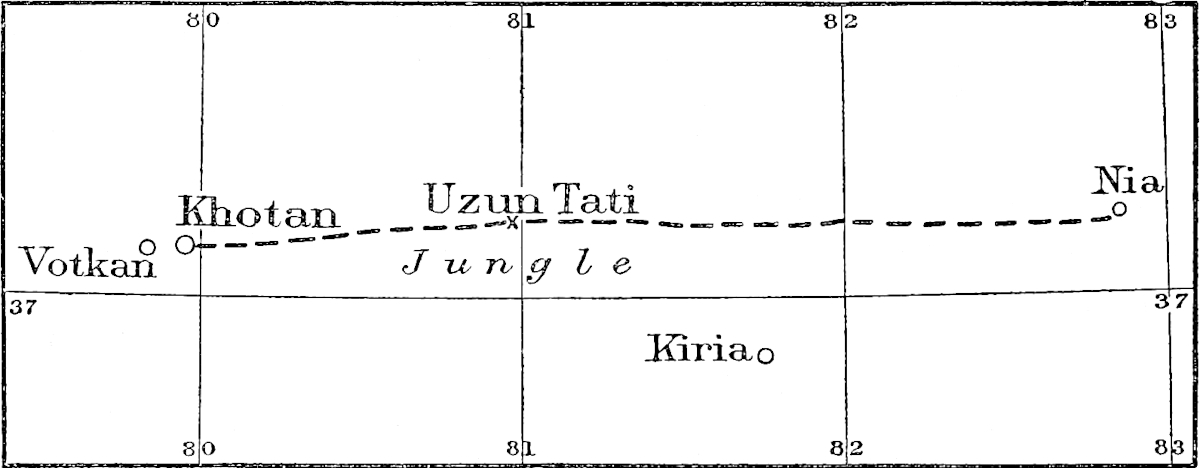
Mr. E. J. Rapson, of the British Museum, with the kind permission of Dr. Stein, has sent me a photograph (which we reproduce) of coins and miscellaneous objects found at Uzun Tati. Coin (1) bears the nien-hao (title of reign) Pao Yuen (1038–1040) of the Emperor Jen Tsung, of the Sung Dynasty; Coin (2) bears the nien-hao, K’ien Yuen (758–760) of the Emperor Su Tsung of the T’ang Dynasty; Coin (3) is of the time of the Khan of Turkestan, Muhammad Arslān Khan, about 441 A.H. = 1049 A.D. From the description sent to me by Mr. Rapson and written by Mr. Andrews, I note that the miscellaneous objects include: “Two fragments of fine Chinese porcelain, highly glazed and painted with Chinese ornament in blue. That on the left is painted on both sides, and appears to be portion of rim of a bowl. Thickness ³⁄₃₂ of an inch. That to the right is slightly coarser, and is probably portion of a larger vessel. Thickness ¼ inch (nearly). A third fragment of porcelain, shown at bottom of photo, is decorated roughly in a neutral brown colour, which has imperfectly ‘fluxed.’ It, also, appears to be Chinese. Thickness ⅛ inch (nearly).—A brass or bronze object, cast. Probably portion of a clasp or buckle.—A brass finger ring containing a piece of mottled green glass held loosely in place by a turned-over denticulated rim. The metal is very thin.”—H. C.
7.—Fire-arms. (Vol. i. p. 342.)
From a paper on Siam’s Intercourse with China, published by Lieutenant-Colonel Gerini in the Asiatic Quarterly Review for October, 1902, it would appear that fire-arms were mentioned for the first time in Siamese Records during the Lāu invasion and the siege of Swankhalôk (from 1085 to 1097 A.D.); it is too early a date for the introduction of fire-arms, though it would look “much more like an anachronism were the advent of these implements of warfare [were] placed, in blind reliance upon the Northern Chronicles, still a few centuries back. The most curious of it all is, however, the statement as to the weapons in question having been introduced into the country from China.” Following W. F. Mayers in his valuable contributions to the Jour. North-China B. R. A. S., 1869–1870, Colonel Gerini, who, of course, did not know of Dr. Schlegel’s paper, adds: “It was not until the reign of the Emperor Yung Lê, and on occasion of the invasion of Tonkin in A.D. 1407, that the Chinese acquired the knowledge of the propulsive effect of gunpowder, from their vanquished enemies.”