Volume 2 / Part 3 — CHAPTER XXIII.
Henry Yule translation
Of the Country Called Comari.
Comari is a country belonging to India, and there you can see something of the North Star, which we had not been able to see from the Lesser Java thus far. In order to see it you must go some 30 miles out to sea, and then you see it about a cubit above the water.{1}
This is a very wild country, and there are beasts of all kinds there, especially monkeys of such peculiar fashion that you would take them for men! There are also gatpauls{2} in wonderful diversity, with bears, lions, and leopards, in abundance.
At the beginning of the Portuguese era in India we hear of a small Kingdom of Comori, the prince of which had succeeded to the kingdom of Kaulam. And this, as Dr. Caldwell points out, must have been the state which is now called Travancore. Kumari has been confounded by some of the Arabian Geographers, or their modern commentators, with Kumár, one of the regions supplying aloes-wood, and which was apparently Khmer or Kamboja. (Caldwell’s Drav. Grammar, p. 67; Gildem. 185; Ram. I. 333.)
The cut that we give is, as far as I know, the first genuine view of Cape Comorin ever published.
[Mr. Talboys Wheeler, in his History of India, vol. iii. (p. 386), says of this tract:
“The region derives its name from a temple which was erected there in honour of Kumárí, ‘the Virgin’; the infant babe who had been exchanged for Krishna, and ascended to heaven at the approach of Kansa.” And in a note:
“Colonel Yule identifies Kumárí with Durgá. This is an error. The temple of Kumárí was erected by Krishna Raja of Narsinga, a zealous patron of the Vaishnavas.”
Mr. Wheeler quotes Faria y Souza, who refers the object of worship to what is meant for this story (II. 394), but I presume from Mr. Wheeler’s mention of the builder of the temple, which does not occur in the Portuguese history, that he has other information. The application of the Virgin title connected with the name of the place, may probably have varied with the ages, and, as there is no time to obtain other evidence, I have removed the words which identified the existing temple with that of Durgá. But my authority for identifying the object of worship, in whose honour the pilgrims bathe monthly at Cape Comorin, with Durgá, is the excellent one of Dr. Caldwell. (See his Dravidian Grammar as quoted in the passage above.) Krishna Raja of whom Mr. Wheeler speaks, reigned after the Portuguese were established in India, but it is not probable that the Krishna stories of that class were even known in the Peninsula (or perhaps anywhere else) in the time of the author of the Periplus, 1450 years before; and ’tis as little likely that the locality owed its name to Yasoda’s Infant, as that it owed it to the Madonna in St. Francis Xavier’s Church that overlooks the Cape.
Fra Paolino, in his unsatisfactory way (Viaggio, p. 68), speaks of Cape Comorin, “which the Indians call Canyamuri, Virginis Promontorium, or simply Comarí or Cumarí ‘a Virgin,’ because they pretend that anciently the goddess Comari ‘the Damsel,’ who is the Indian Diana or Hecate, used to bathe” etc. However, we can discover from his book elsewhere (see pp. 79, 285) that by the Indian Diana he means Párvatí, i.e. Durgá.
Lassen at first[1] identified the Kumárí of the Cape with Párvatí; but afterwards connected the name with a story in the Mahábhárata about certain Apsarases changed into Crocodiles.[2] On the whole there does not seem sufficient ground to deny that Párvatí was the original object of worship at Kumárí, though the name may have lent itself to various legends.]
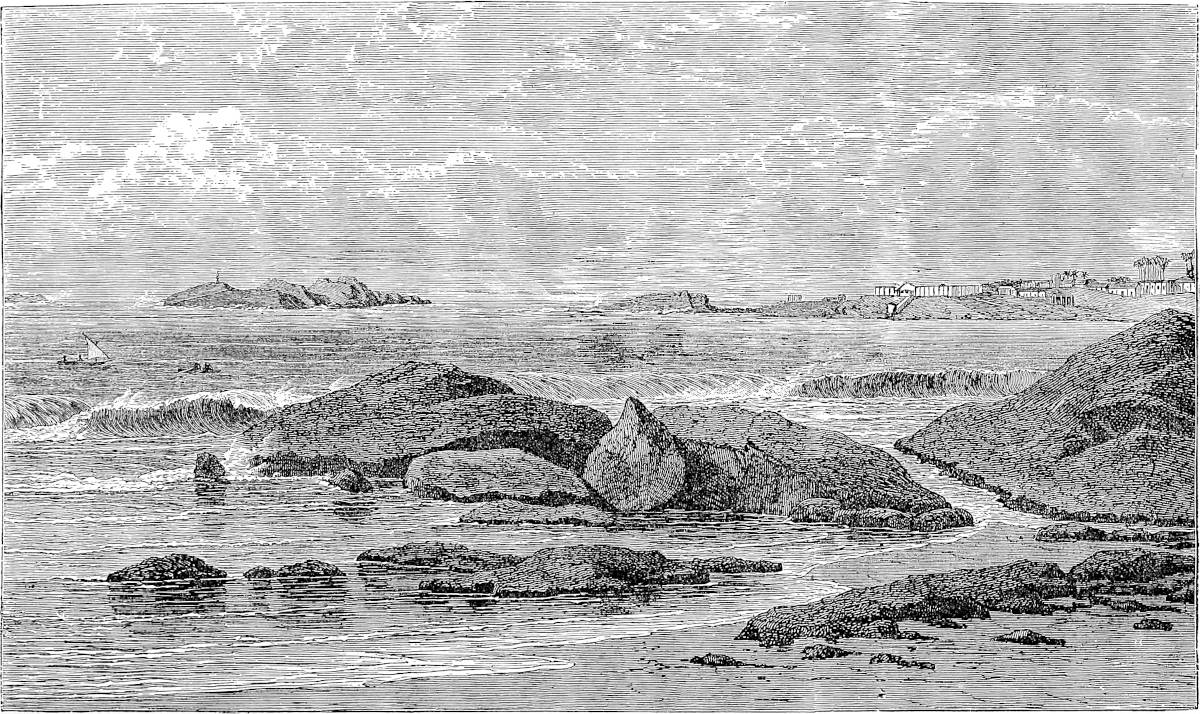
Cape Comorin. (From a sketch by Mr. Foote, of the Geological Survey of India.)