Volume 2 / Part 3 — CHAPTER XX.
Henry Yule translation
Concerning the Province of Lar Whence the Brahmins Come.
Lar is a Province lying towards the west when you quit the place where the Body of St. Thomas lies; and all the Abraiaman in the world come from that province.{1}
You must know that these Abraiaman are the best merchants in the world, and the most truthful, for they would not tell a lie for anything on earth. [If a foreign merchant who does not know the ways of the country applies to them and entrusts his goods to them, they will take charge of these, and sell them in the most loyal manner, seeking zealously the profit of the foreigner and asking no commission except what he pleases to bestow.] They eat no flesh, and drink no wine, and live a life of great chastity, having intercourse with no women except with their wives; nor would they on any account take what belongs to another; so their law commands. And they are all distinguished by wearing a thread of cotton over one shoulder and tied under the other arm, so that it crosses the breast and the back.
They have a rich and powerful King who is eager to purchase precious stones and large pearls; and he sends these Abraiaman merchants into the kingdom of Maabar called Soli, which is the best and noblest Province of India, and where the best pearls are found, to fetch him as many of these as they can get, and he pays them double the cost price for all. So in this way he has a vast treasure of such valuables.{2}
These Abraiaman are Idolaters; and they pay greater heed to signs and omens than any people that exists. I will mention as an example one of their customs. To every day of the week they assign an augury of this sort. Suppose that there is some purchase in hand, he who proposes to buy, when he gets up in the morning takes note of his own shadow in the sun, which he says ought to be on that day of such and such a length; and if his shadow be of the proper length for the day he completes his purchase; if not, he will on no account do so, but waits till his shadow corresponds with that prescribed. For there is a length established for the shadow for every individual day of the week; and the merchant will complete no business unless he finds his shadow of the length set down for that particular day. [Also to each day in the week they assign one unlucky hour, which they term Choiach. For example, on Monday the hour of Half-tierce, on Tuesday that of Tierce, on Wednesday Nones, and so on.{3}]
Again, if one of them is in the house, and is meditating a purchase, should he see a tarantula (such as are very common in that country) on the wall, provided it advances from a quarter that he deems lucky, he will complete his purchase at once; but if it comes from a quarter that he considers unlucky he will not do so on any inducement. Moreover, if in going out, he hears any one sneeze, if it seems to him a good omen he will go on, but if the reverse he will sit down on the spot where he is, as long as he thinks that he ought to tarry before going on again. Or, if in travelling along the road he sees a swallow fly by, should its direction be lucky he will proceed, but if not he will turn back again; in fact they are worse (in these whims) than so many Patarins!{4}
These Abraiaman are very long-lived, owing to their extreme abstinence in eating. And they never allow themselves to be let blood in any part of the body. They have capital teeth, which is owing to a certain herb they chew, which greatly improves their appearance, and is also very good for the health.
There is another class of people called Chughi, who are indeed properly Abraiaman, but they form a religious order devoted to the Idols. They are extremely long-lived, every man of them living to 150 or 200 years. They eat very little, but what they do eat is good; rice and milk chiefly. And these people make use of a very strange beverage; for they make a potion of sulphur and quicksilver mixt together and this they drink twice every month. This, they say, gives them long life; and it is a potion they are used to take from their childhood.{5}
There are certain members of this Order who lead the most ascetic life in the world, going stark naked; and these worship the Ox. Most of them have a small ox of brass or pewter or gold which they wear tied over the forehead. Moreover they take cow-dung and burn it, and make a powder thereof; and make an ointment of it, and daub themselves withal, doing this with as great devotion as Christians do show in using Holy Water. [Also if they meet any one who treats them well, they daub a little of this powder on the middle of his forehead.{6}]
They eat not from bowls or trenchers, but put their victuals on leaves of the Apple of Paradise and other big leaves; these, however, they use dry, never green. For they say the green leaves have a soul in them, and so it would be a sin. And they would rather die than do what they deem their Law pronounces to be sin. If any one asks how it comes that they are not ashamed to go stark naked as they do, they say, “We go naked because naked we came into the world, and we desire to have nothing about us that is of this world. Moreover, we have no sin of the flesh to be conscious of, and therefore we are not ashamed of our nakedness, any more than you are to show your hand or your face. You who are conscious of the sins of the flesh do well to have shame, and to cover your nakedness.”
They would not kill an animal on any account, not even a fly, or a flea, or a louse,{7} or anything in fact that has life; for they say these have all souls, and it would be sin to do so. They eat no vegetable in a green state, only such as are dry. And they sleep on the ground stark naked, without a scrap of clothing on them or under them, so that it is a marvel they don’t all die, in place of living so long as I have told you. They fast every day in the year, and drink nought but water. And when a novice has to be received among them they keep him awhile in their convent, and make him follow their rule of life. And then, when they desire to put him to the test, they send for some of those girls who are devoted to the Idols, and make them try the continence of the novice with their blandishments. If he remains indifferent they retain him, but if he shows any emotion they expel him from their society. For they say they will have no man of loose desires among them.
They are such cruel and perfidious Idolaters that it is very devilry! They say that they burn the bodies of the dead, because if they were not burnt worms would be bred which would eat the body; and when no more food remained for them these worms would die, and the soul belonging to that body would bear the sin and the punishment of their death. And that is why they burn their dead!
Now I have told you about a great part of the people of the great Province of Maabar and their customs; but I have still other things to tell of this same Province of Maabar, so I will speak of a city thereof which is called Cail.
What is said here of the Brahmans coming from “Lar, a province west of St. Thomas’s,” of their having a special King, etc., is all very obscure, and that I suspect through erroneous notions.
Lar-Desa, “The Country of Lár,” properly Láṭ-desa, was an early name for the territory of Guzerat and the northern Konkan, embracing Saimur (the modern Chaul, as I believe), Tana, and Baroch. It appears in Ptolemy in the form Larike. The sea to the west of that coast was in the early Mahomedan times called the Sea of Lár, and the language spoken on its shores is called by Mas’udi Lári. Abulfeda’s authority, Ibn Said, speaks of Lár and Guzerat as identical. That position would certainly be very ill described as lying west of Madras. The kingdom most nearly answering to that description in Polo’s age would be that of the Bellál Rajas of Dwara Samudra, which corresponded in a general way to modern Mysore. (Mas’udi, I. 330, 381; II. 85; Gildem. 185; Elliot, I. 66.)
That Polo’s ideas on this subject were incorrect seems clear from his conception of the Brahmans as a class of merchants. Occasionally they may have acted as such, and especially as agents; but the only case I can find of Brahmans as a class adopting trade is that of the Konkani Brahmans, and they are said to have taken this step when expelled from Goa, which was their chief seat, by the Portuguese. Marsden supposes that there has been confusion between Brahmans and Banyans; and, as Guzerat or Lár was the country from which the latter chiefly came, there is much probability in this.
The high virtues ascribed to the Brahmans and Indian merchants were perhaps in part matter of tradition, come down from the stories of Palladius and the like; but the eulogy is so constant among mediæval travellers that it must have had a solid foundation. In fact it would not be difficult to trace a chain of similar testimony from ancient times down to our own. Arrian says no Indian was ever accused of falsehood. Hiuen Tsang ascribes to the people of India eminent uprightness, honesty, and disinterestedness. Friar Jordanus (circa 1330) says the people of Lesser India (Sind and Western India) were true in speech and eminent in justice; and we may also refer to the high character given to the Hindus by Abu’l Fazl. After 150 years of European trade indeed we find a sad deterioration. Padre Vincenzo (1672) speaks of fraud as greatly prevalent among the Hindu traders. It was then commonly said at Surat that it took three Jews to make a Chinaman, and three Chinamen to make a Banyan. Yet Pallas, in the last century, noticing the Banyan colony at Astrakhan, says its members were notable for an upright dealing that made them greatly preferable to Armenians. And that wise and admirable public servant, the late Sir William Sleeman, in our own time, has said that he knew no class of men in the world more strictly honourable than the mercantile classes of India.
We know too well that there is a very different aspect of the matter. All extensive intercourse between two races far asunder in habits and ideas, seems to be demoralising in some degrees to both parties, especially to the weaker. But can we say that deterioration has been all on one side? In these days of lying labels and plastered shirtings does the character of English trade and English goods stand as high in Asia as it did half a century ago! (Pèl. Boudd. II. 83; Jordanus, p. 22; Ayeen Akb. III. 8; P. Vincenzo, p. 114; Pallas, Beyträge, III. 85; Rambles and Recns. II. 143.)
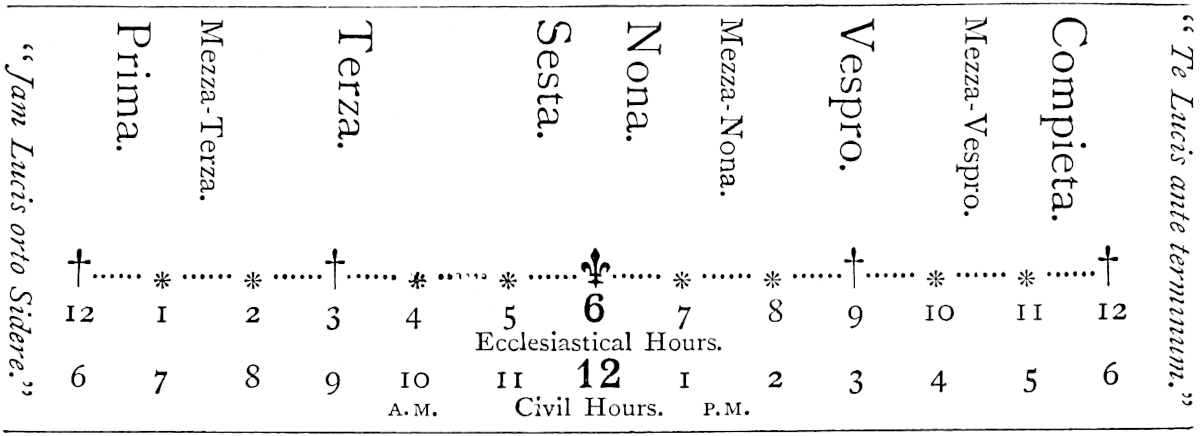
The phrases used in the passage from Ramusio to express the time of day are taken from the canonical hours of prayer. The following passage from Robert de Borron’s Romance of Merlin illustrates these terms: Gauvain “quand il se levoit le matin, avoit la force al millor chevalier del monde; et quant vint à heure de prime si li doubloit, et à heure de tierce aussi; et quant il vint à eure de midi si revenoit à sa première force ou il avoit esté le matin; et quant vint à eure de nonne et à toutes les seures de la nuit estoit-il toudis en sa première force.” (Quoted in introd. to Messir Gauvain, etc., edited by C. Hippeau, Paris, 1862, pp. xii.–xiii.) The term Half-Tierce is frequent in mediæval Italian, e.g. in Dante:—
“Lèvati su, disse’l Maestro, in piede: La via è lunga, e’l cammino è malvagio: E già il Sole a mezza terza riede.” (Inf. xxxiv,)
Half-prime we have in Chaucer:—
“Say forth thy tale and tary not the time Lo Depëford, and it is half way prime.” —(Reeve’s Prologue.)
Definitions of these terms as given by Sir H. Nicolas and Mr. Thomas Wright (Chron. of Hist. p. 195, and Marco Polo, p. 392) do not agree with those of Italian authorities; perhaps in the north they were applied with variation. Dante dwells on the matter in two passages of his Convito (Tratt. III. cap. 6, and Tratt. IV. cap. 23); and the following diagram elucidates the terms in accordance with his words, and with other Italian authority, oral and literary:—
[We read in Ma Huan’s account of Cochin (J. R. A. S. April, 1896, p. 343): “Here also is another class of men, called Chokis (Yogi), who lead austere lives like the Taoists of China, but who, however, are married. These men from the time they are born do not have their heads shaved or combed, but plait their hair into several tails, which hang over their shoulders; they wear no clothes, but round their waists they fasten a strip of rattan, over which they hang a piece of white calico; they carry a conch-shell, which they blow as they go along the road; they are accompanied by their wives, who simply wear a small bit of cotton cloth round their loins. Alms of rice and money are given to them by the people whose houses they visit.”
(See F. Bernier, Voy., ed. 1699, II., Des Gentils de l’Hindoustan, pp. 97, seqq.)
We read in the Nine Heavens of Amír Khusrú (Elliot, III. p. 563): “A jogí who could restrain his breath in this way (diminishing the daily number of their expirations of breath) lived in an idol to an age of more than three hundred and fifty years.”
“I have read in a book that certain chiefs of Turkistán sent ambassadors with letters to the Kings of India on the following mission, viz.: that they, the chiefs, had been informed that in India drugs were procurable which possessed the property of prolonging human life, by the use of which the King of India attained to a very great age ... and the chiefs of Turkistán begged that some of this medicine might be sent to them, and also information as to the method by which the Ráís preserved their health so long.” (Elliot, II. p. 174.)—H. C.]
“The worship of the ox is still common enough, but I can find no trace of the use of the effigy worn on the forehead. The two Tam Pundits whom I consulted, said that there was no trace of the custom in Tamil literature, but they added that the usage was so truly Hindu in character, and was so particularly described, that they had no doubt it prevailed in the time of the person who described it.” (MS. Note by the Rev. Dr. Caldwell.)
I may add that the Jangams, a Linga-worshipping sect of Southern India, wear a copper or silver linga either round the neck or on the forehead. The name of Jangam means “movable,” and refers to their wearing and worshipping the portable symbol instead of the fixed one like the proper Saivas. (Wilson, Mack. Coll. II. 3; J. R. A. S. N.S. V. 142 seqq.)