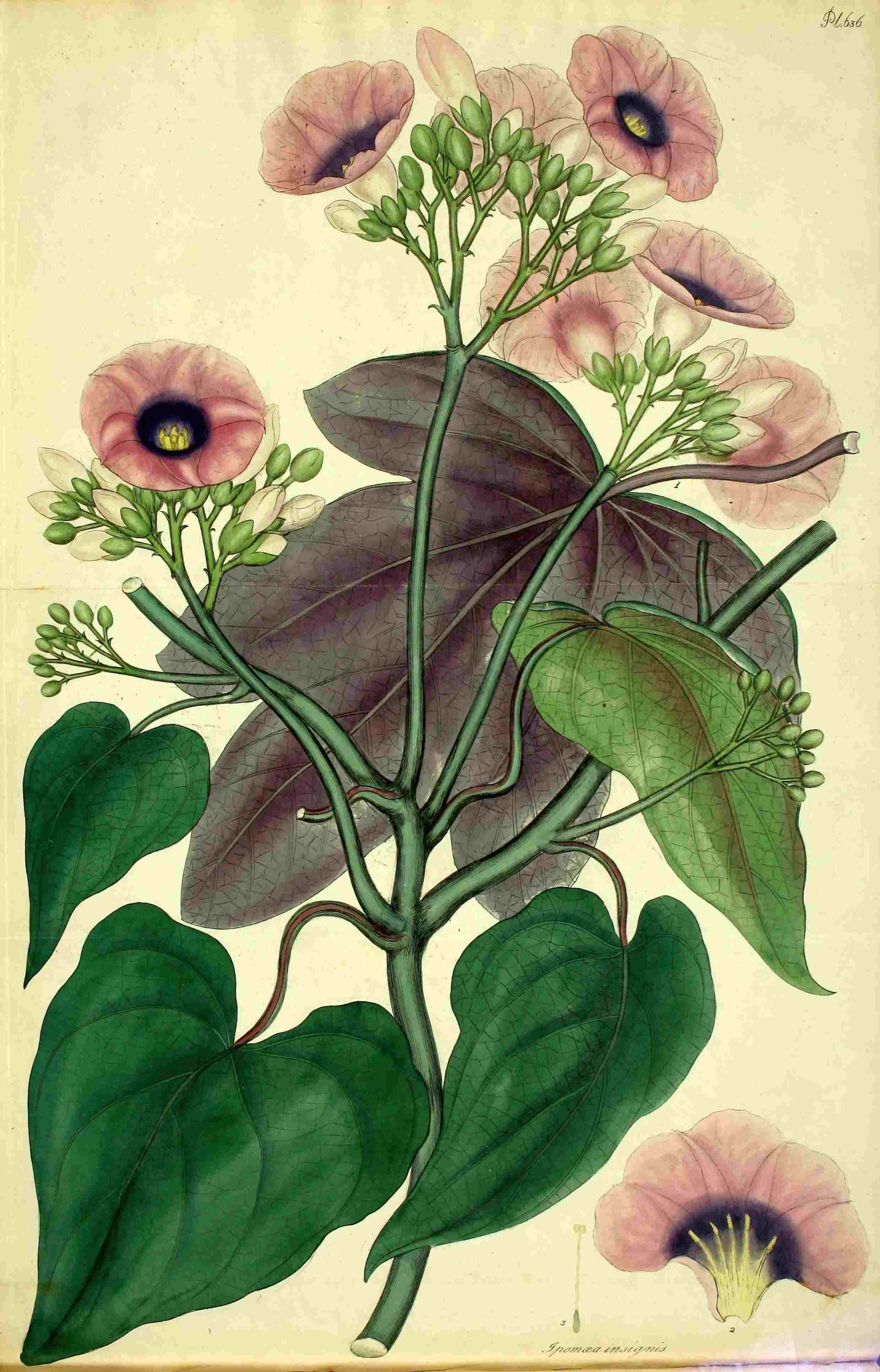
Volume 10 — PLATE DCXXXVI. IPOMŒA INSIGNIS. Magnificent Ipomœa.
Reading edition
CLASS V. ORDER I.
PENTANDRIA MONOGYNIA. Five Stamens. One Style.
GENERIC CHARACTER.
Calyx 5-partitus. Corolla campanulata v. infundibuliformis, 5-plicata. Stigma capitatum, 2-vel 3-lobum. Capsula 2-3-locularis.
Cup 5-parted. Blossom bell-or funnel-shaped, 5-plicate. Stigma headed, 2-or 3-lobed. Capsule of 2 or 3 cells.
SPECIFIC CHARACTER.
Ipomœa caule volubili longissimo et ramosissimo, glabro; foliis crassis, glabriusculis, inferioribus palmato-quinquelobis; superioribus cordato-ovatis ovatisque; mediis subtrilobis: umbellis pedunculatis, axillaribus, compositis, multifloris.
Ipomœa with a turning smooth stem exceedingly long and branching; the leaves fleshy, nearly smooth, the lower palmate-5-lobed; the upper ovate, or a little heart-shaped; the intermediate commonly 3-lobed: the umbels axillary upon footstalks, compound, and bearing many flowers.
REFERENCE TO THE PLATE.
1. A leaf from the base of the plant. 2. A blossom spread open. 3. Seed-bud and pointal.
This remarkable species of Ipomœa was brought from Mrs. Benyon’s hothouse at Englefield, Berkshire, last August, where the plant, after rising to the top of the trellis, extends both right and left to a length of about 30 feet, branching in various directions with hundreds of bunches of flowers. The foliage is singular as to texture, varieties of form, and colour; the lower leaves being of a strong purple on their under side, and dark green above. The plant is perennial, and continues flowering during the greatest part of the summer, but does not ripen its seed—most probably owing to the extreme luxuriance of its inflorescence. All our attempts to discover its native soil, or time of introduction, have proved abortive; neither have we been able to find that any account of it has before been published, or any specimens of it in herbariums.
The propagation is by cuttings; and we are informed that Mr. Lambert, who favoured us with the specimens, is already in possession of some very fine plants of it.