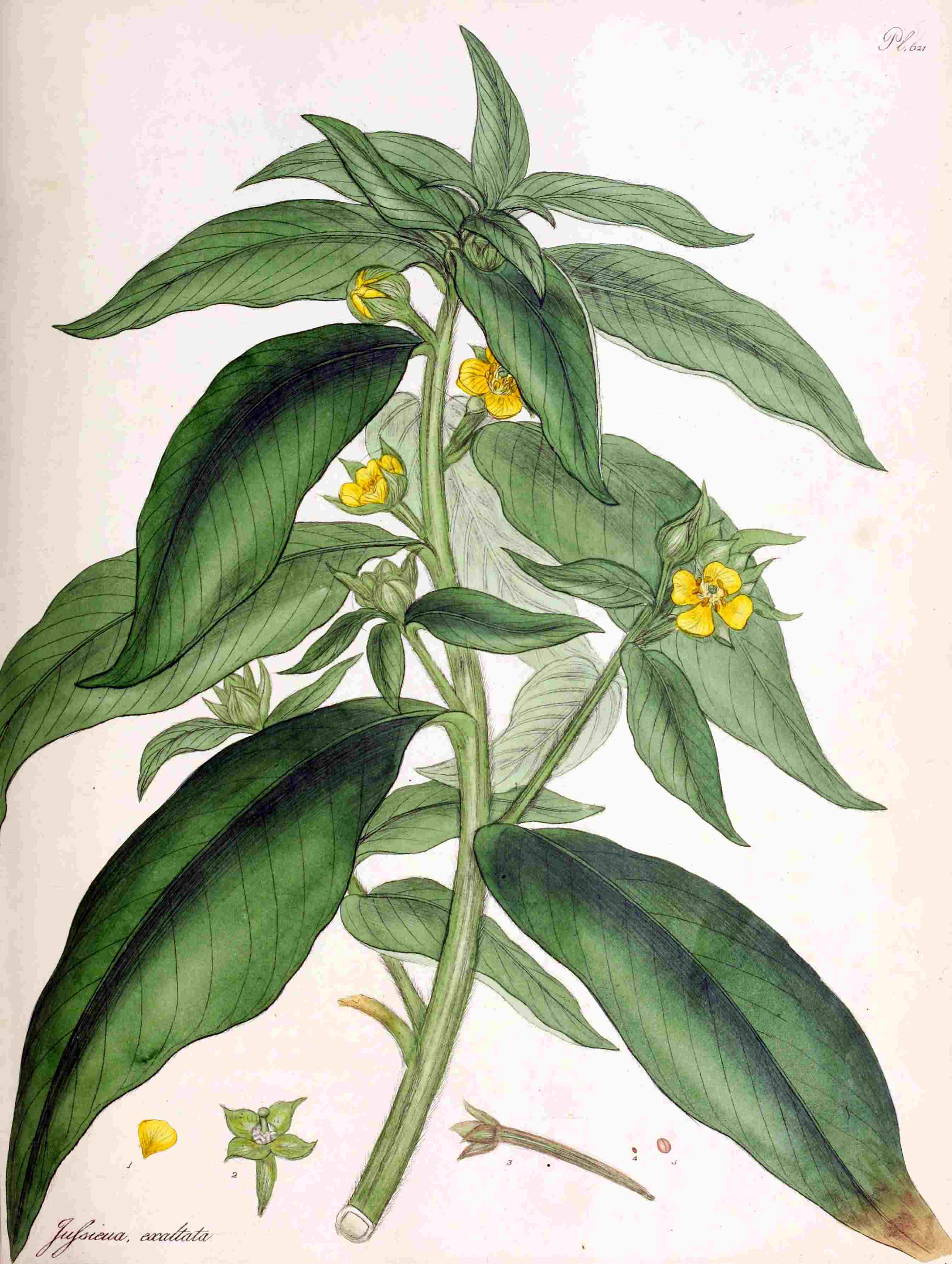
Volume 10 — PLATE DCXXI. JUSSIEUA exaltata. Tall Jussieua.
Reading edition
CLASS VIII or X. ORDER I.
OCTANDRIA seu DECANDRIA MONOGYNIA. Eight or Ten Stamens.
One Style.
GENERIC CHARACTER.
Calyx 4-seu 5-partitus, superus. Petala 4 seu 5. Capsula 4-seu 5-locularis, angulis dehiscens. Semina numerosa.
Cup 4-or 5-parted, above. Petals four or five. Capsule 4-or 5-celled, splitting at the corners. Seeds numerous.
SPECIFIC CHARACTER.
Jussieua erecta, pubescens, foliis oblongo-lanceolatis pubescentibus punctato-scabris; floribus 4-petalis 8-andris, stigmate 4-lobo.
Erect pubescent Jussieua with oblong-lanced pubescent leaves rough with little dots; flowers with 4 petals and 8 stamens, and the stigma four-lobed.
REFERENCE TO THE PLATE.
1. A petal. 2. Empalement, seed-bud, and pointal. 3. The capsule. 4. A ripe seed. 5. The same magnified.
Linnæus could scarcely have selected a happier genus in honour of the great French botanist; by whose arrangement plants agreeing in general habit and character are not liable to be thrown to various classes for a slight difference in their number of stamens, as in the Linnæan; where octandrous and decandrous plants can only be brought together by special license.
Of the twelve species of Jussieua enumerated by Willdenow, and the two additional species since described by Humboldt and Bonpland, our plant, communicated from Boyton in September, most resembles the octovalvis, of which the Professors Swartz and Jacquin appear to have described very different varieties. Ours, however, appears to be specifically distinct from either.
Mr. Lambert informs us that the plant is a native of the East Indies, from whence the seeds were sent to him by Dr. Roxburgh, with a reference to the Cattu Carambu of the Hortus Malabaricus, (tom. ii. p. 97, fig. 50,) which is a very fair representation of it.
The name exaltata, bestowed upon it by Dr. Roxburgh, may have been suggested by comparing it with the two other Indian species, the repens and suffruticosa; but the peruviana must be a much taller plant, from the account given of it by Father Feuillée.