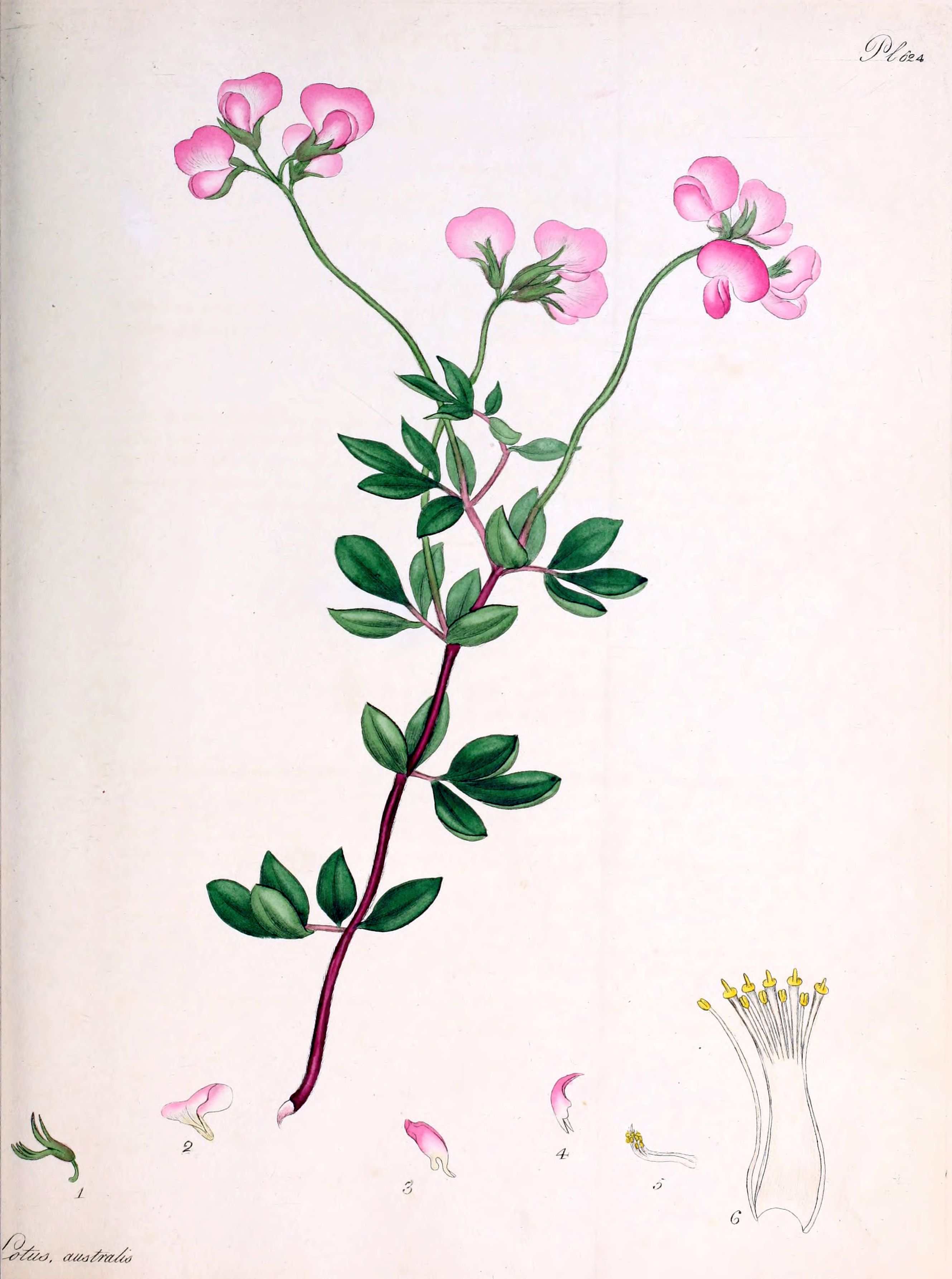
Volume 10 — PLATE DCXXIV LOTUS australis. Southern Lotus, or Bird’s-foot Trefoil.
Reading edition
CLASS XVII. ORDER IV.
DIADELPHIA DECANDRIA. Stamens in Two Sets, Ten.
GENERIC CHARACTER.
Legumen cylindricum, strictum. Filamenta sub-cuneiformia. Alæ sursum longitudinaliter conniventes.
Pod cylindrical, straight. Filaments somewhat wedge-shaped. Wings united lengthways above.
SPECIFIC CHARACTER.
Lotus herbaceus, foliis stipulisque lanceolatis obovato-lanceolatisque pubescentibus; floribus amplis paucis; capitulis longè pedunculatis: leguminibus tereti-linearibus calyce duplò longioribus.
Herbaceous Lotus, with lanceolate and inversely ovate downy leaves and stipules; large flowers few together, in heads upon long footstalks; the pods roundish linear, and double the length of the calyx.
REFERENCE TO THE PLATE.
1. The empalement. 2. The vexillum. 3. One of the wings. 4. The keel. 5. Chives and pointal. 6. The chives spread open and magnified.
New Holland, so rich in new families of plants, sometimes (though rarely) also furnishes us with a few species belonging to genera common to our northern regions, as in Convolvulus, Chenopodium, Campanula, and our present subject, of which the specimen was communicated from Fonthill last July by Mr. Milne. By whom the species was introduced we have not been able to learn; but we have seen dried specimens of it, brought over by the late Governor King, in the herbarium of A. B. Lambert, Esq.
The plant is of humble growth, and rather conspicuous when in blossom from its fine heads of flowers, but has not yet produced seeds in this country; and our account of the fruit is from the foreign specimens above mentioned. Like most other New Holland plants, Lotus australis requires to be kept in the Greenhouse, or at least sheltered in winter.
In our account of Euphorbia meloformis we omitted to add that the figure was taken from a fine plant in the collection of J. Vere, Esq. Kensington Gore, in August last.