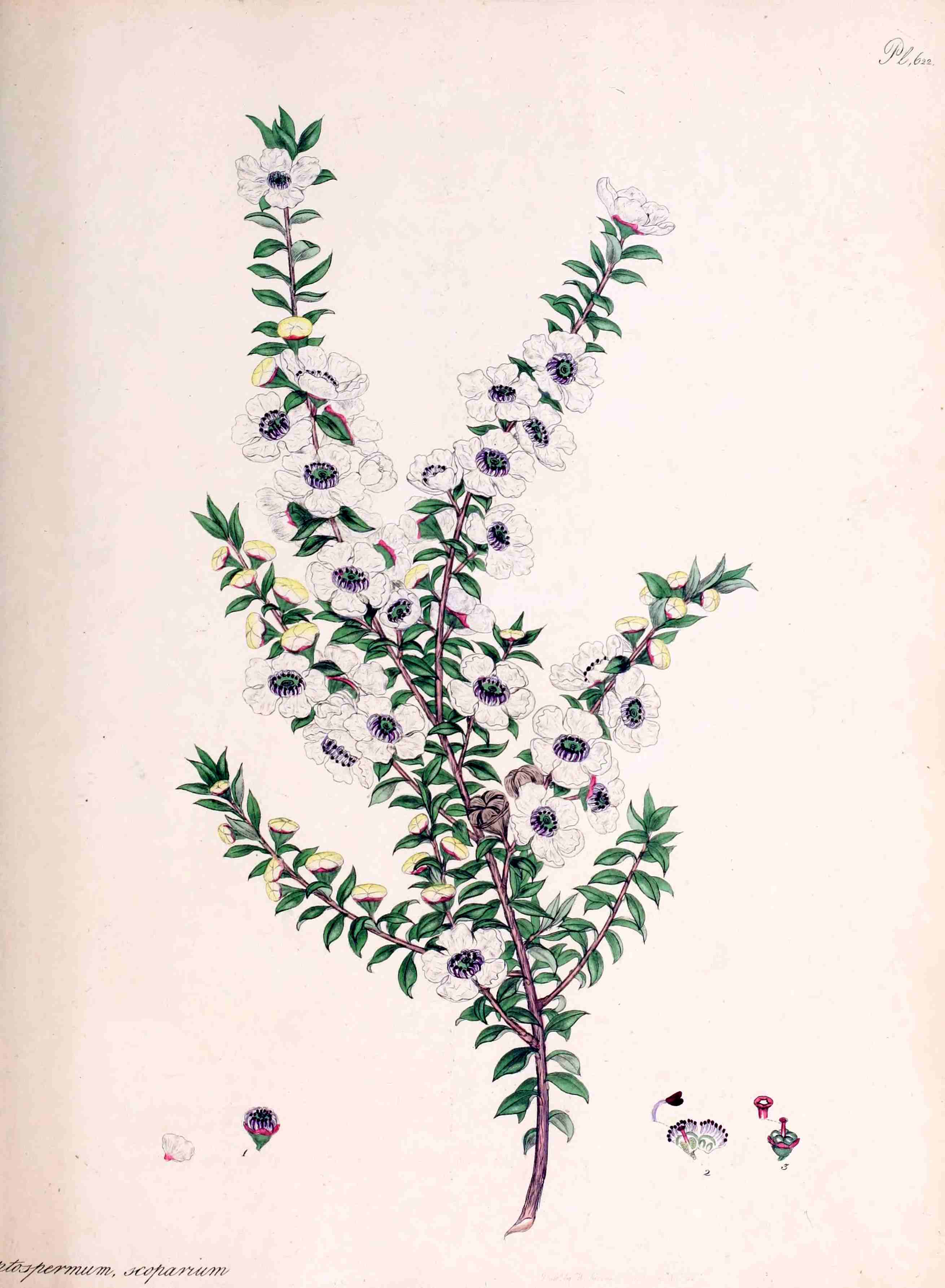
Volume 10 — PLATE DCXXII. LEPTOSPERMUM scoparium. New Zealand Tea.
Reading edition
CLASS XII. ORDER I.
ICOSANDRIA MONOGYNIA. Stamens from the Calyx. One Style.
GENERIC CHARACTER.
Calyx 5-fidus, semisuperus. Petala quinque, unguiculata, staminibus longiora. Stigma capitatum. Capsula 4-seu 5-locularis, polysperma. Semina angulosa.
Cup 5-cleft, free above the middle. Petals five, clawed, and longer than the stamens. Stigma headed. Capsula 4-or 5-celled, many-seeded. Seeds angular.
SPECIFIC CHARACTER.
Leptospermum foliis ovatis ovato-lanceolatisque mucronatis obsolete trinerviis; calycibus glabris, dentibus membranaceis coloratis.
Leptospermum with ovate and ovate-lanced dagger-pointed faintly 3-nerved leaves, and smooth calyces with membranaceous coloured teeth.
L. scoparium. Willd. sp. pl. 2. p. 948.
Tea Plant. Cook’s Second Voyage, vol. 1. p. 100. tab. 32.
REFERENCE TO THE PLATE.
1. Empalement, chives, and pointal. 2. The same cut open, one tip magnified. 3. Seed-bud and pointal, summit magnified. 4. A petal.
The Leptospermum scoparium grows naturally in New Zealand, where it was found in Cook’s first voyage of discovery in the year 1769, and was first published with an engraving of the fructification in 1776, by the two Forsters, in their Characteres Generum Plantarum, or Account of the Plants they collected in that expedition. The following description of the plant, and accounts of the benefits his people derived from it, are extracted from Captain Cook’s Account of his Second Voyage, vol. i. p. 99 to 101.
“The Tea plant is a small tree or shrub, with five white petals or flower-leaves, shaped like those of a rose, having smaller ones of the same figure in the intermediate spaces, and twenty or more filaments or threads. The tree sometimes grows to a moderate height, and is generally bare on the lower part, with a number of small branches growing close together towards the top. The leaves are small and pointed like those of the myrtle; it bears a dry roundish seed-case, and grows commonly in dry places near the shores. The leaves, as I have already observed, were used by many of us as tea, which has a very agreeable bitter and flavour when they are recent, but loses some of both when they are dried. When the infusion was made strong, it proved emetic to some, in the same manner as green tea.
“The beer certainly contributed not a little to the healthiness of our people. As I have already observed, we at first made it of a decoction of the spruce leaves (Dacrydium cupressinum); but finding that this alone made the beer too astringent, we afterwards mixed it with an equal quantity of the Tea plant, (a name it obtained in my former voyage from our using it as tea then, as we also did now,) which partly destroyed the astringency of the other, and made the beer exceedingly palatable, and esteemed by every one on board.”
In the younger Forster’s account of the same expedition, vol. i, p. 128 and 129, a similar account of its utility and beauty is given, with the additional information, that, in a fine soil, in thick forests, it was found from 30 to 40 feet high, and above a foot in diameter; while on a hilly arid situation he found it bearing flowers and seed when only 6 inches high.
The plant was introduced to the Royal Gardens at Kew so early as 1772, and several varieties of it are now in cultivation. It is increased both by seeds and cuttings, and requires to be kept in the Greenhouse or Conservatory.
Specimens were communicated by Mr. Donn from the botanic garden at Cambridge last May, and others in June by Mr. Milne from Fonthill.