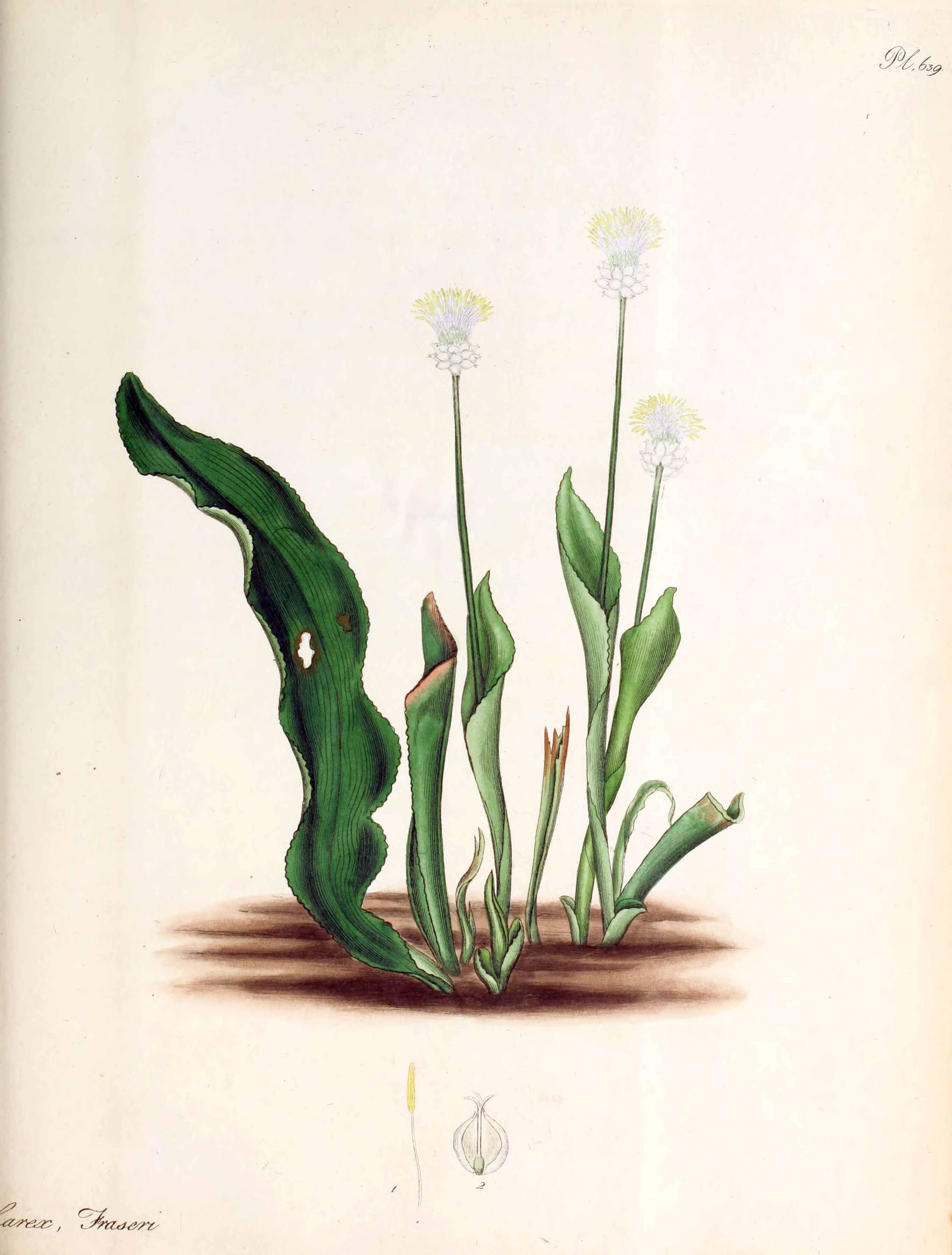
Volume 10 — PLATE DCXXXIX. CAREX FRASERI. Fraser’s Carex.
Reading edition
CLASS XXI. ORDER III.
MONŒCIA TRIANDRIA. One House. Three Stamens.
GENERIC CHARACTER.
Masculi flores.
Amentum imbricatum. Calyx squamosus, solitarius. Corolla nulla.
Feminei flores.
Amentum imbricatum. Calyx squamosus, solitarius. Corolla monopetala, apice bidentata. Stigmata 2 seu 3. Nux triquetra, corolla persistente inclusa.
Male flowers.
Catkin tiled. Empalement skinny and solitary. Blossom none.
Female flowers.
Catkin imbricated. Empalement skinny and solitary. Blossom one-petalled, with two teeth at the end. Summits two or three. Nut three-sided, within the persistent blossom.
SPECIFIC CHARACTER.
Carex floribus androgynis capitibus terminalibus; masculis superioribus, femineis inferioribus. Stigma tripartitum: foliis lanceolatis, undulatis, marginibus crenulatis.
Carex with hermaphrodite flowers growing in terminal heads; male flowers above, females beneath. Summit three-parted. Leaves lance-shaped, undulated, with finely scolloped margins.
REFERENCE TO THE PLATE.
1. A stamen magnified. 2. A blossom spread open, magnified.
For this curious little plant we are indebted to the late Mr. Fraser, nurseryman, Sloane Square, Chelsea; whose ardour in the pursuit of plants carried him thrice over to America in search of botanic novelty. Mr. J. Fraser informs us, that his father and himself discovered this singular species of Carex, in the autumn of 1808, near the Table Mountain, and upon the banks of the Catawba River in the neighbourhood of Morgan Town, North Carolina.