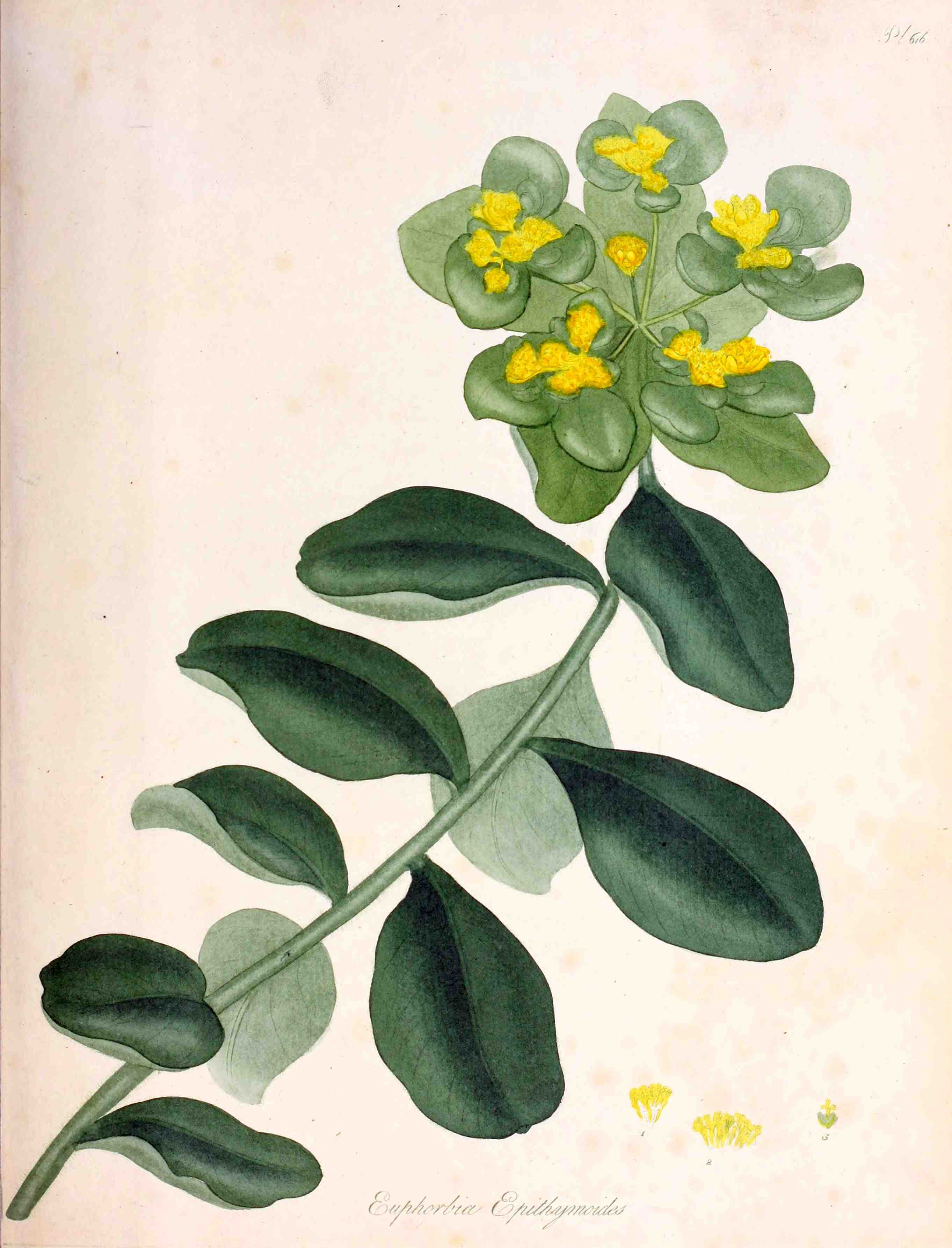
Volume 10 — PLATE DCXVI. EUPHORBIA epithymoides. Broad-leaved Spurge.
Reading edition
CLASS XI. ORDER III.
DODECANDRIA TRIGYNIA. Twelve to Nineteen Stamens. Three Styles.
GENERIC CHARACTER.
Calyx monophyllus, ventricosus. Corolla 4-seu 5-petala calyci insidens. Capsula tricocca.
Cup of one leaf, bellying. Blossom of 4 or 5 petals sitting upon the cup. Fruit a capsule with 3 cells.
SPECIFIC CHARACTER.
Euphorbia umbellâ quinquefidâ, radiis sub-bifidis, involucellis ovatis denticulatis, foliis integerrimis lanceolatis obtusis retusis subtus villosis, capsulis papilloso-hispidis. Willd. Sp. Pl. vol. 2. p. 909.
Euphorbia with a five-cleft umbel, the rays mostly bifid, the involucrets ovate-toothed, the leaves entire, lanced, blunt, retuse and woolly beneath; the capsules with little warts and bristly.
REFERENCE TO THE PLATE.
1. A flower. 2. The same spread open. 3. Seed-bud and pointal.
This ornamental species is a native of Austria, and was introduced, according to Donn’s Catalogue, in the year 1805. Professor Jacquin has given an excellent figure and description of it in its wild state in his Flora Austriaca, vol. iv. p. 23, tab. 344: but it varies very considerably when cultivated, as may be seen by comparing the figures. The figure cited to the species by Linnæus, from Columna, and from which it also derives its name, as already remarked by Jacquin, (who was certain of the identity of his species with the Linnean,) has very little resemblance to the plant; but the name of epithymoides, however apt to mislead, is now sanctioned by so long use, that were the plant of Columna discovered, and proved to be different, one would hardly venture now to restore to it its original appellation. The specimen was communicated by Mr. Donn last May from the Botanic Garden at Cambridge.