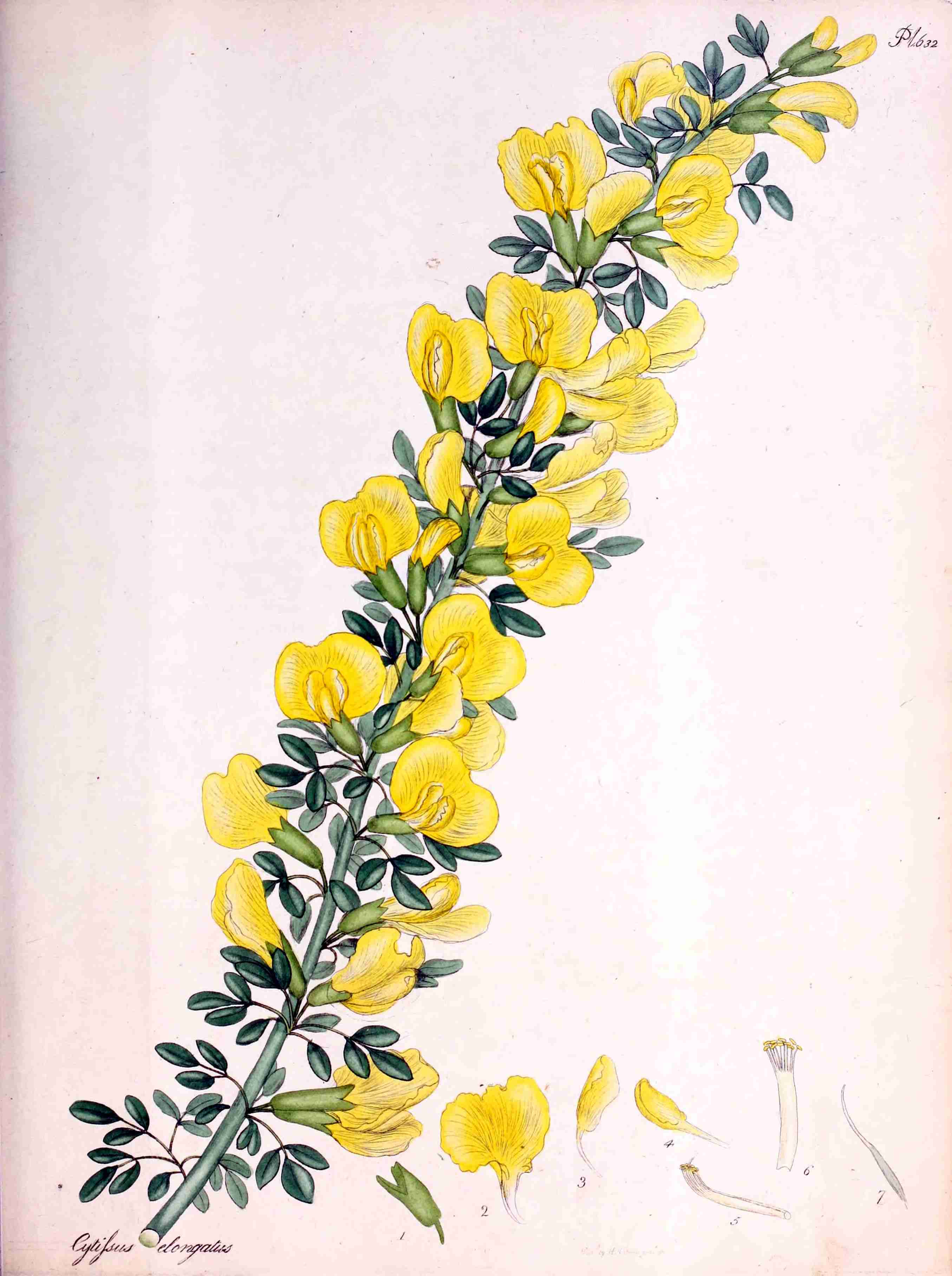
Volume 10 — PLATE DCXXXII. CYTISUS ELONGATUS. Elongated Cytisus.
Reading edition
CLASS XVII. ORDER IV.
DIADELPHIA DECANDRIA. Two Brotherhoods. Ten Stamens.
GENERIC CHARACTER.
Calyx sub-bilabiatus. Stigma simplex. Legumen oblongum, compressum, polyspermum.
Cup sub-bilabiate. Stigma simple. Pod oblong, compressed, many-seeded.
SPECIFIC CHARACTER.
Cytisus floribus pedunculatis, lateralibus, subquaternis; caule erecto: ramis elongatis; calycibus tubulosis; foliolis obovatis.—Waldst. et Kit. Hung. v. 2. p. 200. t. 183.
Cytisus with lateral flowers, commonly by fours, on footstalks; the stem erect; branches elongated; cups tubular, and leaflets inversely egg-shaped.
REFERENCE TO THE PLATE.
1. Empalement. 2. The vexillum. 3. One of the alæ. 4. The carina. 5. The chives. 6. The same spread open. 7. Seed-bud and pointal.
This ornamental species of Cytisus was discovered by Francis Count Waldstein and Dr. Kitaibel, in the county of Bereghi and the Banatian forests in the eastern parts of Hungary, during their botanical excursions in that before nearly uninvestigated region, and published in their Figures and Descriptions of the rare Plants of Hungary, above quoted, at Vienna in 1802. The plant was introduced to this country by Mr. Donn of Cambridge in 1808, and from fine flowering specimens which he communicated last May the present drawing was taken. The common height of the plant is said to be from three to five feet, and the thickness of the stem about an inch. It is perfectly hardy, and has not as yet been enumerated in any catalogue of plants cultivated in this country.