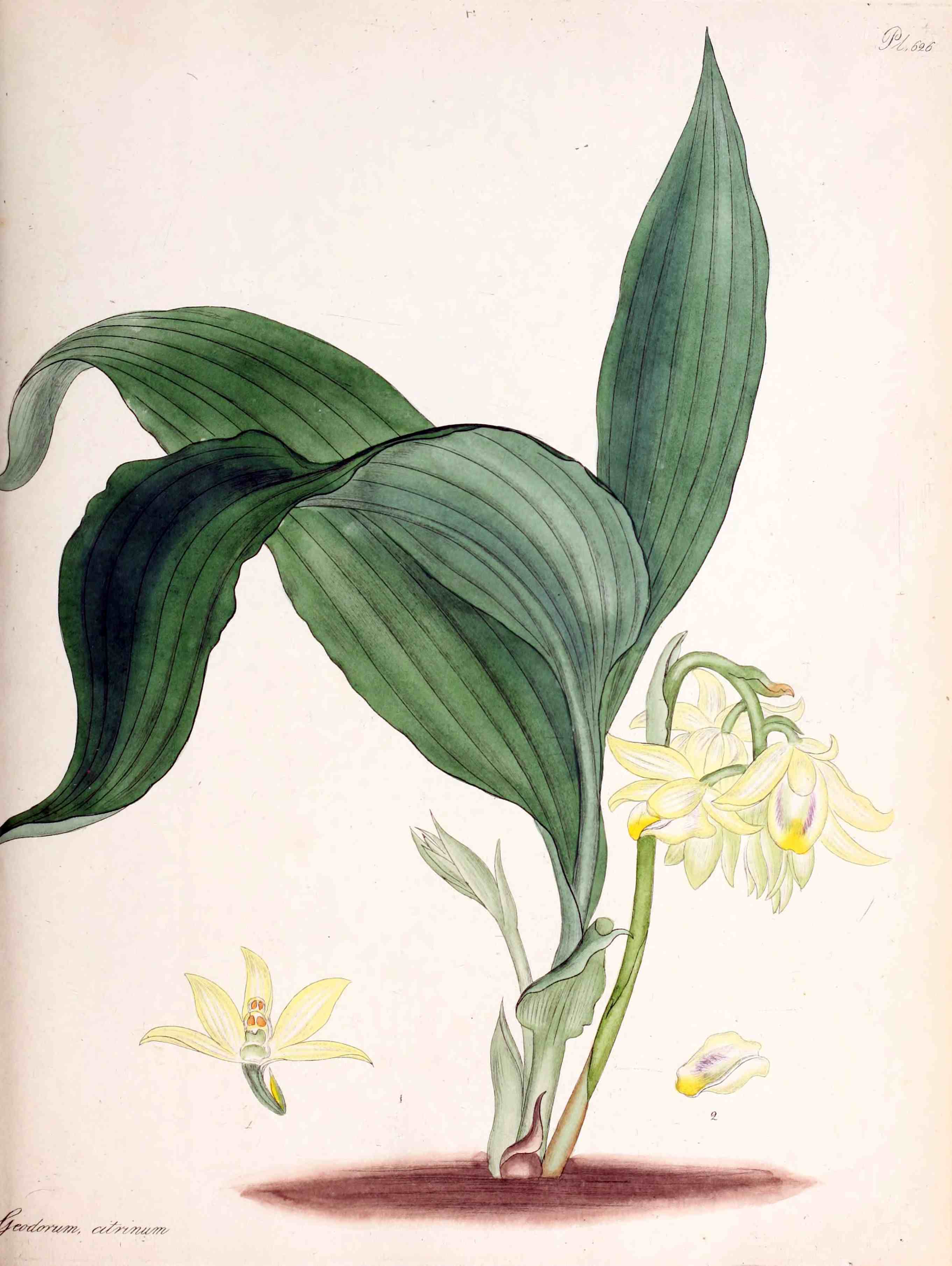
Volume 10 — PLATE DCXXVI. GEODORUM CITRINUM. Lemon-coloured Geodorum.
Reading edition
CLASS XX. ORDER I.
GYNANDRIA MONANDRIA. Style bearing the Stamens. Stamen One.
ESSENTIAL GENERIC CHARACTER.
Petala quinque, longitudine subæqualia, patentia. Labellum cymbiforme; carinâ posticè paulò productâ. Anthera terminalis, opercularis, decidua. Massæ pollinis duæ, reniformes, cereaceæ.
Petals five, about an equal length, spreading. Lip boat-shaped, with the keel a little prolonged behind. Anther terminal, cover-like, deciduous. Masses of pollen two, kidney-shaped, waxy.
REFERENCE TO THE PLATE.
1. A blossom spread open, divested of the lip. 2. The lip detached.
Little more than sixty years ago, Mr. Miller, the best informed gardener of his time, and emphatically styled by foreigners, to whom he was known by his writings, ‘Hortulanorum Princeps;’ after forty years experience in gardening, in the last edition of his Dictionary which he published, when treating of Epidendrums, says: “It would be to little purpose to enumerate them here, as the plants cannot by any art yet known be cultivated in the ground; though, could the plants be brought to thrive by culture, many of them produce very fine flowers of uncommon forms.”—Genius and perseverance, however, have completely vanquished this prejudice, and we now cultivate more species of Epidendrum in England, or what in Mr. Miller’s time would have been considered as such, than he supposed to exist: indeed few plants are at present in greater favour with cultivators than those of the beautiful order of Orchideæ; and our present subject, discovered in Pulo-Pinang, or Prince of Wales’s Island, at the same time with the Ardisia elegans, is certainly not one of the least elegant. Both its peculiar habit and character easily prevent its being confounded with any natural genus yet described, although some species have been enumerated amongst the Limodorums by Dr. Roxburgh, and transposed with no more felicity from thence to Malaxis by Professor Willdenow.—The genus, however, is more allied to Cymbidium in character than either of the above; and, as far as our knowledge of the order at present extends, ought to be placed near to that in the arrangement. The other species of the genus before alluded to are the Malaxis nutans and cernua of Willdenow, Limodorum nutans of the Plants of Coromandel, and the L. recurvum of the same; all of which agree in having the same remarkable flaccidity of foliage, and recurved inflorescence.
The drawing was taken at Stepney last October, and the plant was still in blossom in the end of November.
Some idea of the prodigious extent of this family of plants may be inferred from Dr. Buchanan’s having gathered more than fifty new species in his late journey through Napaul, and Mr. Brown above a hundred, (all now described in his Prodromus,) during his botanical expedition to New Holland and Van Diemen’s Land; and from the statement of the Spanish botanists, Messrs. Ruiz and Pavon, who spent eight years botanizing in South America, that more than a thousand distinct species grow there upon the sides of the Cordilleras!