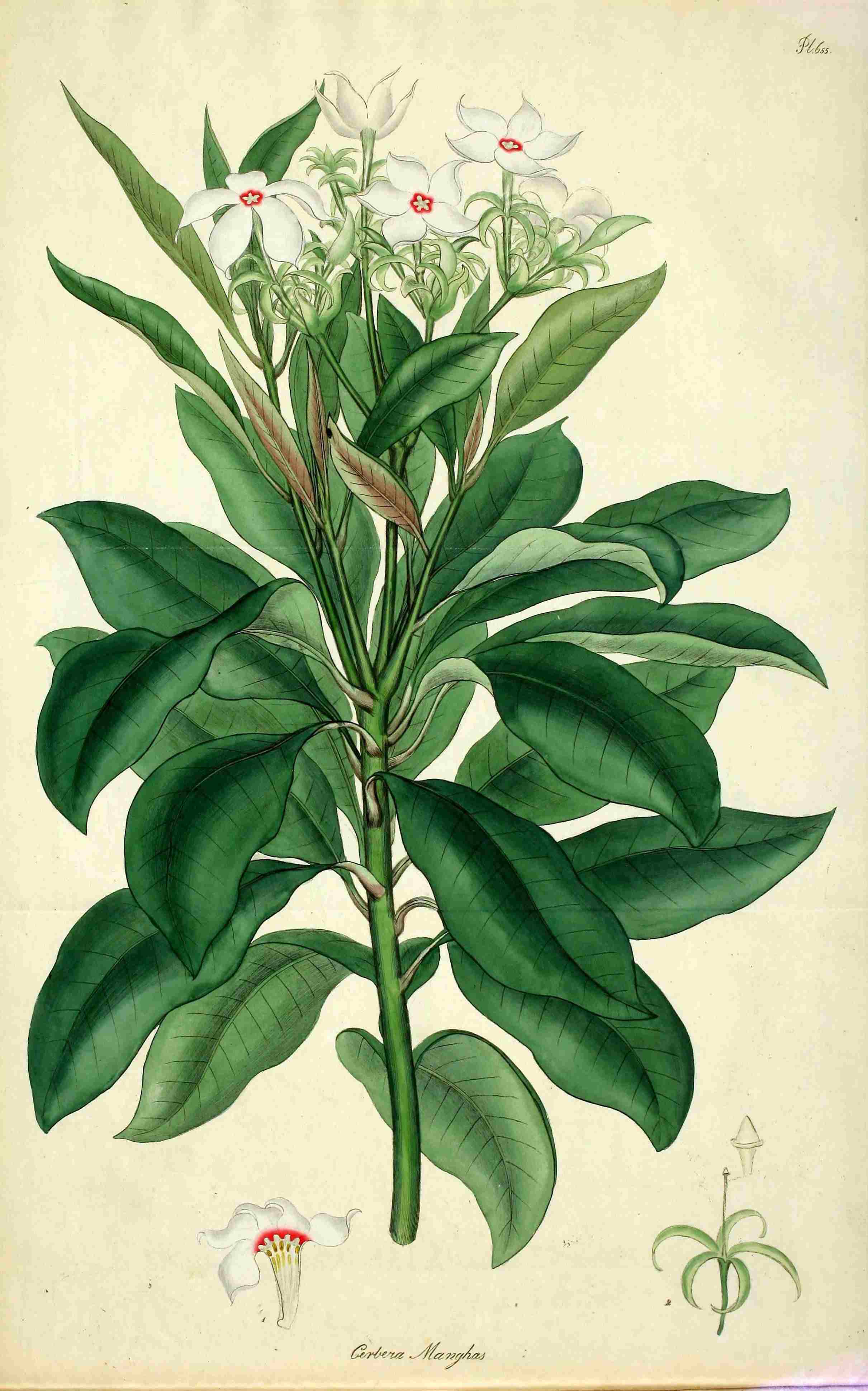
Volume 10 — PLATE DCLV. CERBERA MANGHAS. Poisonous-fruited Cerbera.
Reading edition
CLASS V. ORDER I.
PENTANDRIA MONOGYNIA. Five Stamens. One Pointal.
ESSENTIAL GENERIC CHARACTER.
Flores contorti. Corolla infundibuliformis, pulposa. Drupa monosperma.
Flowers contorted. Blossom funnel-shaped, pulpy. Seed-vessel one-seeded.
SPECIFIC CHARACTER.
Cerbera foliis alternis, lato-lanceolatis, glabris: ramis floriferis terminalibus: corolla alba, infundibuliformi: perianthio 5-phyllo: foliolis lanceolatis, deciduis: fructu persistente.
Cerbera with leaves alternate, broadly lance-shaped, and smooth: flower-branches terminal: blossoms white and funnel-shaped: empalement 5-leaved: leaflets lance-shaped and deciduous: fruit persistent.
REFERENCE TO THE PLATE.
1. A blossom spread open. 2. Empalement, summit magnified.
Our drawing represents a new species of Cerbera introduced from Pulo-Pinang in 1809, and which flowered late in the autumn of 1812, for the first time in this country, in the hot stove of T. Evans, Esq. whose collector informs us that it grows in abundance by the sea-side, and is a handsome shrub about three feet high. By the natives it is called Devil’s flower, a title they apply indiscriminately to all noxious plants. But although it is considered as poisonous (as are all the Cerberas at present known) the natives of Amboyna are said by Rumphius to use it medicinally as a purgative, but that it is too powerful to be taken with safety by strangers. In Macassar an oil is expressed from the fruit, which is burnt in lamps, and emits a disagreeable smell. It bears a variety of names. By the Dutch it is called Mükhout; in Portugal and Malay, Manga Brava; at Amboyna, Wabba; in Macassar, Lambuto Baleyice, Bintaro and Sassura Utan, and by some Caju Mattu, Buta or Blinthout. There are three uncoloured figures of it; one in Burmann’s Zeylanica, page 150, tab. 70. figure 1; another in Rumphius’s Amboynensis, vol. ii. page 243, figure 81; and in Rheede’s Hortus Malabancus, page 71, tab. 3. there is a representation of it by the title of Odallam; and, although a rough draft, it is certainly not the worst figure of the plant.