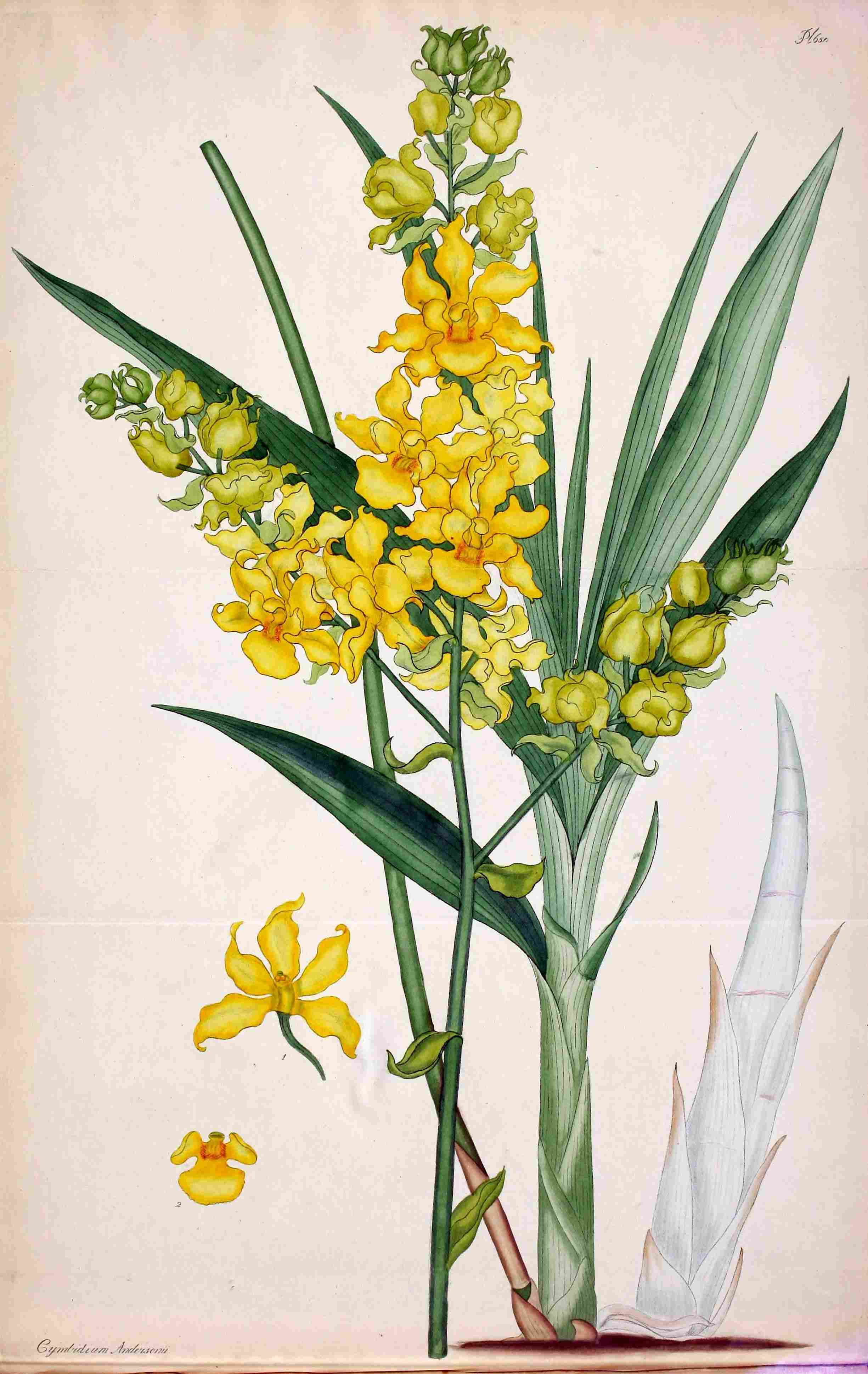
Volume 10 — PLATE DCLI. CYMBIDIUM ANDERSONII. Anderson’s Cymbidium.
Reading edition
CLASS XX. ORDER I.
GYNANDRIA DIANDRIA. Chives on the Pointals. Two Chives.
ESSENTIAL GENERIC CHARACTER.
Corolla 4-5-petala, erecta vel patens, labello basi concavo. Anthera opercularis, decidua.
Blossom 4-5-petalled, upright or spreading, with a nectary concave at the base. Tips covered, deciduous.
SPECIFIC CHARACTER.
Cymbidium caule elato: foliis vaginatis, lanceolatis, costatis: floribus in spicis longis ramosis: corollis flavis.
Cymbidium with a tall stem: leaves sheathed, lance-shaped, and ribbed. Flowers grow in long branched spikes: blossoms yellow.
REFERENCE TO THE PLATE.
1. A flower without the nectarium. 2. The nectarium.
Our figure represents a nondescript species of Cymbidium communicated to us by T. Evans, Esq., in whose collection at Stepney it flowered last summer (1811) for the first time in this country. We have given it the specific title of Andersonii, as a tribute of respect to the late Dr. Anderson, by whom it was introduced in 1804, with many other fine new plants, from the botanic garden in the island of St. Vincent, and may be considered as a valuable addition to the hot stove, from its great height and numerous large yellow blossoms.
⁂ In the description of the Alstromeria edulis of our last Number, Cape of Good Hope is inserted instead of Cape François, a mistake occasioned by our writing it off in a hurry along with some pages of the Erica, a tribe of plants (with few exceptions) all natives of the Cape of Good Hope. We detected the error as soon as printed, but did not think it of sufficient consequence to cancel the page and prolong its publication, as it had already been too long delayed; and should have only noticed it in the Errata at the end of the Volume, (which is nearly terminated,) were it not for the partial criticism in the Monthly Magazine given by an interested friend to the Botanical Magazine, who probably imagines the sale of our work is detrimental to that publication, and reminds us of the story of the man with a very short nose, who was always railing at the long nose of another person; which led to the conclusion that he thought it was made at the expense of his short one. But as our readers may think these observations long enough, they will doubtless think those of the botanical report still more so, as in the comments on the Protea radiata, fifteen lines are nearly filled with technical phrases, in an ineffectual attempt to explain the meaning of two botanical terms which he allows to be differently accepted by different authors, and at last leaves off just where he began. But meeting with a better opportunity in Alstromeria edulis, he has not only made the most of that, but rather more than enough of it, verifying the old adage, that those who can make something of nothing will make a little go a great way.