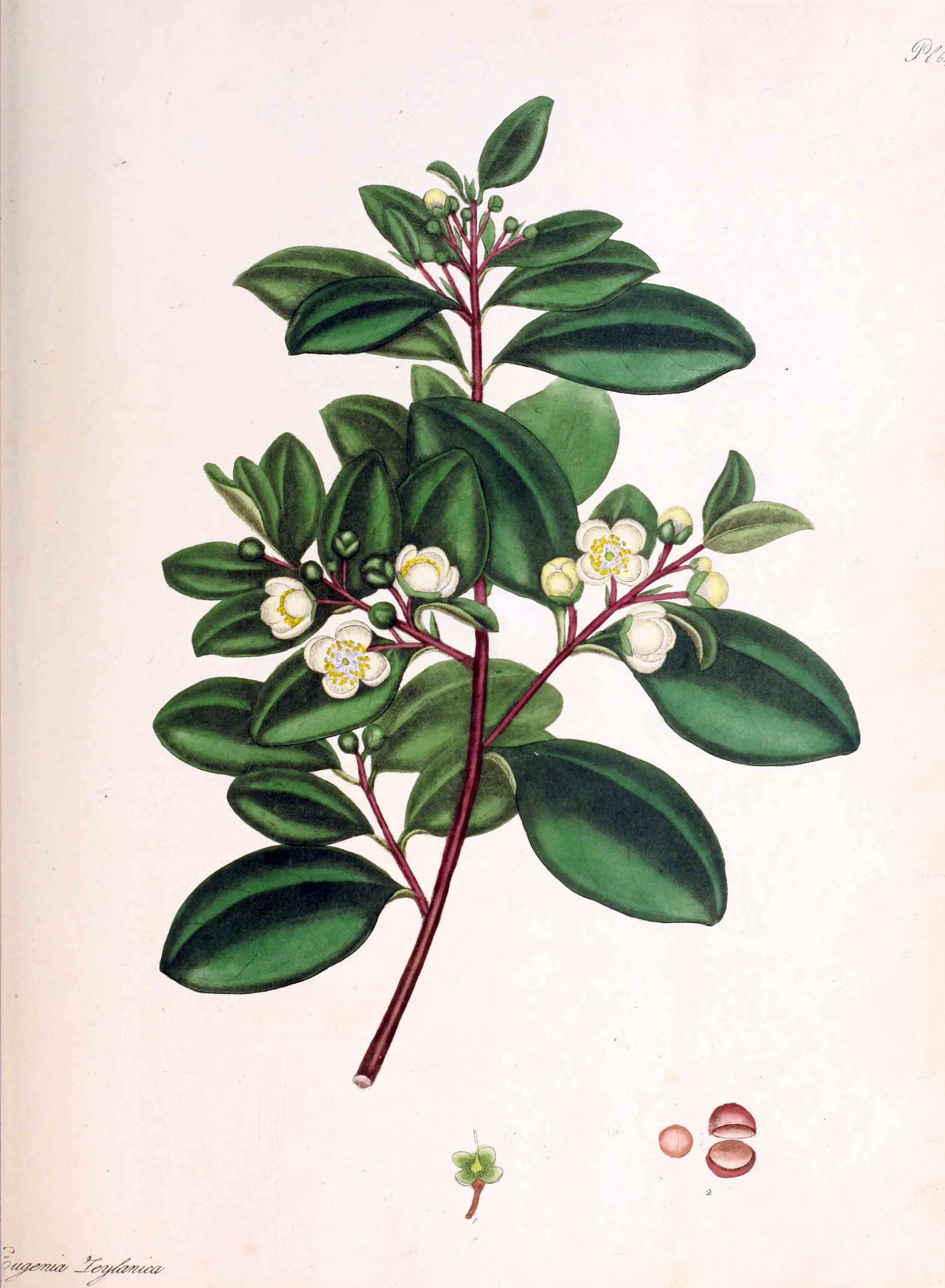
Volume 10 — PLATE DCXIX. EUGENIA Zeylanica. Ceylon Eugenia.
Reading edition
CLASS XII. ORDER I.
ICOSANDRIA MONOGYNIA. Stamens from the Cup. One Style.
GENERIC CHARACTER.
Calyx quadripartitus, superus. Petala quatuor. Bacca 1-locularis, 1-sperma.
Cup four-parted, above. Petals four. Berry of one cell, one-seeded.
SPECIFIC CHARACTER.
Eugenia foliis subovalibus integerrimis coriaceis retusis, pedunculis unifloris solitariis vel geminatis, axillaribus lateralibusque.
Eugenia with oval entire leathery retuse leaves, and one-flowered peduncles, either solitary or in pairs, axillary or lateral.
Eugenia zeylanica. Willd. Sp. Pl. vol. 2. p. 963.
REFERENCE TO THE PLATE.
1. Empalement, seed-bud and pointal. 2. The fruit, with the seed detached.
The Ceylon Eugenia is a low bushy wide-spreading shrub, with both the leaves and branches extending nearly horizontally. The flowers grow from the axils of the leaves and sides of the branches upon simple downy footstalks, which have two small bracts a little above their middle; and open in succession from the lower axils upwards. Professor Willdenow is not quite correct in stating the leaves to be impunctate, a minute dotting being visible on both surfaces with the naked eye, and very distinctly with the aid of a common eye-glass. The fruit is of the size of a large pea, rough with minute warts, and crowned with the persistent calyx.
We have seldom seen a more striking example of the astonishing resources provided by nature for the continuation of species than this plant, whose little germen when blossoming contains sixteen infant seeds (clustering round a common centre), while the fruit admits of one only coming to maturity! Above eighty stamens are also provided for the fertilization of a solitary stigma. We have often admired the common chesnut, each germen of which when blossoming contains twelve seeds in embryo, but this yet surpasses it.
We were favoured with fresh specimens last July by A. B. Lambert, esq. from his seat at Boyton, and a foreign specimen in his collection has also enabled us to add the fruit, which has not yet ripened in this country. The plant is stated in Donn’s Catalogue to have been introduced in 1798, most probably by Sir Abraham Hume, as the only plants of it that we have seen came originally from his collection.