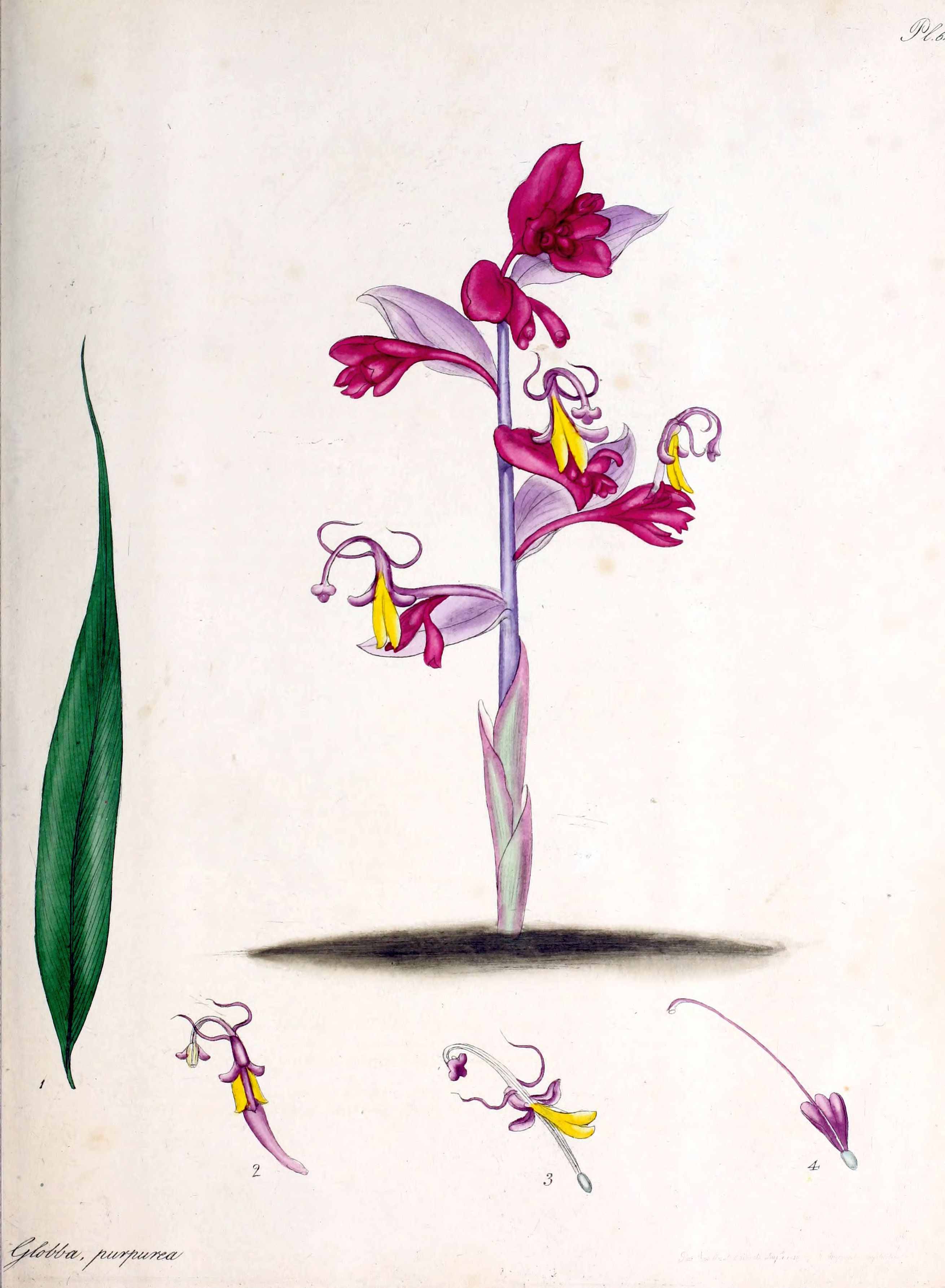
Volume 10 — PLATE DCXV. GLOBBA PURPUREA. Purple Globba.
Reading edition
CLASS I. ORDER I.
MONANDRIA MONOGYNIA. One Stamen. One Style.
GENERIC CHARACTER.
Anthera duplex. Filamentum lineare, incurvatum, longissimum, appendiculatum. Stylus laxus filiformis in medio antheræ receptus. Stigma incrassatum. Nectarium utrinque bifidum. Roscoe in the Transactions of the Linnean Society, vol. 8. p. 355.
Anthers double. Filament linear, incurved, very long and appendaged. Style (or shaft) long thread-shaped, going up between the anthers. Stigma (or summit) swelling. Nectary cleft at both ends.
SPECIFIC CHARACTER.
Globba scapo aphyllo paniculato; bracteis calyce multo longioribus subovatis, corollâ trilobâ, filamento medio biappendiculato, nectario cordato-oblongo.
Globba with a leafless panicled stem, the bracts many times longer than the cup and nearly ovate, the blossom of three lobes, the filament with two appendages in the middle, and the nectary between a heart-shape and an oblong.
REFERENCE TO THE PLATE.
1. A leaf. 2. A flower. 3. A front view of the same divested of the calyx. 4. Empalement, seed-bud, and pointal.
No genus of plants has more puzzled botanists than the Globba of Linnæus, no plant having yet been discovered that agrees with his generic character; but as the possessor of his herbarium has decided that the Globba marantina, the only species of this genus Linnæus professes to have seen, was the same plant with that called by Dr. Roxburgh, and also by Mr. Donn in his Catalogue of the Cambridge Botanic Garden, Colebrookia bulbifera; (see Smith’s Exotic Botany, page 85, where he has corrected the generic character;) this plant, also sent from India by Dr. Roxburgh to Sir Abraham Hume, bart. in 1809, now also changes its name to Globba. The inflorescence, which is directly from the root, whilst in all the species described by Dr. Smith it is placed above the leaves on a common stem, together with the three-lobed corolla, might doubtless be quite sufficient characters to distinguish it as a separate genus; but another having already been published in honour of Mr. Colebrook, we prefer leaving it with the congeners amongst which it was originally placed by its discoverer Dr. Roxburgh.
The delicacy and elegance of the whole plant, the rich tint of the floral leaves, and the curious construction of the blossoms, (where the long projecting filament drawn back by the style which is held by its summit protruded beyond the anthers, at one period of the inflorescence nearly resembles a half-bent bow,) have been admired by all who have seen it. The leaves only appear as the flowers decay.
The plant blossomed in the middle of last May, for the first time in this country, in the collection of Sir Abraham Hume, bart. where our drawing was taken. From a very useful manuscript catalogue of Indian plants by Dr. Roxburgh in the collection of A. B. Lambert, esq. we learn that it is a native of India, and has been found growing wild about Chittagong.
The ripe fruit we have not seen; but the germ is nearly oval, with three blunt angles and of one cell with many seeds affixed to three lateral receptacles. The plant is perennial, and may be propagated by the roots like other scitamineous plants.