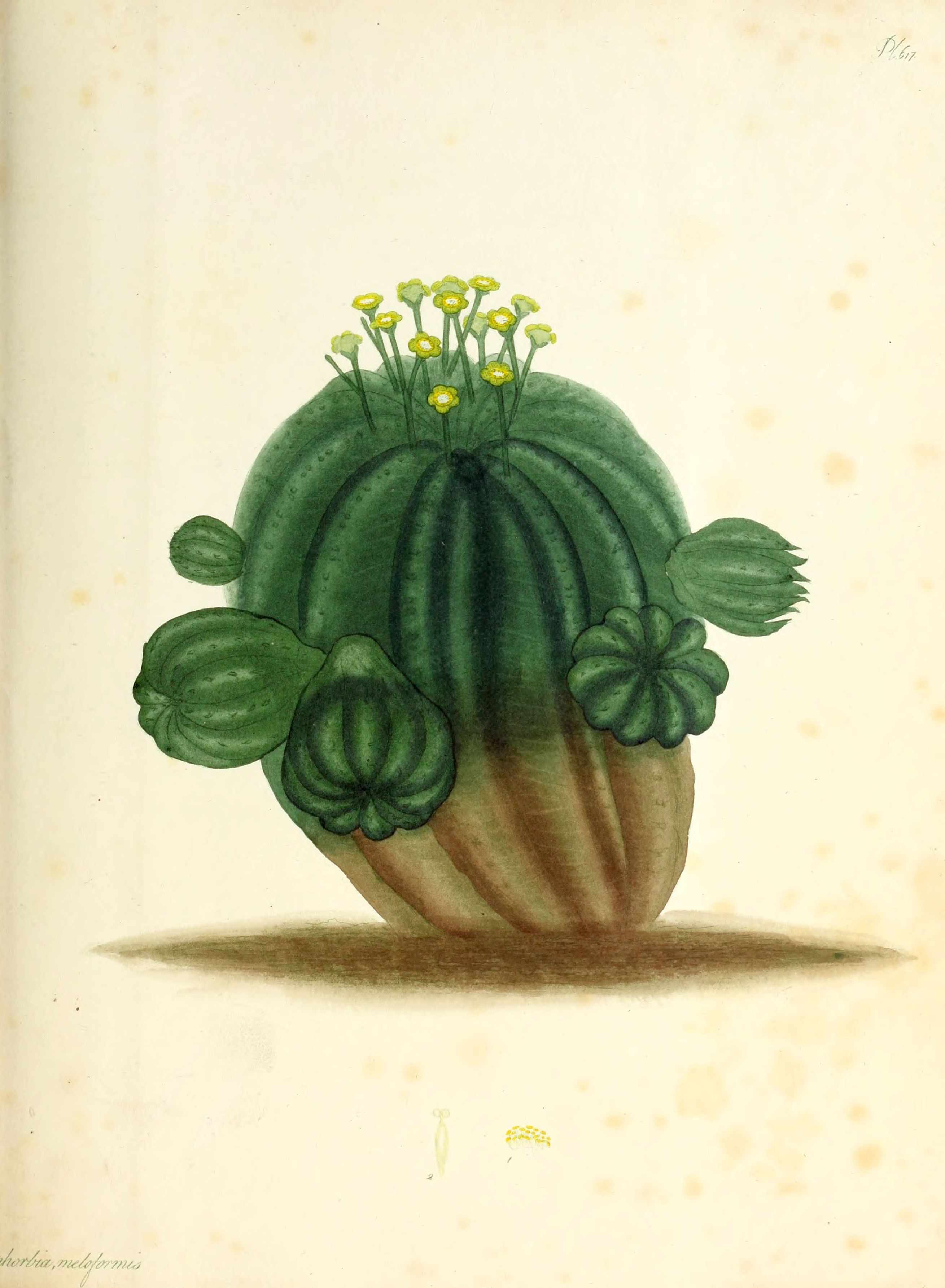
Volume 10 — PLATE DCXVII. EUPHORBIA meloformis. Melon-shaped Euphorbia.
Reading edition
CLASS XI. ORDER III.
DODECANDRIA TRIGYNIA. Twelve to Nineteen Stamens. Three Styles.
GENERIC CHARACTER.
Calyx monophyllus, ventricosus. Corolla 4- seu 5-petala calyci insidens. Capsula tricocca.
Cup of one leaf, bellying. Blossom of 4 or 5 petals sitting upon the cup. Fruit a capsule with 3 cells.
SPECIFIC CHARACTER.
Euphorbia subglobosa multangularis.
Euphorbia nearly round with many angles.
REFERENCE TO THE PLATE.
1. A flower spread open. 2. A chive magnified.
Those who are unacquainted with the versatility of this extraordinary Genus will be a little surprised at seeing a plant with so little resemblance to that on our last plate under the same generic appellation. Even the variations of Protea itself appear trifling, when compared with those of Euphorbia, which includes species with leaves opposite, alternate, scattered, whorled, and imbricated, and others leafless, like the present; plants round, oval, square, triangular and oblong; annual, herbaceous, succulent, thorny, woody, and even arboreous; and natives of all climates, from Siberia to Dusky Bay. Almost all the species agree in being replete with a milky juice which flows from them freely when wounded, and is generally of an acrid corrosive quality. An excellent description of the Euphorbia meloformis was given in the second volume of the Hortus Kewensis, and has been since copied into the Species Plantarum. An engraving and description of it by Mons. Desfontaines, one of the professors in the Museum of Natural History at Paris, also ornaments the first volume of their Annales. The species is dioicous; and, except in the Royal Gardens at Kew, male flowers only have as yet been produced by the plants cultivated in this country, and their progeny at Paris. The stamens come to maturity at different times, those of the centre being the earliest, the woolly filaments of which persisting after the antheræ are fallen off give to the flowers a singular appearance. The species is a native of Africa towards the Cape of Good Hope, and was introduced by Mr. Masson in 1774, but is still very scarce, and requires to be kept in the dry stove or on a shelf in the hot-house, much moisture being always inimical to it. The propagation is by separating the young bulbs from their parent stock, and planting them in pots of earth nearly dry, as they retain their vegetative powers for months without either earth or water.