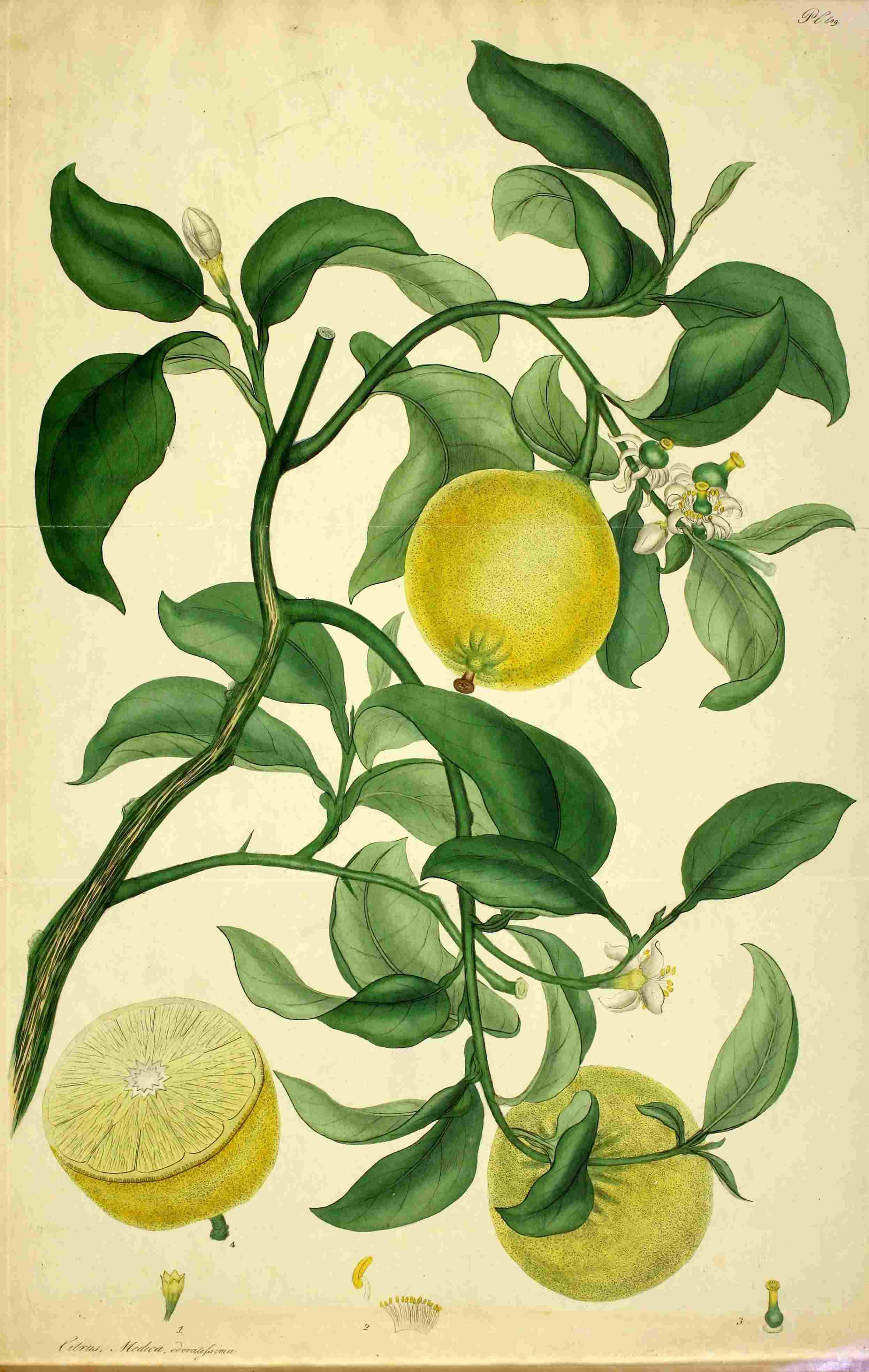
Volume 10 — PLATE DCIX. CITRUS MEDICA, odoratissima. Bergamot Lemon.
Reading edition
CLASS XVIII. ORDER III.
POLYADELPHIA ICOSANDRIA. Many Sets of Chives. Threads from the Calyx or Receptacle.
GENERIC CHARACTER.
Calyx 5-dentatus. Corolla 5-petala. Stamina 20 in cylindrum passim connata. Stylus 1. Bacca 9—12-locularis, pulpa vesiculari.
Cup 5-toothed. Petals five. Stamens about 20, generally united at the base. Shaft 1. Fruit 9-to 12-celled, the pulp bladdery.
SPECIFIC CHARACTER.
Citrus foliis acuminatis.
Citrus with pointed leaves.
Citrus medica β. Linn. Sp. Pl. Limon Bergamotta. Volkamer. Hesperides, cap. 26. tab. p. 154.
REFERENCE TO THE PLATE.
1. The empalement. 2. Chives spread open. 3. The seed-bud and pointal. 4. A horizontal section of the fruit.
The drawing of this curious and valuable fruit was also taken at Wormleybury last May. Sir Abraham Hume informs us, that the plant was introduced in 1785, by Mrs. Evelyn, of St. Clare in Kent, who brought it with her from Nice. The name Bergamot is said by the Chevalier Lamarck (in the French Encyclopédie) to come from Bergame in Italy, where the principal cultivation of the plant lies. The valuable perfume called Essence of Bergamot is prepared in Italy from the fruit, but by what method they extract it we have not been able to learn: it is rather remarkable that England, so celebrated for her commerce, her collections of natural history, and spirit in gardening, and annually importing so much of this Essence, should have been so long without the plant that produced it.
In arranging the Bergamot for the present as a variety of the Lemon, we by no means subscribe to the opinion of those who, servilely following Linnæus, include all sorts of apples and pears under his Pyrus mala and communis; all grape-vines under Vitis vinifera; and limes, lemons, citrons, oranges and shaddocks of all kinds, under his Citrus Medica and Aurantium. Already the last-mentioned genus has been considerably illustrated by the works of Gmelin, Rumphius, Thunberg, and Loureiro; and Professor Willdenow now enumerates six species of Citrus, and the Chevalier Lamarck eleven species; and many more are probably yet latent in the unexplored regions of Asia. Indeed it is only to those who have an opportunity of observing them in their original situations, where the spade of the labourer has never disturbed their repose, that we must look for their complete illustration. The immense tracts on our northern hemisphere, over which apples are naturally scattered, as well as the vast and permanent differences observed in their fruits, give us also much to hope for; even Linnæus himself observes in his Flora Suecica, that the apple which he found growing naturally in Smoland was very different from that which he found in other parts of Sweden; the original Paradise-apple (Malus pumila of the old authors) has already been recovered by the Russian naturalist Pallas, forming large thickets on the banks of the Wolga and Tanais, (see his Flora Rossica, vol. i. p. 22.); and the same author informs us that the apples he found growing about the Terek were of a large size, and excellent even in their wild state; while those that he met with in other parts of Russia were quite worthless. Even in India our indefatigable countryman Dr. Buchanan has discovered five original species of this genus (one of them a quince) growing naturally on the elevated regions towards the snowy mountains. His descriptions of them, however, are yet unpublished, but we have seen his specimens in the collection of A. B. Lambert, esq.