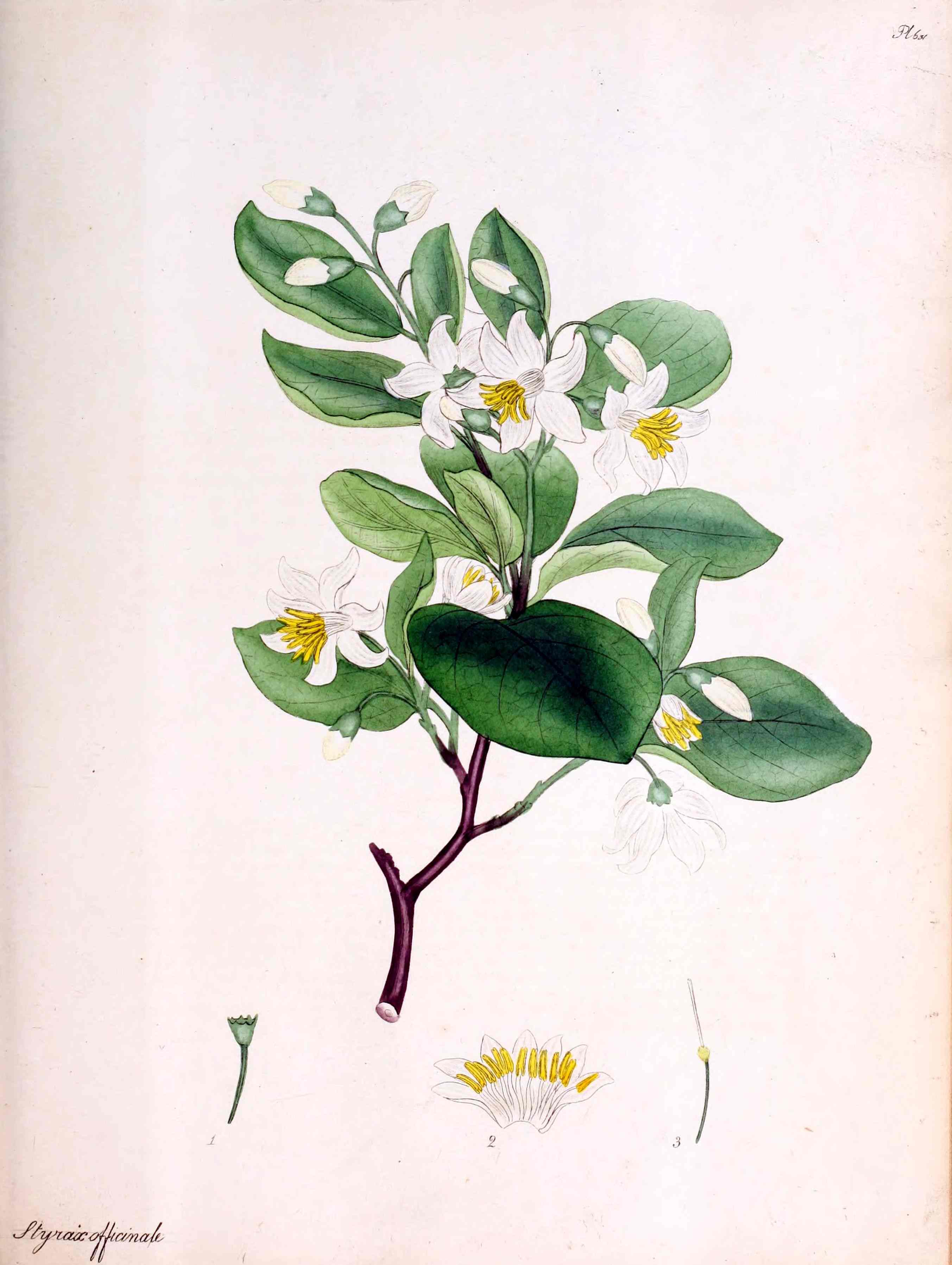
Volume 10 — PLATE DCXXXI. STYRAX OFFICINALE. Storax Tree.
Reading edition
CLASS X. ORDER I.
DECANDRIA MONOGYNIA. Ten Stamens. One Style.
GENERIC CHARACTER.
Calyx inferus. Corolla imo calyci inserta, subcampanulata, 3-8-partita. Antheræ 10-15. Germen triloculare, polyspermum. Drupa coriacea, subglobosa, 1-3-sperma.
Cup below. Blossom adhering to the base of the cup, nearly bell-shaped, 3-to 8-parted. Stamens 10 to 15. Germen of three cells with many seeds. Berry dry, leathery, nearly round. Seeds 1 to 3.
SPECIFIC CHARACTER.
Styrax foliis ovatis subtus villosis, racemis simplicibus folio brevioribus. Ait. Kew. 2. p. 75.
Styrax with the leaves oval, downy beneath, the racemes (bunches of flowers) simple, shorter than the leaf.
REFERENCE TO THE PLATE.
1. Empalement. 2. A blossom spread open. 3. Seed-bud and pointal.
The Storax tree is a native of the Levant, of Italy, and of the southern parts of Provence in France. The tree is very ornamental, but requires the shelter of a wall in this climate, and while young either to be kept in the green-house or covered during severe frosts. The time of flowering is June and July, but ripe fruits are rarely produced in this country. The principal importation of Storax is said to be from Turkey, where it is obtained both by gathering that which naturally exudes from the trees, and also by making artificial incisions, to which hollow reeds are affixed to receive it. From the accounts of some travellers published by Du Hamel, we learn that they generally adulterate it by mixing it with wax. The Storax-tree is by no means a new acquisition in this country. Gerard in his Herball, published in 1597, informs us that he had two small trees of it in his garden. It is however still a very scarce plant, and only to be found in a few of the principal collections, which, we are informed, is occasioned by the great difficulty of propagating it either by cuttings or layers.
The specimen was communicated, in the beginning of last June, from the well known garden of the Company of Apothecaries at Chelsea.