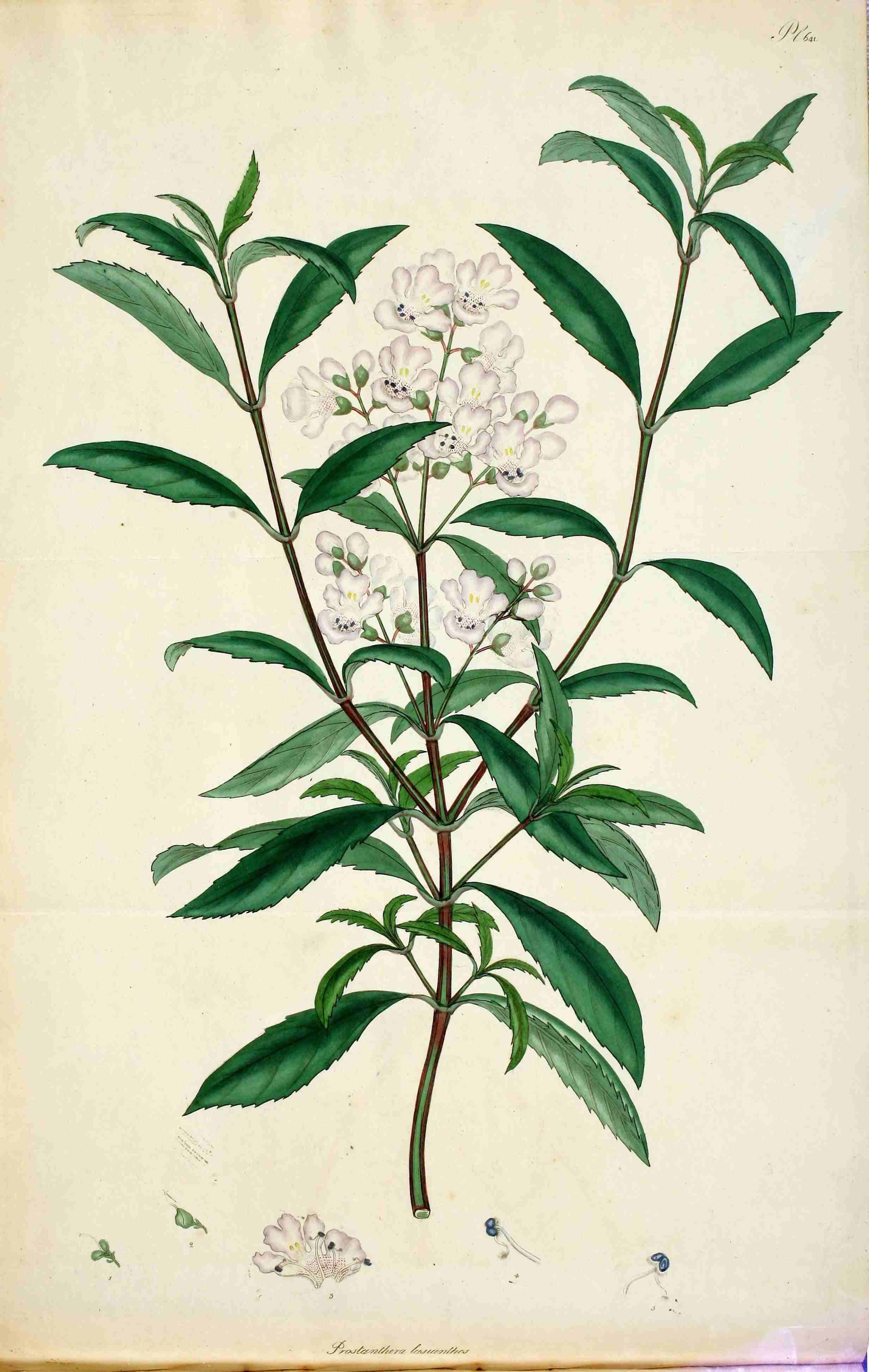
Volume 10 — PLATE DCXLI. PROSTANTHERA LASIANTHOS. Downy-flowered Prostanthera.
Reading edition
CLASS XIV. ORDER I.
DIDYNAMIA GYMNOSPERMIA. Two Chives longer. Seeds naked.
GENERIC CHARACTER.
Calyx post florescentiam clausus, utroque labio integerrimo. Corolla monopetala, lanata, ringens; antheris appendiculatis: baccæ quatuor, monospermæ: foliis petiolatis: pedunculis lanceolatis, serratis: floribus paniculis axillaribus terminalibusque: ramulis oppositis, quadrangularibus.
Habitat in Capite Van Diemen.
Labillardiere Nova Hollandia, vol. ii. p. 18. tab. 157.
The empalement after flowering shuts, both segments entire. Blossom one-petalled, woolly, gaping: chives with an appendage: berries four, one-seeded: leaves with petioles: footstalks lance-shaped, and sawed: flowers terminate the branches in panicles from the axils of the leaves: branches opposite, and four-sided.
Native of Van Diemen’s Land.
REFERENCE TO THE PLATE.
1. The empalement, seed-bud and pointal. 2. The same as it appears after flowering. 3. A blossom spread open. 4. A chive magnified. 5. The same shown from the inner side, magnified.
This fine plant is perfectly new to the British gardens, and the only species of a genus named and figured by Labillardiere in his Nova Hollandia, or Description of New South Wales.
It was raised from seed in the summer of 1807, in the collection of the Right Hon. Lord Grenville, at Dropmore, who favoured us with specimens in full bloom, last June, 1811, being the first time of its flowering in this country. His Lordship’s botanic gardener informs us that the plant is about eight feet high, and the stem one inch and a quarter in diameter; that during the first year it had the appearance of being herbaceous, but afterwards became woody; its growth is very luxuriant, flowering at the termination of every branch, and seems as if it would thrive in any sort of earth, and was nearly if not quite hardy, as the roots remained in the ground one year at Dropmore, and shot up strong again in the summer. It may be increased by cuttings, and will be found not only an acquisition in point of novelty, but ornamental from its numerous light graceful blossoms, which possess an agreeable fragrance.