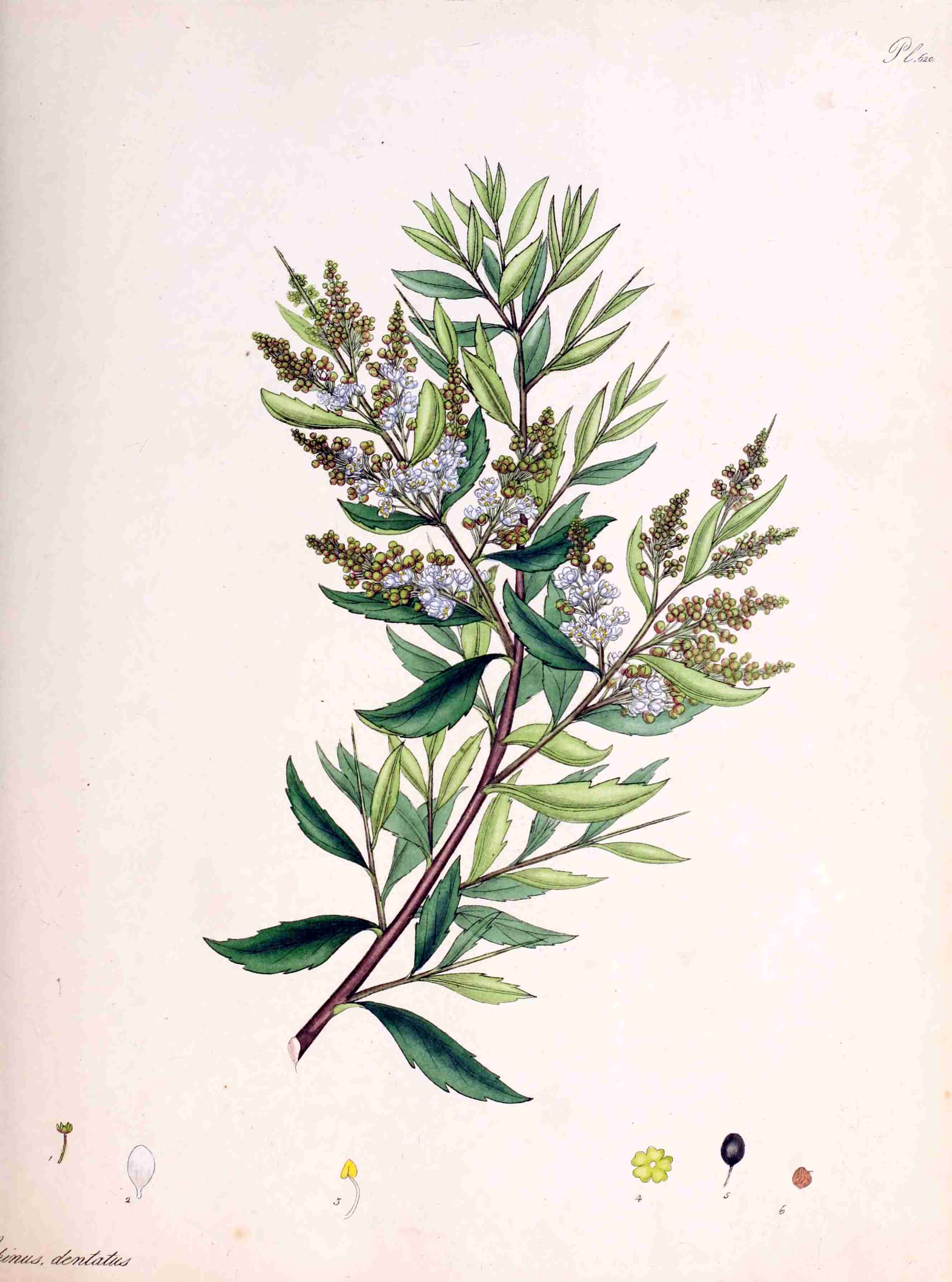
Volume 10 — PLATE DCXX. SCHINUS DENTATA. Toothed Schinus.
Reading edition
CLASS XXII. ORDER IX.
DIOECIA s. POLYGAMIA DECANDRIA. Shafts and Chives separate on different Plants, or both on the same. Ten Chives.
GENERIC CHARACTER.
Mas. Calyx 5-fidus. Petala 5. Stamina 8-10 sub nectario rotato inserta.
Fem. Calyx et petala maris. Stigmata 3. Drupa sicca, multi-locularis, submonosperma. Nux subturbinatus, obtusè angulatus. Embryo subreniformis, compressus. Cotyledones 2, æquales, latofalcatæ. Radicula supera, cylindrica, incurva.
Male. Cup 5-cleft. Petals 5. Chives 8-10 affixed under a wheel-shaped nectary.
Female. Cup and blossom as in the male. Summits 3. Berry dry, with many cells and generally one seed. Nut nearly top-shaped with blunt angles. Embryo nearly kidney-shaped, compressed. Seed-leaves 2, equal, broadly falcate. Radicle above, cylindrical, incurved.
SPECIFIC CHARACTER.
Schinus foliis simplicibus dentatis.
Schinus with simple toothed leaves.
REFERENCE TO THE PLATE.
1. The empalement. 2. A petal magnified. 3. A chive magnified. 4. The nectary magnified. 5. A ripe berry. 6. The nut cleared from the pulp.
Specimens of this curious Schinus were communicated in May by the Right Honourable the Marquis of Blandford, from his gardens at White Knights. Its native country, as we are informed, is Owhyhee, an island long to be remembered in English history for the loss of the illustrious Cook;
Who, born to bless mankind, fair Science bore To Ocean’s bounds and isles unknown before; And, while to guard barbarian lives his care, Was murder’d by the men he sought to spare.
At what time the Schinus dentata was brought to England, or by whom, we have not been able to learn. It thrives very well in sheltered situations here in the open ground, and even ripens fruit in good seasons when trained against a wall. The berries are black, nearly of the size of small currants, with a sweet fleshy pulp, each berry containing a single nut which is bluntly angled, and a flattened two-leaved crooked embryo enclosed in a farinaceous perisperm of unequal thickness, having outwardly the same form as the nut.
Another species agreeing exactly in habit with the present, the toothed leaves excepted, S. dependens, (the Amyris polygama of Cavanilles and Willdenow,) has before been added to the genus by Ortega: and we cannot help noticing how remarkable it is that three plants, two of which differ so widely in habit, should yet agree so closely in their fructification. The insertion of the stamens, nectary, germen, stigmas and fruit is exactly similar; and the fruit of Schinus Molle figured by Gærtner (as far as his figure and description go) coincides exactly with the fruit of S. dentata. For the ripe fruit and some observations on the genus we are indebted to A. B. Lambert, esq.