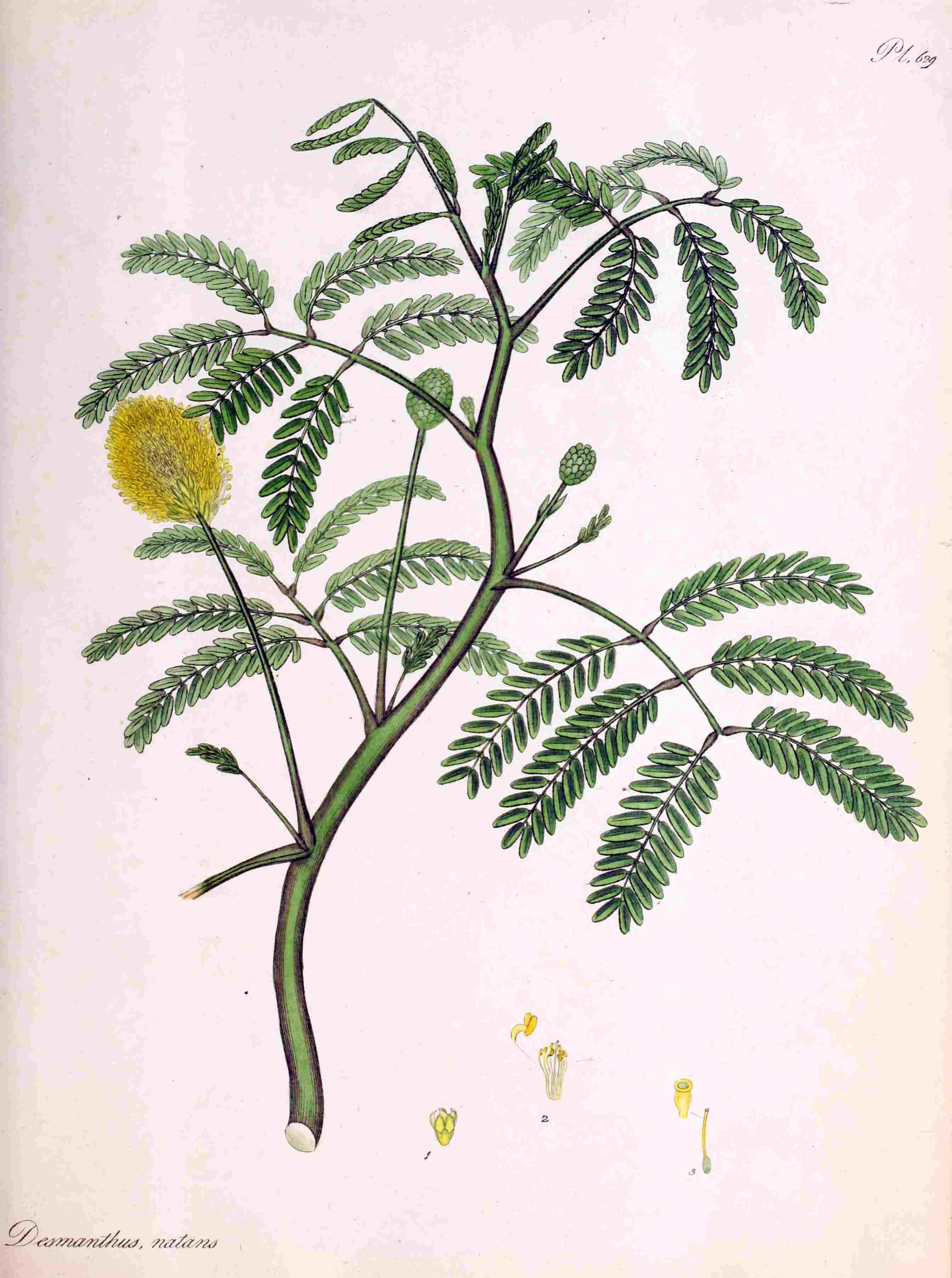
Volume 10 — PLATE DCXXIX. DESMANTHUS NATANS. Floating Desmanthus, or Aquatic Sensitive.
Reading edition
CLASS XXIII. ORDER I.
POLYGAMIA MONŒCIA. Various Dispositions upon one Plant.
GENERIC CHARACTER.
Hermaph. Calyx 5-dentatus. Corolla 5-petala vel 5-partita. Stamina 10. Pistillum 1. Legumen bivalve.
Neuter. Calyx 5-dentatus. Corolla 5-petala vel 5-partita vel nulla. Stamina 10, sterilia, lanceolato-dilatata.
Hermaph. Cup 5-toothed. Blossom 5-petalled or 5-parted. Stamens 10. Style 1. Pod 2-valved.
Neuter. Cup 5-toothed. Blossom 5-petalled or 5-parted or none. Stamens 10, sterile, enlarged into a lance-shape.
SPECIFIC CHARACTER.
Desmanthus inermis, foliis bipinnatis, partialibus trijugis, propriis tredecimjugis, spicis oblongis, interruptis, pedunculo nudo, caule tereti, radicante. Willd. Sp. Pl. 4. p. 1044.
Unarmed Desmanthus, with doubly pinnate leaves, the partial wings in 3 pairs, the proper in 13, the spikes oblong, interrupted, the flower-stalk naked, the stem round and rooting.
REFERENCE TO THE PLATE.
1. Empalement and blossom. 2. Stamens and pointal, one anther magnified. 3. Seed-bud and pointal, summit magnified.
This little delicate aquatic, growing naturally in pools and lakes of fresh water in India and Cochinchina, and quivering at every breeze, its roots having no attachment to the soil, and the foliage yielding but little to that of the Mimosa pudica in sensibility, forms a most striking contrast to the Anneslea spinosa of our 128th number. Father Loureiro, who calls it Neptunia oleracea, informs us that in China and Cochinchina, where they cultivate it as a salad herb in pools and slow-flowing streams, they are accustomed to tie the plants to stakes, to prevent their floating to a distance.
A description of the plant, accompanied by an elegant figure, will be found in the 2d volume of Dr. Roxburgh’s Plants of the Coast of Coromandel, under the name of Mimosa natans; but from the total dissimilarity between the fruit and that of the genus Mimosa, we have preferred following the arrangement of Professor Willdenow. The specimens from which the drawing was taken were obligingly communicated by Mr. Milne last September from Fonthill. The plant is annual, and according to Mr. Donn’s Catalogue (where see Mimosa natans) was introduced to this country in 1802.