THE THIRD PART CALLED THE ORCHARD,
Reading edition

Containing all sorts of trees bearing fruit for mans vse to eate, proper and fit for to plant an Orchard in our climate and countrie: I bound it with this limitation, because both Dates, Oliues, and other fruits, are planted in the Orchards of Spaine, Italy, and other hot countries, which will not abide in ours. Yet herein I will declare whatsoeuer Art, striuing with Nature, can cause to prosper with vs, that whosoeuer will, may see what can bee effected in our countrie. And first to begin with the lower shrubbes or bushes, and after ascend to the higher trees.
Chap. I. Rubus Idæus. Raspis.
The Raspis berrie is of two sorts, white and red, not differing in the forme either of bush, leafe, or berry, but onely in the colour and taste of the fruit. The Raspis bush hath tender whitish stemmes, with reddish small prickes like haires set round about them, especially at the first when they are young; but when they grow old they become more wooddy and firme, without any shew of thornes or prickles vpon them, and hath onely a little hairinesse that couereth them: the leaues are somewhat rough or rugged, and wrinkled, standing three or fiue vpon a stalke, somewhat like vnto Roses, but greater, and of a grayer greene colour: the flowers are small, made of fine whitish round leaues, with a dash as it were of blush cast ouer them, many standing together, yet euery one vpon his owne stalke, at the tops of the branches; after which come vp small berries, somewhat bigger then Strawberries, and longer, either red or white, made of many graines, more eminent then in the Strawberry, with a kinde of douninesse cast ouer them, of a pleasant taste, yet somewhat sowre, and nothing so pleasant as the Strawberrie. The white Raspis is a little more pleasant then the red, wherein there is small seede inclosed: the rootes creepe vnder ground verie farre, and shoote vp againe in many places, much encreasing thereby.
There is another whose stemme and branches are wholly without prickles: the fruit is red, and somewhat longer, and a little more sharpe.
The Vse of Raspis.
The leaues of Raspis may be vsed for want of Bramble leaues in gargles, and other decoctions that are cooling and drying, although not fully to that effect.
The Conserue or Syrupe made of the berries, is effectuall to coole an hot stomacke, helping to refresh and quicken vp those that are ouercome with faintnesse.
The berries are eaten in the Summer time, as an afternoones dish, to please the taste of the sicke as well as the sound.
The iuyce and the distilled water of the berries are verie comfortable and cordiall.
It is generally held of many, but how true I know not, that the red wine that is vsually sold at the Vintners, is made of the berries of Raspis that grow in colder countries, which giueth it a kinde of harshnesse: And also that of the same berries growing in hotter climates, which giueth vnto the wine a more pleasant sweetnesse, is made that wine which the Vintners call Alligant: but we haue a Vine or Grape come to vs vnder the name of the Alligant Grape, as you shall finde it set downe hereafter among the Grapes; and therefore it is likely to be but an opinion, and no truth in this, as it may be also in the other.
Chap. II. Ribes rubra, alba, nigra. Currans red, white, and blacke.
The bushes that beare those berries, which are vsually called red Currans, are not those Currans either blew or red, that are sold at the Grocers, nor any kind thereof; for that they are the grapes of a certaine Vine, as shall be shewed by and by: but a farre differing kinde of berry, whereof there are three sorts, red, white, and blacke.
The red Curran bush is of two sorts, and groweth to the height of a man, hauing sometimes a stemme of two inches thicknesse, and diuers armes and branches, couered with a smooth, darke, brownish barke, without anie pricke or thorne at all vpon anie part thereof, whereon doe growe large cornered blackish greene leaues, cut in on the edges, seeming to be made of fiue parts, almost like a Vine leafe, the ends a little pointing out, and standing one aboue another on both sides of the branches: the flowers are little and hollow, comming forth at the ioynts of the leaues, growing many together on a long stalke, hanging downe aboue a fingers length, and of an herbie colour: after which come small round fruit or berries, greene at the first, and red as a Cherry when they are ripe, of a pleasant and tart taste: the other differeth not in anie other thing then in the berries, being twice as bigge as the former: the roote is wooddy, and spreadeth diuersly.
The white Curran bush riseth vsually both higher then the red, and straighter or more vpright, bigger also in the stemme, and couered with a whiter barke: the leaues are cornered, somewhat like the former, but not so large: the flowers are small and hollow like the other, hanging downe in the same manner on long stalkes, being of a whiter colour: the berries likewise growe on the long stalkes, somewhat thicker set together, and of a cleare white colour, with a little blacke head, so transparent that the seedes may be easily seene thorough them, and of a more pleasant winie taste then the red by much.
The blacke Curran bush riseth higher then the white, with more plentifull branches, and more pliant and twiggie: the stemme and the elder branches being couered with a brownish barke, and the younger with a paler: the flowers are also like vnto little bottles as the others be, of a greenish purple colour, which turne into blacke berries, of the bignesse of the smaller red Currans: the leaues are somewhat like vnto the leaues of the red Currans, but not so large: both branches, leaues, and fruit haue a kind of stinking sent with them, yet they are not vnwholsome, but the berries are eaten of many, without offending either taste or smell.
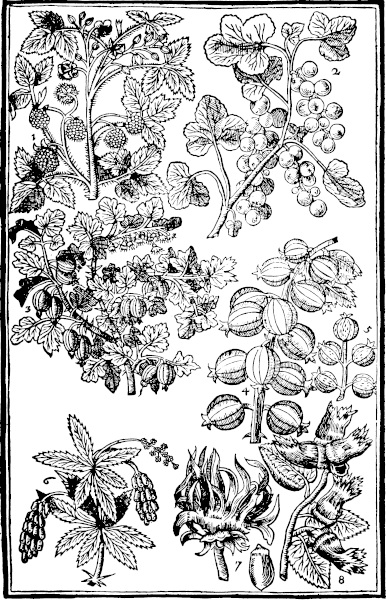
1Rubus Idæus. The raspis.
2Ribes fructu rubro vel albo. White or red Currans.
3Grossularia vulgaris. The ordinary Gooseberry.
4Grossularia fructu rubro. The great red Gooseberry.
5Grossularia aculeata. The prickly Gooseberry.
6Oxyacantha seu Berberis. The Barbary bush.
7Auellana Byzantina. The Filberd of Constantinople.
8Auellana rubra nostras. The best red Filberd.
The Vse of Currans.
The red Currans are vsually eaten when they are ripe, as a refreshing to an hot stomacke in the heate of the yeare, which by the tartnesse is much delighted. Some preserue them, and conserue them also as other fruits, and spend them at neede.
The white Currans, by reason of the more pleasant winie taste, are more accepted and desired, as also because they are more daintie, and lesse common.
Some vse both the leaues and berries of the blacke Currans in sawces, and other meates, and are well pleased both with the sauour and taste thereof, although many mislike it.
Chap. III. Vua Crispa siue Grossularia. Gooseberries or Feaberries.
Wee haue diuers sorts of Gooseberries, besides the common kinde, which is of three sorts, small, great, and long. For wee haue three red Gooseberries, a blew and a greene.
The common Gooseberrie, or Feaberrie bush, as it is called in diuers Countries of England, hath oftentimes a great stemme, couered with a smooth darke coloured bark, without anie thorne thereon, but the elder branches haue here and there some on them, and the younger are whitish, armed with verie sharpe and cruell crooked thorns, which no mans hand can well auoide that doth handle them, whereon are set verie greene and small cornered leaues cut in, of the fashion almost of Smallage, or Hawthorne leaues, but broad at the stalke: the flowers come forth single, at euerie ioynt of the leafe one or two, of a purplish greene colour, hollow and turning vp the brims a little: the berries follow, bearing the flowers on the heads of them, which are of a pale greene at the first, and of a greenish yellow colour when they are ripe, striped in diuers places, and cleare, almost transparent, in which the seede lyeth. In some these berries are small and round; in others much greater; a third is great, but longer then the other: all of them haue a pleasant winie taste, acceptable to the stomacke of anie (but the long kinde hath both the thicker skin, and the worser taste of the other) and none haue been distempered by the eating of them, that euer I could heare of.
The first of the red Gooseberries is better knowne I thinke then the rest, and by reason of the small bearing not much regarded; the stemme is somewhat bigge, and couered with a smooth darke coloured barke, the younger branches are whiter, and without anie thorne or pricke at all, so long, weake, small, and slender, that they lye vpon the ground, and will there roote againe: the leaues are like vnto the former Gooseberries, but larger: the flowers and berries stand single, and not manie to bee found anie yeare vpon them, but are somewhat long, and are as great as the ordinarie Gooseberry, of a darke brownish red colour, almost blackish when they are ripe, and of a sweetish taste, but without any great delight.
The second red Gooseberry riseth vp with a more straight stemme, couered with a brownish barke; the young branches are straight likewise, and whitish, and grow not so thicke vpon it as the former red kinde, and without any thorne also vpon them: the leaues are like vnto the former red, but smaller: the berries stand singly at the leaues as Gooseberries doe, and are of a fine red colour when they are ripe, but change with standing to be of a darker red colour, of the bignesse of the small ordinary Gooseberry, of a pretty tart taste, and somewhat sweete withall.
The third red Gooseberry which is the greatest, and knowne but vnto few, is so like vnto the common great Gooseberry, that it is hardly distinguished: the fruit or berries grow as plentifully on the branches as the ordinary, and are as great & round as the great ordinary kinde, but reddish, and some of them paler, with red stripes.
The blew Gooseberry riseth vp to bee a bush like vnto the red Curran, and of the same bignesse and height, with broader and redder leaues at the first shooting out, then the second red Gooseberry: the berries are more sparingly set on the branches, then on the small red, and much about the same bignesse, or rather lesser, of the colour of a Damson, with an ouershadowing of a blewish colour vpon them, as the Damson hath, before it be handled or wiped away.
The greene prickly Gooseberry is very like vnto the ordinary Gooseberry in stemme and branches, but that they are not stored with so many sharpe prickles; but the young shootes are more plentifull in small prickles about, and the greene leafe is a little smaller: the flowers are alike, and so are the berries, being of a middle size, and not very great, greene when they are thorough ripe as well as before, but mellower, and hauing a few small short prickles, like small short haires vpon them, which are harmlesse, and without danger to anie the most dainty and tender palate that is, and of a verie good pleasant taste. The seede hereof hath produced bushes bearing berries, hauing few or no prickles vpon them.
The Vse of Gooseberries.
The berries of the ordinary Gooseberries, while they are small, greene, and hard, are much vsed to bee boyled or scalded to make sawce, both for fish and flesh of diuers sorts, for the sicke sometimes as well as the sound, as also before they bee neere ripe, to bake into tarts, or otherwise, after manie fashions, as the cunning of the Cooke, or the pleasure of his commanders will appoint. They are a fit dish for women with childe to stay their longings, and to procure an appetite vnto meate.
The other sorts are not vsed in Cookery that I know, but serue to bee eaten at pleasure; but in regard they are not so tart before maturity as the former, they are not put to those vses they be.
Chap. IIII. Oxyacantha, sed potius Berberis. Barberries.
The Barberry bush groweth oftentimes with very high stemmes, almost two mens height, but vsually somewhat lower, with manie shootes from the roote, couered with a whitish rinde or barke, and yellow vnderneath, the wood being white and pithy in the middle: the leaues are small, long, and very greene, nicked or finely dented about the edges, with three small white sharpe thornes, for the most part set together at the setting on of the leaues: the flowers doe growe vpon long clustering stalkes, small, round, and yellow, sweete in smell while they are fresh, which turne into small, long, and round berries, white at the first, and very red when they are ripe, of a sharpe sowre taste, fit to set their teeth on edge that eate them: the roote is yellow, spreading far vnder the vpper part of the ground, but not very deepe.
There is (as it is thought) another kinde, whose berries are thrice as bigge as the former, which I confesse I haue not seene, and know not whether it be true or no: for it may peraduenture be but the same, the goodnesse of the ground and ayre where they growe, and the youngnesse of the bushes causing that largenesse, as I haue obserued in the same kinde, to yeeld greater berries.
There is said to be also another kinde, whose berries should be without stones or seede within them, not differing else in anie thing from the former: but because I haue long heard of it, and cannot vnderstand by all the inquirie I haue made, that any hath seene such a fruit, I rest doubtfull of it.
The Vse of Barberries.
Some doe vse the leaues of Barberries in the stead of Sorrell, to make sawce for meate, and by reason of their sowrenesse are of the same quality.
The berries are vsed to be pickled, to serue to trimme or set out dishes of fish and flesh in broth, or otherwise, as also sometime to bee boyled in the broth, to giue it a sharpe rellish, and many other wayes, as a Master Cooke can better tell then my selfe.
The berries are preserued and conserued to giue to sicke bodies, to helpe to coole any heate in the stomacke or mouth, and quicken the appetite.
The depurate iuyce is a fine menstrue to dissolue many things, and to verie good purpose, if it be cunningly handled by an Artist.
The yellow inner barke of the branches, or of the rootes, are vsed to be boyled in Ale, or other drinkes, to be giuen to those that haue the yellow iaundise: As also for them that haue anie fluxes of choller, to helpe to stay and binde.
Clusius setteth downe a secret that hee had of a friend, of a cleane differing propertie, which was, that if the yellow barke were laid in steepe in white wine for the space of three houres, and afterwards drunke, it would purge one very wonderfully.
Chap. V. Nux Auellana. The Filberd.
The Filberd tree that is planted in Orchards, is very like vnto the Hasell nut tree that groweth wilde in the woods, growing vpright, parted into many boughes and tough plyable twigges, without knots, couered with a brownish, speckled, smooth, thinne rinde, and greene vnderneath: the leaues are broad, large, wrinkled, and full of veines, cut in on the edges into deepe dents, but not into any gashes, of a darke greene colour on the vpperside, and of a grayish ash colour vnderneath: it hath small and long catkins in stead of flowers, that come forth in the Winter, when as they are firme and close, and in the Spring open themselues somewhat more, growing longer, and of a brownish yellow colour: the nuts come not vpon those stalkes that bore those catkins, but by themselues, and are wholly inclosed in long, thicke, rough huskes, bearded as it were at the vpper ends, or cut into diuers long iagges, much more then the wood nut: the nut hath a thinne and somewhat hard shell, but not so thicke and hard as the wood nut, in some longer then in other, and in the long kinde, one hath the skinne white that couereth the kernels, and another red.
There is another sort of the round kinde that came from Constantinople, whose huske is more cut, torne, or iagged, both aboue and belowe, then any of our country; the barke also is whiter, and more rugged then ours, and the leaues somewhat larger.
We haue had from Virginia Hasell nuts, that haue beene smaller, rounder, browner, thinner sheld, and more pointed at the end then ours: I know not if any hath planted of them, or if they differ in leafe or any thing else.
The Vse of Filberds.
Filberds are eaten as the best kinde of Hasell nuts, at bankets among other dainty fruits, according to the season of the yeare, or otherwise, as euery one please: But Macer hath a Verse, expressing prettily the nature of these nuts, which is,
Ex minimis nucibus nulli datur esca salubris.
that is, There is no wholsome food or nourishment had from these small kinde of nuts.
Yet they are vsed sometime physically to be rosted, and made into a Lohoc or Electuary, that is vsed for the cough or cold. And it is thought of some, that Mithridates meant the kernels of these nuts, to be vsed with Figs and Rue for his Antidote, and not of Walnuts.
Chap. VI. Vitis. The Vine.
There is so great diuersities of Grapes, and so consequently of Vines that bear them, that I cannot giue you names to all that here grow with vs: for Iohn Tradescante my verie good friend, so often before remembred, hath assured me, that he hath twentie sorts growing with him, that hee neuer knew how or by what name to call them. One description therefore shall serue (as I vse to doe in such varieties) for all the rest, with the names afterwards, of as many as we can giue, and the seuerall formes, colours and proportions of the grapes.
The manured Vine, in the places where it hath abiden long time, groweth to haue a great bodie, stemme or trunke, sometimes of the bignesse of a mans arme, sleeue and all, spreading branches if it bee suffered without end or measure, but vsually stored with many armes or branches, both old and new, but weake, and therefore must bee sustained; whereof the old are couered with a thin scaly rinde, which will often chap and peele off of it selfe; the youngest being of a reddish colour, smooth and firme, with a hollownesse or pith in the middle: from the ioints of the young branches, and sometimes from the bodie of the elder, breake out on euerie side broade greene leaues, cut on the edges into fiue diuisions for the most part, and besides notched or dented about: right against the leafe, and likewise at other ioynts of the branches, come forth long twining or clasping tendrels, winding themselues about any thing standeth next vnto them: at the bottome of these leaues come forth clusters of small greenish yellow bloomes or flowers, and after them the berries, growing in the same manner in clusters, but of diuers formes, colours, tastes and greatnesse. For some grapes are great, others lesse, some very small (as the Currans that the Grocers sell) some white, some red, blew, blacke, or partie-coloured, some are as it were square, others round: some the clusters are close, others open, some are sweete, others sower or harsh, or of some other mixed taste; euerie one differing from others, verie notably either in taste, colour or forme; within euerie one of which grapes, (and yet there is a grape without stones) are contained one, two, or more kernels or stones, some of them being smal, others greater: the rootes spread far and deepe. They that keepe their Vines in the best order, doe cut them low, not suffering them to grow high, or with too many branches, whereby they grow the better, take vp the lesser roome, and bring their grapes fairer and sweeter.
The kindes of Vines and Grapes.
Our ordinarie Grape both white and red, which excelleth Crabs for veriuice, and is not fit for wine with vs.
The white Muscadine Grape is a verie great Grape, sweete and firme, some of the bunches haue weighed sixe pound, and some of the grapes halfe an ounce.
The redde Muscadine is as great as the white, and chiefly differeth in colour.
The Burlet is a very great white Grape, but fitter for veriuice; then wine for the most part; yet when a hot yeare happeneth fit for it, the Grape is pleasant.
The little blacke Grape that is ripe very early.
The Raisin of the Sunne Grape is a very great Grape, and very great clusters, of a reddish colour when it is ripe with vs, yet in an extraordinarie hot yeare, it hath got a little blewnesse cast ouer by the best: but naturally verie blew.
The Curran Grape (or the Grape of Corinth) is the least Grape of all, and beareth both few, and verie seldome with vs, but in reasonable great clusters, and of a blackish blew colour, when they are ripe with vs, and very sweete. There is another sort of them that are red or browne, and of a sower taste, nothing so sweete.
The Greeke wine Grape is a blackish Grape, and very sweete.
The Frontignack is a white Grape, of a verie sweete and delicate taste, as the wine declareth, that smelleth as it were of Muske.
The square Grape is reported to bear a Grape not fully round, but sided, or as it were square, whereby it became so called.
The Damasco Grape is a great white grape, very sweete, and is the true Vva Zibeba, that the Apothecaries should vse in the Trochisci Ciphi: and such wee haue had in former times come ouer vnto vs in great, long and round white boxes, containing halfe an hundred weight a peece.
The Russet Grape is a reasonable faire grape, exceeding sweet and whitish, with a thicke skinne, crusted ouer with a shew of ash colour.
The white long Grape is like vnto a Pigeons egge, or as it were pointed pendent like a Pearle.
The partie-coloured Grape is a reasonable great Grape, and discoloured when it is ripe, sometimes the whole bunches, and sometimes but some of the grapes being parted whitish, and blacke halfe through, verie variably.
The Rhenish wine Grape is a white Grape, and endureth the cold of winter when it commeth earely, more then the Muscadine before set downe, and is nothing so sweete.
The White wine Grape is verie like vnto the Rhine Grape, the soile only and climate adding more sweetnesse vnto the one then to the other.
The Claret wine Grape is altogether like the white Grape, but that it is not white, but of a reddish colour, which lying bruised vpon the skins before they are pressed, giue that Claret tincture to the wine.
The Teint is a Grape of a deeper or darker colour, whose iuice is of so deepe a colour, that it serueth to colour other wine.
The Bursarobe is a faire sweete white Grape of much esteeme about Paris.
The Alligant is a verie sweete Grape, giuing so deep and liuely a coloured red wine, that no other whatsoeuer is comparable to it, and therefore vsually called Spaniards blood.
The blew or blacke Grape of Orleans is another blacke Grape, giuing a darke coloured sweete wine much commended in those parts.
The Grape without stones is also a kinde by it selfe, and groweth naturally neere Ascalon, as Brochard affirmeth, the wine whereof is redde, and of a good taste.
The Virginia Vine, whereof I must needes make mention among other Vines, beareth small Grapes without any great store of iuice therein, and the stone within it bigger then in any other Grape: naturally it runneth on the ground, and beareth little.
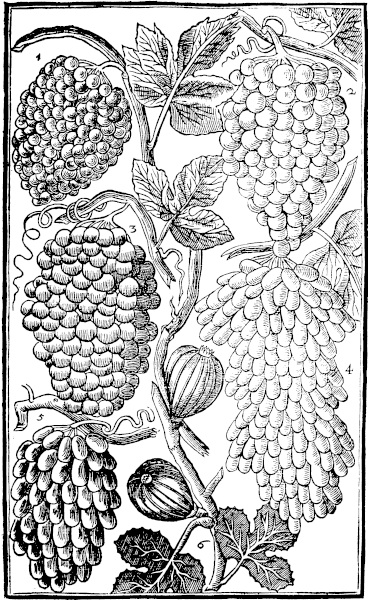
1Vuæ nigræ minores. The small blacke Grape.
2Vuæ cæruleæ maiores. The great blew Grape.
3Vuæ Moschatellinæ. The Muscadine Grape.
4Vuæ Burletenses. The Burlet Grape.
5Vuæ insolatæ. The Ray sins of the sunne Grape.
6Ficus. The Figge Tree.
The Vse of Vines, Grapes, and other parts that come of them.
The greene leaues of the Vine are cooling and binding, and therefore good to put among other herbes that make gargles and lotions for sore mouthes.
And also to put into the broths and drinke of those that haue hot burning feauers, or any other inflammation.
They stay (as it is held for true) womens longings, if they be either taken inwardly, or applyed outwardly.
Wine is vsually taken both for drinke and medicine, and is often put into sawces, broths, cawdles, and gellies that are giuen to the sicke. As also into diuers Physicall drinkes, to be as a vehiculum for the properties of the ingredients.
It is distilled likewise after diuers manners, with diuers things, for diuers & sundry waters to drinke, & for diuers purposes both inward and outward.
Also distilled of it selfe, is called Spirit of wine, which serueth to dissolue, and to draw out the tincture of diuers things, and for many other purposes.
The iuice or veriuice that is made of greene hard grapes, before they be ripe, is vsed of the Apothecaries to be made into a Syrupe, that is very good to coole and refresh a faint stomacke.
And being made of the riper grapes is the best veriuice, farre exceeding that which is made of crabs, to be kept all the yeare, to be put both into meates and medicines.
The grapes of the best sorts of Vines are pressed into wine by some in these dayes with vs, and much more as I verily beleeue in times past, as by the name of Vineyard giuen to many places in this Kingdome, especially where Abbies and Monasteries stood, may bee coniectured: but the wine of late made hath beene but small, and not durable, like that which commeth from beyond Sea, whether our vnkindly yeares, or the want of skill, or a conuenient place for a Vineyard be the cause, I cannot well tell you.
Grapes of all sorts are familiarly eaten when they are ripe, of the sicke sometimes as well as the sound.
The dryed grapes which we call great Raysins, and the Currans which we call small Raysins, are much vsed both for meates, broths, and sawces, in diuers manners, and this Countrey in generall aboue any other, wherein many thousands of Frailes full, Pipes, Hogs-heads, and Buts full are spent yearly, that it breedeth a wonder in them of those parts where they growe and prouide them, how we could spend so many.
The Raysins of the Sunne are the best dryed grapes, next vnto the Damasco, and are very wholsome to eate fasting, both to nourish, and to helpe to loosen the belly.
The dryed Lees of wine called Argoll or Tartar, is put to the vse of the Goldsmith, Dyer, and Apothecary, who doe all vse it in seuerall manners, euery one in his art.
Of it the Apothecaries make Cremor Tartari, a fine medicine to bee vsed, as the Physitian can best appoint, and doth helpe to purge humours by the stoole.
Thereof likewise they make a kinde of water or oyle, fit to bee vsed, to take away freckles, spots, or any such deformities of the face or skinne, and to make it smooth. It causeth likewise haire to growe more aboundantly in those places where it naturally should growe.
The liquor of the Vine that runneth forth when it is cut, is commended to be good against the stone wheresoeuer it be; but that liquor that is taken from the end of the branches when they are burnt, is most effectuall to take away spots and markes, ring-wormes and tetters in any place.
Chap. VII. Ficus. The Figge tree.
The Figge trees that are noursed vp in our country are of three sorts, whereof two are high; the one bearing against a wall goodly sweete and delicate Figs, called Figs of Algarua, and is blewish when it is ripe: the other tall kinde is nothing so good, neither doth beare ripe Figges so kindly and well, and peraduenture may be the white ordinary kinde that commeth from Spaine. The third is a dwarfe kinde of Figge tree, not growing much higher then to a mans body or shoulders, bearing excellent good Figges and blew, but not so large as the first kinde.
The Figge trees of all these three kindes are in leaues and growing one like vnto another, sauing for their height, colour, and sweetnesse of the fruit, hauing many armes or branches, hollow or pithy in the middle, bearing large leaues, and somewhat thicke, diuided sometimes into three, but vsually into fiue sections, of a darke greene colour on the vpperside, and whitish vnderneath, yeelding a milkie iuyce when it is broken, as the branches also or the figges when they are greene: the fruit breaketh out from the branches without anie blossome, contrary to all other trees of our Orchard, being round and long, fashioned very like vnto a small Peare, full of small white grains or kernels within it, of a very sweete taste when it is ripe, and very mellow or soft, that it can hardly be carried farre without bruising.
The other two sorts you may easily know and vnderstand, by so much as hath been said of them. Take only this more of the Figge tree, That if you plant it not against a bricke wall, or the wall of an house, &c. it will not ripen so kindly. The dwarfe Figge tree is more tender, and is therefore planted in great square tubs, to be remoued into the sunne in the Summer time, and into the house in Winter.
The Vse of Figges.
Figges are serued to the table with Raysins of the Sunne, and blanched Almonds, for a Lenten dish.
The Figs that growe with vs when they are ripe, and fresh gathered, are eaten of diuers with a little salt and pepper, as a dainty banquet to entertaine a friend, which seldome passeth without a cup of wine to wash them downe.
In Italy (as I haue beene enformed by diuers Gentlemen that haue liued there to study physicke) they eate them in the same manner, but dare not eate many for feare of a feuer to follow, they doe account them to be such breeders of bloud, and heaters of it likewise.
The Figges that are brought vs from Spaine, are vsed to make Ptisan drinkes, and diuers other things, that are giuen them that haue coughes or colds.
It is one of the ingredients also with Nuts and Rue, into Mithridates counterpoison.
The small Figges that growe with vs, and will not ripen, are preserued by the Comfitmakers, and candid also, to serue as other moist or candid banquetting stuffe.
Chap. VIII. Sorbus. The Seruice tree.
There are two kindes of Seruice trees that are planted in Orchards with vs, and there is also a wilde kinde like vnto the later of them, with Ashen leaues, found in the woods growing of it selfe, whose fruit is not gathered, nor vsed to bee eaten of any but birds. And there is another kinde also growing wilde abroad in many places, taken by the Country people where it groweth, to be a Seruice tree, and is called in Latine, Aria Theophrasti, whose leaues are large, somewhat like Nut tree leaues, but greene aboue, and grayish vnderneath: some doe vse the fruit as Seruices, and for the same purposes to good effect, yet both of these wilde kindes wee leaue for another worke, and here declare vnto you onely those two sorts are noursed vp in our Orchards.
The more common or ordinary Seruice tree with vs, is a reasonable great tree, couered with a smooth barke, spread into many great armes, whereon are set large leaues, very much cut in on the edges, almost like vnto a Vine leafe, or rather like vnto that kinde of Maple, that is vsually called the Sycomore tree with vs: the flowers are white, and growe many clustering together, which after bring forth small browne berries when they are ripe, of the bignesse almost of Hasell nuts, with a small tuft, as if it were a crowne on the head, wherein are small blacke kernels.
The other kinde, which is more rare with vs, and brought into this Land by Iohn Tradescante, heretofore often remembered, hath diuers winged leaues, many set together like vnto an Ashen leafe, but smaller, and euery one endented about the edges: the flowers growe in long clusters, but nothing so many, or so close set as the wilde kinde: the fruit of this tree is in some round like an Apple, and in others a little longer like a Peare, but of a more pleasant taste then the ordinarie kinde, when they are ripe and mellowed, as they vse to doe with both these kindes, and with Medlars.
The Vse of Seruices.
They are gathered when they growe to be neare ripe (and that is neuer before they haue felt some frosts) and being tyed together, are either hung vp in some warme roome, to ripen them thoroughly, that they may bee eaten, or (as some vse to doe) lay them in strawe, chaffe, or branne, to ripen them.
They are binding, fit to be taken of them that haue any scouring or laske, to helpe to stay the fluxe; but take heed, lest if you binde too much, more paine and danger may come thereof then of the scouring.
Chap. IX. Mespilus. The Medlar tree.
There are three sorts of Medlars: The greater and the lesser English, and the Neapolitan.
The great and the small English Medlar differ not one from the other in any thing, but in the size of the fruit, except that the small kinde hath some prickes or thornes vpon it, which the great one hath not, bearing diuers boughes or armes, from whence breake forth diuers branches, whereon are set long and somewhat narrow leaues, many standing together; in the middle whereof, at the end of the branch, commeth the flower, which is great and white, made of fiue leaues, broad at the ends, with a nicke in the middle of euery one; after which commeth the fruit, being round, and of a pale brownish colour, bearing a crowne of those small leaues at the toppe, which were the huske of the flower before, the middle thereof being somewhat hollow, and is harsh, able to choake any that shall eate it before it be made mellow, wherein there are certaine flat and hard kernels.
The Medlar of Naples groweth likewise to bee a reasonable great tree, spreading forth armes and branches, whereon are set many gashed leaues, somewhat like vnto Hawthorne leaues, but greater, and likewise diuers thornes in many places: the flowers are of an herbie greene colour, and small, which turne into smaller fruit then the former, and rounder also, but with a small head or crowne at the toppe like vnto it, and is of a more sweete and pleasant taste then the other, with three seeds only therein ordinarily.
The Vse of Medlars.
Medlars are vsed in the same manner that Seruices are, that is, to be eaten when they are mellowed, and are for the same purposes to binde the body when there is a cause: yet they as well as the Seruices, are often eaten by them that haue no neede of binding, and but onely for the pleasant sweetnesse of them when they are made mellow, and sometimes come as a dish of ripe fruit at their fit season, to be serued with other sorts to the table.
Chap. X. Lotus. The Lote or Nettle tree.
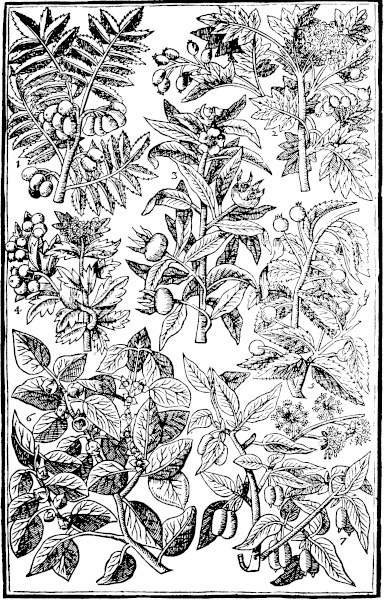
1Sorbus legitima. The true Seruice tree.
2Sorbus vulgaris siue Terminalis. The ordinary Seruice tree.
3Mespilus vulgaris. The common Medlar tree.
4Mespilus Aronia. The Medlar of Naples.
5Lotus arbor. The Nettle tree.
6Lotus Virginiana. The Pishamin or Virginia Plumme.
7Cornus mas. The Cornell Cherry tree.
The first kinde of Lote tree, whereof Dioscorides maketh mention, is but of one kinde; but there are some other trees spoken of by Theophrastus, that may be referred thereunto, which may bee accounted as bastard kindes thereof, of which I meane to entreate in this Chapter, hauing giuen you before the description of another kinde hereof (by the opinion of good Authors) vnder the name of Laurocerasus.
The first or true Lote tree groweth to be a tree of a great height, whose bodie and elder branches are couered with a smooth darke greene barke, the leaues are somewhat rough in handling, of a darke greene colour, long pointed, and somewhat deepe dented about the edges, somewhat like vnto a Nettle leafe, and oftentimes growe yellow toward Autumne: the flowers stand here and there scattered vpon the branches, after which come round berries like vnto Cherries, hanging downewards vpon long footstalkes, greene at the first, and whitish afterwards; but when they are ripe they become reddish, and if they be suffered to hang too long on the branches, they grow blackish, of a pleasant austere taste, not to be misliked, wherein is a hard round stone.
The second, which is a bastard kinde, and called Guaiacum Patauinum, groweth to bee a faire tree, with a smooth darke greene barke, shooting out many faire great boughes, and also slender greene branches, beset with faire broad greene leaues, almost like vnto the leaues of the Cornell tree, but larger: the flowers growe along the branches close vnto them, without any or with a very short foote-stalke consisting of foure greene leaues, which are as the huske, containing within it a purplish flower, made of foure leaues somewhat reddish: the fruit standeth in the middle of the green huske, greene at the first, and very harsh, but red and round when it is ripe, and somewhat like a Plumme, with a small point or pricke at the head thereof, and of a reasonable pleasant taste or rellish, wherein are contained flat and thicke browne seeds or kernels, like vnto the kernels of Cassia Fistula, somewhat hard, and not so stonie, but that it may somewhat easily be cut with a knife.
The third is called in Virginia Pishamin, The Virginia Plumme (if it be not all one with the former Guaiacana, whereof I am more then halfe perswaded) hath growne with vs of the kernels that were sent out of Virginia, into great trees, whose wood is very hard and brittle, and somewhat white withall: the branches are many, and grow slender to the end, couered with a very thinne greenish bark, whereon doe grow many faire broad greene leaues, without dent or notch on the edges, and so like vnto the former Guaiacum, that I verily thinke it (as I before said) to bee the same. It hath not yet borne flower or fruit in our Countrey that I can vnderstand: but the fruit, as it was sent to vs, is in forme and bignesse like vnto a Date, couered with a blackish skinne, set in a huske of foure hard leaues, very firme like vnto a Date, and almost as sweete, with great flat and thicke kernels within them, very like vnto the former, but larger.
The Vse of these Lote trees.
The first sort is eaten as an helper to coole and binde the body: the last, as Captaine Smith relateth in the discouery of Virginia, if the fruit be eaten while it is greene, and not ripe, is able by the harsh and binding taste and quality to draw ones mouth awry (euen as it is said of the former Guaiacana) but when it is thorough ripe it is pleasant, as I said before.
Chap. XI. Cornus mas. The Cornell tree.
The Cornell tree that is planted in Orchards, being the male (for the female is an hedge bush) is of two sorts, the one bearing red, the other whiter berries, which is very rare yet in our country, and not differing else.
It groweth to a reasonable bignesse and height, yet neuer to any great tree, the wood whereof is very hard, like vnto horne, and thereof it obtained the name: the body and branches are couered with a rugged barke, and spreadeth reasonable well, hauing somewhat smooth leaues, full of veines, plaine, and not dented on the edges: the flowers are many small yellow tufts, as it were of short haires or threads set together, which come forth before any leafe, and fall away likewise before any leafe bee much open: the fruit are long and round berries, of the bignesse of small Oliues, with an hard round stone within them, like vnto an Oliue stone, and are of a yellowish red when they are ripe, of a reasonable pleasant taste, yet somewhat austere withall.
The white (as I said) is like vnto the red, but onely that his fruit is more white when it is ripe.
The Vse of the Cornelles.
They helpe to binde the body, and to stay laskes, and by reason of the pleasantnesse in them when they are ripe, they are much desired.
They are also preserued and eaten, both for rarity and delight, and for the purpose aforesaid.
Chap. XII. Cerasus. The Cherry tree.
There are so many varieties and differences of Cherries, that I know not well how to expresse them vnto you, without a large relation of their seuerall formes. I will therefore endeauour after one generall description (as my custome is in many other the like variable fruits) to giue as briefe and short notes vpon all the rest, as I can both for leafe and fruit, that so you may the better know what the fruit is, when you haue the name.
The English Cherrie tree groweth in time to be of a reasonable bignesse and height, spreading great armes, and also small twiggy branches plentifully; the leaues whereof are not verie large or long, but nicked or dented about the edges: the flowers come forth two or three or foure at the most together, at a knot or ioynt, euerie one by it selfe, vpon his owne small and long footestalke, consisting of fiue white leaues, with some threds in the middle; after which come round berries, greene at the first, and red when they are through ripe, of a meane bignesse, and of a pleasant sweete taste, somewhat tart withall, with a hard white stone within it, whose kernell is somewhat bitter, but not vnpleasant.
The Flanders Cherrie differeth not from the English, but that it is somewhat larger, and the Cherry somewhat greater and sweeter, and not so sower.
The early Flanders Cherry is more rathe or early ripe, almost as soone as the May Cherry, especially planted against a wall, and of many false knaues or Gardiners are sold for May Cherrie trees.
The May Cherrie in a standard beareth ripe fruite later then planted against a wall, where the berries will be red in the verie beginning of May sometimes.
The Arch-Dukes Cherrie is one of the fairest and best cherries wee haue, being of a very red colour when it is ripe, and a little long more then round, and somewhat pointed at the end, of the best rellish of any Cherrie whatsoeuer, and of a firme substance; scarce one of twentie of our Nurserie men doe sell the right, but giue one for another: for it is an inherent qualitie almost hereditarie with most of them, to sell any man an ordinary fruit for whatsoeuer rare fruit he shall aske for: so little they are to be trusted.
The ounce Cherrie hath the greatest and broadest leafe of any other cherrie, but beareth the smallest store of cherries euerie yeare that any doth, and yet blossometh well: the fruit also is nothing answerable to the name being not verie great, of a pale yellowish red, neere the colour of Amber, and therefore some haue called it, the Amber Cherrie.
The great leafed Cherrie is thought of diuers to bee the Ounce Cherrie, because it hath almost as great a leafe as the former: but the fruit of this also doth not answer the expectation of so great a leafe, being but of a meane bignesse, and a small bearer, yet of a pale reddish colour.
The true Gascoign Cherry is known but to a few; for our Nursery men do so change the names of most fruits they sell, that they deliuer but very few true names to any: In former times before our wilde blacke Cherrie was found to grow plentifully in our owne woods in many places of this Land, the French continually stored vs with wilde stockes to graft vpon, which then were called Gascoigne stocks, but since they haue so termed another red Cherrie, and obtruded it vpon their customers: but the true is one of our late ripe white Cherries, euen as Gerard saith, it is a great cherrie and spotted: and this is that Cherrie I so commend to be a fit stocke to graft May cherries vpon.
The Morello Cherrie is of a reasonable bignesse, of a darke red colour when they are full ripe, and hang long on, of a sweetish sower taste, the pulpe or substance is red, and somewhat firme: if they be dryed they will haue a fine sharpe or sower taste very delectable.
The Hartlippe Cherrie is so called of the place where the best of this kinde is noursed vp, being betweene Sittingbourne and Chattam in Kent, and is the biggest of our English kindes.
The smaller Lacure or Hart Cherrie is a reasonable faire Cherrie, full aboue, and a little pointing downward, after the fashion of an heart, as it is vsually painted, blackish when it is full ripe, and lesser then the next.
The great Lacure or Hart Cherrie differeth not in forme, but in greatnesse, being vsually twice as great as the former, and of a reddish blacke colour also: both of them are of a firme substance, and reasonable sweete. Some doe call the white cherrie, the White hart cherrie.
The Luke Wardes Cherrie hath a reasonable large leafe, and a larger flower then many other: the cherries grow with long stalkes, and a stone of a meane size within them, of a darke reddish colour when they are full ripe, of a reasonable good rellish, and beareth well.
The Corone Cherrie hath a leafe little differing from the Luke Wardes cherrie; the fruit when it is ripe, is of a faire deepe red colour, of a good bignesse, and of a verie good taste, neither verie sweete or sower: the pulpe or iuice will staine the hands.
The Vrinall Cherrie in a most fruitfull yeare is a small bearer, hauing many yeares none, and the best but a few; yet doth blossome plentifully euery yeare for the most part: the cherrie is long and round, like vnto an Vrinall, from whence it tooke his name; reddish when it is full ripe, and of an indifferent sweete rellish.
The Agriot Cherrie is but a small Cherrie, of a deepe redde colour when it is ripe, which is late; of a fine sharpe taste, most pleasant and wholsome to the stomacke of all other cherries, as well while they are fresh as being dryed, which manner they much vse in France, and keepe them for the vse both of the sicke and sound at all times.
The Biguarre Cherrie is a fair cherrie, much spotted with white spots vpon the pale red berry, and sometimes discoloured halfe white and halfe reddish, of a reasonable good rellish.
The Morocco Cherrie hath a large white blossome, and an indifferent big berrie, long and round, with a long stalke of a darke reddish purple colour, a little tending to a blew when it is full ripe, of a firme substance: the iuice is of a blackish red, discolouring the hands or lips, and of a pleasant taste: Some doe thinke that this and the Morello be both one.
The Naples Cherrie is also thought to bee all one with the Morello or Morocco.
The white Spanish Cherrie is an indifferent good bearer, the leafe and blossome somewhat large, and like the Luke Wardes cherrie: the cherries are reasonable faire berries, with long stalkes and great stones, white on the outside, with some rednesse, on the one side of a firme substance, and reasonable sweet, but with a little aciditie, and is one of the late ripe ones: But there is another late ripe white Cherry, which some call the Gascoigne, before remembred.
The Flanders cluster Cherrie is of two sorts, one greater then another: the greater kinde hath an indifferent large leafe; the blossomes haue many threds within them, shewing as it were many parts, which after turne into clusters of berries, foure, fiue or sixe together, and but with one stalke vnder them, as if they grew one out of another, and sometimes they will beare but two or three, and most of them but one cherry on a stalke, which are red when they are ripe, very tender, and waterish sweete in eating.
The lesser is in all things like the greater, but smaller, which maketh the difference.
The wilde cluster or birds cluster Cherry beareth many blossomes set all along the stalkes, and cherries after them in the same maner, like a long thinne bunch of grapes, and therefore called of some the Grape cherry: there are of them both red and blacke.
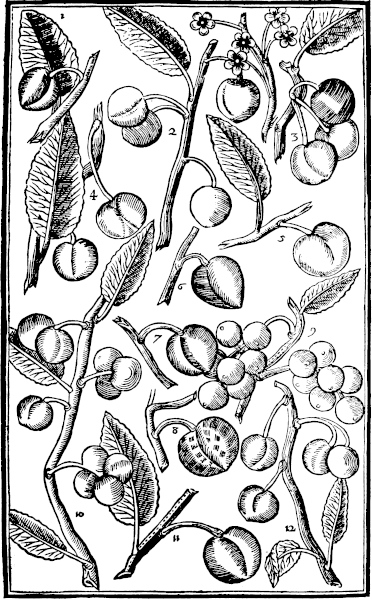
1Cerasus præcox. The May Cherry.
2Cerasus Batauica. The Flanders Cherry.
3Cerasus Hispanica siue alba. The white Cherry.
4Cerasus platophyllos. The great leafed Cherry.
5Cerasus Luca Wardi. Luke Wards Cherry.
6Cerasus Neapolitana. The Naples Cherry.
7Cerasus Cordata. The Heart Cherry.
8Cerasus maculata. The bignarre or spotted Cherry.
9Cerasus auium racemosa. The wilde cluster Cherry.
10Cerasus Corymbisera. The Flanders cluster Cherry.
11Cerasus Archiducis. The Archdukes Cherry.
12Chamacerasus. The dwarfe Cherry.
The soft sheld Cherrie is a small red cherrie when it is ripe, hauing the stone within it so soft and tender, that it may easily be broken in the eating of the cherrie.
Iohn Tradescantes Cherrie is most vsually sold by our Nursery Gardiners, for the Archdukes cherrie, because they haue more plenty thereof, and will better be increased, and because it is so faire and good a cherrie that it may be obtruded without much discontent: it is a reasonable good bearer, a faire great berrie, deepe coloured, and a little pointed.
The Baccalaos or New-found-land Cherrie hath a shining long leafe, most like vnto a Peach leafe, the blossomes come very many together as it were in an vmbell, which is such a cluster as is neither like the Flanders cluster, nor the wilde cluster cherrie blossome: it bringeth forth berries standing in the same manner euerie one vpon his own footestalke, being no bigger then the largest berrie of the red Curran tree or bush, of a pale or waterish red colour when it is ripe.
The strange long cluster Cherrie, or Padus Theophrasti Dalechampio is reckoned by the Author of that great Herball that goeth vnder his name, among the sorts of cherries; and so must I vntill a fitter place be found for it. It groweth in time to be a great tree, with a sad coloured barke both on the bodie and branches, whereon doe grow many leaues, somewhat broade, shorter, harder, and a little more crumpled then any cherrie leafe: the blossomes are very small, and of a pale or whitish colour, smelling very sweete and strong, or rather heady, like Orenge flowers, growing on small long branches, very like the toppe of flowers vpon the Laburnum or Beane trefoile trees: after which come small blacke berries, growing together all along the long stalke, like vnto the wilde cluster or birds cherrie mentioned before, but not much bigger then tares, with small stones within them, and little or no sustance vpon them: the French call the tree Putier, because the wood thereof stinketh, and make it to be wonderfull that the blossomes of the tree mould be so sweete, and the wood so stinking.
The Cullen Cherrie is a darke red cherrie like the Agriot, which they of those parts neere Cullen and Vtrecht &c. vse to put into their drinke, to giue it the deeper colour.
The great Hungarian Cherrie of Zwerts is like both in leafe and fruite vnto the Morello cherrie, but much greater and fairer, and a far better bearer: for from a small branch hath beene gathered a pound of cherries, and this is vsuall continually, and not accidentally, most of them foure inches in compasse about, and very many of them more of a faire deepe red colour, and very sweete, excelling the Arch-Dukes cherry, or any other whatsoeuer.
The Cameleon or strange changeable Cherry deseruedly hath this name, although of mine owne imposition, not only because it beareth vsually both blossomes, greene and ripe fruit at one time thereupon, but that the fruit will be of many formes; some round, some as it were square, and some bunched forth on one side or another, abiding constant in no fashion, but for the most part shewing forth all these diuersities euerie yeare growing vpon it: the fruit is of a very red colour, and good taste.
The great Rose Cherry, or double blossomd Cherry differeth not in any thing from the English Cherrie, but only in the blossomes, which are very thicke of white leaues, as great and double as the double white Crowfoote, before remembred, and sometimes out of the middle of them will spring another smaller flower, but double also; this seldome beareth fruit, but when it doth I suppose it commeth from those blossomes are the least double, and is red, no bigger then our ordinary English cherrie.
The lesser Rose or double blossomd Cherrie beareth double flowers also, but not so thicke and double as the former; but beareth fruit more plentifully, of the same colour and bignesse with the former.
The Dwarfe Cherrie is of two sorts; one whose branches fall downe low, round about the body of it, with small greene leaues, and fruit as small, of a deep red colour.
The other, whose branches, although small, grow more vpright, hauing greener shining leaues: the fruit is little bigger then the former, red also when it is ripe, with a litle point at the end: both of them of a sweetish rellish, but more sower.
The great bearing Cherry of Master Millen is a reasonable great red cherry, bearing very plentifully, although it bee planted against a North wall, yet it will bee late ripe, but of an indifferent sweet and good rellish.
The long finger Cherry is another small long red one, being long & round like a finger, wherof it took the name: this is not the Vrinall cherry before, but differing from it.
The Vse of Cherries.
All these sorts of Cherries serue wholly to please the palate, and are eaten at all times, both before and after meales.
All Cherries are cold, yet the sower more then the sweete; and although the sweete doe most please, yet the sower are more wholsome, if there bee regard taken in the vsing.
The Agriot or sower Cherries are in France much vsed to bee dryed (as is said before) as Pruines are, and so serue to be ministred to the sicke in all hot diseases, as feuers &c. being both boyled in their drinkes, and taken now and then of themselues, which by reason of their tartnesse, doe please the stomacke passing well.
The Gum of the Cherrie tree is commended to bee good for those are troubled with the grauell or stone. It is also good for the cough being dissolued in liquour, and stirreth vp an appetite. The distilled water of the blacke Cherries, the stones being broken among them, is vsed for the same purpose, for the grauell, stone, and winde.
Chap. XIII. Prunus. The Plumme tree.
There are many more varieties of Plummes then of Cherries, so that I must follow the same order with these that I did with them, euen giue you their names apart, with briefe notes vpon them, and one description to serue for all the rest. And in this recitall I shall leaue out the Apricockes which are certainly a kind of Plum, of an especiall difference, and not of a Peach, as Galen and some others haue thought, and set them in a chapter by themselues, and only in this set down those fruits are vsually called Plums.
The Plum tree (especially diuers of them) riseth in time to bee a reasonable tall and great tree, whose bodie and greater armes are couered with a more rugged barke, yet in some more or lesse, the younger branches being smooth in all, the leaues are somewhat rounder then those of the Cherrie tree, and much differing among themselues, some being longer, or larger, or rounder then others, and many that are exercised herein, can tell by the leafe what Plum the tree beareth (I speake this of many, not of all) as in many Cherries they can doe the like: the flowers are white, consisting of fiue leaues: the fruit is as variable in forme, as in taste or colour, some being ovall or Peare fashion or Almond like, or sphericall or round, some firme, some soft and waterish, some sweete, some sower or harsh, or differing from all these tastes: and some white, others blacke, some red, others yellow, some purple, others blew, as they shall bee briefly set downe vnto you in the following lines, where I meane not to insert any the wilde or hedge fruit, but those only are fit for an Orchard, to be stored with good fruit: and of all which sorts, the choysest for goodnesse, and rarest for knowledge, are to be had of my very good friend Master Iohn Tradescante, who hath wonderfully laboured to obtaine all the rarest fruits hee can heare off in any place of Christendome, Turky, yea or the whole world; as also with Master Iohn Millen, dwelling in Olde streete, who from Iohn Tradescante and all others that haue had good fruit, hath stored himselfe with the best only, and he can sufficiently furnish any.
The Amber Primordian Plumme is an indifferent faire Plumme, early ripe, of a pale yellowish colour, and of a waterish taste, not pleasing.
The red Primordian Plumme is of a reasonable size, long and round, reddish on the outside, of a more dry taste, and ripe with the first sorts in the beginning of August.
The blew Primordian is a small plumme, almost like the Damascene, and is subiect to drop off from the tree before it be ripe.
The white Date Plum is no very good plum.
The red Date plumme is a great long red pointed plumme, and late ripe, little better then the white.
The blacke Mussell plumme is a good plumme, reasonable drye, and tasteth well.
The red Mussell Plumme is somewhat flat as well as round, of a very good taste, and is ripe about the middle of August.
The white Mussell plumme is like the redde, but somewhat smaller, and of a whitish greene colour, but not so well tasted.
The Imperiall plum is a great long reddish plum, very waterish, and ripeneth somewhat late.
The Gaunt plum is a great round reddish plum, ripe somewhat late, and eateth waterish.
The red Pescod plum is a reasonable good plum.
The white Pescod plum is a reasonable good rellished plumme, but somewhat waterish.
The greene Pescod plum is a reasonable big and long pointed plum, and ripe in the beginning of September.
The Orenge plum is a yellowish plum, moist, and somewhat sweetish.
The Morocco plumme is blacke like a Damson, well tasted, and somewhat drye in eating.
The Dine plum is a late ripe plum, great and whitish, speckled all ouer.
The Turkie plum is a large long blackish plum, and somewhat flat like the Mussell plum, a well rellished dry plum.
The Nutmeg plumme is no bigger then a Damson, and is of a greenish yellow colour when it is ripe, which is with vs about Bartholmew tide, and is a good plum.
The Perdigon plumme is a dainty good plumme, early blackish, and well rellished.
The Verdoch plum is a great fine greene shining plum fit to preserue.
The Ienua plum is the white Date plum, before remembred.
The Barberry plum is a great early blacke plum, and well tasted.
The Pruneola plum is a small white plum, of a fine tart taste: it was wont to bee vsually brought ouer in small round boxes, and sold most commonly at the Comfitmakers, (cut in twaine, the stone cast away) at a very deere rate: the tree groweth and beareth well with vs.
The Shepway Bulleis is of a darke blewish brown colour, of a larger size then the ordinary, and of a sharpe taste, but not so good as the common.
The white and the blacke Bulleis are common in most Countries, being small round plums, lesser then Damsons, sharper in taste, and later ripe.
The Flushing Bulleis groweth with his fruite thicke clustring together like grapes.
The Winter Creke is the latest ripe plum of all sorts, it groweth plentifully about Bishops Hatfield.
The white Peare plum early ripe, is of a pale yellowish greene colour.
The late ripe white Peare plum is a greater and longer plum, greenish white, and is not ripe vntill it be neere the end of September, both waterish plums.
The blacke Peare plum is like vnto the white Peare plumme, but that the colour is blackish when it is ripe, and is of a very good relish, more firme and drye then the other.
The red Peare plumme is of the same fashion and goodnesse, but is the worst of the three.
The white Wheate plum is a waterish fulsome plum.
The red Wheate plum is like the other for taste.
The Bowie plum is flat and round, yet flatter on the one side then on the other, which caused the name, and is a very good rellished blacke plum.
The Friars plumme is a very good plum, well tasted, and comming cleane from the stone, being blacke when it is ripe, and some whitish spots vpon it.
The Catalonia plum is a very good plum.
The Don Alteza is also a very good plum.
The Muscadine plum, some call the Queene mother plumme, and some the Cherry plum, is a faire red plum, of a reasonable bignesse, and ripe about Bartholmew tide.
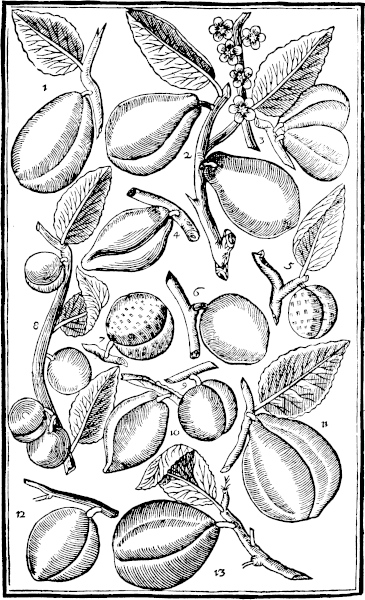
1Prunum Imperiale. The Imperiall Plum.
2Prunum Turcicum. The Turkey Plum.
3Prunum præcox rubrum. The red Primordian Plum.
4Prunum Mytellinum. The Mussell Plum.
5Prunum Ambariuum. The Amber Plum.
6Prunum Regineum. The Queen mother Plum.
7Prunum viride. The green Oysterly Plum.
8Prunum Arantiacum. The Orenge Plum.
9Prunum Myristicum. The Nutmeg Plum.
10Prunum Siliquosum. The Pescod Plum.
11Prunum Gandauense. The Gaunt Plum.
12Prunum Dactylites. The Date Plum.
13Prunum Pyrinum præcox. The early Peare Plum.
The Christian plum, called also the Nutmeg plum; the tree groweth very shrubby, and will abide good for six weekes at the least after it is gathered, and after all other plums are spent.
The Cherry plum remembred before, speaking of the Muscadine plum, is a very good plum, but small.
The Amber plum is a round plum, as yellow on the outside almost as yellow waxe, of a sowre vnpleasant taste that which I tasted, but I thinke it was not the right; for I haue seene and tasted another of the same bignesse, of a paler colour, farre better rellished, and a firmer substance, comming cleane from the stone like an Apricocke.
The Apricocke plum is a good plum when it is in its perfection, but that is seldome; for it doth most vsually cracke, thereby diminishing much of its goodnesse, and besides yeeldeth gumme at the crackes.
The Eason plum is a little red plum, but very good in taste.
The Violet plum is a small and long blackish blew plum, ripe about Bartholmew tide, a very good dry eating fruit.
The Grape plum is the Flushing Bulleis before remembred.
The Dennie plum is called also the Cheston, or the Friars plum before remembred.
The Damaske Violet plum, or Queen mother plum spoken of before.
The blacke Damascene plum is a very good dry plum, and of a darke blew colour when it is ripe.
The white Damson is nothing so well rellished as the other.
The great Damson or Damaske plum is greater then the ordinary Damson, and sweeter in taste.
The blew Damson well knowne, a good fruit.
The Coserers plum is flat, like vnto a Peare plum, it is early ripe and blacke, of a very good rellish.
The Margate plum the worst of an hundred.
The green Oysterly plum is a reasonable great plum, of a whitish green colour when it is ripe, of a moist and sweete taste, reasonable good.
The red Mirobalane plum groweth to be a great tree quickly, spreading very thicke and farre, very like the blacke Thorne or Sloe bush: the fruit is red, earlier ripe, and of a better taste then the white.
The white Mirobalane plum is in most things like the former red, but the fruit is of a whitish yellow colour, and very pleasant, especially if it be not ouer ripe: both these had need to be plashed against a wall, or else they will hardly beare ripe fruit.
The Oliue plum is very like a greene Oliue, but for colour and bignesse, and groweth lowe on a small bushing tree, and ripeneth late, but is the best of all the sorts of greene plums.
The white diapred plum of Malta, scarce knowne to any in our Land but Iohn Tradescante, is a very good plum, and striped all ouer like diaper, and thereby so called.
The blacke diapred plum is like the Damascene plum, being blacke with spots, as small as pins points vpon it, of a very good rellish.
The Peake plum is a long whitish plum, and very good.
The Pishamin or Virginia plum is called a plum, but vtterly differeth from all sorts of plums, the description whereof may truely enforme you, as it is set downe in the tenth Chapter going before, whereunto I referre you.
The Vse of Plums.
The great Damaske or Damson Plummes are dryed in France in great quantities, and brought ouer vnto vs in Hogs-heads, and other great vessels, and are those Prunes that are vsually sold at the Grocers, vnder the name of Damaske Prunes: the blacke Bulleis also are those (being dryed in the same manner) that they call French Prunes, and by their tartnesse are thought to binde, as the other, being sweet, to loosen the body.
The Bruneola Plumme, by reason of his pleasant tartnesse, is much accounted of, and being dryed, the stones taken from them, are brought ouer to vs in small boxes, and sold deere at the Comfitmakers, where they very often accompany all sorts of banquetting stuffes.
Some of these Plums, because of their firmnesse, are vndoubtedly more wholsome then others that are sweete and waterish, and cause lesse offence in their stomackes that eate them; and therefore are preserued with Sugar, to be kept all the yeare. None of them all is vsed in medicines so much as the great Damson or Damaske Prune, although all of them for the most part doe coole, lenifie, and draw forth choller, and thereby are fittest to be vsed of such as haue chollericke Agues.
Chap. XIIII. Mala Armeniaca siue Præcocia. Apricockes.
The Apricocke (as I said) is without question a kinde of Plumme, rather then a Peach, both the flower being white, and the stone of the fruit smooth also, like a Plumme, and yet because of the excellencie of the fruit, and the difference therein from all other Plummes, I haue thought it meete to entreate thereof by it selfe, and shew you the varieties haue been obserued in these times.
The Apricocke tree riseth vp to a very great height, either standing by it selfe (where it beareth not so kindly, and very little in our country) or planted against a wall, as it is most vsuall, hauing a great stemme or body, and likewise many great armes or branches, couered with a smooth barke: the leaues are large, broad, and almost round, but pointed at the ends, and finely dented about the edges: the flowers are white, as the Plumme tree blossomes, but somewhat larger, and rounder set: the fruit is round, with a cleft on the one side, somewhat like vnto a Peach, being of a yellowish colour as well on the inside as outside, of a firme or fast substance, and dry, not ouermoist in the eating, and very pleasant in taste, containing within it a broad and flat stone, somewhat round and smooth, not rugged as the Peach stone, with a pleasant sweete kernell (yet some haue reported, that there is such as haue their kernels bitter, which I did neuer see or know) and is ripe almost with our first or earliest Plummes, and thereof it tooke the name of Præcox; and it may bee was the earliest of all others was then knowne, when that name was giuen.
The great Apricocke, which some call the long Apricocke, is the greatest and fairest of all the rest.
The smaller Apricocke, which some call the small round Apricocke, is thought to be small, because it first sprang from a stone: but that is not so; for the kinde it selfe being inoculated, will bee alwaies small, and neuer halfe so faire and great as the former.
The white Apricocke hath his leaues more folded together, as if it were halfe double: it beareth but seldome, and very few, which differ not from the ordinary, but in being more white, without any red when it is ripe.
The Mascoline Apricocke hath a finer greene leafe, and thinner then the former, and beareth very seldome any store of fruit, which differeth in nothing from the first, but that it is a little more delicate.
The long Mascoline Apricocke hath his fruit growing a little longer then the former, and differeth in nothing else.
The Argier Apricocke is a smaller fruit then any of the other, and yellow, but as sweete and delicate as any of them, hauing a blackish stone within it, little bigger then a Lacure Cherry stone: this with many other sorts Iohn Tradescante brought with him returning from the Argier voyage, whither hee went voluntary with the Fleete, that went against the Pyrates in the yeare 1620.
The Vse of Apricockes.
Apricockes are eaten oftentimes in the same manner that other dainty Plummes are, betweene meales of themselues, or among other fruit at banquets.
They are also preserued and candid, as it pleaseth Gentlewomen to bestowe their time and charge, or the Comfitmaker to sort among other candid fruits.
Some likewise dry them, like vnto Peares, Apples, Damsons, and other Plummes.
Matthiolus doth wonderfully commend the oyle drawne from the kernels of the stones, to annoint the inflamed hæmorrhoides or piles, the swellings of vlcers, the roughnesse of the tongue and throate, and likewise the paines of the eares.
Chap. XV. Mala Persica. Peaches.
As I ordered the Cherries and Plummes, so I intend to deale with Peaches, because their varieties are many, and more knowne in these dayes then in former times: but because the Nectorin is a differing kinde of Peach, I must deale with it as I did with the Apricocke among the Plummes, that is, place it in a Chapter by it selfe.
The Peach tree of it selfe groweth not vsually altogether so great, or high as the Apricocke, because it is lesse durable, but yet spreadeth with faire great branches, from whence spring smaller and slenderer reddish twigges, whereon are set long narrow greene leaues, dented about the edges: the blossomes are greater then of any Plumme, of a deepe blush or light purple colour: after which commeth the fruit, which is round, and sometimes as great as a reasonable Apple or Pippin (I speake of some sorts; for there be some kindes that are much smaller) with a furrow or cleft on the one side, and couered with a freese or cotton on the outside, of colour either russet, or red, or yellow, or of a blackish red colour; of differing substances and tastes also, some being firme, others waterish, some cleauing fast to the stone on the inside, others parting from it more or lesse easily, one excelling another very farre, wherein is contained a rugged stone, with many chinkes or clefts in it, the kernell whereof is bitter: the roots growe neither deepe nor farre; and therefore are subiect to the winds, standing alone, and not against a wall. It sooner waxeth old and decayeth, being sprung of a stone, then being inoculated on a Plumme stocke, whereby it is more durable.
The great white Peach is white on the outside as the meate is also, and is a good well rellished fruit.
The small white Peach is all one with the greater, but differeth in size.
The Carnation Peach is of three sorts, two are round, and the third long; they are all of a whitish colour, shadowed ouer with red, and more red on the side is next the sunne: the lesser round is the more common, and the later ripe.
The grand Carnation Peach is like the former round Peach, but greater, and is as late ripe, that is, in the beginning of September.
The red Peach is an exceeding well rellished fruit.
The russet Peach is one of the most ordinary Peaches in the Kingdome, being of a russet colour on the outside, and but of a reasonable rellish, farre meaner then many other.
The Island Peach is a faire Peach, and of a very good rellish.
The Newington Peach is a very good Peach, and of an excellent good rellish, being of a whitish greene colour on the outside, yet halfe reddish, and is ripe about Bartholmew tide.
The yellow Peach is of a deepe yellow colour; there be hereof diuers sorts, some good and some bad.
The St. Iames Peach is the same with the Queenes Peach, here belowe set downe, although some would make them differing.
The Melocotone Peach is a yellow faire Peach, but differing from the former yellow both in forme and taste, in that this hath a small crooked end or point for the most part, it is ripe before them, and better rellished then any of them.
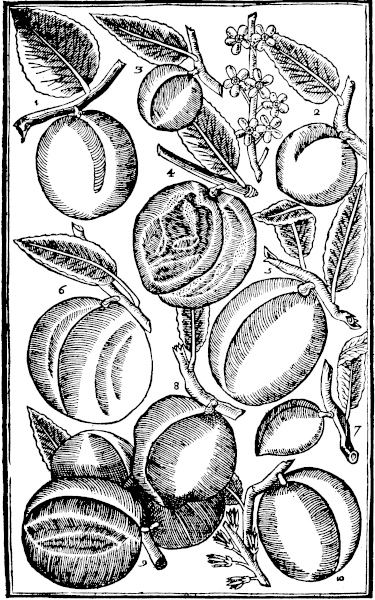
1Malus Armeniaca siue Præcocia. The Apricocke.
2Malus Persica Melocotonea. The Melocotone Peach.
3Persica Moschatellina. The Nutmeg Peach.
4Persica nigra. The blacke Peach.
5Persica Carnea longa. The long Carnation Peach.
6Persica Reginea. The Queenes Peach.
7Amygdalus. The Almond.
8Persica du Troas. The Peach du Troas.
9Nucipersica rubra optima. The best Romane red Nectorin.
10Nucipersica rubra altera. The bastard red Nectorin with a pincking blossome.
The Peach du Troas is a long and great whitish yellow Peach, red on the outside, early ripe, and is another kinde of Nutmeg Peach.
The Queenes Peach is a faire great yellowish browne Peach, shadowed as it were ouer with deepe red, and is ripe at Bartholmew tide, of a very pleasant good taste.
The Romane Peach is a very good Peach, and well rellished.
The Durasme or Spanish Peach is of a darke yellowish red colour on the outside, and white within.
The blacke Peach is a great large Peach, of a very darke browne colour on the outside, it is of a waterish taste, and late ripe.
The Alberza Peach is late ripe, and of a reasonable good taste.
The Almond Peach, so called, because the kernell of the stone is sweete, like the Almond, and the fruit also somewhat pointed like the Almond in the huske; it is early ripe, and like the Newington Peach, but lesser.
The Man Peach is of two sorts, the one longer then the other, both of them are good Peaches, but the shorter is the better rellished.
The Cherry Peach is a small Peach, but well tasted.
The Nutmeg Peach is of two sorts, one that will be hard when it is ripe, and eateth not so pleasantly as the other, which will bee soft and mellow; they are both small Peaches, hauing very little or no resemblance at all to a Nutmeg, except in being a little longer then round, and are early ripe.
Many other sorts of Peaches there are, whereunto wee can giue no especiall name; and therefore I passe them ouer in silence.
The Vse of Peaches.
Those Peaches that are very moist and waterish (as many of them are) and not firme, doe soone putrefie in the stomacke, causing surfeits oftentimes; and therefore euery one had neede bee carefull, what and in what manner they eate them: yet they are much and often well accepted with all the Gentry of the Kingdome.
The leaues, because of their bitternesse, serue well being boyled in Ale or Milke, to be giuen vnto children that haue wormes, to help to kill them, and doe gently open the belly, if there be a sufficient quantity vsed.
The flowers haue the like operation, that is, to purge the body somewhat more forceably then Damaske Roses; a Syrupe therefore made of the flowers is very good.
The kernels of the Peach stones are oftentimes vsed to be giuen to them that cannot well make water, or are troubled with the stone; for it openeth the stoppings of the vritory passages, whereby much ease ensueth.
Chap. XVI. Nucipersica. Nectorins.
I presume that the name Nucipersica doth most rightly belong vnto that kinde of Peach, which we call Nectorins, and although they haue beene with vs not many yeares, yet haue they beene knowne both in Italy to Matthiolus, and others before him, who it seemeth knew no other then the yellow Nectorin, as Dalechampius also: But we at this day doe know fiue seuerall sorts of Nectorins, as they shall be presently set downe; and as in the former fruits, so in this, I will giue you the description of one, and briefe notes of the rest.
The Nectorin is a tree of no great bignesse, most vsually lesser then the Peach tree, his body and elder boughes being whitish, the younger branches very red, whereon grow narrow long greene leaues, so like vnto Peach leaues, that none can well distinguish them, vnlesse it be in this, that they are somewhat lesser; the blossomes are all reddish, as the Peach, but one of a differing fashion from all the other, as I shall shew you by and by: the fruit that followeth is smaller, rounder, and smoother then Peaches, without any cleft on the side, and without any douny cotton or freeze at all; and herein is like vnto the outer greene rinde of the Wallnut, whereof as I am perswaded it tooke the name, of a fast and firme meate, and very delicate in taste, especially the best kindes, with a rugged stone within it, and a bitter kernell.
The Muske Nectorin, so called, because it being a kinde of the best red Nectorins, both smelleth and eateth as if the fruit were steeped in Muske: some thinke that this and the next Romane Nectorin are all one.
The Romane red Nectorin, or cluster Nectorin, hath a large or great purplish blossome, like vnto a Peach, reddish at the bottome on the outside, and greenish within: the fruit is of a fine red colour on the outside, and groweth in clusters, two or three at a ioynt together, of an excellent good taste.
The bastard red Nectorin hath a smaller or pincking blossome, more like threads then leaues, neither so large nor open as the former, and yellowish within at the bottome: the fruit is red on the outside, and groweth neuer but one at a ioynt; it is a good fruit, but eateth a little more rawish then the other, euen when it is full ripe.
The yellow Nectorin is of two sorts, the one an excellent fruit, mellow, and of a very good rellish; the other hard, and no way comparable to it.
The greene Nectorin, great and small; for such I haue seene abiding constant, although both planted in one ground: they are both of one goodnesse, and accounted with most to be the best rellished Nectorin of all others.
The white Nectorin is said to bee differing from the other, in that it will bee more white on the outside when it is ripe, then either the yellow or greene: but I haue not yet seene it.
The Vse of Nectorins.
The fruit is more firme then the Peach, and more delectable in taste; and is therefore of more esteeme, and that worthily.
Chap. XVII. Amygdala. Almonds.
The Almond also may be reckoned vnto the stock or kindred of the Peaches, it is so like both in leafe and blossome, and somewhat also in the fruit, for the outward forme, although it hath onely a dry skinne, and no pulpe or meate to bee eaten: but the kernell of the stone or shell, which is called the Almond, maketh recompense of that defect, whereof some are sweete, some bitter, some great, some small, some long, and some short.
The Almond tree groweth vpright, higher and greater then any Peach; and is therefore vsually planted by it selfe, and not against a wall, whose body sometime exceedeth any mans fadome, whereby it sheweth to be of longer continuance, bearing large armes, and smaller branches also, but brittle, whereon are set long and narrow leaues, like vnto the Peach tree: the blossomes are purplish, like vnto Peach blossoms, but paler: the fruit is somewhat like a Peach for the forme of the skinne or outside, which is rough, but not with any such cleft therein, or with any pulpe or meate fit to bee eaten, but is a thicke dry skinne when it is ripe, couering the stone or shell, which is smooth and not rugged, and is either long and great, or small, or thicke and short, according as the nut or kernell within it is, which is sweete both in the greater and smaller, and onely one smaller kinde which is bitter: yet this I haue obserued, that all the Almond trees that I haue seene growe in England, both of the sweete and bitter kindes, beare Almonds thicke and short, and not long, as that sort which is called the Iorden Almond.
The Vse of Almonds.
They are vsed many ways, and for many purposes, either eaten alone with Figges, or Raysins of the Sunne, or made into paste with Sugar and Rosewater for Marchpanes, or put among Floure, Egges, and Sugar, to make Mackerons, or crusted ouer with Sugar, to make Comfits, or mixed with Rosewater and Sugar, to make Butter, or with Barley water, to make Milke, and many other waies, as euery one list, that hath skill in such things.
The oyle also of Almonds is vsed many waies, both inwardly and outwardly, for many purposes; as the oyle of sweete Almonds mixt with poudered white Sugar Candy, for coughes and hoarsenesse, and to be drunk alone, or with some other thing (as the Syrupe of Marsh Mallowes) for the stone, to open and lenifie the passages, and make them slipperie, that the stone may passe the easier. And also for women in Child bed after their sore trauell. And outwardly either by it selfe, or with oyle of Tartar to make a creame, to lenifie the skin, parched with the winde or otherwise, or to annoint the stomacke either alone, or with other things to helpe a cold.
The oyle of bitter Almonds is much vsed to be dropped into their eares that are hard of hearing, to helpe to open them. And as it is thought, doth more scoure and cleanse the skin then the sweet oyle doth, and is therefore more vsed of many for that purpose, as the Almonds themselues are.
Chap. XVIII. Mala Arantia. Orenges.
I bring here to your consideration, as you see, the Orenge tree alone, without mentioning the Citron or Lemmon trees, in regard of the experience we haue seen made of them in diuers places: For the Orenge tree hath abiden with some extraordinary looking and tending of it, when as neither of the other would by any meanes be preserued any long time. If therefore any be desirous to keepe this tree, he must so prouide for it, that it be preserued from any cold, either in the winter or spring, and exposed to the comfort of the sunne in summer. And for that purpose some keepe them in great square boxes, and lift them to and fro by iron hooks on the sides, or cause them to be rowled by trundels, or small wheels vnder them, to place them in an house, or close gallerie for the winter time: others plant them against a bricke wall in the ground, and defend them by a shed of boardes, couered ouer with seare-cloth in the winter, and by the warmth of a stoue, or other such thing, giue them some comfort in the colder times: but no tent or meane prouision will preserue them.
The Orenge tree in the warme Countries groweth very high, but with vs (or else it is a dwarfe kinde thereof) riseth not very high: the barke of the elder stemmes being of a darke colour, and the young branches very greene, whereon grow here and there some few thornes: the leaues are faire, large, and very greene, in forme almost like a Bay leafe, but that it hath a small eare, or peece of a leafe, fashioned like vnto an heart vnder euery one of them, with many small holes to be seene in them, if you hold them vp betweene you and the light, of a sweet but strong smell, naturally not falling away, but alwaies abiding on, or vntill new be come vp, bearing greene leaues continually: the flowers are whitish, of a very strong and heady sent; after which come small round fruit, greene at the first, while they are small, and not neere maturitie, but being grown and ripe, are (as all men know) red on the out side, some more pale then others, and some kindes of a deeper yellowish red, according to the climate, and as it receiueth the heate of the sunne, wherein is contained sower or sweete iuice, and thicke white kernels among it: it beareth in the warme Countries both blossomes and greene fruit continually vpon it, and ripe fruit also with them for the best part of the yeare, but especially in Autumne and Winter.
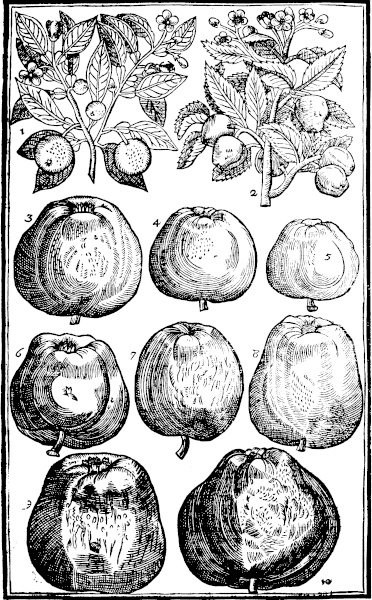
1Malus Arantia. The Orenge tree.
2Malus. The Apple tree.
3Malum Carbonarium. The Pomewater.
4Malum Curtipendulum. The golden Pippin.
5Melapium. The Pearmaine.
6Malum Regineum. The Queene Apple.
7Malum primis maturum. The Genneting.
8Malum Regale. The pound Royall.
9Malum Kentij ad seruescendum. The Kentish Codlin.
10Malum Regineum spurium. The Bardfield Quining.
The Vse of Orenges.
Orenges are vsed as sawce for many sorts of meates, in respect of their sweete sowernesse, giuing a rellish of delight, whereinsoeuer they are vsed.
The inner pulpe or iuice doth serue in agues and hot diseases, and in Summer to coole the heate of deiected stomackes, or fainting spirits.
The dryed rinde, by reason of the sweete and strong sent, serueth to bee put among other things to make sweet pouthers.
The outer rindes, when they are clensed from all the inner pulpe and skins, are preserued in Sugar, after the bitternesse by often steepings hath been taken away, & do serue either as Succots, and banquetting stuffes, or as ornaments to set out dishes for the table, or to giue a rellish vnto meats, whether baked or boyled: Physically they helpe to warme a cold stomack, and to digest or breake winde therein: or they are candid with Sugar, and serue with other dryed Iunquets.
The water of Orange flowers is oftentimes vsed as a great perfume for gloues, to washe them, or in stead of Rose-water to mixe with other things.
It is vsed to bee drunke by some, to preuent or to helpe any pestilentiall feuer.
The oyntment that is made of the flowers, is very comfortable both for the stomache, against the could or cough, or for the head, for paines and disinesse.
The kernels or seede beeing cast into the ground in the spring time, will quickely grow vp, (but will not abide the winter with vs, to bee kept for growing trees) and when they are of a finger length high, being pluckt vp, and put among sallets, will giue them a maruellous fine aromaticke or spicy taste, very acceptable.
The seed or kernels are a little cordiall, although nothing so much as the kernels of the Pomecitron.
Chap. XIX. Poma. Apples.
The sorts of Apples are so many, and infinite almost as I may say, that I cannot giue you the names of all, though I haue endeauoured to giue a great many, and I thinke it almost impossible for any one, to attaine to the full perfection of knowledge herein, not onely in regard of the multiplicitie of fashions, colours and tastes, but in that some are more familiar to one Countrey then to another, being of a better or worse taste in one place then in another, and therefore diuersly called: I will therefore as I haue done before, giue you the description of the Tree in generall, as also of the Paradise or dwarfe Apple, because of some especiall difference, and afterwards the names of as many, with their fashions, as haue come to my knowledge, either by sight or relation: for I doe confesse I haue not seene all that I here set downe, but vse the helpe of some friends, and therefore if it happen that the seuerall names doe not answer vnto seuerall sorts, but that the same fruit may bee called by one name in one Country, that is called by another elsewhere, excuse it I pray you; for in such a number, such a fault may escape vnknowne.
The Apple tree for the most part is neyther very high, great or straight, but rather vsually boweth and spreadeth (although in some places it groweth fairer and straighter then in others) hauing long and great armes or boughes, and from them smaller branches, whereon doe grow somewhat broade, and long greene leaues, nicked about the edges: the flowers are large and white, with blush coloured sides, consisting of fiue leaues: the fruit (as I said) is of diuers formes, colours and tastes, and likewise of a very variable durabilitie; for some must be eaten presently after they are gathered, and they are for the most part the earliest ripe; others will abide longer vpon the trees, before they bee fit to be gathered; some also will be so hard when others are gathered, that they will not be fit to be eaten, for one, two or three months after they bee gathered; and some will abide good but one, two or three moneths, and no more; and some will be best, after a quarter or halfe a yeares lying, vnto the end of that yeare or the next.
The Paradise or dwarfe Apple tree groweth nothing so high as the former, and many times not much higher then a man may reach, hauing leaues and flowers altogether like the other, the fruit is a faire yellow Apple, and reasonable great, but very light and spongy or loose, and of a bitterish sweet taste, nothing pleasant. And these faults also are incident vnto this tree, that both bodie and branches are much subiect vnto cancker, which will quickely eate it round, and kill it; besides it will haue many bunches, or tuberous swellings in many places, which grow as it were scabby or rough, and will soone cause it to perish: the roote sendeth forth many shootes and suckers, whereby it may be much increased. But this benefit may be had of it, to recompence the former faults, That being a dwarfe Tree, whatsoeuer fruit shall be grafted on it, will keepe the graft low like vnto it selfe, and yet beare fruit reasonable well. And this is a pretty way to haue Pippins, Pomewaters, or any other sort of Apples (as I haue, had my selfe, and also seene with others) growing low, that if any will, they may make a hedge rowe of these low fruits, planted in an Orchard all along by a walke side: but take this Caueat, if you will auoide the danger of the cancker and knots, which spoile the tree, to graft it hard vnto the ground, that therby you may giue as little of the nature of the stock thereunto as possibly you can, which wil vndoubtedly help it very much.
The kindes or sorts of Apples.
The Summer pippin is a very good apple first ripe, and therefore to bee first spent, because it will not abide so long as the other.
The French pippin is also a good fruit and yellow.
The Golding pippin is the greatest and best of all sorts of pippins.
The Russet pippin is as good an apple as most of the other sorts of pippins.
The spotted pippin is the most durable pippin of all the other sorts.
The ordinary yellow pippin is like the other, and as good; for indeed I know no sort of pippins but are excellent good well rellished fruites.
The great pearemaine differeth little either in taste or durabilitie from the pippin, and therefore next vnto it is accounted the best of all apples.
The summer pearemaine is of equall goodnesse with the former, or rather a little more pleasing, especially for the time of its eating, which will not bee so long lasting, but is spent and gone when the other beginneth to be good to eate.