THE ORDERING OF THE GARDEN OF PLEASVRE.
Reading edition
Chap. I. The situation of a Garden of pleasure, with the nature of soyles, and how to amend the defects that are in many sorts of situations and grounds.

The seuerall situations of mens dwellings, are for the most part vnauoideable and vnremoueable; for most men cannot appoint forth such a manner of situation for their dwelling, as is most fit to auoide all the inconueniences of winde and weather, but must bee content with such as the place will afford them; yet all men doe well know, that some situations are more excellent than others: according therfore to the seuerall situation of mens dwellings, so are the situations of their gardens also for the most part. And although diuers doe diuersly preferre their owne seuerall places which they haue chosen, or wherein they dwell; As some those places that are neare vnto a riuer or brooke to be best for the pleasantnesse of the water, the ease of transportation of themselues, their friends and goods, as also for the fertility of the soyle, which is seldome bad neare vnto a riuers side; And others extoll the side or top of an hill, bee it small or great, for the prospects sake; And againe, some the plaine or champian ground, for the euen leuell thereof: euery one of which, as they haue their commodities accompanying them, so haue they also their discommodities belonging vnto them, according to the Latine Prouerbe, Omne commodum fert suum incommodum. Yet to shew you for euerie of these situations which is the fittest place to plant your garden in, and how to defend it from the iniuries of the cold windes and frosts that may annoy it, will, I hope, be well accepted. And first, for the water side, I suppose the North side of the water to be the best side for your garden, that it may haue the comfort of the South Sunne to lye vpon it and face it, and the dwelling house to bee aboue it, to defend the cold windes and frosts both from your herbes, and flowers, and early fruits. And so likewise I iudge for the hill side, that it may lye full open to the South Sunne, and, the house aboue it, both for the comfort the ground shall receiue of the water and raine descending into it, and of defence from winter and colds. Now for the plaine leuell ground, the buildings of the house should be on the North side of the garden, that so they might bee a defence of much sufficiency to safeguard it from many iniurious cold nights and dayes, which else might spoyle the pride thereof in the bud. But because euery one cannot so appoint his dwelling, as I here appoint the fittest place for it to be, euery ones pleasure thereof shall be according to the site, cost, and endeauours they bestow, to cause it come nearest to this proportion, by such helpes of bricke or stone wals to defend it, or by the helpe of high growne and well spread trees, planted on the North side thereof, to keepe it the warmer. And euery of these three situations, hauing the fairest buildings of the house facing the garden in this manner before specified, besides the benefit of shelter it shall haue from them, the buildings and roomes abutting thereon, shall haue reciprocally the beautifull prospect into it, and haue both sight and sent of whatsoeuer is excellent, and worthy to giue content out of it, which is one of the greatest pleasures a garden can yeeld his Master. Now hauing shewed you the best place where this your garden should be, let me likewise aduise you where it should not be, at least that it is the worst place wherein it may be, if it be either on the West or East side of your house, or that it stand in a moorish ground, or other vnwholsome ayre (for many, both fruits, herbes, and flowers that are tender, participate with the ayre, taking in a manner their chiefest thriuing from thence) or neare any common Lay-stalles, or common Sewers, or else neare any great Brew-house, Dye-house, or any other place where there is much smoake, whether it be of straw, wood, or especially of sea-coales, which of all other is the worst, as our Citie of London can giue proofe sufficient, wherein neither herbe nor tree will long prosper, nor hath done euer since the vse of sea-coales beganne to bee frequent therein. And likewise that it is much the worse, if it bee neare vnto any Barnes or Stackes of corne or hey, because that from thence will continually with the winde bee brought into the garden the strawe and chaffe of the corne, the dust and seede of the hey to choake or pester it. Next vnto the place or situation, let mee shew you the grounds or soyles for it, eyther naturall or artificiall. No man will deny, but the naturall blacke mould is not only the fattest and richest, but farre exceedeth any other either naturall or artificiall, as well in goodnesse as durability. And next thereunto, I hold the sandy loame (which is light and yet firme, but not loose as sand, nor stiffe like vnto clay) to be little inferiour for this our Garden of pleasure; for that it doth cause all bulbous and tuberous rooted plants to thriue sufficiently therein, as likewise all other flower-plants, Roses, Trees, &c. which if it shall decay by much turning and working out the heart of it, may soone be helped with old stable manure of horses, being well turned in, when it is old and almost conuerted to mould. Other grounds, as chalke, sand, grauell, or clay, are euery of them one more or lesse fertill or barren than other; and therefore doe require such helpes as is most fit for them. And those grounds that are ouer dry, loose, and dustie, the manure of stall fedde beasts and cattell being buried or trenched into the earth, and when it is thorough rotten (which will require twice the time that the stable soyle of horses will) well turned and mixed with the earth, is the best soyle to temper both the heate and drinesse of them. So contrariwise the stable dung of horses is the best for cold grounds, to giue them heate and life. But of all other sorts of grounds, the stiffe clay is the very worst for this purpose; for that although you should digge out the whole compasse of your Garden, carry it away, and bring other good mould in the stead thereof, and fill vp the place, yet the nature of that clay is so predominant, that in a small time it will eate out the heart of the good mould, and conuert it to its owne nature, or very neare vnto it: so that to bring it to any good, there must bee continuall labour bestowed thereon, by bringing into it good store of chalke, lime, or sand, or else ashes eyther of wood or of sea-coales (which is the best for this ground) well mixed and turned in with it. And as this stiffe clay is the worst, so what ground soeuer commeth nearest vnto the nature thereof, is neared vnto it in badnesse, the signes whereof are the ouermuch moysture thereof in Winter, and the much cleaning and chapping thereof in Summer, when the heate of the yeare hath consumed the moysture, which tyed and bound it fast together, as also the stiffe and hard working therein: but if the nature of the clay bee not too stiffe, but as it were tempered and mixed with sand or other earths, your old stable soyle of horses will helpe well the small rifting or chapping thereof, to be plentifully bestowed therin in a fit season. Some also do commend the casting of ponds and ditches, to helpe to manure these stiffe chapping grounds. Other grounds, that are ouermoist by springs, that lye too neare the vpper face of the earth, besides that the beds thereof had need to be laid vp higher, and the allies, as trenches and furrowes, to lye lower, the ground it selfe had neede to haue some good store of chalke-stones bestowed thereon, some certaine yeares, if it may be, before it be laid into a Garden, that the Winter frosts may breake the chalke small, and the Raine dissolue it into mould, that so they may bee well mixed together; than which, there is not any better manure to soyle such a moist ground, to helpe to dry vp the moysture, and to giue heate and life to the coldnesse thereof, which doth alwayes accompany these moist grounds, and also to cause it abide longer in heart than any other. For the sandy and grauelly grounds, although I know the well mollified manure of beasts and cattell to be excellent good, yet I know also, that some commend a white Marle, and some a clay to be well spread thereon, and after turned thereinto: and for the chalkie ground, è conuerso, I commend fatte clay to helpe it. You must vnderstand, that the lesse rich or more barren that your ground is, there needeth the more care, labour, and cost to bee bestowed thereon, both to order it rightly, & so to preserue it from time to time: for no artificiall or forc’t ground can endure good any long time, but that within a few yeares it must be refreshed more or lesse, according as it doth require. Yet you shall likewise vnderstand, that this Garden of pleasure stored with these Out-landish flowers; that is, bulbous and tuberous rooted plants, and other fine flowers, that I haue hereafter described, and assigned vnto it, needeth not so much or so often manuring with soyle, &c. as another Garden planted with the other sorts of English flowers, or a Garden of ordinary Kitchin herbes doth. Your ground likewise for this Garden had neede to bee well cleansed from all annoyances (that may hinder the well doing or prospering of the flowers therein) as stones, weedes, rootes of trees, bushes, &c. and all other things cumbersome or hurtfull; and therefore the earth being not naturally fine enough of it selfe, is vsed to bee fitted to make it the finer, and that either through a hurdle made of sticks, or lathes, or through square or round sieues platted with fine and strong thin stickes, or with wyers in the bottome. Or else the whole earth of the Garden being course, may be cast in the same manner that men vse to try or fine sand from grauell, that is, against a wall; whereby the courser and more stony, falling downe from the fine, is to be taken away from the foote of the heape, the finer sand and ground remaining still aboue, and on the heape. Or else in the want of a wall to cast it against, I haue seene earth fined by it selfe in this manner: Hauing made the floore or vpper part of a large plat of ground cleane from stones, &c. let there a reasonable round heape of fine earth be set in the midst thereof, or in stead thereof a large Garden flowerpot, or other great pot, the bottome turned vpwards, and then poure your course earth on the top or head thereof, one shouell full after another somewhat gently, and thereby all the course stuffe and stones will fall downe to the bottome round about the heape, which must continually be carefully taken away, and thus you may make your earth as fine as if it were cast against a wall, the heape being growne great, seruing in stead thereof. Those that will not prepare their grounds in some of these manners aforesaid, shall soone finde to their losse the neglect thereof: for the trash and stones shall so hinder the encrease of their roots, that they will be halfe lost in the earth among the stones, which else might be saued to serue to plant wheresoeuer they please.
Chap. II. The frame or forme of a Garden of delight and pleasure, with the seuerall varieties thereof.
Although many men must be content with any plat of ground, of what forme or quantity soeuer it bee, more or lesse, for their Garden, because a more large or conuenient cannot bee had to their habitation: Yet I perswade my selfe, that Gentlemen of the better sort and quality, will prouide such a parcell of ground to bee laid out for their Garden, and in such conuenient manner, as may be fit and answerable to the degree they hold. To prescribe one forme for euery man to follow, were too great presumption and folly: for euery man will please his owne fancie, according to the extent he designeth out for that purpose, be it orbicular or round, triangular or three square, quadrangular or foure square, or more long than broad. I will onely shew you here the seuerall formes that many men haue taken and delighted in, let euery man chuse which him liketh best, or may most fitly agree to that proportion of ground hee hath set out for that purpose. The orbicular or round forme is held in it owne proper existence, to be the most absolute forme, containing within it all other formes whatsoeuer; but few I thinke will chuse such a proportion to be ioyned to their habitation, being not accepted any where I think, but for the generall Garden to the Vniuersity at Padoa. The triangular or three square is such a forme also, as is seldome chosen by any that may make another choise, and as I thinke is onely had where another forme cannot be had, necessitie constraining them to be therewith content. The foure square forme is the most vsually accepted with all, and doth best agree to any mans dwelling, being (as I said before) behinde the house, all the backe windowes thereof opening into it. Yet if it bee longer than the breadth, or broader than the length, the proportion of walkes, squares, and knots may be soon brought to the square forme, and be so cast, as the beauty thereof may bee no lesse than the foure square proportion, or any other better forme, if any be. To forme it therfore with walks, crosse the middle both waies, and round about it also with hedges, with squares, knots and trayles, or any other worke within the foure square parts, is according as euery mans conceit alloweth of it, and they will be at the charge: For there may be therein walkes eyther open or close, eyther publike or priuate, a maze or wildernesse, a rocke or mount, with a fountaine in the midst thereof to conuey water to euery part of the Garden, eyther in pipes vnder the ground, or brought by hand, and emptied into large Cisternes or great Turkie Iarres, placed in conuenient places, to serue as an ease to water the nearest parts thereunto. Arbours also being both gracefull and necessary, may be appointed in such conuenient places, as the corners, or else where, as may be most fit, to serue both for shadow and rest after walking. And because many are desirous to see the formes of trayles, knots, and other compartiments, and because the open knots are more proper for these Out-landish flowers; I haue here caused some to be drawne, to satisfie their desires, not intending to cumber this worke with ouer manie, in that it would be almost endlesse, to expresse so many as might bee conceiued and set downe, for that euery man may inuent others farre differing from these, or any other can be set forth. Let euery man therefore, if hee like of these, take what may please his mind, or out of these or his own conceit, frame any other to his fancy, or cause others to be done as he liketh best, obseruing this decorum, that according to his ground he do cast out his knots, with conuenient roome for allies and walkes; for the fairer and larger your allies and walkes be, the more grace your Garden shall haue, the lesse harme the herbes and flowers shall receiue, by passing by them that grow next vnto the allies sides, and the better shall your Weeders cleanse both the beds and the allies.
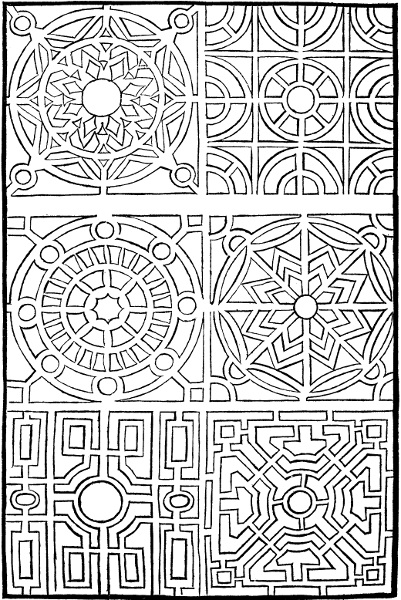
Chap. III. The many sorts of herbes and other things, wherewith the beds and parts of knots are bordered to set out the forme of them, with their commodities and discommodities.
It is necessary also, that I shew you the seuerall materials, wherewith these knots and trayles are set forth and bordered; which are of two sorts: The one are liuing herbes, and the other are dead materials; as leade, boords, bones, tyles, &c. Of herbes, there are many sorts wherewith the knots and beds in a Garden are vsed to bee set, to shew forth the forme of them, and to preserue them the longer in their forme, as also to be as greene, and sweete herbes, while they grow, to be cut to perfume the house, keeping them in such order and proportion, as may be most conuenient for their seuerall natures, and euery mans pleasure and fancy: Of all which, I intend to giue you the knowledge here in this place; and first, to begin with that which hath beene most anciently receiued, which is Thrift. This is an euerliuing greene herbe, which many take to border their beds, and set their knots and trayles, and therein much delight, because it will grow thicke and bushie, and may be kept, being cut with a paire of Garden sheeres, in some good handsome manner and proportion for a time, and besides, in the Summer time send forth many short stalkes of pleasant flowers, to decke vp an house among other sweete herbes: Yet these inconueniences doe accompany it; it will not onely in a small time ouergrow the knot or trayle in many places, by growing so thicke and bushie, that it will put out the forme of a knot in many places: but also much thereof will dye with the frosts and snowes in Winter, and with the drought in Summer, whereby many voide places will be seene in the knot, which doth much deforme it, and must therefore bee yearely refreshed: the thicknesse also and bushing thereof doth hide and shelter snayles and other small noysome wormes so plentifully, that Gilloflowers, and other fine herbes and flowers being planted therein, are much spoyled by them, and cannot be helped without much industry, and very great and daily attendance to destroy them. Germander is another herbe, in former times also much vsed, and yet also in many places; and because it will grow thicke, and may be kept also in some forme and proportion with cutting, and that the cuttings are much vsed as a strawing herbe for houses, being pretty and sweete, is also much affected by diuers: but this also will often dye and grow out of forme, and besides that, the stalkes will grow too great, hard and stubby, the rootes doe so farre shoote vnder ground, that, vpon a little continuance thereof, will spread into many places within the knot, which if continually they be not plucked vp, they will spoile the whole knot it selfe; and therefore once in three or foure yeares at the most, it must be taken vp and new set, or else it will grow too roynish and cumbersome. Hyssope hath also been vsed to be set about a knot, and being sweete, will serue for strewings, as Germander: But this, although the rootes doe not runne or creep like it, yet the stalkes doe quickly grow great aboue ground, and dye often after the first yeares setting, whereby the grace of the knot will be much lost. Marierome, Sauorie, and Thyme, in the like manner being sweete herbes, are vsed to border vp beds and knots, and will be kept for a little while, with cutting, into some conformity; but all and euery of them serve most commonly but for one yeares vse, and will soone decay and perish: and therefore none of these, no more than any of the former, doe I commend for a good bordering herbe for this purpose. Lauander Cotton also being finely slipped and set, is of many, and those of the highest respect of late daies, accepted, both for the beauty and forme of the herbe, being of a whitish greene mealy colour, for his sent smelling somewhat strong, and being euerliuing and abiding greene all the Winter, will, by cutting, be kept in as euen proportion as any other herbe may be. This will likewise soone grow great and stubbed, notwithstanding the cutting, and besides will now and then perish in some places, especially if you doe not strike or put off the snow, before the Sunne lying vpon it dissolue it: The rarity & nouelty of this herbe, being for the most part but in the Gardens of great persons, doth cause it to be of the greater regard, it must therfore be renewed wholly euery second or third yeare at the most, because of the great growing therof. Slips of Iuniper or Yew are also receiued of some & planted, because they are alwayes green, and that the Iuniper especially hath not that ill sent that Boxe hath, which I will presently commend vnto you, yet both Iuniper and Yew will soon grow too great and stubbed, and force you to take vp your knot sooner, than if it were planted with Boxe. Which lastly, I chiefly and aboue all other herbes commend vnto you, and being a small, lowe, or dwarfe kinde, is called French or Dutch Boxe, and serueth very well to set out any knot, or border out any beds: for besides that it is euer greene, it being reasonable thicke set, will easily be cut and formed into any fashion one will, according to the nature thereof, which is to grow very slowly, and will not in a long time rise to be of any height, but shooting forth many small branches from the roote, will grow very thicke, and yet not require so great tending, nor so much perish as any of the former, and is onely receiued into the Gardens of those that are curious. This (as I before said) I commend and hold to bee the best and surest herbe to abide faire and greene in all the bitter stormes of the sharpest Winter, and all the great heates and droughts of Summer, and doth recompence the want of a good sweet sent with his fresh verdure, euen proportion, and long lasting continuance. Yet these inconueniences it hath, that besides the vnpleasing sent which many mislike, and yet is but small, the rootes of this Boxe do so much spread themselues into the ground of the knot, and doe draw from thence so much nourishment, that it robbeth all the herbes that grow neare it of their sap and substance, thereby making all the earth about it barren, or at least lesse fertile. Wherefore to shew you the remedy of this inconuenience of spreading, without either taking vp the Boxe of the border, or the herbes and flowers in the knot, is I thinke a secret knowne but vnto a few, which is this: You shall take a broad pointed Iron like vnto a Slise or Chessill, which thrust downe right into the ground a good depth all along the inside of the border of Boxe somewhat close thereunto, you may thereby cut away the spreading rootes thereof, which draw so much moisture from the other herbes on the inside, and by this meanes both preserue your herbes and flowers in the knot, and your Boxe also, for that the Boxe will be nourished sufficiently from the rest of the rootes it shooteth on all the other sides. And thus much for the liuing herbes, that serue to set or border vp any knot. Now for the dead materials, they are also, as I said before diuers: as first, Leade, which some that are curious doe border their knots withall, causing it to be cut of the breadth of foure fingers, bowing the lower edge a little outward, that it may lye vnder the vpper crust of the ground, and that it may stand the faster, and making the vpper edge either plain, or cut out like vnto the battlements of a Church: this fashion hath delighted some, who haue accounted it stately (at the least costly) and fit for their degree, and the rather, because it will be bowed and bended into any round square, angular, or other proportion as one listeth, and is not much to be misliked, in that the Leade doth not easily breake or spoile without much iniury, and keepeth vp a knot for a very long time in his due proportion: but in my opinion, the Leade is ouer-hot for Summer, and ouer-cold for Winter. Others doe take Oaken inch boords, and sawing them foure or fiue inches broad, do hold vp their knot therewith: but in that these boordes cannot bee drawne compasse into any small scantling, they must serue rather for long outright beds, or such knots as haue no rounds, halfe rounds or compassings in them. And besides, these boordes are not long lasting, because they stand continually in the weather, especially the ends where they are fastened together will soonest rot and perish, and so the whole forme will be spoyled. To preuent that fault, some others haue chosen the shanke bones of Sheep, which after they haue beene well cleansed and boyled, to take out the fat from them, are stucke into the ground the small end downewards, and the knockle head vpwards, and thus being set side to side, or end to end close together, they set out the whole knot therewith, which heads of bones although they looke not white the first yeare, yet after they haue abiden some frosts and heates will become white, and prettily grace out the ground: but this inconvenience is incident to them, that the Winter frosts will raise them out of the ground oftentimes, and if by chance the knockle head of any doe breake, or be strucke off with any ones foot, &c. going by, from your store, that lyeth by you of the same sort, set another in the place, hauing first taken away the broken peece: although these will last long in forme and order, yet because they are but bones many mislike them, and indeed I know but few that vse them. Tyles are also vsed by some, which by reason they may bee brought compasse into any fashion many are pleased with them, who doe not take the whole Tyle at length, but halfe Tyles, and other broken pieces set somewhat deepe, into the ground, that they may stand fast, and these take vp but little roome, and keepe vp the edge of the beds and knots in a pretty comely manner, but they are often out of frame, in that many of them are broken and spoiled, both with mens feete passing by, the weather and weight of the earth beating them downe and breaking them, but especially the frosts in Winter doe so cracke off their edges, both at the toppes and sides that stand close one vnto another, that they must be continually tended and repaired with fresh and sound ones put in the place of them that are broken or decayed. And lastly (for it is the latest inuention) round whitish or blewish pebble stones, of some reasonable proportion and bignesse, neither too great nor too little, haue beene vsed by some to be set, or rather in a manner but laide vpon the ground to fashion out the traile or knot, or all along by the large grauelly walke sides to set out the walke, and maketh a pretty handsome shew, and because the stones will not decay with the iniuries of any time or weather, and will be placed in their places againe, if any should be thrust out by any accident, as also that their sight is so conspicuous vpon the ground, especially if they be not hid with the store of herbes growing in the knot; is accounted both for durability, beauty of the sight, handsomnesse in the worke, and ease in the working and charge, to be of all other dead materials the chiefest. And thus, Gentlemen, I haue shewed you all the varieties that I know are vsed by any in our Countrey, that are worth the reciting (but as for the fashion of Iawe-bones, vsed by some in the Low Countries, and other places beyond the Seas, being too grosse and base, I make no mention of them) among which euery one may take what pleaseth him best, or may most fitly be had, or may best agree with the ground or knot. Moreouer, all these herbes that serue for borderings, doe serue as well to be set vpon the ground of a leuelled knot; that is, where the allies and foot-pathes are of the same leuell with the knot, as they may serue also for the raised knot, that is, where the beds of the knot are raised higher than the allies; but both Leade, Boordes, Bones, and Tyles, are only for the raised ground, be it knot or beds. The pebble stones againe are onely for the leuelled ground, because they are so shallow, that as I said before, they rather lye vpon the earth than are thrust any way into it. All this that I haue here set downe, you must vnderstand is proper for the knots alone of a Garden. But for to border the whole square or knot about, to serue as a hedge thereunto, euery one taketh what liketh him best; as either Priuet alone, or sweete Bryer, and white Thorne enterlaced together, and Roses of one, or two, or more sorts placed here and there amongst them. Some also take Lauander, Rosemary, Sage, Southernwood, Lauander Cotton, or some such other thing. Some againe plant Cornell Trees, and plash them, or keepe them lowe, to forme them into an hedge. And some againe take a lowe prickly shrubbe, that abideth alwayes greene, described in the end of this Booke, called in Latine Pyracantha, which in time will make an euer greene hedge or border, and when it beareth fruit, which are red berries like vnto Hawthorne berries, make a glorious shew among the greene leaues in the Winter time, when no other shrubbes haue fruit or leaues.
Chap. IV. The nature and names of diuers Out-landish flowers, that for their pride, beauty, and earlinesse, are to be planted in Gardens of pleasure for delight.
Having thus formed out a Garden, and diuided it into his fit and due proportion, with all the gracefull knots, arbours, walkes, &c. likewise what is fit to keepe it in the same comely order, is appointed vnto it, both for the borders of the squares, and for the knots and beds themselues; let vs now come and furnish the inward parts, and beds with those fine flowers that (being strangers vnto vs, and giuing the beauty and brauery of their colours so early before many of our home bred flowers, the more to entice vs to their delight) are most beseeming it; and namely, with Daffodils, Fritillarias, Iacinthes, Saffron-flowers, Lillies, Flowerdeluces, Tulipas, Anemones, French Cowslips, or Beares eares, and a number of such other flowers, very beautifull, delightfull, and pleasant, hereafter described at full, whereof although many haue little sweete scent to commend them, yet their earlinesse and exceeding great beautie and varietie doth so farre counteruaile that defect (and yet I must tell you with all, that there is among the many sorts of them some, and that not a few, that doe excell in sweetnesse, being so strong and heady, that they rather offend by too much than by too little sent, and some againe are of so milde and moderate temper, that they scarce come short of your most delicate and daintiest flowers) that they are almost in all places with all persons, especially with the better sort of the Gentry of the Land, as greatly desired and accepted as any other the most choisest, and the rather, for that the most part of these Out-landish flowers, do shew forth their beauty and colours so early in the yeare, that they seeme to make a Garden of delight euen in the Winter time, and doe so giue their flowers one after another, that all their brauery is not fully spent, vntil that Gilliflowers, the pride of our English Gardens, do shew themselues: So that whosoeuer would haue of euery sort of these flowers, may haue for euery moneth seueral colours and varieties, euen from Christmas vntill Midsommer, or after; and then, after some little respite, vntill Christmas againe, and that in some plenty, with great content and without forcing; so that euery man may haue them in euery place, if they will take any care of them. And because there bee many Gentlewomen and others, that would gladly haue some fine flowers to furnish their Gardens, but know not what the names of those things are that they desire, nor what are the times of their flowring, nor the skill and knowledge of their right ordering, planting, displanting, transplanting, and replanting; I haue here for their sakes set downe the nature, names, times, and manner of ordering in a briefe manner, referring the more ample declaration of them to the worke following. And first of their names and natures: Of Daffodils there are almost an hundred sorts, as they are seuerally described hereafter, euery one to be distinguished from other, both in their times, formes, and colours, some being eyther white, or yellow, or mixt, or else being small or great, single or double, and some hauing but one flower vpon a stalke, others many, whereof many are so exceeding sweete, that a very few are sufficient to perfume a whole chamber, and besides, many of them be so faire and double, eyther one vpon a stalke, or many vpon a stalke, that one or two stalkes of flowers are in stead of a whole nose-gay, or bundell of flowers tyed together. This I doe affirme vpon good knowledge and certaine experience, and not as a great many others doe, tell of the wonders of another world, which themselues neuer saw nor euer heard of, except some superficiall relation, which themselues haue augmented according to their owne fansie and conceit. Againe, let me here also by the way tell you, that many idle and ignorant Gardiners and others, who get names by stealth, as they doe many other things, doe call some of these Daffodils Narcisses, when as all know that know any Latine, that Narcissus is the Latine name, and Daffodill the English of one and the same thing; and therefore alone without any other Epithite cannot properly distinguish seuerall things. I would willingly therefore that all would grow iudicious, and call euery thing by his proper English name in speaking English, or else by such Latine name as euery thing hath that hath not a proper English name, that thereby they may distinguish the seuerall varieties of things and not confound them, as also to take away all excuses of mistaking; as for example: The single English bastard Daffodill (which groweth wilde in many Woods, Groues, and Orchards in England.) The double English bastard Daffodill. The French single white Daffodill many vpon a stalke. The French double yellow Daffodill. The great, or the little, or the least Spanish yellow bastard Daffodill, or the great or little Spanish white Daffodill. The Turkie single white Daffodill, or, The Turkie single or double white Daffodill many vpon a stalke, &c. Of Fritillaria, or the checkerd Daffodill, there are halfe a score seuerall sorts, both white and red, both yellow and blacke, which are a wonderfull grace and ornament to a Garden in regard of the Checker like spots are in the flowers. Of Iacinthes there are aboue halfe an hundred sorts, as they are specified hereafter; some like vnto little bells or starres, others like vnto little bottles or pearles, both white and blew, sky-coloured and blush, and some starlike of many pretty various formes, and all to giue delight to them that will be curious to obserue them. Of Crocus or Saffron flowers, there are also twenty sorts; some of the Spring time, others flowring onely in the Autume or Fall, earlier or later than another, some whereof abide but a while, others indure aboue a moneth in their glorious beauty. The Colchicum or Medowe Saffron, which some call the sonne before the father, but not properly, is of many sorts also; some flowring in the Spring of the yeare, but the most in Autume, whereof some haue faire double flowers very delightfull to behold, and some partly coloured both single and double so variable, that it would make any one admire the worke of the Creatour in the various spots and stripes of these flowers. Then haue wee of Lillies twenty seuerall sorts and colours, among whom I must reckon the Crowne Imperiall, that for his stately forme deserueth some speciall place in this Garden, as also the Martagons, both white and red, both blush and yellow, that require to be set by themselues apart, as it were in a small round or square of a knot, without many other, or tall flowers growing neare them. But to tell you of all the sorts of Tulipas (which are the pride of delight) they are so many, and as I may say, almost infinite, doth both passe my ability, and as I beleeue the skill of any other. They are of two especiall sorts, some flowring earlier, and others later than their fellowes, and that naturally in all grounds, wherein there is such a wonderfull variety and mixture of colours, that it is almost impossible for the wit of man to descipher them thoroughly, and to giue names that may be true & seuerall distinctions to euery flower, threescore seuerall sorts of colours simple and mixed of each kind I can reckon vp that I haue, and of especiall note, and yet I doubt not, but for euery one of them there are ten others differing from them, which may be seen at seuerall times, and in seuerall places: & besides this glory of variety in colors that these flowers haue, they carry so stately & delightfull a forme, & do abide so long in their brauery (enduring aboue three whole moneths from the first vnto the last) that there is no Lady or Gentlewoman of any worth that is not caught with this delight, or not delighted with these flowers. The Anemones likewise or Windeflowers are so full of variety and so dainty, so pleasant and so delightsome flowers, that the sight of them doth enforce an earnest longing desire in the minde of any one to be a possessour of some of them at the least: For without all doubt, this one kinde of flower, so variable in colours, so differing in forme (being almost as many sorts of them double as single) so plentifull in bearing flowers, and so durable in lasting, and also so easie both; to preserue and to encrease, is of it selfe alone almost sufficient to furnish a garden with their flowers for almost halfe the yeare, as I shall shew you in a fit and conuenient place. The Beares eares or French Cowslips must not want their deserued commendations, seeing that their flowers, being many set together vpon a stalke, doe seeme euery one of them to bee a Nosegay alone of it selfe: and besides the many differing colours that are to be seene in them, as white, yellow, blush, purple, red, tawney, murrey, haire colour, &c. which encrease much delight in all sorts of the Gentry of the Land, they are not vnfurnished with a pretty sweete sent, which doth adde an encrease of pleasure in those that make them an ornament for their wearing. Flowerdeluces also are of many sorts, but diuided into two especiall, kindes; the one bearing a leafe like a flagge whose roots are tuberous, thicke and short (one kinde of them being the Orris rootes that are sold at the Apothecaries, whereof sweete powders are made to lye among garments) the other having round rootes like vnto Onions, and narrow long leaues somewhat like grasse: Of both these kindes there is much variety, especially in their colours. The greater Flagge kinde is frequent enough and dispersed in this Land, and well doth serue to decke vp both a Garden and House with natures beauties: But the chiefe of all is your Sable flower, so fit for a mourning habit, that I thinke in the whole compasse of natures store, there is not a more patheticall, or of greater correspondency, nor yet among all the flowers I know any one comming neare vnto the colour of it. The other kinde which hath bulbous or Onion like rootes, diuersifieth it selfe also into so many fine colours, being of a more neate shape and succinct forme than the former, that it must not bee wanting to furnish this Garden. The Hepatica or Noble Liuerwoort is another flower of account, whereof some are white, others red, or blew, or purple, somewhat resembling Violets, but that there are white threads in the middest of their flowers, which adde the more grace vnto them; and one kinde of them is so double, that it resembleth a double thicke Dasie or Marigold, but being small and of an excellent blew colour, is like vnto a Button: but that which commendeth the flower as much as the beauty, is the earlinesse in flowring, for that it is one of the very first flowers that open themselues after Christmas, euen in the midst of Winter. The Cyclamen or Sowebread is a flower of rare receipt, because it is naturally hard to encrease, and that the flowers are like vnto red or blush coloured Violets, flowring in the end of Summer or beginning of Autumne: the leaues likewise hereof haue no small delight in their pleasant colour, being knotted and circled white vpon greene, and that which most preferreth it, is the Physicall properties thereof for women, which I will declare when I shall shew you the seuerall descriptions of the varieties in his proper place. Many other sorts of flowers there are fit to furnish this Garden, as Leucoium or Bulbous Violet, both early and late flowring. Muscari or Muske Grape flower. Starre flowers of diuers sorts. Phalangium or Spiderwort, the chiefe of many is that sort whose flowers are like vnto a white Lilly. Winter Crowfoote or Wolfes bane. The Christmas flower like vnto a single white Rose. Bell flowers of many kindes. Yellow Larkes spurre, the prettiest flower of a score in a Garden. Flower-gentle or Floramour. Flower of the Sunne. The Maruaile of Peru or of the world. Double Marsh Marigold or double yellow Buttons, much differing and farre exceeding your double yellow Crowfoote, which some call Batchelours Buttons. Double French Marigolds that smell well, and is a greater kinde than the ordinary, and farre surpasseth it. The double red Ranunculus or Crowfoote (farre excelling the most glorious double Anemone) and is like vnto our great yellow double Crowfoote. Thus having giuen you the knowledge of some of the choisest flowers for the beds of this Garden, let me also shew you what are fittest for your borders and for your arbours. The Iasmine white and yellow. The double Honysockle. The Ladies Bower, both white, and red, and purple single and double, are the fittest of Outlandish plants to set by arbours and banqueting houses, that are open, both before and aboue to helpe to couer them, and to giue both sight, smell, and delight. The sorts of Roses are fittest for Standards in the hedges or borders. The Cherry Bay or Laurocerasus. The Rose Bay or Oleander. The white and the blew Syringa or Pipe tree, are all gracefull and delightfull to set at seuerall distances in the borders of knots; for some of them giue beautifull and sweete flowers. The Pyracantha or Prickly Corall tree doth remaine with greene leaues all the yeare, and may be plashed, or laid downe, or tyed to make a fine hedge to border the whole knot, as is said before. The Wilde Bay or Laurus Tinus, doth chiefly desire to be sheltered vnder a wall, where it will best thriue, and giue you his beautifull flowers in Winter for your delight, in recompence of his fenced dwelling. The dwarfe Bay or Mesereon, is most commonly either placed in the midst of a knot, or at the corners thereof, and sometimes all along a walke for the more grace. And thus to fit euery ones fancy, I haue shewed you the variety of natures store in some part for you to dispose of them to your best content.
Chap. V. The nature and names of those that are called vsually English flowers.
Those flowers that haue beene vsually planted in former times in Gardens of this Kingdome (when as our forefathers knew few or none of those that are recited before) haue by time and custome attained the name of English flowers, although the most of them were neuer naturall of this our Land, but brought in from other Countries at one time or other, by those that tooke pleasure in them where they first saw them: and I doubt not, but many other sorts than here are set downe, or now knowne to vs, haue beene brought, which either haue perished by their negligence or want of skill that brought them, or else because they could not abide our cold Winters; those onely remaining with vs that haue endured of themselues, and by their encreasing haue beene distributed ouer the whole Land. If I should make any large discourse of them, being so well knowne to all, I doubt I should make a long tale to small purpose: I will therefore but briefly recite them, that you may haue them together in one place, with some little declaration of the nature and quality of them, and so passe to other matters. And first of Primroses and Cowslips, whereof there are many prettie varieties; some better knowne in the West parts of this Kingdome, others in the North, than in any other, vntill of late being obserued by some curious louers of varieties, they haue been transplanted diuersly, and so made more common: for although we haue had formerly in these parts about London greene Primroses vsually, yet we neuer saw or heard of greene Cowslips both single and double but of late dayes, and so likewise for Primroses to be both single and double from one roote, and diuers vpon one stalke of diuers fashions, I am sure is not vsuall: all which desire rather to bee planted vnder some hedge, or fence, or in the shade, than in the Sunne. Single Rose Campions, both white, red, and blush, and the double red Rose Campion also is knowne sufficiently, and will abide moderate Sunne as well as the shade. The flower of Bristow or None-such is likewise another kinde of Campion, whereof there is both white flowring plants and blush as well as Orange colour, all of them being single flowers require a moderate Sunne and not the shadow: But the Orange colour Nonesuch with double flowers, as it is rare and not common, so for his brauery doth well deserue a Master of account that will take care to keepe and preserue it. Batchelours Buttons both white and red, are kindes of wilde Campions of a very double forme, and will reasonably well like the Sunne but not the shade. Wall-flowers are common in euery Garden, as well the ordinary double as the single, and the double kinde desireth no more shade than the single, but the greater kindes both double and single must haue the Sunne. Stock-Gilloflowers likewise are almost as common as Wall-flowers, especially the single kindes in euery womans Garden, but the double kindes are much more rare, and possessed but of a few, and those onely that will bee carefull to preserue them in Winter; for besides that the most of them are more tender, they yeeld no seede as the single kindes doe to preserue them, although one kinde from the sowing of the seed yeeld double flowers: They will all require the comfort of the Sunne, especially the double kindes, and to be defended from cold, yet so as in the Summer they doe not want water wherein they much ioy, and which is as it were their life. Queenes Gilloflowers (which some call Dames Violets, and some Winter Gilloflowers, are a kinde of Stock-Gilloflower) planted in Gardens to serue to fill vp the parts thereof for want of better things, hauing in mine opinion neither sight nor sent much to commend them. Violets are the Springs chiefe flowers for beauty, smell, and vse, both single and double, the more shadie and moist they stand the better. Snapdragon are flowers of much more delight, and in that they are more tender to keep, and will hardly endure the sharpe Winters, vnlesse they stand well defended, are scarce seene in many Gardens. Columbines single and double, of many sorts, fashions, and colours, very variable both speckled and party coloured, are flowers of that respect, as that no Garden would willingly bee without them, that could tell how to haue them, yet the rarer the flowers are, the more trouble to keepe; the ordinary sorts on the contrary part will not be lost, doe what one will. Larkes heeles, or spurres, or toes, as in seuerall Countries they are called, exceed in the varietie of colours, both single and double, any of the former times; for vntill of late dayes none of the most pleasant colours were seene or heard of: but now the single kindes are reasonable well disperst ouer the Land, yet the double kindes of all those pleasant colours (and some other also as beautifull) which stand like little double Roses, are enioyed but of a few: all of them rise from seed, and must be sowne euery yeare, the double as well as the single. Pansyes or Hartes eases of diuers colours, and although without sent, yet not without some respect and delight. Double Poppies are flowers of a great and goodly proportion, adorning a Garden with their variable colours to the delight of the beholders, wherein there is some speciall care to be taken, lest they turne single; and that is, if you see them grow vp too thicke, that you must pull them vp, and not suffer them to grow within lesse than halfe a yard distance, or more one from another. Double Daisies are flowers not to be forgotten, although they be common enough in euery Garden, being both white and red, both blush and speckled, or party coloured, besides that which is called Iacke an Apes on horsebacke, they require a moist and shadowie place; for they are scorched away, if they stand in the Sunne in any dry place. Double Marigolds also are the most common in all Gardens. And so are the French Marigolds that haue a strong heady sent, both single and double, whose glorious shew for colour would cause any to beleeue there were some rare goodnesse or vertue in them. These all are sometimes preserued in the Winter, if they bee well defended from the cold. But what shall I say to the Queene of delight and of flowers, Carnations and Gilloflowers, whose brauery, variety, and sweete smell ioyned together, tyeth euery ones affection with great earnestnesse, both to like and to haue them? Those that were knowne, and enioyed in former times with much acceptation, are now for the most part lesse accounted of, except a very few: for now there are so many other varieties of later inuention, that trebleth the other both in number, beauty, and worth: The names of them doe differ very variably, in that names are imposed and altered as euerie ones fancy will haue them, that carryed or sent them into the seuerall Countries from London, where their truest name is to be had, in mine opinion. I will here but giue you the names of some, and referre you to the worke ensuing for your further knowledge. The red and the gray Hulo. The old Carnation, differing from them both. The Gran Pere. The Cambersiue. The Sauadge. The Christall. The Prince. The white Carnation, or Delicate. The ground Carnation. The French Carnation. The Douer. The Oxford. The Bristow. The Westminster. The Daintie. The Granado, and many other Gilloflowers too tedious to recite in this place, because I haue amply declared them in the booke following. But there is another sort of great delight and varietie, called the Orange tawny Gilloflower, which for the most part hath risen from seed, and doth giue seed in a more plentifull manner than any of the former sorts, and likewise by the sowing of the seed, there hath been gained so many varieties of that excellent worth and respect, that it can hardly be expressed or beleeued, and called by diuers names according to the marking of the flowers; as The Infanta. The Stript Tawny, The Speckled Tawny. The Flackt Tawny. The Griseld Tawny, and many others, euery one to bee distinguished from others: Some also haue their flowers more double and large than others, and some from the same seed haue single flowers like broad single Pinkes: the further relation of them, viz. their order to sowe, encrease and preserue them, you shall haue in the subsequent discourse in a place by it selfe. Pinkes likewise both single and double are of much variety, all of them very sweete, comming neare the Gilloflowers. Sweete Williams and Sweete Iohns, both single and double, both white, red, and spotted, as they are kindes of wilde Pinkes, so for their grace and beauty helpe to furnish a Garden, yet desire not to stand so open to the Sunne as the former. Double and single Peonies are fit flowers to furnish a Garden, and by reason of their durability, giue out fresh pleasure euery yeare without any further trouble of sowing. And lastly, Hollihocks both single and double, of many and sundry colours, yeeld out their flowers like Roses on their tall branches, like Trees, to sute you with flowers, when almost you haue no other to grace out your Garden: the single and double doe both yeeld seed, and yet doe after their seeding abide many yeares. Thus haue I shewed you most of the English, as well as (I did before) the Outlandish flowers that are fit to furnish the knots, trailes, beds, and borders of this Garden. Roses onely, as I said before, I reserve to circle or encompasse all the rest, because that for the most part they are planted in the outer borders or the quarters, and sometimes by themselues in the middle of long beds, the sorts or kindes whereof are many, as they are declared in their proper place: but the White Rose, the Red, and the Damaske, are the most ancient Standards in England, and therefore accounted naturall.
Chap. VI. The order and manner to plant and replant all the sorts of Out-landish flowers spoken of before, as well those with bulbous rootes, as others with stringie rootes.
Whereas it is the vsuall custome of most in this Land, to turne vp their Gardens, and to plant them againe in the Spring of the yeare, which is the best time that may bee chosen for all English flowers, yet it is not so for your Out-landish flowers. And herein indeede hath beene not onely the errour of a great many to hinder their rootes from bearing out their flowers as they should, but also to hinder many to take delight in them, because as they say they will not thriue and prosper with them, when as the whole fault is in the want of knowledge of the fit and conuenient time wherein they should bee planted. And because our English Gardiners are all or the most of them vtterly ignorant in the ordering of these Out-landish flowers, as not being trained vp to know them, I haue here taken vpon mee the forme of a new Gardiner, to giue instructions to those that will take pleasure in them, that they may be the better enabled with these helpes I shall shew them, both to know how they should be ordered, and to direct their Gardiners that are ignorant thereof, rightly to dispose them according to their naturall qualities. And I doe wish all Gentlemen and Gentlewomen, whom it may concerne for their owne good, to bee as carefull whom they trust with the planting and replanting of these fine flowers, as they would be with so many Iewels; for the rootes of many of them being small, and of great value, may be soone conueyed away, and a cleanly tale faire told, that such a roote is rotten, or perished in the ground if none be seen where it should be, or else that the flower hath changed his colour, when it hath been taken away, or a counterfeit one hath beene put in the place thereof; and thus many haue been deceiued of their daintiest flowers, without remedy or true knowledge of the defect. You shall therefore, if you will take the right course that is proper for these kindes of flowers, not set or plant them among your English flowers; for that when the one may be remoued, the other may not be stirred: but plant those rootes that are bulbous, or round like Onions, eyther in knots or beds by themselues which is the best, or with but very few English or Out-landish flower plants that haue stringie rootes: For you must take this for a generall rule, that all those rootes that are like Lillies or Onions, are to bee planted in the moneths of Iuly or August, or vnto the middle or end of September at the furthest, if you will haue them to prosper as they should; and not in the Spring of the yeare, when other gardening is vsed. Yet I must likewise giue you to vnderstand, that if Tulipas, and Daffodils, and some other that are firme and hard rootes, and not limber or spongie, being taken vp out of the ground in their fit season, that is, in Iune, Iuly, and August, and likewise kept well and dry, may be reserued out of the ground vntill Christmas or after, and then (if they could not be set sooner) being set, will thriue reasonable well, but not altogether so well as the former, being set long before; but if you shall remoue these bulbous rootes againe, either presently after their planting; hauing shot their small fibres vnder the round rootes, and sprung likewise vpwards, or before they be in flower at the soonest (yet Tulipas, Daffodils, and many other bulbous, may be safely remoued being in flower, and transplanted into other places, so as they be not kept too long out of the ground) you shall much endanger them either vtterly to perish, or to be hindered from bearing out their flowers they then would haue borne, and for two or three years after from bearing flowers againe. For the order of their planting there are diuers wayes, some whereof I will shew you in this place: Your knot or beds being prepared fitly, as before is declared, you may place and order your rootes therein thus, Eyther many rootes of one kind set together in a round or cluster, or longwise crosse a bed one by another, whereby the beauty of many flowers of one kinde being together, may make a faire shew well pleasing to many; Or else you may plant one or two in a place dispersedly ouer the whole knot, or in a proportion or diameter one place answering another of the knot, as your store will suffer you, or your knot permit: Or you may also mingle these rootes in their planting many of diuers sorts together, that they may giue the more glorious shew when they are in flower; and that you may so doe, you must first obserue the seuerall kindes of them, which doe flower at one and the same time, and then to place them in such order and so neare one vnto another, that their flowers appearing together of seuerall colours, will cause the more admiration in the beholders: as thus, The Vernall Crocus or Saffron flowers of the Spring, white, purple, yellow, and stript, with some Vernall Colchicum or Medow Saffron among them, some Dens Caninus or Dogges teeth, and some of the small early Leucoium or Bulbous Violet, all planted in some proportion as neare one vnto another as is fit for them, will giue such a grace to the Garden, that the place will seeme like a peece of tapestry of many glorious colours, to encrease euery ones delight: Or else many of one sort together, as the blew, white, and blush Grape flowers in the same manner intermingled, doe make a maruellous delectable shew, especially because all of them rise almost to an equall height, which causeth the greater grace, as well neare hand as farre of. The like order may be kept with many other things, as the Hepatica, white, blew, purple, and red set or sowne together, will make many to beleeue that one roote doth beare all those colours: But aboue and beyond all others, the Tulipas may be so matched, one colour answering and setting of another, that the place where they stand may resemble a peece of curious needle-worke, or peece of painting; and I haue knowne in a Garden, the Master as much commended for this artificiall forme in placing the colours of Tulipas, as for the goodnesse of his flowers, or any other thing. The diuers sorts and colours of Anemones or Winde-flowers may be so ordered likewise, which are very beautifull, to haue the seuerall varieties planted one neare vnto another, that their seuerall colours appearing in one place will be a very great grace in a Garden, or if they be dispersed among the other sorts of flowers, they will make a glorious shew. Another order in planting you may obserue; which is this, That those plants that grow low, as the Aconitum Hyemale or Winter-wolues bane, the Vernall Crocus or Saffron-flowers of diuers sorts, the little early Leucoium or Bulbous Violet, and some such other as rise not vp high, as also some Anemones may be very well placed somewhat neare or about your Martagons, Lillies, or Crownes Imperiall, both because these little plants will flower earlier than they, and so will bee gone and past, before the other greater plants will rise vp to any height to hinder them; which is a way may well be admitted in those Gardens that are small, to saue roome, and to place things to the most aduantage. Thus hauing shewed you diuers wayes and orders how to plant your rootes, that your flowers may giue the greater grace in the Garden, let mee shew you likewise how to set these kindes of rootes into the ground; for many know not well eyther which end to set vpwards or downewards, nor yet to what depth they should be placed in the ground. Daffodils if they be great rootes, will require (as must bee obserued in all other great plants) to bee planted somewhat deeper than the smaller of the same kinde as also that the tops or heads of the rootes be about two or three fingers breadth hid vnder ground. The Tulipas likewise if you set them deepe, they will be the safer from frosts if your ground be cold, which will also cause them to be a little later before they be in flower, yet vsually if the mould be good, they are to be set a good hand breadth deep within the ground, so that there may be three or foure inches of earth at the least aboue the head, which is the smaller end of the roote: for if they shall lye too neare the vpper face or crust of the earth, the colds & frosts will pierce and pinch them the sooner. After the same order and manner must Hyacinthes, whether great or small, and other such great rootes be planted. Your greater rootes, as Martagons, Lillies, and Crownes Imperiall, must be set much deeper than any other bulbous roote, because they are greater rootes than others, and by themselues also, as is most vsuall either in some square, round, triangle, or other small part in the Garden, because they spread and take vp a very great deale of ground. All of them likewise are to be set with the broad end of the roote downewards, and the small end vpwards, that is, both Lillies, Daffodils, Hyacinthes, and Tulipas, and all other sorts of round rootes, which shew one end to bee smaller than another. But the Colchicum or Medow-Saffron onely requireth an exception to this generall rule, in regard the roote thereof hath a small eminence or part on the one side thereof, which must bee set or planted downeward, and not vpward; for you shall obserue, if the roote lye a little moist out of the ground, that it will shoote fibres out at the small long end thereof, although you may perceiue when you take it vp, that the fibres were at the other broad end or side of the roote. As for the Crowne Imperiall, which is a broad round roote and flat withall, hauing a hole in the middle, for the most part quite thorow, when it is taken vp in his due time out of the ground, you shall perceiue the scales or cloues of the rootes to bee a little open on the vpperside, and close and flat on the vnderside, which will direct you which part to set vpward; as also that the hole is bigger aboue then it is below. The Persian Lilly is almost like unto the Crowne Imperiall, but that the roote thereof is not so flat, and that it hath a smaller head at the one part, whereby it may be discerned the plainer how to be set. The Fritillaria is a small white root diuided as it were into two parts, so that many haue doubted, as formerly in the Crowne Imperiall, what part to set vppermost; you shall therefore marke, that the two parts of the roote are ioyned together at the bottome, where it shooteth out fibres or small stringie rootes, as all other sorts of bulbous rootes doe, and withall you shall see, that betweene the two parts of the roote a small head will appeare, which is the burgeon that will spring vp to beare leaues and flowers. In the rootes of Anemones there are small round swelling heads, easie enough to be obserued if you marke it, which must be set vpwards. All other sorts of stringie rooted plants (and not bulbous or tuberous rooted) that lose their greene leaues in Winter, will shew a head from whence the leaues and flowers will spring, and all others that keepe their greene leaues, are to bee planted in the same manner that other herbes and flower-plants are accustomed to be. But yet for the better thriuing of the stringie rooted plants, when you will plant them, let me informe you of the best way of planting, and the most sure to cause any plant to comprehend in the ground without failing, and is no common way with any Gardiner in this Kingdome, that euer I heard or knew, which is thus: Presuming that the stringie rooted plant is fresh and not old gathered, and a plant that being remoued will grow againe, make a hole in the ground large enough where you meane to set this roote, and raise the earth within the hole a little higher in the middle then on the sides, and set the roote thereon, spreading the strings all abroad about the middle, that they may as it were couer the middle, and then put the earth gently round about it, pressing it a little close, and afterwards water it well, if it be in Summer, or in a dry time, or otherwise moderately: thus shall euery seuerall string of the roote haue earth enough to cause it to shoote forth, and thereby to encrease farre better than by the vsuall way, which is without any great care and respect to thrust the rootes together into the ground. Diuers other flower plants are but annuall, to bee new sowne euery yeare; as the Maruaile of the world, the Indian Cresses, or yellow Larkes heeles, the Flower of the Sunne, and diuers others: they therefore that will take pleasure in them, that they may enioy their flowers the earlier in the yeare, and thereby haue ripe seede of them while warme weather lasteth, must nurse vp their seedes in a bed of hot dung, as Melons and Cowcumbers are, but your bed must be prouided earlier for these seeds, than for Melons, &c. that they may haue the more comfort of the Summer, which are to be carefully tended after they are transplanted from the hotbed, and couered with straw from colds, whereby you shall not faile to gaine ripe seed euery yeare, which otherwise if you should misse of a very kindly & hot Summer, you should neuer haue. Some of these seedes neede likewise to be transplanted from the bed of dung vnder a warme wall, as the Flower of the Sunne, and the Maruaile of the world, and some others, and that for a while after their transplanting, as also in the heate of Summer, you water them at the roote with water that hath stood a day or two in the Sunne, hauing first laid a round wispe of hay or such other thing round about the roote, that so all helpes may further their giuing of ripe seede. One or two rules more I will giue you concerning these dainty flowers, the first whereof is this, That you shall not bee carefull to water any of your bulbous or tuberous rooted plants at any time; for they all of them do better prosper in a dry ground than in a wet, onely all sorts of tuberous rooted Flowerdeluces vpon their remouall had neede of a little water, and some will doe so also to such Tulipas and other bulbous rootes as they transplant, when they are in flower, and this is I grant in some sort tolerable, if it bee not too much, and done onely to cause the stalke and flower to abide sometime the longer before they wither, but else in no other case to be permitted. The second rule is, That I would aduise you to water none of your dainty flowers or herbes, with any water that hath presently before been drawne out of a well or pumpe, but onely with such water that hath stood open in the Sunne in some cisterne, tubbe, or pot for a day at the least, if more the better: for that water which is presently drawne out of a well, &c. is so cold, that it presently chilleth & killeth any dainty plant be it younger or elder grown, whereof I haue had sufficient proofe: and therfore I giue you this caution by mine own experience. Thus haue I directed you from point to point, in all the particulars of preparing & planting that belong to this Garden, sauing only that yet I would further enforme you of the time of the flowring of these Out-landish plants, according to the seuerall moneths in the yeare, that euery one may know what flowers euery moneth yeeldeth, and may chuse what them liketh best, in that they may see that there is no moneth, but glorieth in some peculiar sorts of rare flowers. I would likewise rather in this place shew you, the true and best manner & order to encrease and preserue all sorts of Gilloflowers & Carnations, then ioyne it with the Chapter of Gilloflowers in the worke following, because it would in that place take vp too much roome. And lastly, I must of necessity oppose three sundry errours, that haue possessed the mindes of many both in former and later times, which are, that any flower may be made to grow double by art, that was but single before by nature: And that one may by art cause any flower to grow of what colour they will: And that any plants may be forced to flower out of their due seasons, either earlier or later, by an art which some can vse. All which being declared, I then suppose enough is spoken for an introduction to this worke, referring many other things to the seuerall directions in the Chapters of the booke.
Chap. VII. The seuerall times of the flowring of these Out-landish flowers, according to the seuerall moneths of the yeare.
I intend in this place onely to giue you briefly, the names of some of the chiefest of these Out-landish flowers, according to the seuerall moneths of the yeare wherein they flower, that euery one seeing what sorts of flowers euery moneth yeeldeth, may take of them which they like best. I begin with Ianuary, as the first moneth of the yeare, wherein if the frosts be not extreme, you shall haue these flowers of plants; the Christmas flower or Helleborus niger verus, Winter wolues bane or Aconitum hyemale, Hepatica or Noble Liuer wort blew and red, and of shrubbes, the Laurus Tinus or Wilde Bay tree, and Mesereon or the dwarfe Bay: but because Ianuarie is oftentimes too deepe in frosts and snow, I therefore referre the Hepaticas vnto the moneth following, which is February, wherein the weather beginneth to be a little milder, and then they will flower much better, as also diuers sorts of Crocus or Saffron flower will appeare, the little early Summer foole or Leucoium bulbosum, and towards the latter end thereof the Vernall Colchicum, the Dogges tooth Violet or Dens Caninus, and some Anemones, both single and double, which in some places will flower all the Winter long. March will yeeld more varieties; for besides that it holdeth some of the flowers of the former moneth, it will yeeld you both the double blew Hepatica, and the white and the blush single: then also you shall haue diuers other sorts of Crocus or Saffron flowers, Double yellow Daffodils, Orientall Iacinths and others, the Crowne Imperiall, diuers sorts of early Tulipas, some sorts of French Cowslips, both tawney, murry, yellow and blush, the early Fritillaria or checkered Daffodill, and some other sorts of early Daffodils, and many sorts of Anemones. In Aprill commeth on the pride of these strangers; for herein you may behold all the sorts of Auricula Vrsi or Beares Eares, many sorts of Anemones, both single and double, both the sorts of Tulipas, the earlier vntill the middle of the moneth, and the later then beginning; which are of so many different colours, that it is almost impossible to expresse them, the white, red, blacke, and yellow Fritillarias, the Muscari or Muske Grape flower, both ash colour and yellow. Diuers other sorts of Iacinths and Daffodils, both single and double, the smaller sorts of Flowerdeluces, the Veluet Flowerdeluce and double Honysuckles, with diuers others. May likewise at the beginning seemeth as glorious as Aprill, although toward the end it doth decline, in regard the heate of the Sunne hath by this time drawne forth all the store of natures tenderest dainties, which are vsually spent by the end of this moneth, and then those of stronger constitution come forward. Herein are to bee seene at the beginning the middle flowring Tulipas, and at the end the later sorts: some kindes of Daffodils, the Day Lillies, the great white Starre flower, the Flowerdeluce of Constantinople or the mourning Sable flower, the other sorts of Flowerdeluces. Single and double white Crowfoote, and single and double red Crowfoot, the glory of a Garden: the early red Martagon, the Persian Lilly, the yellow Martagon, the Gladiolus or Corne flagge, both white, red, and blush: the double yellow Rose, and some other sorts of Roses. In Iune doe flower the white and the blush Martagon, the Martagon Imperiall, the mountaine Lillies, and the other sorts of white and red Lillies, the bulbous Flowerdeluces of diuers sorts, the red flowred Ladies bower, the single and double purple flowred Ladies bower, the white Syringa or Pipe tree, for the blew Pipe tree flowreth earlier, the white and the yellow Iasmin. Iuly holdeth in flower some of the Ladies bowers and Iasmines, and besides doth glory in the Female Balsame apple, the Indian Cresses or yellow Larkes spurres, the purple Flower-gentle and the Rose Bay. In August begin some of the Autumne bulbous flowers to appeare, as the white and the purple Colchicum or Medow Saffron, the purple mountaine Crocus or Saffron flower, the little Autumne Leucoium and Autumne Iacinth, the Italian Starrewort, called of some the purple Marigold, the Meruaile of Peru or of the world, the Flower of the Sunne, the great blew Bell-flower, the great double French Marigold. September flourisheth with the Flower of the Sunne, the Meruaile of the world, the purple Marigold, and blew Bell-flower spoken of before, and likewise the other sorts of Medow Saffron, and the double kinde likewise, the siluer Crocus, the Autumne yellow Daffodill, Cyclamen also or Sowbread shew their flowers in the end of this moneth. October also will shew the flowers of Cyclamen, and some of the Medow Saffrons. In Nouember, as also sometimes in the moneth before, the party coloured Medow Saffron may bee seene, that will longest hold his flower, because it is the latest that sheweth it selfe, and the ash coloured mountaine Crocus. And euen December it selfe will not want the true blacke Hellebor or Christmas flower, and the glorious shew of the Laurus Tinus or wilde Bay tree. Thus haue I shewed you some of the flowers for euery moneth, but I referre you to the more ample declarion of them and all the others, vnto the work following.
Chap. VIII. The true manner and order to encrease and preserue all sorts of Gilloflowers, as well by slippes as seedes.
Because that Carnations and Gilloflowers bee the chiefest flowers of account in all our English Gardens, I haue thought good to entreate somewhat amply of them, and that a part by it selfe, as I said a little before, in regard there is so much to be said concerning them, and that if all the matters to be entreated of should haue beene inserted in the Chapter of Gilloflowers, it would haue made it too tedious and large, and taken vp too much roome. The particular matters whereof I mean in this place to entreate are these: How to encrease Gilloflowers by planting and by sowing, and how to preserue them being encreased, both in Summer from noysome and hurtfull vermine that destroy them, and in Winter from frosts, snowes, and windes, that spoile them. There are two wayes of planting, whereby to encrease these faire flowers; the one is by slipping which is the old and ready vsuall way, best knowne in this Kingdome; the other is more sure, perfect, ready, and of later inuention, videlicet, by laying downe the branches. The way to encrease Gilloflowers by slipping, is so common with all that euer kept any of them, that I think most persons may thinke me idle, to spend time to set downe in writing that which is so well known vnto all: Yet giue me leaue to tell them that so might imagine, that (when they haue heard or read what I haue written thereof, if they did know fully as much before) what I here write, was not to informe them, but such as did not know the best, or so good a way as I teach them: For I am assured, the greatest number doe vse, and follow the most vsuall way, and that is not alwaies the best, especially when by good experience a better way is found, and may be learned; and therefore if some can doe a thing better than others, I thinke it is no shame to learne it of them. You shall not then (to take the surest course) take any long spindled branches, nor those branches that haue any young shootes from the ioynts on them, nor yet sliue or teare any slippe or branch from the roote; for all these waies are vsuall and common with most, which causeth so many good rootes to rot and perish, and also so many slippes to be lost, when as for the most part, not the one halfe, or with some, not a third part doth grow and thriue of those slippes they set. And although many that haue store of plants, doe not so much care what hauocke they make to gaine some, yet to saue both labour and plants, I doe wish them to obserue these orders: Take from those rootes from whence you intend to make your encrease, those shootes onely that are reasonable strong, but yet young, and not either too small and slender, or hauing any shootes from the ioynts vpon them; cut these slippes or shootes off from the stemme or roote with a knife, as conueniently as the shoote or branch will permit, that is, either close vnto the maine branch, if it be short, or leauing a ioynt or two behinde you, if it be long enough, at which it may shoote anew: When you haue cut off your slippes, you may either set them by and by, or else as the best Gardiners vse to doe, cast them into a tubbe or pot with water for a day or two, and then hauing prepared a place conuenient to set them in, which had neede to bee of the finest, richest, and best mould you can prouide, that they may thriue therein the better, cut off your slippe close at the ioynt, and hauing cut away the lowest leaues close to the stalke, and the vppermost euen at the top, with a little sticke make a little hole in the earth, and put your slippe therein so deep, as that the vpper leaues may be wholly aboue the ground, (some vse to cleaue the stalke in the middle, and put a little earth or clay within the cleft, but many good and skilfull Gardiners doe not vse it); put the earth a little close to the slippe with your finger and thumbe, and there let it rest, and in this manner doe with as many slippes as you haue, setting them somewhat close together, and not too farre in sunder, both to saue ground and cost thereon, in that a small compasse will serue for the first planting, and also the better to giue them shadow: For you must remember in any case, that these slippes new set, haue no sight of the Sunne, vntill they be well taken in the ground, and shot aboue ground, and also that they want not water, both vpon the new planting and after. When these slippes are well grown vp, they must be transplanted into such other places as you thinke meete; that is, either into the ground in beds, or otherwise, or into pots, which that you may the more safely doe, after you haue well watered the ground, for halfe a day before you intend to transplant them, you shall separate them seuerally, by putting down a broad pointed knife on each side of the slippe, so cutting it out, take euery one by it selfe, with the earth cleauing close vnto the root, which by reason of the moisture it had formerly, and that which you gaue presently before, will be sufficient with any care had, to cause it to hold fast vnto the roote for the transplanting of it: for if the earth were dry, and that it should fall away from the roote in the transplanting, it would hazzard and endanger the roote very much, if it did thriue at all. You must remember also, that vpon the remouing of these slips, you shadow them from the heate of the Sunne for a while with some straw or other thing, vntill they haue taken hold in their new place. Thus although it bee a little more labour and care than the ordinary way is, yet it is surer, and will giue you plants that will be so strongly growne before Winter, that with the care hereafter specified, you shall haue them beare flowers the next yeare after, and yeeld you encrease of slippes also. To giue you any set time, wherein these slippes will take roote, and begin to shoote aboue ground, is very hard to doe; for that euery slip, or yet euery kinde of Gilloflower is not alike apt to grow; nor is euery earth in like manner fit to produce and bring forward the slippes that are set therein: but if both the slippe be apt to grow, and the earth of the best, fit to produce, I thinke within a fortnight or three weekes, you shall see them begin to put forth young leaues in the middle, or else it may be a moneth and more before you shall see any springing. The best time likewise when to plant, is a speciall thing to be knowne, and of as great consequence as any thing else: For if you slippe and set in September, as many vse to doe, or yet in August, as some may thinke will doe well, yet (vnlesse they be the most ordinary sorts, which are likely to grow at any time, and in any place) the most of them, if not all, will either assuredly perish or neuer prosper well: for the more excellent and dainty the Gilloflower is, the more tender for the most part, and hard to nurse vp will the slippes be. The best time therefore is, that you cut off such slippes as are likely, and such as your rootes may spare, from the beginning of May vntill the middle of Iune at the furthest, and order them as I haue shewed you before, that so you may haue faire plants, plenty of flowers, and encrease sufficient for new supply, without offence or losse of your store. For the enriching likewise of your earth, wherein you shall plant your slippes, that they may the better thriue and prosper, diuers haue vsed diuers sorts of manure; as stable soyle of horse, beasts or kine, of sheepe, and pigeons, all which are very good when they are thoroughly turned to mould, to mixe with your other earth, or being steeped in water, may serue to water the earth at times, and turned in with it. And some haue likewise proued Tanners earth, that is, their barke, which after they haue vsed, doth lye on heapes and rot in their yards, or the like mould from wood-stackes or yards; but especially, and beyond all other is commended the Willow earth, that is, that mould which is found in the hollow of old Willow trees, to be the most principall to mixe with other good earth for this purpose. And as I haue now giuen you directions for the first way to encrease them by slipping, so before I come to the other way, let mee giue you a caueat or two for the preseruing of them, when they are beginning to runne vtterly to decay and perish: The one is, that whereas many are, ouer greedy to haue their plants to giue them flowers, and therefore let them runne all to flower, so farre spending themselues thereby, that after they haue done flowring, they grow so weake, hauing out spent themselues, that they cannot possibly be preserued from the iniuries of the succeeding Winter; you shall therefore keepe the kinde of any sort you are delighted withall, if you carefully looke that too many branches doe not runne vp and spindle for flowers, but rather either cut some of them downe, before they are run vp too high, within two or three ioynts of the rootes; or else pluck away the innermost leaues where it springeth forwards, which you see in the middle of euery branch, before it be runne vp too high, which will cause them to breake out the faster into slips and suckers at the ioynts, to hinder their forward luxurie, and to preserue them the longer: The other is, If you shall perceiue any of your Gilloflower leaues to change their naturall fresh verdure, and turne yellowish, or begin to wither in anie part or branch thereof, it is a sure signe that the roote is infected with some cancker or rottennesse, and will soon shew it selfe in all the rest of the branches, whereby the plant will quickly be lost: to preserue it therefore, you shall betime, before it be runne too farre, (for otherwise it is impossible to saue it) either couer all or most of the branches with fresh earth, or else take the fairest slippes from it, as many as you can possibly, and cast them into a pot or tubbe with water, and let them there abide for two or three daies at the least: the first way hath recouered many, being taken in time. Thus you shall see them recouer their former stiffenesse and colour, and then you may plant them as you haue beene heretofore directed; and although many of them may perish, yet shall you haue some of them that will grow to continue the kinde againe. The other or second way to encrease Gilloflowers by planting, is, as I said before, by in-laying or laying downe the branches of them and is a way of later inuention, and as frequently vsed, not onely for the tawney or yellow Gilloflower, and all the varieties therof, but with the other kinds of Gilloflowers, whereof experience hath shewed that they will likewise take if they be so vsed; the manner whereof is thus: You must choose out the youngest, likeliest, and lowest branches that are nearest the ground (for the vpper branches will sooner breake at the ioynt, than bend downe so low into the earth, without some pot with earth raised vp vnto them) and cut it on the vnderside thereof vpwards at the second ioynt next vnto the roote, to the middle of the branch, and no more, and not quite thorough in any case, and then from that second ioynt vnto the third; slit or cut the branch in the middle longwise, that so it may be the more easily bended into the ground, the cut ioynt seeming like the end of a slippe, when you haue bended downe the branch where it is cut into the ground (which must bee done very gently for feare of breaking) with a little sticke or two thrust slopwise, crosse ouer it, keepe it downe within the earth, and raise vp sufficient earth ouer it, that there it may lye and take roote, which commonly will be effected within sixe weekes or two moneths in the Summer time, and then (or longer if you doubt the time too short for it to take sufficient roote) you may take or cut it away, and transplant it where you thinke good, yet so as in any case you shadow it from the heate of the Sunne, vntill it haue taken good hold in the ground. The other way to encrease Gilloflowers, is by sowing the seede: It is not vsuall with all sorts of Gilloflowers to giue seede, but such of them as doe yeeld seede may be encreased thereby, in the same manner as is here set downe. The Orange tawney Gilloflower and the varieties thereof is the most vsuall kinde, (and it is a kinde by it selfe, how various soeuer the plants be that rise from the seede) that doth giue seede, and is sowne, and from thence ariseth so many varieties of colours, both plaine and mixt, both single and double, that one can hardly set them downe in writing: yet such as I haue obserued and marked, you shall finde expressed in the Chapter of Gilloflowers in the worke following. First therefore make choise of your seede that you intend to sowe (if you doe not desire to haue as many more single flowers as double) that it bee taken from double flowers, and not from single, and from the best colours, howsoeuer some may boast to haue had double and stript flowers from the seede of a single one; which if it were so, yet one Swallow (as we say) maketh no Summer, nor a thing comming by chance cannot bee reckoned for a certaine and constant rule; you may be assured they will not vsually doe so: but the best, fairest, and most double flowers come alwaies, or for the most part, from the seede of those flowers that were best, fairest, and most double; and I doe aduise you to take the best and most double: for euen from them you shall haue single ones enow, you neede not sowe any worser sort. And againe, see that your seede bee new, of the last yeares gathering, and also that it was full ripe before it was gathered, lest you lose your labour, or misse of your purpose, which is, to haue faire and double flowers. Hauing now made choise of your seede, and prepared you a bedde to sowe them on, the earth whereof must be rich and good, and likewise sifted to make it the finer; for the better it is, the better shall your profit and pleasure bee: hereon, being first made leuell, plaine, and smooth, sowe your seede somewhat thinne, and not too thicke in any case, and as euenly as you can, that they be not too many in one place, and too few in another, which afterwards couer with fine sifted earth ouer them about one fingers thicknesse; let this be done in the middle of Aprill, if the time of the yeare be temperate, and not too cold, or else stay vntill the end of the moneth: after they are sprung vp and growne to be somewhat bigge, let them bee drawne forth that are too close and neare one vnto another, and plant them in such place where they shall continue, so that they stand halfe a yard of ground distance asunder, which after the planting, let be shadowed for a time, as is before specified; and this may bee done in the end of Iuly, or sooner if there be cause. I haue not set downe in all this discourse of planting, transplanting, sowing, setting, &c. any mention of watering those slips or plants, not doubting but that euery ones reason will induce them to thinke, that they cannot prosper without watering: But let this Caueat be a sufficient remembrance vnto you, that you neuer water any of these Gilloflowers, nor yet indeede any other fine herbe or plant with cold water, such as you haue presently before drawne out from a pumpe or Well, &c. but with such water as hath stood open in the aire in a cisterne, tubbe, or pot, for one whole day at the least; if it be two or three daies it will be neuer the worse, but rather the better, as I haue related before: yet take especiall heede that you doe not giue them too much to ouer-glut them at any time, but temperately to irrorate, bedew or sprinkle them often. From the seedes of these Gilloflowers hath risen both white, red, blush, stamell, tawny lighter and sadder, marbled, speckled, striped, flaked, and that in diuers manners, both single and double flowers, as you shall see them set downe in a more ample manner in the Chapter of Gilloflowers. And thus much for their encrease by the two wayes of planting and sowing: For as for a third way, by grafting one into or vpon another, I know none such to be true, nor to be of any more worth than an old Wiues tale, both nature, reason, and experience, all contesting against such an idle fancy, let men make what ostentation they please. It now resteth, that we also shew you the manner how to preserue them, as well in Summer from all noysome and hurtfull things, as in the Winter and Spring from the sharp and chilling colds, and the sharpe and bitter killing windes in March. The hurtfull things in the Summer are especially these, too much heate of the Sunne which scorcheth them, which you must be carefull to preuent, by placing boughes, boords, clothes or mats, &c. before them, if they bee in the ground; or else if they bee in pots, to remoue them into the shadow, to giue them refreshing from the heate, and giue them water also for their life: too much water, or too little is another annoyance, which you must order as you see there is iust cause, by withholding or giuing them water gently out of a watering pot, and not cast on by dishfuls: Some also to water their Gilloflowers, vse to set their pots into tubbes or pots halfe full of water, that so the water may soake in at the lower holes in each flower pot, to giue moisture to the roots of the Gilloflowers onely, without casting any water vpon the leaues, and assuredly it is an excellent way to moisten the rootes so sufficiently at one time, that it doth saue a great deale of paines many other times. Earwickes are a most infestuous vermine, to spoyle the whole beauty of your flowers, and that in one night or day; for these creatures delighting to creepe, into any hollow or shadowie place, doe creepe into the long greene pods of the Gilloflowers, and doe eate away the white bottomes of their leaues, which are sweete, whereby the leaues of the flowers being loose, doe either fall away of themselues before, or when they are gathered, or handled, or presently wither within the pods before they are gathered, and blowne away with the winde. To auoide which inconuenience, many haue deuised many waies and inuentions to destroy them, as pots with double verges or brimmes, containing a hollow gutter betweene them, which being filled with water, will not suffer these small vermine to passe ouer it to the Gilloflowers to spoile them. Others haue vsed old shooes, and such like hollow things to bee set by them to take them in: but the best and most vsuall things now vsed, are eyther long hollow canes, or else beasts hoofes, which being turned downe vpon stickes ends set into the ground, or into the pots of earth, will soone drawe into them many Earwickes, lying hid therein from sunne, winde, and raine, and by care and diligence may soone bee destroyed, if euery morning and euening one take the hoofes gently off from the stickes, and knocking them against the ground in a plain allie, shake out all the Earwicks that are crept into them, which quickly with ones foot may be trode to peeces. For sodain blasting with thunder and lightening, or fierce sharp windes, &c. I know no other remedy, vnlesse you can couer them therefrom when you first foresee the danger, but patiently to abide the losse, whatsoeuer some haue aduised, to lay litter about them to auoide blasting; for if any shall make tryall thereof, I am in doubt, he shall more endanger his rootes thereby, being the Summer time, when any such feare of blasting is, than any wise saue them from it, or doe them any good. For the Winter preseruation of them, some haue aduised to couer them with Bee-hiues, or else with small Willow stickes, prickt crossewise into the ground ouer your flowers, and bowed archwise, and with litter laid thereon, to couer the Gilloflowers quite ouer, after they haue been sprinkled with sope ashes and lyme mixt together: and this way is commended by some that haue written thereof, to be such an admirable defence vnto them in Winter, that neither Ants, nor Snailes, nor Earwickes shall touch them, because of the sope ashes and lyme, and neyther frosts nor storms shall hurt them, because of the litter which so well will defend them; and hereby also your Gilloflowers will bee ready to flower not onely in the Spring very early, but euen all the Winter. But whosoeuer shall follow these directions, may peraduenture finde them in some part true, as they are there set downe for the Winter time, and while they are kept close and couered; but let them bee assured, that all such plants, or the most part of them, will certainely perish and dye before the Summer be at an end: for the sope ashes and lyme will burne vp and spoile any herbe; and againe it is impossible for any plant that is kept so warme in Winter, to abide eyther the cold or the winde in the Spring following, or any heate of the Sun, but that both of them will scorch them, and carry them quite away. One great hurt vnto them, and to all other herbes that wee preserue in Winter, is to suffer the snow to lye vpon them any time after it is fallen, for that it doth so chill them, that the Sunne afterward, although in Winter, doth scorch them and burne them vp: looke therefore vnto your Gilloflowers in those times, and shake or strike off the snow gently off from them, not suffering it to abide on them any day or night if you can; for assure your selfe, if it doth not abide on them, the better they will be. The frosts likewise is another great annoyance vnto them, to corrupt the rootes, and to cause them to swell, rot, and break: to preuent which inconuenience, I would aduise you to take the straw or litter of your horse stable, and lay some thereof about euery roote of your Gilloflowers (especially those of the best account) close vnto them vpon the ground, but be as carefull as you can, that none thereof lye vpon the greene leaues, or as little as may be, and by this onely way haue they been better defended from the frosts that spoile them in Winter, then by any other that I haue seen or knowne. The windes in March, and Sunneshine dayes then, are one of the greatest inconueniences that happeneth vnto them; for they that haue had hundreds of plants, that haue kept faire and greene all the Winter vntill the beginning or middle of March, before the end thereof, haue had scarce one of many, that either hath not vtterly perished, or been so tainted, that quickly after haue not been lost; which hath happened chiefly by the neglect of these cautions before specified, or in not defending them from the bitter sharp windes and sunne in this moneth of March. You shall therefore for their better preseruation, besides the litter laid about the rootes, which I aduise you not to remoue as yet, shelter them somewhat from the windes, with eyther bottomlesse pots, pales, or such like things, to keep away the violent force both of windes and sun for that moneth, and for some time before & after it also: yet so, that they be not couered close aboue, but open to receiue ayre & raine. Some also vse to wind withes of hey or straw about the rootes of their Gilloflowers, and fasten them with stickes thrust into the ground, which serue very well in the stead of the other. Thus haue I shewed you the whole preseruation of these worthy and dainty flowers, with the whole manner of ordering them for their encrease: if any one haue any other better way, I shall be as willing to learne it of them, as I haue beene to giue them or any others the knowledge of that I haue here set downe.