THE THIRD PART CALLED THE ORCHARD, (continued 2)
Reading edition
The Russetting is also a firme and a very good apple, not so waterish as the pippin or pearemaine, and will last the best part of the year, but will be very mellow at the last, or rather halfe dryed.
The Broading is a very good apple.
The Pomewater is an excellent good and great whitish apple, full of sap or moisture, somewhat pleasant sharpe, but a little bitter withall: it will not last long, the winter frosts soone causing it to rot, and perish.
The Flower of Kent is a faire yellowish greene apple both good and great.
The Gilloflower apple is a fine apple, and finely spotted.
The Marligo is the same, that is called the Marigold apple, it is a middle sized apple, very yellow on the outside, shadowed ouer as it were with red, and more red on one side, a reasonable well rellished fruit.
The Blandrill is a good apple.
The Dauie Gentle is a very good apple.
The Gruntlin is somewhat a long apple, smaller at the crowne then at the stalke, and is a reasonable good apple.
The gray Costerd is a good great apple, somewhat whitish on the outside, and abideth the winter.
The greene Costerd is like the other, but greener on the outside continually.
The Haruy apple is a faire great goodly apple, and very well rellished.
The Dowse apple is a sweetish apple not much accounted of.
The Pome-paris is a very good apple.
The Belle boon of two sorts winter and summer, both of them good apples, and fair fruit to look on, being yellow and of a meane bignesse.
The pound Royall is a very great apple, of a very good and sharpe taste.
The Doues Bill a small apple.
The Deusan or apple Iohn is a delicate fine fruit, well rellished when it beginneth to be fit to be eaten, and endureth good longer then any other apple.
The Master William is greater then a pippin, but of no very good rellish.
The Master Iohn is a better tasted apple then the other by much.
The Spicing is a well tasted fruite.
Pome de Rambures ⎧all faire and ⎭good apples ⎫brought ⎩from France.
Pome de Capandu
Pome de Calual
The Queene apple is of two sorts, both of them great faire red apples, and well rellished, but the greater is the best.
The Bastard Queene apple is like the other for forme and colour, but not so good in taste: some call this the bardfield Queening.
The Boughton or greening is a very good and well tasted apple.
The Leather coate apple is a good winter apple, of no great bignesse, but of a very good and sharpe taste.
The Pot apple is a plaine Country apple.
The Cowsnout is no very good fruit.
The Gildiling apple is a yellow one, not much accounted.
The Cats head apple tooke the name of the likenesse, and is a reasonable good apple and great.
The Kentish Codlin is a faire great greenish apple, very good to eate when it is ripe; but the best to coddle of all other apples.
The Stoken apple is a reasonable good apple.
The Geneting apple is a very pleasant and good apple.
The Worcester apple is a very good apple, as bigge as a Pomewater.
Donime Couadis is a French apple, and of a good rellish.
The French Goodwin is a very good apple.
The old wife is a very good, and well rellished apple.
The towne Crab is an hard apple, not so good to be eaten rawe as roasted, but excellent to make Cider.
The Virgilling apple is a reasonable good apple.
The Crowes egge is no good rellished fruit, but noursed vp in some places of the common people.
The Sugar apple is so called of the sweetnesse.
Sops in wine is so named both of the pleasantnesse of the fruit, and beautie of the apple.
The womans breast apple is a great apple.
The blacke apple or pippin is a very good eating apple, and very like a Pearemaine, both for forme and bignesse, but of a blacke sooty colour.
Tweenty sorts of Sweetings and none good.
The Peare apple is a small fruit, but well rellished being ripe, and is for shape very like vnto a small short Peare, and greene.
The Paradise apple is a faire goodly yellow apple, but light and spongy, and of a bitterish sweet taste, not to be commended.
The apple without blossome, so called because although it haue a small shew of a blossome, yet they are but small threds rather then leaues, neuer shewing to bee like a flower, and therefore termed without blossome: the apple is neyther good eating nor baking fruit.
Wildings and Crabs are without number or vse in our Orchard, being to be had out of the woods, fields and hedges rather then any where else.
The Vse of Apples.
The best sorts of Apples serue at the last course for the table, in most mens houses of account, where, if there grow any rare or excellent fruit, it is then set forth to be seene and tasted.
Diuers other sorts serue to bake, either for the Masters Table, or the meynes sustenance, either in pyes or pans, or else stewed in dishes with Rosewater and Sugar, and Cinamon or Ginger cast vpon.
Some kinds are fittest to roast in the winter time, to warme a cup of wine, ale or beere; or to be eaten alone, for the nature of some fruit is neuer so good, or worth the eating, as when they are roasted.
Some sorts are fittest to scald for Codlins, and are taken to coole the stomacke, as well as to please the taste, hauing Rosewater and Sugar put to them.
Some sorts are best to make Cider of, as in the West Countrey of England great quantities, yea many Hogsheads and Tunnes full are made, especially to bee carried to the Sea in long voyages, and is found by experience to bee of excellent vse, to mixe with water for beuerage. It is vsually seene that those fruits that are neither fit to eate raw, roasted, nor baked, are fittest for Cider, and make the best.
The iuice of Apples likewise, as of pippins, and pearemaines, is of very good vse in Melancholicke diseases, helping to procure mirth, and to expell heauinesse.
The distilled water of the same Apples is of the like effect.
There is a fine sweet oyntment made of Apples called Pomatum, which is much vsed to helpe chapt lips, or hands, or for the face, or any other part of the skinne that is rough with winde, or any other accident, to supple them, and make them smooth.
Chap. XX. Cydonia. Quinces.
Wee haue some diuersities of Quinces, although not many, yet more then our elder times were acquainted with, which shall be here expressed.
The Quince tree groweth oftentimes to the height and bignesse of a good Apple tree, but more vsually lower, with crooked and spreading armes and branches farre abroad, the leaues are somewhat round, and like the leaues of the Apple tree, but thicker, harder, fuller of veines, and white on the vnderside: the blossomes or flowers are white, now and then dasht ouer with blush, being large and open, like vnto a single Rose: the fruit followeth, which when it is ripe is yellow, and couered with a white cotton or freeze, which in the younger is thicker and more plentifull, but waxeth lesse and lesse, as the fruit ripeneth, being bunched out many times in seuerall places, and round, especially about the head, some greater, others smaller, some round like an Apple, others long like a Peare, of a strong heady sent, accounted not wholsome or long to be endured, and of no durabilitie to keepe, in the middle whereof is a core, with many blackish seedes or kernels therein, lying close together in cels, and compassed with a kinde of cleare gelly, which is easier seene in the scalded fruit, then in the raw.
The English Quince is the ordinarie Apple Quince, set downe before, and is of so harsh a taste being greene, that no man can endure to eate it rawe, but eyther boyled, stewed, roasted or baked; all which waies it is very good.
The Portingall Apple Quince is a great yellow Quince, seldome comming to bee whole and faire without chapping; this is so pleasant being fresh gathered, that it may be eaten like vnto an Apple without offence.
The Portingall Peare Quince is not fit to be eaten rawe like the former, but must be vsed after some of the waies the English Quince is appointed, and so it will make more dainty dishes then the English, because it is lesse harsh, will bee more tender, and take lesse sugar for the ordering then the English kinde.
The Barbary Quince is like in goodnesse vnto the Portingall Quince last spoken of, but lesser in bignesse.
The Lyons Quince.
The Brunswicke Quince.
The Vse of Quinces.
There is no fruit growing in this Land that is of so many excellent vses as this, seruing as well to make many dishes of meate for the table, as for banquets, and much more for the Physicall vertues, whereof to write at large is neither conuenient for mee, nor for this worke: I will onely briefly recite some, as it were to giue you a taste of that plenty remaineth therein, to bee conuerted into sundry formes: as first for the table, while they are fresh (and all the yeare long after being pickled vp) to be baked, as a dainty dish, being well and orderly cookt. And being preserued whole in Sugar, either white or red, serue likewise, not onely as an after dish to close vp the stomacke, but is placed among other Preserues by Ladies and Gentlewomen, and bestowed on their friends to entertaine them, and among other sorts of Preserues at Banquets. Codimacke also and Marmilade, Ielly and Paste, are all made of Quinces, chiefly for delight and pleasure, although they haue also with them some physicall properties.
We haue for the vse of physicke, both Iuyce and Syrupe, both Conserue and Condite, both binding and loosening medicines, both inward and outward, and all made of Quinces.
The Ielly or Muccilage of the seedes, is often vsed to be laid vpon womens breasts, to heale them being sore or rawe, by their childrens default giuing them sucke.
Athenæus reciteth in his third booke, that one Philarchus found, that the smell of Quinces tooke away the strength of a certaine poison, called Phariacum. And the Spaniards haue also found, that the strength of the iuyce of white Ellebor (which the Hunters vse as a poyson to dippe their arrow heads in, that they shoote at wilde beasts to kill them) is quite taken away, if it stand within the compasse of the smell of Quinces. And also that Grapes, being hung vp to bee kept, and spent in Winter, doe quickly rot with the smell of a Quince.
Chap. XXI. Pyra. Peares.
The variety of peares is as much or more then of apples, and I thinke it is as hard in this, as before in apples, for any to be so exquisite, as that hee could number vp all the sorts that are to be had: for wee haue in our country so manie, as I shall giue you the names of by and by, and are hitherto come to our knowledge: but I verily beleeue that there be many, both in our country, and in others, that we haue not yet knowne or heard of; for euery yeare almost wee attaine to the knowledge of some, we knew not of before. Take therefore, according to the manner before held, the description of one, with the seuerall names of the rest, vntill a more exact discourse be had of them, euery one apart.
The Peare tree groweth more slowly, but higher, and more vpright then the apple tree, and not lesse in the bulke of the body: his branches spread not so farre or wide, but growe vprighter and closer: the leaues are somewhat broader and rounder, greene aboue, and whiter vnderneath then those of the apple tree: the flowers are whiter and greater: the fruit is longer then round for the most part, smaller at the stalke, and greater at the head, of so many differing formes, colours, and tastes, that hardly can one distinguish rightly between them, the times also being as variable in the gathering and spending of them, as in apples: the roote groweth deeper then the apple tree, and therefore abideth longer, and giueth a faster, closer, & smoother gentle wood, easie to be wrought vpon.
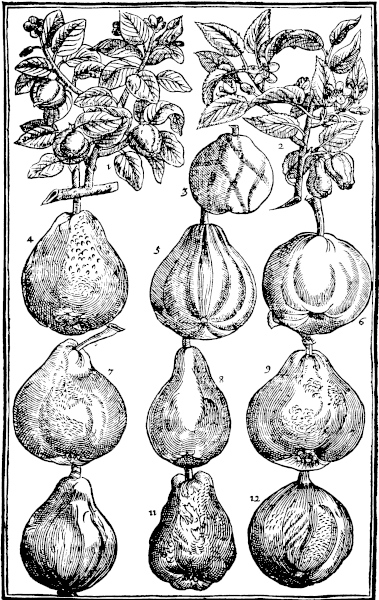
1Malus Cotonea. The Quince tree.
2Cydonium Lusitanicum. The Portingall Quince.
3Pyrus. The Peare tree.
4Pyrum Pompeianum, siue Cucumerinum hyemale. The Winter Bon Chretien.
5Pyrum pictum vel striatum. The painted or striped Peare of Ierusalem.
6Pyrum Palatinale. The Burgomot Peare.
7Pyrum Cucumerinum siue Pompeianum æstivum. The Summer Bon Chretien.
8Pyrum Volemam. The best Warden.
9Pyrum Librale. The pound Peare.
10Pyrum Windsorianum. The Windsor Peare.
11Pyrum Cucumerinum. The Gratiola Peare.
12Pyrum Caryophyllatum. The Gilloflower Peare.
The kindes of Peares.
The Summer bon Chretien is somewhat a long peare, with a greene and yellow russetish coate, and will haue sometimes red sides; it is ripe at Michaelmas: some vse to dry them as they doe Prunes, and keepe them all the yeare after. I haue not seene or heard any more Summer kindes hereof then this one, and needeth no wall to nourse it as the other.
The Winter bon Chretien is of many sorts, some greater, others lesser, and all good; but the greatest and best is that kinde that groweth at Syon: All the kinds of this Winter fruit must be planted against a wall, or else they will both seldome beare, and bring fewer also to ripenesse, comparable to the wall fruit: the kindes also are according to their lasting; for some will endure good much longer then others.
The Summer Bergomot is an excellent well rellished peare, flattish, & short, not long like others, of a meane bignesse, and of a darke yellowish greene colour on the outside.
The Winter Bergomot is of two or three sorts, being all of them small fruit, somewhat greener on the outside then the Summer kindes; all of them very delicate and good in their due time: for some will not be fit to bee eaten when others are well-nigh spent, euery of them outlasting another by a moneth or more.
The Diego peare is but a small peare, but an excellent well rellished fruit, tasting as if Muske had been put among it; many of them growe together, as it were in clusters.
The Duetete or double headed peare, so called of the forme, is a very good peare, not very great, of a russettish browne colour on the outside.
The Primating peare is a good moist peare, and early ripe.
The Geneting peare is a very good early ripe peare.
The greene Chesill is a delicate mellow peare, euen melting as it were in the mouth of the eater, although greenish on the outside.
The Catherine peare is knowne to all I thinke to be a yellow red sided peare, of a full waterish sweete taste, and ripe with the foremost.
The King Catherine is greater then the other, and of the same goodnesse, or rather better.
The Russet Catherine is a very good middle sized peare.
The Windsor peare is an excellent good peare, well knowne to most persons, and of a reasonable greatnesse: it will beare fruit some times twice in a yeare (and as it is said) three times in some places.
The Norwich peare is of two sorts, Summer and Winter, both of them good fruit, each in their season.
The Worster peare is blackish, a farre better peare to bake (when as it will be like a Warden, and as good) then to eate rawe; yet so it is not to be misliked.
The Muske peare is like vnto a Catherine peare for bignesse, colour, and forme; but farre more excellent in taste, as the very name importeth.
The Rosewater peare is a goodly faire peare, and of a delicate taste.
The Sugar peare is an early peare, very sweete, but waterish.
The Summer Popperin & the Winter Popperin, both of them are very good dry firme peares, somewhat spotted, and brownish on the outside.
The greene Popperin is a winter fruit, of equall goodnesse with the former.
The Soueraigne peare, that which I haue seene and tasted, and so termed vnto me, was a small brownish yellow peare, but of a most dainty taste; but some doe take a kind of Bon Chretien, called the Elizabeth peare, to be the Soueraigne peare; how truely let others iudge.
The Kings peare is a very good and well tasted peare.
The peare Royall is a great peare, and of a good rellish.
The Warwicke peare is a reasonable faire and good peare.
The Greenfield peare is a very good peare, of a middle size.
The Lewes peare is a brownish greene peare, ripe about the end of September, a reasonable well rellished fruit, and very moist.
The Bishop peare is a middle sized peare, of a reasonable good taste, not very waterish; but this property is oftentimes seene in it, that before the fruit is gathered, (but more vsually those that fall of themselues, and the rest within a while after they are gathered) will be rotten at the core, when there will not be a spot or blemish to bee seene on the outside, or in all the peare, vntill you come neare the core.
The Wilford peare is a good and a faire peare.
The Bell peare a very good greene peare.
The Portingall peare is a great peare, but more goodly in shew then good indeed.
The Gratiola peare is a kinde of Bon Chretien, called the Cowcumber peare, or Spinola’s peare.
The Rowling peare is a good peare, but hard, and not good before it bee a little rowled or bruised, to make it eate the more mellow.
The Pimpe peare is as great as the Windsor peare, but rounder, and of a very good rellish.
The Turnep peare is a hard winter peare, not so good to eate rawe, as it is to bake.
The Arundell peare is most plentifull in Suffolke, and there commended to be a verie good peare.
The Berry peare is a Summer peare, reasonable faire and great, and of so good and wholsome a taste, that few or none take harme by eating neuer so many of them.
The Sand peare is a reasonable good peare, but small.
The Morley peare is a very good peare, like in forme and Colour vnto the Windsor, but somewhat grayer.
The peare pricke is very like vnto the Greenfield peare, being both faire, great, and good.
The good Rewell is a reasonable great peare, as good to bake as to eate rawe, and both wayes it is a good fruit.
The Hawkes bill peare is of a middle size, somewhat like vnto the Rowling peare.
The Petworth peare is a winter peare, and is great, somewhat long, faire, and good.
The Slipper peare is a reasonable good peare.
The Robert peare is a very good peare, plentifull in Suffolke and Norfolke.
The pound peare is a reasonable good peare, both to eate rawe, and to bake.
The ten pound peare, or the hundred pound peare, the truest and best, is the best Bon Chretien of Syon, so called, because the grafts cost the Master so much the fetching by the messengers expences, when he brought nothing else.
The Gilloflower peare is a winter peare, faire in shew, but hard, and not fit to bee eaten rawe, but very good to bake.
The peare Couteau is neither good one way nor other.
The Binsce peare is a reasonable good winter peare, of a russetish colour, and a small fruit: but will abide good a long while.
The Pucell is a greene peare, of an indifferent good taste.
The blacke Sorrell is a reasonable great long peare, of a darke red colour on the outside.
The red Sorrell is of a redder colour, else like the other.
The Surrine is no very good peare.
The Summer Hasting is a little greene peare, of an indifferent good rellish.
Peare Gergonell is an early peare, somewhat long, and of a very pleasant taste.
The white Genneting is a reasonable good peare, yet not equall to the other.
The Sweater is somewhat like the Windsor for colour and bignesse, but nothing neare of so good a taste.
The bloud red peare is of a darke red colour on the outside, but piercing very little into the inner pulpe.
The Hony peare is a long greene Summer peare.
The Winter peare is of many sorts, but this is onely so called, to bee distinguished from all other Winter peares, which haue seuerall names giuen them, and is a very good peare.
The Warden or Luke Wards peare of two sorts, both white and red, both great and small.
The Spanish Warden is greater then either of both the former, and better also.
The peare of Ierusalem, or the stript peare, whose barke while it is young, is as plainly seene to be stript with greene, red, and yellow, as the fruit it selfe is also, and is of a very good taste: being baked also, it is as red as the best Warden, whereof Master William Ward of Essex hath assured mee, who is the chiefe keeper of the Kings Granary at Whitehall.
Hereof likewise there is a wilde kinde no bigger then ones thumbe, and striped in the like manner, but much more.
The Choke peares, and other Wilde peares, both great and small, as they are not to furnish our Orchard, but the Woods, Forrests, Fields, and Hedges, so wee leaue them to their naturall places, and to them that keep them, and make good vse of them.
The Vse of Peares.
The most excellent sorts of Peares, serue (as I said before of Apples) to make an after-course for their masters table, where the goodnesse of his Orchard is tryed. They are dryed also, and so are an excellent repaste, if they be of the best kindes, fit for the purpose.
They are eaten familiarly of all sorts of people, of some for delight, and of others for nourishment, being baked, stewed, or scalded.
The red Warden and the Spanish Warden are reckoned among the most excellent of Peares, either to bake or to roast, for the sicke or for the sound: And indeede, the Quince and the Warden are the two onely fruits are permitted to the sicke, to eate at any time.
Perry, which is the iuyce of Peares pressed out, is a drinke much esteemed as well as Cyder, to be both drunke at home, and carried to the Sea, and found to be of good vse in long voyages.
The Perry made of Choke Peares, notwithstanding the harshnesse, and euill taste, both of the fruit when it is greene, as also of the iuyce when it is new made, doth yet after a few moneths become as milde and pleasant as wine, and will hardly bee knowne by the sight or taste from it: this hath beene found true by often experience; and therefore wee may admire the goodnesse of God, that hath giuen such faculty to so wilde fruits, altogether thought vselesse, to become vsefull, and apply the benefit thereof both to the comfort of our soules and bodies.
For the Physicall properties, if we doe as Galen teacheth vs, in secundo Alimentorum, referre the qualities of Peares to their seuerall tastes, as before he had done in Apples, we shall not neede to make a new worke; those that are harsh and sowre doe coole and binde, sweet do nourish and warme, and those betweene these, to haue middle vertues, answerable to their temperatures, &c.
Much more might be said, both of this and the other kinds of fruits; but let this suffice for this place and worke, vntill a more exact be accomplished.
Chap. XXII. Nux Iuglans. The Wallnut.
Although the Wallnut tree bee often planted in the middle of great Courtyards, where by reason of his great spreading armes it taketh vp a great deale of roome, his shadow reaching farre, so that scarce any thing can well grow neare it; yet because it is likewise planted in fit places or corners of Orchards, and that it beareth fruit or nuts, often brought to the table, especially while they are freshest, sweetest, and fitted to be eaten, let not my Orchard want his company, or you the knowledge of it. Some doe thinke that there are many sorts of them, because some are much greater then others, and some longer then others, and some haue a more frangible shell then others; but I am certainly perswaded, that the soyle and climate where they grow, are the whole and onely cause of the varieties and differences. Indeed Virginia hath sent vnto vs two sorts of Wallnuts, the one blacke, the other white, whereof as yet wee haue no further knowledge. And I know that Clusius reporteth, he tooke vp at a banquet a long Wallnut, differing in forme and tendernesse of shell from others, which being set, grew and bore farre tenderer leaues then the others and a little snipt about the edges, which (as I said) might alter with the soyle and climate: and besides you may obserue, that many of Clusius differences are very nice, and so I leaue it.
The Wallnut tree groweth very high and great, with a large and thicke body or trunke, couered with a thicke clouen whitish greene barke, tending to an ash colour; the armes are great, and spread farre, breaking out into smaller branches, whereon doe growe long & large leaues, fiue or seuen set together one against another, with an odde one at the end, somewhat like vnto ashen leaues, but farre larger, and not so many on a stalke, smooth, and somewhat reddish at the first springing, and tender also, of a reasonable good sent, but more strong and headie when they growe old: the fruit or nut is great and round, growing close to the stalkes of the leaues, either by couples or by three set together, couered with a double shell, that is to say, with a greene thicke and soft outer rinde, and an inner hard shell, within which the white kernell is contained, couered with a thinne yellow rinde or peeling, which is more easily peeled away while it is greene then afterwards, and is as it were parted into foure quarters, with a thinne wooddy peece parting it at the head, very sweete and pleasant while it is fresh, and for a while after the gathering; but the elder they growe, the harder and more oily: the catkins or blowings are long and yellow, made of many scaly leaues set close together, which come forth early in the Spring, and when they open and fall away, vpon their stalkes arise certaine small flowers, which turne into so many nuts.
The Vse of Wallnuts.
They are often serued to the table with other fruits while they abide fresh and sweete; and therefore many to keepe them fresh a long time haue deuised many wayes, as to put them into great pots, and bury them in the ground, and so take them out as they spend them, which is a very good way, and will keepe them long.
The small young nuts while they are tender, being preserued or candid, are vsed among other sorts of candid fruits, that serue at banquets.
The iuyce of the outer greene huskes are held to be a soueraigne remedy against either poyson, or plague, or pestilentiall feuer.
The distilled water of the huskes drunke with a little vinegar, if the fits growe hot and tedious, is an approued remedy for the same.
The water distilled from the leaues, is effectuall to be applyed to fluent or running vlcers, to dry and binde the humours.
Some haue vsed the pouder of the catkins in white wine, for the suffocation or strangling of the mother.
The oyle of Wallnuts is vsed to varnish Ioyners workes. As also is accounted farre to excell Linseede oyle, to mixe a white colour withall, that the colour bee not dimmed. It is of excellent vse for the coldnesse, hardnesse and contracting of the sinewes and ioynts, to warme, supple, and to extend them.
Chap. XXIII. Castanea Equina. The Horse Chesnut.
Although the ordinary Chesnut is not a tree planted in Orchards, but left to Woods, Parkes, and other such like places; yet wee haue another sort which wee haue noursed vp from the nuts sent vs from Turky, of a greater and more pleasant aspect for the faire leaues, and of as good vse for the fruit. It groweth in time to be a great tree, spreading with great armes and branches, whereon are set at seuerall distances goodly faire great greene leaues, diuided into six, seuen, or nine parts or leaues, euery one of them nicked about the edges, very like vnto the leaues of Ricinus, or Palma Christi, and almost as great: it beareth at the ends of the branches many flowers set together vpon a long stalke, consisting of foure white leaues a peece, with many threads in the middle, which afterwards turne into nuts, like vnto the ordinary Chesnuts, but set in rougher and more prickly huskes: the nuts themselues being rounder and blacker, with a white spot at the head of each, formed somewhat like an heart, and of a little sweeter taste.
The Vse of this Chesnut.
It serueth to binde and stop any maner of fluxe, be it of bloud or humours, either of the belly or stomacke; also the much spitting of bloud. They are roasted and eaten as the ordinary sort, to make them taste the better.
They are vsually in Turkie giuen to horses in their prouender, to cure them of coughes, and helpe them being broken winded.
Chap. XXIIII. Morus. The Mulberrie.
There are two sorts of Mulberries sufficiently known to most, the blackish and the white: but wee haue had brought vs from Virginia another sort, which is of greater respect then eyther of the other two, not onely in regard of the raritie, but of the vse, as you shall presently vnderstand.
1. Morus nigra. The blacke Mulberrie.
The blacke Mulberrie tree groweth oftentimes tall and great, and oftentimes also crooked, and spreading abroade, rather then high; for it is subiect to abide what forme you will conforme it vnto: if by suffering it to grow, it will mount vp, and if you will binde it, or plash the boughes, they will so abide, and be carried ouer arbours, or other things as you will haue it. The bodie groweth in time to bee very great, couered with a rugged or thicke barke, the armes or branches being smoother, whereon doe grow round thicke leaues pointed at the ends, and nicked about the edges, and in some there are to be seene deep gashes, making it seeme somewhat like the Vine leafe: the flowers are certaine short dounie catkings, which turne into greene berries at the first, afterwards red, and when they are full ripe blacke, made of many graines set together, like vnto the blacke berrie, but longer and greater: before they are ripe, they haue an austere and harsh taste, but when they are full ripe, they are more sweete and pleasant; the iuice whereof is so red, that it will staine the hands of them that handle and eate them.
2. Morus alba. The white Mulberrie.
The white Mulberrie tree groweth not with vs to that greatnesse or bulke of bodie that the blacke doth, but runneth vp higher, slenderer, more knotty, hard and brittle, with thinner spreade armes and branches: the leaues are like the former, but not so thicke set on the branches, nor so hard in handling, a little paler also, hauing somewhat longer stalkes: the fruit is smaller and closer set together, greene, and somewhat harsh before they be ripe, but of a wonderfull sweetnesse, almost ready to procure loathing when they are thorough ripe, and white, with such like seede in them as in the former, but smaller.
3. Morus Virginiana. The Virginia Mulberrie.
The Virginia Mulberry tree groweth quickely with vs to be a very great tree, spreading many armes and branches, whereon grow faire great leaues, very like vnto the leaues of the white Mulberrie tree: the berry or fruit is longer and redder then either of the other, and of a very pleasant taste.
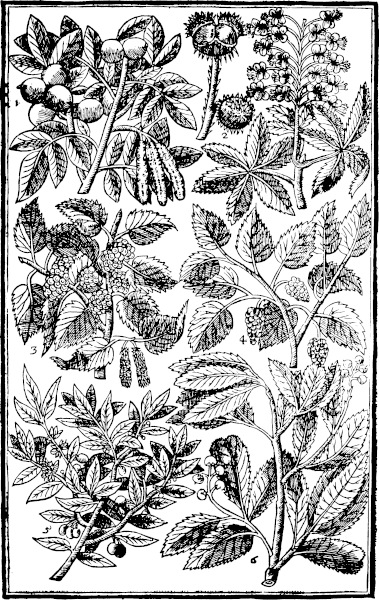
1Nux Iuglans. The Wallnut.
2Castanea equina. The horse Chestnut.
3Morus nigra vel alba. The Mulberry.
4Morus Virginiana. The Virginia Mulberry.
5Laurus vulgaris. The ordinary Bay tree.
6Laurea Cerasus Virginiana. The Virginia Cherry Bay.
The Vse of Mulberries.
The greatest and most especiall vse of the planting of white Mulberries, is for the feeding of Silke wormes, for which purpose all the Easterne Countries, as Persia, Syria, Armenia, Arabia &c. and also the hither part of Turkie, Spaine also and Italie, and many other hot Countries doe nourish them, because it is best for that purpose, the wormes feeding thereon, giuing the finest and best silke; yet some are confident that the leaues of the blacke will doe as much good as the white: but that respect must be had to change your seede, because therein lyeth the greatest mysterie. But there is a Booke or Tractate printed, declaring the whole vse of whatsoeuer can belong vnto them: I will therefore referre them thereunto, that would further vnderstand of that matter.
Mulberries are not much desired to be eaten, although they be somewhat pleasant, both for that they staine their fingers and lips that eate them, and doe quickly putrefie in the stomacke, if they bee not taken before meate.
They haue yet a Physicall vse, which is by reason of the astringent quality while they are red, and before they bee ripe, for sore mouthes and throats, or the like, whereunto also the Syrup, called Diamoron, is effectuall.

Corollarium. A COROLLARIE To this Orchard.

There are certaine other trees that beare no fruit fit to bee eaten, which yet are often seene planted in Orchards, and other fit and conuenient places about an house, whereof some are of especiall vse, as the Bay tree &c. others for their beauty and shadow are fit for walkes or arbours; some being euer green are most fit for hedge-rowes; and some others more for their raritie then for any other great vse, whereof I thought good to entreat apart by themselues, and bring them after the fruit trees of this Orchard, as an ornament to accomplish the same.
1. Laurus. The Bay tree.
There are to bee reckoned vp fiue kindes of Bay trees, three whereof haue been entreated of in the first part, a fourth wee will only bring here to your consideration, which is that kinde that is vsually planted in euery mans yard or orchard, for their vse throughout the whole land, the other we will leaue to bee considered of in that place is fit for it.
The Bay tree riseth vp oftentimes to carry the face of a tree of a meane bignesse in our Countrey (although much greater in the hoter) and oftentimes shooteth vp with many suckers from the roote, shewing it selfe more like to a tall shrubbe or hedge-bush, then a tree, hauing many branches, the young ones whereof are sometimes reddish, but most vsually of a light or fresh greene colour, when the stemme and elder boughes are couered with a darke greene barke: the leaues are somewhat broad, and long pointed as it were at both the ends, hard and sometimes crumpled on the edges, of a darke greene colour aboue, and of a yellowish greene vnderneath, in smell sweet, in taste bitter, and abiding euer greene: the flowers are yellow and mossie, which turne into berries that are a little long as well as round, whose shell or outermost peele is greene at the first, and black when it is ripe; wherein is contained an hard bitter kernell, which cleaueth in two parts.
The Vse of Bayes.
The Bay leaues are of as necessary vse as any other in Garden or Orchard; for they serue both for pleasure and profit, both for ornament and for vse, both for honest Ciuill vses, and for Physicke, yea both for the sicke and for the sound, both for the liuing and for the dead: And so much might be said of this one tree, that if it were all told, would as well weary the Reader, as the Relater: but to explaine my selfe; It serueth to adorne the house of God as well as of man: to procure warmth, comfort and strength to the limmes of men and women, by bathings and annoyntings outward, and by drinkes &c. inward to the stomacke, and other parts: to season vessels &c. wherein are preserued our meates, as well as our drinkes: to crowns or encircle as with a garland, the heads of the liuing, and to sticke and decke forth the bodies of the dead: so that from the cradle to the graue we haue still vse of it, we haue still neede of it.
The berries likewise serue for stitches inward, and for paines outward, that come of cold eyther in the ioynts, sinewes, or other places.
2. Laurea Cerasus, siue Laurus Virginiana. The Virginian Bay, or Cherry Baye.
This Virginian (whether you will call it a Baye, or a Cherrie, or a Cherrie Bay, I leaue it to euery ones free will and iudgement, but yet I thinke I may as well call it a Bay as others a Cherrie, neither of them being answerable to the tree, which neyther beareth such berries as are like Cherries, neither beareth euer greene leaues like the Bay: if it may therefore bee called the Virginia Cherry Bay, for a distinction from the former Bay Cherry that beareth faire blacke Cherries, it will more fitly agree thereunto, vntill a more proper may be imposed) riseth vp to be a tree of a reasonable height, the stemme or bodie thereof being almost as great as a mans legge, spreading forth into diuers armes or boughes, and they againe into diuers small branches, whereon are set without order diuers faire broade greene leaues, somewhat like vnto the former Bay leaues, but more limber and gentle, and not so hard in handling, broader also, and for the most part ending in a point but in many somewhat round pointed, very finely notched or toothed about the edges, of a bitter taste, very neere resembling the taste of the Bay leafe, but of little or no sent at all, either greene or dryed, which fall away euery autumne, and spring afresh euery yeare: the blossomes are small and white, many growing together vpon a long stalke, somewhat like the Bird Cherry blossomes, but smaller, and come forth at the ends of the young branches, which after turne into small berries, euery one set in a small cup or huske, greene at the first, and blacke when they are ripe, of the bignesse of a small pease, of a strong bitter taste, and somewhat aromaticall withall, but without any fleshy substance like a Cherry at all vpon it; for it is altogether like a berry.
The Vse of this Virginia Cherry Bay.
Being a stranger in our Land, and possessed but of a very few, I doe not heare that there hath beene any triall made thereof what properties are in it: let this therefore suffice for this present, to haue shewed you the description and forme thereof, vntill we can learne further of his vses.
3. Pinus. The Pine tree.
My purpose in this place is not to shew you all the diuersities of Pine trees, or of the rest that follow, but of that one kinde is planted in many places of our Land for ornament and delight, and there doth reasonably well abide: take it therefore into this Orchard, for the raritie and beautie of it, though we haue little other vse of it.
The Pine tree groweth with vs, though slowely, to a very great height in many places, with a great straight bodie, couered with a grayish greene barke, the younger branches are set round about, with very narrow long whitish greene leaues, which fall away from the elder, but abide on the younger, being both winter and summer alwaies greene. It hath growing in sundry places on the branches, certaine great hard wooddy clogs (called of some apples, of others nuts) composed of many hard wooddy scales, or tuberous knobs, which abide for the most part alwaies greene in our Countrey, and hardly become brownish, as in other Countries, where they haue more heat and comfort of the Sun, and where the scales open themselues; wherein are contained white long and round kernels, very sweete while they are fresh, but quickely growing oylely and rancide.
The Vse of the Pine apples and kernels.
The Cones or Apples are vsed of diuers Vintners in this City, being painted, to expresse a bunch of grapes, whereunto they are very like, and are hung vp in their bushes, as also to fasten keyes vnto them, as is seene in many places.
The kernels within the hard shels, while they are fresh or newly taken out, are vsed many waies, both with Apothecaries, Comfit-makers, and Cookes: for of them are made medicines, good to lenifie the pipes and passages of the lungs and throate, when it is hoarse. Of them are made Comfits, Pastes, Marchpanes, and diuers other such like: And with them a cunning Cooke can make diuers Keck shoses for his Masters table.
Matthiolus commendeth the water of the greene apples distilled, to take away the wrinkles in the face, to abate the ouer-swelling breasts of Maidens, by fomenting them after with linnen clothes, wet in the water; and to restore such as are rauisht into better termes.
4. Abies. The Firre tree.
The Firre tree groweth naturally higher then any other tree in these parts of Christendome where no Cedars grow, and euen equalling or ouer-topping the Pine: the stemme or bodie is bare without branches for a great height, if they bee elder trees, and then branching forth at one place of the bodie foure wayes in manner of a crosse, those boughes againe hauing two branches at euery ioynt, on which are set on all sides very thicke together many small narrow long hard whitish greene leaues, and while they are young tending to yellownesse, but nothing so long or hard or sharpe pointed as the Pine tree leaues, growing smaller and shorter to the end of the branches: the bloomings are certaine small long scaly catkins, of a yellowish colour, comming forth at the ioynts of the branches, which fall away: the cones are smaller and longer then of the Pine tree, wherein are small three square seede contained, not halfe so big as the Pine kernels.
The Vse of the Firre tree.
The vse of this tree is growne with vs of late daies to bee more frequent for the building of houses then euer before: for hereof (namely of Deale timber and Deale boords) are framed many houses, and their floores, without the helpe of any other timber or boord of any other tree almost; as also for many other workes and purposes. The yellow Rossen that is vsed as well to make salues as for many other common vses, is taken from this tree, as the Pitch is both from the Pitch and Pine trees, and is boyled to make it to bee hard, but was at the first a yellow thin cleere Turpentine, and is that best sort of common Turpentine is altogether in vse with vs, as also another more thicke, whitish, and troubled, both which are vsed in salues, both for man and beast (but not inwardly as the cleere white Venice Turpentine is) and serueth both to draw, cleanse and heale. Dodonæus seemeth to say, that the cleere white Turpentine, called Venice Turpentine, is drawn from the Firre: but Matthiolus confuteth that opinion, which Fulsius also held before him.
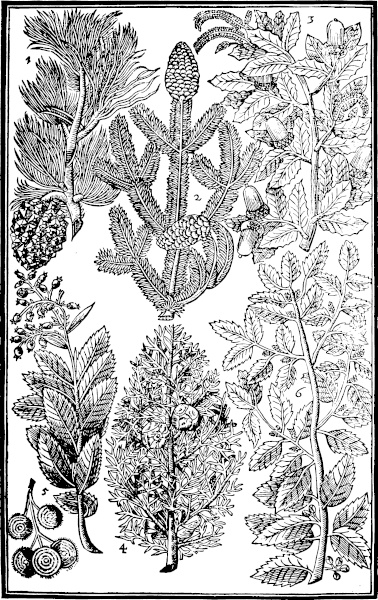
1Pinus. The Pine tree.
2Abies. The Firre tree.
3Ilex. The euer greene Oake.
4Cupressus. The Cipresse tree.
5Arbutus. The Strawberry tree.
6Alaternus. The euer greene Priuet.
5. Ilex arbor. The euer-greene Oake.
The Ilex or euer-greene Oake riseth in time to be a very great tree, but very long and slow in growing (as is to be seene in the Kings priuy Garden at Whitehall, growing iust against the backe gate that openeth into the way going to Westminster, and in some other places) spreading many fair large great armes and branches, whereon are set small and hard greene leaues, somewhat endented or cornered, and prickly on the edges, especially in the young trees, and sometimes on those branches that are young and newly sprung forth from the elder rootes, but else in a manner all smooth in the elder growne, abiding greene all the winter as well as summer, and are of a grayish greene on the vnderside. It beareth in the spring time certaine slender long branches (like as other Okes doe) with small yellowish mossie flowers on them, which fall away, and are vnprofitable, the acornes not growing from those places, but from others which are like vnto those of our ordinary Oake, but smaller and blacker, and set in a more rugged huske or cuppe. This and no other kinde of Ilex doe I know to grow in all our land in any Garden or Orchard: for that kind with long and narrower leaues, and not prickly, growing so plentifully as Matthiolus saith in Tuscane, I haue not seen: and it is very probable to bee the same that Plinie remembreth to haue the leafe of an Oliue; but not as some would haue it, that Smilax Theophrastus maketh mention of in his third Booke and sixteenth Chapter of his Historie of Plants, which the Arcadians so called, and had the leafe of the Ilex, but not prickly: for Theophrastus saith, the timber of Smilax is smooth and soft, and this of the Ilex is harder, and stronger then an Oake.
The Vse of the Ilex or euer-greene Oake.
Seeing this is to be accounted among the kindes of Oake (and all Oakes by Dioscorides his opinion are binding) it is also of the same qualitie, but a little weaker, and may serue to strengthen weake members. The young tops and leaues are also vsed in gargles for the mouth and throate.
6. Cupressus. The Cypresse tree.
The Cypresse tree that is noursed vp by vs, in our Country, doth grow in those places where it hath beene long planted, to a very great height, whose bodie and boughes are couered with a reddish ash-coloured bark; the branches grow not spreading, but vpright close vnto the bodie, bushing thicke below, and small vpwards, spire fashion, those below reaching neere halfe the way to them aboue, whereon doe grow euer greene leaues, small, long and flat, of a resinous sweete smell, and strong taste, somewhat bitter: the fruit, which are called nuts, grow here and there among the boughes, sticking close vnto them, which are small, and clouen into diuers parts, but close while they are young, of a russetish browne colour; wherein are contained small browne seede, but not so small as motes in the Sunne, as Matthiolus and others make them to be.
The Vse of the Cypresse tree.
For the goodly proportion this tree beareth, as also for his euer-greene head, it is and hath beene of great account with all Princes, both beyond, and on this side of the Sea, to plant them in rowes on both sides of some spatious walke, which by reason of their high growing, and little spreading, must be planted the thicker together, and so they giue a goodly, pleasant and sweet shadow: or else alone, if they haue not many, in the middle of some quarter, or as they thinke meete. The wood thereof is firme and durable, or neuer decaying, of a brown yellow colour, and of a strong sweete smell, whereof Chests or Boxes are made to keepe apparell, linnen, furres, and other things, to preserue them from moths, and to giue them a good smell.
Many Physicall properties, both wood, leaues and nuts haue, which here is not my purpose to vnfold, but only to tell you, that the leaues being boyled in wine, and drunke, helpe the difficultie of making vrine, and that the nuts are binding, fit to bee vsed to stay fluxes or laskes, and good also for ruptures.
7. Arbutus. The Strawberry tree.
The Strawberry tree groweth but slowly, and riseth not to the height of any great tree, no not in France, Italy, or Spaine: and with vs the coldnesse of our country doth the more abate his vigour, so that it seldome riseth to the height of a man: the barke of the body is rough, and smooth in the younger branches: the leaues are faire and greene, very like vnto Baye leaues, finely dented or snipped about the edges, abiding alwayes greene thereon both Winter and Summer: the flowers come forth at the end of the branches vpon long stalkes, not clustering thicke together, but in long bunches, and are small, white, and hollow, like a little bottle, or the flower of Lilly Conually, which after turne into rough or rugged berries, most like vnto Strawberries (which hath giuen the name to the tree) somewhat reddish when they are ripe, of a harsh taste, nothing pleasant, wherein are contained many small seedes: It hardly bringeth his fruit to ripenesse in our countrey; for in their naturall places they ripen not vntill Winter, which there is much milder then with vs.
The Vse of the Strawberry tree.
Amatus Lusitanus I thinke is the first that euer recorded, that the water distilled from the leaues and flowers hereof, should bee very powerfull against the plague and poysons: for all the ancient Writers doe report, that the fruit hereof being eaten, is an enemy to the stomacke and head. And Clusius likewise setteth downe, that at Lishbone, and other places in Portingall where they are frequent, they are chiefly eaten, but of the poorer sort, women and boyes. They are somewhat astringent or binding, and therefore may well serue for fluxes. It is chiefly noursed with vs for the beauty and rarenesse of the tree; for that it beareth his leaues alwayes green.
8. Alaternus. The euer greene Priuet.
The tree which we haue growing in our country called Alaternus, groweth not to be a tree of any height; but abiding lowe, spreadeth forth many branches, whereon are set diuers small and hard, greene leaues, somewhat round for the forme, and endented a little by the edges: it beareth many small whitish greene flowers at the ioynts of the stalkes, and setting on of the lower leaues clustering thicke together, which after turne into small blacke berries, wherein are contained many small graines or seedes: the beauty and verdure of these leaues abiding so fresh all the yeare, doth cause it to be of the greater respect; and therefore findeth place in their Gardens onely, that are curious conseruers of all natures beauties.
The Vse of the euer greene Priuet.
It is seldome vsed for any Physicall property, neither with vs, nor in the places where it is naturall and plentifull: but as Clusius reporteth, hee learned that the Portingall Fishermen do dye their nets red with the decoction of the barke hereof, and that the Dyers in those parts doe vse the small peeces of the wood to strike a blackish blew colour.
9. Celastrus Theophrasti Clusio. Clusius his Celastrus.
Although the Collectour (who is thought to be Ioannes Molineus of the great Herball or History of plants, and generally bearing Daleschampius name, because the finding and relation of diuers herbes therein expressed, is appropriate to him, and printed at Lyons) of all our moderne Writers doth first of all others appoint the Celastrus, whereof Theophrastus onely among all the ancient Writers of plants maketh mention, to be the first Alaternus that Clusius hath set forth in his History of rarer plants: yet I finde, that Clusius himselfe before his death doth appropriate that Celastrus of Theophrastus to another plant, growing in the Garden at Leyden, which formerly of diuers had beene taken to be a kinde of Laurus Tinus, or the wilde Baye; but he impugning that opinion for diuers respects, decyphreth out that Leyden tree in the same manner that I doe: and because it is not onely faire, in bearing his leaues alwayes greene, but rare also, being noursed vp in our Land in very few places, but principally with a good old Lady, the widow of Sir Iohn Leuson, dwelling neere Rochester in Kent; I thought it fit to commend it for an ornament, to adorne this our Garden and Orchard. It groweth vp to the height of a reasonable tree, the body whereof is couered with a darke coloured barke, as the elder branches are in like manner; the younger branches being greene, whereon are set diuers leaues thicke together, two alwayes at a ioynt, one against another, of a sad but faire greene colour on the vpperside, and paler vnderneath, which are little or nothing at all snipped about the edges, as large as the leaues of the Laurus Tinus, or wilde Baye tree: at the end of the young branches breake forth between the leaues diuers small stalkes, with foure or fiue flowers on each of them, of a yellowish greene colour, which turne into small berries, of the bignesse of blacke Cherries, greene at the first, and red when they begin to be ripe, but growing blacke if they hang too long vpon the branches, wherein is contained a hard shell, and a white hard kernell within it, couered with a yellowish skin. This abideth (as I said before) with greene leaues as well Winter as Summer; and therefore fittest to be planted among other of the same nature, to make an euer greene hedge.
The Vse of Clusius his Celastrus.
Being so great a stranger in this part of the Christian world, I know none hath made tryall of what property it is, but that the taste of the leaues is somewhat bitter.
10. Pyracantha. The euer greene Hawthorne, or prickly Corall tree.
This euer greene shrubbe is so fine an ornament to a Garden or Orchard, either to be noursed vp into a small tree by it selfe, by pruining and taking away the suckers and vnder branches, or by suffering it to grow with suckers, thicke and plashing the branches into a hedge, for that it is plyable to be ordered either way; that I could not but giue you the knowledge thereof, with the description in this manner. The younger branches are couered with a smooth darke blewish greene barke, and the elder with a more ash coloured, thicke set with leaues without order, some greater and others smaller, somewhat like both in forme and bignesse vnto the leaues of the Barberry tree, but somewhat larger, and more snipt about the edges, of a deeper green colour also, and with small long thornes scattered here & there vpon the branches: the flowers come forth as well at the ends of the branches, as at diuers places at the ioynts of the leaues, standing thicke together, of a pale whitish colour, a little dasht ouer with a shew of blush, consisting of fiue leaues a peece, with some small threads in the middle, which turne into berries, very like vnto Hawthorne berries, but much redder and dryer, almost like polished Corall, wherein are contained foure or fiue small yellowish white three square seede, somewhat shining. It is thought to be the Oxyacantha of Dioscorides; but seeing Dioscorides doth explaine the forme of the leafe in his Chapter of Medlars, which he concealed in the Chapter of Oxyacantha, it cannot be the same: for Mespilus Anthedon of Theophrastus, or Aronia of Dioscorides, hath the leafe of Oxyacantha, as Dioscorides saith, or of Smalladge, as Theophrastus, which cannot agree to this Thorne; but doth most liuely delineate out our white Thorne or Hawthorne, that now there is no doubt, but that Oxyacantha of Dioscorides is the Hawthorne tree or bush.
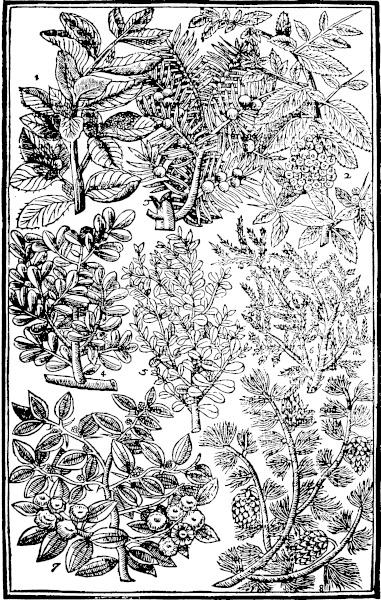
1Celastrus Theophrasti Clusio. Clusius his Celastrus.
2Pyracantha. The euer green prickly Corall tree.
3Taxus. The Yewe tree.
4Buxus arbor. The Boxe tree.
5Buxus humilis. The lowe or dwarfe Boxe.
6Sabina. The Sauine tree.
7Paliurus. Christs thorne.
8Larix. The Larch tree.
The Vse of this Corall tree.
Although Lobel maketh mention of this tree to grow both in Italy, and Prouence in France, in some of their hedges, yet he saith it is neglected in the naturall places, and to be of no vse with them: neither doe I heare, that it is applyed to any Physicall vse with vs, but (as I before said) it is preserued with diuers as an ornament to a Garden or Orchard, by reason of his euer greene leaues, and red berries among them, being a pleasant spectacle, and fit to be brought into the forme of an hedge, as one please to lead it.
11. Taxus. The Yewe tree.
The Yewe tree groweth with vs in many places to bee a reasonable great tree, but in hoter countries much bigger, couered with a reddish gray scaly barke; the younger branches are reddish likewise, whereon grow many winged leaues, that is, many narrow long darke greene leaues, set on both sides of a long stalke or branch, neuer dying or falling away, but abiding on perpetually, except it be on the elder boughes: the flowers are small, growing by the leaues, which turne into round red berries, like vnto red Asparagus berries, in taste sweetish, with a little bitternesse, and causing no harme to them for any thing hath been knowne in our country.
The Vse of the Yewe tree.
It is found planted both in the corners of Orchards, and against the windowes of Houses, to be both a shadow and an ornament, in being alwayes greene, and to decke vp Houses in Winter: but ancient Writers haue euer reckoned it to be dangerous at the least, if not deadly.
12. Buxus. The Boxe tree.
The Boxe tree in some places is a reasonable tall tree, yet growing slowly; the trunke or body whereof is of the bignesse of a mans thigh, which is the biggest that euer I saw: but sometimes, and in other places it groweth much lower, vsually not aboue a yard, or a yard and a halfe high, on the backe sides of many Houses, and in the Orchards likewise: the leaues are small, thicke and hard, and still the greater or lesser the tree is, the greater or lesser are the leaues, round pointed, and of a fresh shining greene colour: the flowers are small and greenish, which turne into heads or berries, with foure hornes, whitish on the outside, and with reddish seede within them.
Buxus aureus. Gilded Boxe.
There is another kinde hereof but lately come to our knowledge, which differeth not in any thing from the former, but onely that all the leaues haue a yellow lift or gard about the edge of them on the vpperside, and none on the lower, which maketh it seeme very beautifull; and is therefore called gilded Boxe.
Buxus humilis. Dwarfe Boxe.
We haue yet another kinde of Boxe, growing small and lowe, not aboue halfe a foote, or a foote high at the most, vnlesse it be neglected, which then doth grow a little more shrubby, bearing the like leaues, but smaller, according to the growth, and of a deeper greene colour: I could neuer know that this kinde euer bore flower or seede, but is propagated by slipping the roote, which encreaseth very much.
The Vse of Boxe.
The wood of the Boxe tree is vsed in many kindes of small works among Turners, because it is hard, close, and firme, and as some haue said, the roots much more, in regard of the diuers waues and crooked veines running through it. It hath no Physicall vse among the most and best Physitians, although some haue reported it to stay fluxes, and to be as good as the wood of Guaiacum, or Lignum vitæ for the French disease. The leaues and branches serue both Summer and Winter to decke vp houses; and are many times giuen to horses for the bots.
The lowe or dwarfe Boxe is of excellent vse to border vp a knot, or the long beds in a Garden, being a maruailous fine ornament thereunto, in regard it both groweth lowe, is euer greene, and by cutting may bee kept in what maner euery one please, as I haue before spoken more largely.
13. Sabina. The Sauine tree or bush.
The Sauine tree or bush that is most vsuall in our country, is a small lowe bush, not so high as a man in any place, nor so bigge in the stemme or trunke as a mans arme, with many crooked bending boughes and branches, whereon are set many small, short, hard, and prickly leaues, of a darke green colour, fresh and green both Winter and Summer: it is reported, that in the naturall places it beareth small blacke berries, like vnto Iuniper, but with vs it was neuer knowne to beare any.
The Vse of Sauine.
It is planted in out-yards, backsides, or voide places of Orchards, as well to cast clothes thereon to dry, as for medicines both for men and horses: being made into an oyle, it is good to annoint childrens bellies for to kill the Wormes: and the powder thereof mixed with Hogs grease, to annoint the running sores or scabs in their heads; but beware how you giue it inwardly to men, women, or children. It is often put into horses drenches, to helpe to cure them of the bots, and other diseases.
14. Paliurus. Christs thorne.
This thorny shrubbe (wherewith as it is thought, our Sauiour Christ was crowned, because as those that haue trauelled through Palestina and Iudæa, doe report no other thorne doth grow therein so frequent, or so apt to be writhed) riseth in some places to a reasonable height, but in our country seldome exceedeth the height of a man, bearing many slender branches, full of leaues, set on either side thereof one by one, which are somewhat broad and round, yet pointed, and full of veines, thicke set also with small thornes, euen at the foote of euery branch, and at the foote of euery leafe one or two, some standing vpright, others a little bending downe: the flowers are small and yellow, standing for the most part at the end of the branches, many growing vpon a long stalke, which after turne into round, flat, and hard shelly fruit, yet couered with a soft fleshy skinne, within which are included two or three hard, small, and browne flat seeds, lying in seuerall partitions. The leaues hereof fall away euery yeare, and spring forth afresh againe the next May following. The rarity and beauty of this shrubbe, but chiefly (as I thinke) the name hath caused this to be much accounted of with all louers of plants.
The Vse of Christs thorne.
Wee haue so few of these shrubbes growing in our country, and those that are, doe, for any thing I can vnderstand, neuer beare fruit with vs; that there is no other vse made hereof then to delight the owners: but this is certainly receiued for the Paliurus of Dioscorides and Theophrastus, and thought also by Matthiolus to be the very true Rhamnus tertius of Dioscorides. Matthiolus also seemeth to contradict the opinion is held by the Physitians of Mompelier, and others, that it cannot be the Paliurus of Theophrastus. It is held to be effectuall to helpe to breake the stone, both in the bladder, reines, and kidneyes; the leaues and young branches haue an astringent quality, and good against poysons and the bitings of serpents.
15. Larix. The Larch tree.
The Larch tree, where it naturally groweth, riseth vp to be as tall as the Pine or Firre tree, but in our Land being rare, and noursed vp but with a few, and those onely louers of rarities, it groweth both slowly, and becommeth not high: the barke hereof is very rugged and thicke, the boughes and branches grow one aboue another in a very comely order, hauing diuers small yellowish knobs or bunches set thereon at seuerall distances; from whence doe yearely shoote forth many small, long, and narrow smooth leaues together, both shorter and smaller, and not so hard or sharpe pointed as either the Pine or Firre tree leaues, which doe not abide the Winter as they doe, but fall away euery yeare, as other trees which shed their leaues, and gaine fresh euery Spring: the blossomes are very beautifull and delectable, being of an excellent fine crimson colour, which standing among the greene leaues, allure the eyes of the beholders to regard it with the more desire: it also beareth in the naturall places (but not in our Land that I could heare) small soft cones or fruit, somewhat like vnto Cypresse nuts, when they are greene and close.
The Vse of the Larch tree.
The coles of the wood hereof (because it is so hard and durable as none more) is held to be of most force being fired, to cause the Iron oare to melt, which none other would doe so well. Matthiolus contesteth against Fuchsius, for deeming the Venice Turpentine to be the liquid Rossen of the Firre tree, which he assureth vpon his owne experience and certaine knowledge, to be drawne from this Larch tree, and none other; which cleere Turpintine is altogether vsed inwardly, and no other, except that of the true Turpintine tree, and is very effectuall to cleanse the reines, kidneyes, and bladder, both of grauell and the stone, and to prouoke vrine: it is also of especiall property for the gonorrhæa, or running of the reines, as it is called, with some powder of white Amber mixed therewith, taken for certaine dayes together. Taken also in an Electuary, it is singular good for to expectorate rotten flegme, and to helpe the consumption of the lungs. It is vsed in plaisters and salues, as the best sort of Turpintine. The Agaricke that is vsed in physicke, is taken from the bodies and armes of this tree. And Matthiolus doth much insist against Brasauolus, that thought other trees had produced Agaricke, affirming them to be hard Fungi, or Mushroms (such as wee call Touch-wood) wherwith many vse to take fire, strooke thereinto from steele.
16. Tilia. The Line or Linden tree.
There are two sorts of Line trees, the male and the female; but because the male is rare to be seene, and the female is more familiar, I will onely giue you the description of the female, and leaue the other.
The female Line tree groweth exceeding high and great, like vnto an Elme, with many large spreading boughes, couered with a smooth barke, the innermost being very plyant and bending from whence come smaller branches, all of them so plyable, that they may bee led or carried into any forme you please: the leaues thereon are very faire, broad, and round, somewhat like vnto Elme leaues, but fairer, smoother, and of a fresher greene colour, dented finely about the edges, and ending in a sharpe point: the flowers are white, and of a good smell, many standing together at the top of a stalke, which runneth all along the middle ribbe of a small long whitish leafe; after which come small round berries, wherein is contained small blackish seede: this tree is wholly neglected by those that haue them, or dwell neere them, because they suppose it to be fruitlesse, in regard it beareth chaffie huskes, which in many places fall away, without giuing ripe seede.
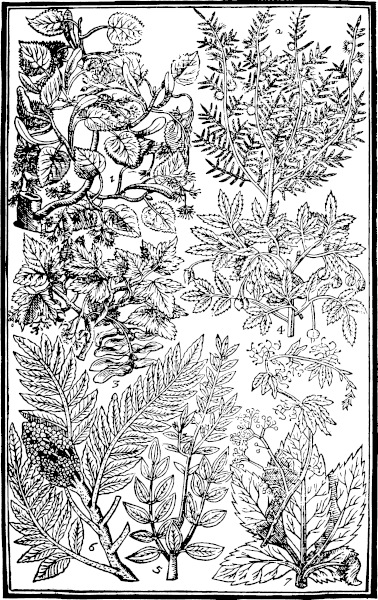
1Tilia famina. The Line or Linden tree.
2Tamariscus. The Tamariske tree.
3Acer maius latifolium. The Sycomore tree.
4Staphylodendron. The bladder nut.
5Rhus Myrtifolia. The Mirtle leafed Sumach.
6Rhus Virginiana. The Bucks horne tree.
7Vitis seu potius Hedera Virginensis. The Virginia Vine or rather Iuie.
The Vse of the Line tree.
It is planted both to make goodly Arbours, and Summer banquetting houses, either belowe vpon the ground, the boughes seruing very handsomely to plash round about it, or vp higher, for a second aboue it, and a third also: for the more it is depressed, the better it will grow. And I haue seene at Cobham in Kent, a tall or great bodied Line tree, bare without boughes for eight foote high, and then the branches were spread round about so orderly, as if it were done by art, and brought to compasse that middle Arbour: And from those boughes the body was bare againe for eight or nine foote (wherein might bee placed halfe an hundred men at the least, as there might be likewise in that vnderneath this) & then another rowe of branches to encompasse a third Arbour, with stayres made for the purpose to this and that vnderneath it: vpon the boughes were laid boards to tread vpon, which was the goodliest spectacle mine eyes euer beheld for one tree to carry.
The coles of the wood are the best to make Gunpowder. And being kindled, and quenched in vinegar, are good to dissolue clotted bloud in those that are bruised with a fall. The inner barke being steeped in water yeeldeth a slimie iuyce, which is found by experience, to be very profitable for them that haue been burnt with fire.
17. Tamarix. Tamariske tree.
The Tamariske tree that is common in our country, although in some places it doth not grow great, yet I haue seene it in some other, to be as great as a great apple tree in the body, bearing great arms; from whose smaller branches spring forth young slender red shootes, set with many very fine, small, and short leaues, a little crisped, like vnto the leaues of Sauine, not hard or rough, but soft and greene: the flowers be white mossie threads, which turne into dounie seede, that is carried away with the winde.
Tamariscus solijs albidis. White Tamariske.
There is another kinde hereof very beautifull and rare, not to be seene in this Land I thinke, but with Mʳ. William Ward, the Kings seruant in his Granary, before remembred, who brought me a small twigge to see from his house at Boram in Essex, whose branches are all red while they are young, and all the leaues white, abiding so all the Summer long, without changing into any shew of greene like the other and so abideth constant yeare after yeare, yet shedding the leaues in Winter like the other.
The Vse of Tamariske.
The greatest vse of Tamariske is for spleneticke diseases, either the leaues or the barke made into drinkes; or the wood made into small Cans or Cups to drinke in.
18. Acer maius latifolium. The great Maple or Sycomore tree.
The Sycomore tree, as we vsually call it (and is the greatest kind of Maple, cherished in our Land onely in Orchards, or elsewhere for shade and walkes, both here in England, and in some other countries also) groweth quickly to bee a faire spreading great tree, with many Boughes and branches, whose barke is somewhat smooth: the leaues are very great, large, and smooth, cut into foure or fiue diuisions, and ending into so many corners, euery one standing on a long reddish stalke: the bloomings are of a yellowish green colour, growing many together on each side of a long stalke, which after turne into long and broad winged seede, two alwaies standing together on a stalke, and bunched out in the middle, where the seed or kernell lyeth, very like vnto the common Maple growing wilde abroad, but many more together, and larger.
The Vse of the Sycomore tree.
It is altogether planted for shady walkes, and hath no other vse with vs that I know.
19. Nux Vesicaria. The bladder Nut.
This tree groweth not very high, but is of a meane stature, when it is preserued and pruined to grow vpright, or else it shooteth forth many twigges from the rootes, and so is fit to plant in a hedge rowe, as it is vsed in some places: the body and armes are couered with a whitish greene barke: the branches and leaues on them are like vnto the Elder, hauing three or fiue leaues set one against another, with one of them at the end, each whereof is nicked or dented about the edges: the flowers are sweete and white, many growing together on a long stalke, hanging downeward, in forme resembling a small Daffodill, hauing a small round cup in the middle, and leaues about it: after which come the fruit, inclosed in russetish greene bladders, containing one or two brownish nuts, lesser then Hasell nuts, whose outer shell is not hard and woody, like the shell of a nut, but tough, and hard withall, not easie to breake, within which is a greene kernell, sweetish at the first, but lothsome afterwards, ready to procure casting, and yet liked of some people, who can well endure to eate them.
The Vse of the Bladder Nut.
The greatest vse that I know the tree or his fruit is put vnto, is, that it is receiued into an Orchard, either for the rarity of the kinde, being suffered to grow into a tree, or (as I said before) to make an hedge, being let grow into suckers.
Some Quacksaluers haue vsed these nuts as a medicine of rare vertue for the stone, but what good they haue done, I neuer yet could learne.
20. Rhus Myrtifolia. The Mirtle leafed Sumach.
This lowe shrubbe groweth seldome to the height of a man, hauing many slender branches, and long winged leaues set thereon, euery one whereof is of the bignesse of the broad or large Mirtle leafe, and set by couples all the length of the ribbe, running through the middle of them. It beareth diuers flowers at the tops of the branches, made of many purple threads, which turne into small blacke berries, wherein are contained small, white, and rough seed, somewhat like vnto Grape kernels or stones. This vseth to dye down to the ground in my Garden euery Winter, and rise vp again euery Spring, whether the nature thereof were so, or the coldnesse of our climate the cause thereof, I am not well assured. It is also rare, and to be seen but with a few.
The Vse of this Sumach.
It is vsed to thicken or tanne leather or hides, in the same manner that the ordinary Sumach doth; as also to stay fluxes both in men and women.
21. Rhus Virginiana. The Virginia Sumach, or Buckes horne tree of Virginia.
This strange tree becommeth in some places to bee of a reasonable height and bignesse, the wood whereof is white, soft, and pithy in the middle, like vnto an Elder, couered with a darke coloured barke, somewhat smooth: the young branches that are of the last yeares growth are somewhat reddish or browne, very soft and smooth in handling, and so like vnto the Veluet head of a Deere, that if one were cut off from the tree, and shewed by it selfe, it might soone deceiue a right good Woodman, and as they grow seeme most like thereunto, yeelding a yellowish milke when it is broken, which in a small time becommeth thicke like a gumme: the leaues grow without order on the branches, but are themselues set in a seemly order on each side of a middle ribbe, seuen, nine, ten, or more on a side, and one at the end, each whereof are somewhat broad and long, of a darke greene colour on the vpperside, and paler greene vnderneath, finely snipped or toothed round about the edges: at the ends of the branches come forth long and thicke browne tufts, very soft, and as it were woolly in handling, made all of short threads or thrums; from among which appeare many small flowers, much more red or crimson then the tufts, which turne into a very small seede: the roote shooteth forth young suckers farre away, and round about, whereby it is mightily encreased.
The Vse of this Sumach.
It is onely kept as a rarity and ornament to a Garden or Orchard, no bodie, that I can heare of, hauing made any tryall of the Physicall properties.
22. Vitis, seu potius Hedera Virginensis. The Virginia Vine, or rather Iuie.
This slender, but tall climing Virginia Vine (as it was first called; but Iuie, as it doth better resemble) riseth out of the ground with diuers stems, none much bigger then a mans thumbe, many lesse; from whence shoote forth many long weake branches, not able to stand vpright, vnlesse they be sustained: yet planted neere vnto a wall or pale, the branches at seuerall distances of the leaues will shoote forth small short tendrels, not twining themselues about any thing, but ending into foure, fiue, or six, or more small short and somewhat broad clawes, which will fasten like a hand with fingers so close thereunto, that it will bring part of the wall, morter, or board away with it, if it be pulled from it, and thereby stay it selfe, to climbe vp to the toppe of the highest chimney of a house, being planted thereat: the leaues are crumpled, or rather folded together at the first comming forth, and very red, which after growing forth, are very faire, large, and greene, diuided into foure, fiue, six, or seuen leaues, standing together vpon a small foote-stalke, set without order on the branches, at the ends whereof, as also at other places sometime, come forth diuers short tufts of buds for flowers; but we could neuer see them open themselues, to shew what manner of flower it would be, or what fruit would follow in our country: the roote spreadeth here and there, and not very deepe.
The Use of this Virginian.
We know of no other vse, but to furnish a Garden, and to encrease the number of rarities.